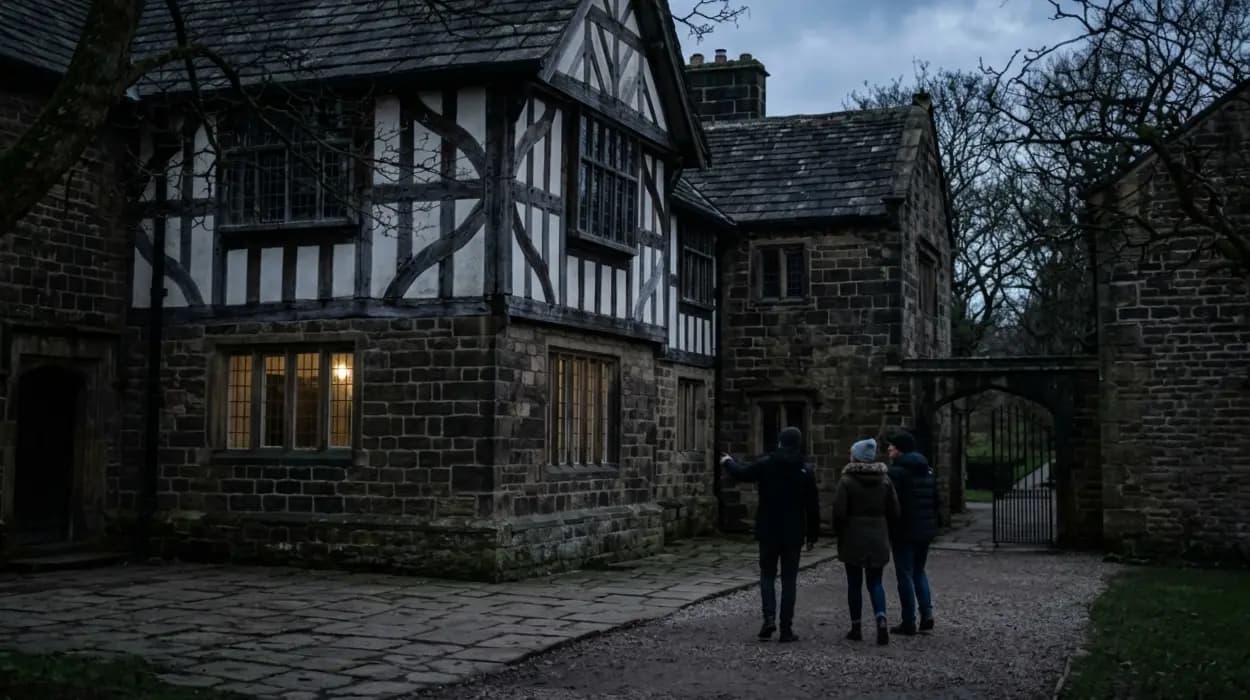
Bolton, a historically significant town located within Greater Manchester, possesses a dense architectural and social history spanning more than eight centuries. Established as a market town via a royal charter granted by King Henry III in 1251, the settlement evolved rapidly into an industrial manufacturing powerhouse during the Industrial Revolution. This long structural existence left behind an extensive network of medieval manors, historic public houses, and subterranean architecture.
For the contemporary audience at Bolton Today, these locations serve as prominent cultural landmarks that heavily intertwine local folklore with well-documented historical traumas. The retention of original building frameworks from the 14th, 16th, and 17th centuries provides a tangible link to catastrophic national events. These events include the English Civil War and the Marian Persecutions, which continue to fuel contemporary reports of paranormal occurrences and spectral extractions.
What Is the Historical Origin of Ghost Stories in Bolton?
The historical origin of ghost stories in Bolton stems directly from major religious and political conflicts, including the 16th-century Marian Persecutions and the 1644 Bolton Massacre during the English Civil War, which caused severe casualties within the local population.
The Marian Persecutions and Religious Martyrdom
During the reign of Queen Mary I between 1553 and 1558, the English state actively enforced the suppression of Protestantism, leading to the execution of approximately 280 religious dissidents across the nation. In Bolton, this national policy directly impacted local agricultural workers and preachers, most notably George Marsh. Arrested for heresy due to his Protestant preachings, Marsh underwent intensive interrogation within local administrative and residential spaces before his execution at the stake in Chester on April 24, 1555.
The physical locations associated with his detention became immediate focal points for localized folklore. The trauma of state-sanctioned execution left a permanent mark on the collective consciousness of the township. Local residents documented specific physical phenomena, such as anomalous marks on stone flooring, attributing them to Marsh's final declarations of faith. These documentations established the framework for Bolton's earliest structural ghost stories.
The Civil War and the 1644 Bolton Massacre
The English Civil War brought unprecedented physical destruction to Lancashire, culminating in the Storming of Bolton on May 28, 1644. Royalist forces commanded by Prince Rupert of the Rhine and James Stanley, the 7th Earl of Derby, assaulted the Parliamentarian garrison defending the town. The resulting conflict led to the deaths of an estimated 1,600 soldiers and non-combatant residents, making it one of the most severe urban massacres recorded on English soil during the war.
The sheer scale of sudden, violent mortality overwhelmed local infrastructure, requiring rapid burials in mass graves near Churchgate and the surrounding parish grounds. The high concentration of casualties within a tightly confined urban perimeter linked specific commercial and residential structures to the fatalities of the battle. Royalist leaders who directed the assault were later executed on the exact site of the slaughter, cementing a cyclical narrative of violence, retribution, and localized hauntings that persists in modern regional history.
Why Is Smithills Hall Considered Bolton's Most Haunted Historic Manor?
Smithills Hall is considered Bolton's most haunted historic manor due to its 800-year occupancy timeline, the discovery of human skeletal remains beneath its foundations, and documented accounts of spectral encounters linked directly to the Marian martyr George Marsh.
The Architectural Evolution of Smithills Hall
Smithills Hall is a Grade I listed manor house situated on the edge of the West Pennine Moors, featuring a continuous structural lineage dating back to the 14th century. The complex contains distinct architectural phases:
- The Medieval Great Hall, constructed in the early 1300s, featuring timber-framed walls and cathedral-high ceilings.
- The Tudor West Wing, added in the 1500s to expand domestic quarters for the ruling Barton family.
- The Victorian East Wing, designed by prominent architect George Devey around 1875 for the wealthy Ainsworth family.
This physical configuration creates distinct thermal zones and acoustic pathways. In the 1950s, structural conservation work beneath the floorboards of the withdrawing room revealed an array of human bones. Archaeological analysis associated these remains with an early medieval burial ground attached to an ancient, long-demolished chapel on the estate, confirming that the modern tourist venue rests directly over historical human interments.
The Green Room and the Footprint of George Marsh
The Green Room, located within the Tudor section of the property, served as a courtroom where the homeowner, Robert Barton, conducted judicial examinations. In 1555, George Marsh stood trial in this specific room before his condemnation. According to documented records maintained by Bolton Libraries and Museums, a permanent indentation exists in the stone floor just outside the room's threshold.
Historical Legend: Local tradition asserts that Marsh stamped his foot in defiance to assert the validity of his Protestant beliefs, leaving a physical mark that allegedly bleeds or secretes moisture every year on the April 24 anniversary of his execution.
Museum attendants and visitors frequently report seeing a male figure wearing black clothing and possessing white hair near the staircase leading to the Green Room. Security personnel have cataloged numerous instances where barrier ropes swing without draft exposure, and collections of decorative glasses inside Colonel Ainsworth’s room are found systematically inverted overnight despite secure lockup procedures.
How Does Ye Olde Man and Scythe Connect to Civil War Phantoms?
Ye Olde Man and Scythe connects to Civil War phantoms through its role as the final holding site for James Stanley, the 7th Earl of Derby, who sat inside the establishment immediately prior to his public decapitation outside the entrance.
The Execution of the 7th Earl of Derby
Operating under a market charter since at least 1251, Ye Olde Man and Scythe on Churchgate ranks as one of the ten oldest public houses in the United Kingdom. The current structure consists of a timber frame rebuilt in 1636, resting directly above a vaulted medieval stone cellar. On October 15, 1651, Parliamentarian forces brought James Stanley to the inn following his capture at the Battle of Worcester.
Stanley was held inside the pub, where he consumed his final meal while seated in a carved oak chair belonging to his family, who owned the property at the time. Parliamentarians then escorted him out of the front doorway onto Churchgate, where he underwent execution via beheading as punishment for his involvement in the 1644 Bolton Massacre. The execution chair remains permanently on display inside the pub premises, acting as a structural anchor for regional ghost tourism.
Documented Paranormal Incidents and CCTV Records
The public house experienced a surge in global media attention in 2014 when digital CCTV surveillance cameras recorded an anomalous, semi-transparent entity moving across the bar area during non-operational hours. The video footage showed the sudden illumination and extinguishing of utility lights, followed by the appearance of a human-shaped silhouette near the main serving counter.
In 2016, the location became the center of an international cultural dispute when Chinese contemporary artist Lu Pingyuan claimed to have visited the establishment, performed an incantation inside the bathroom facilities, and trapped the spirit of James Stanley inside a metal canister for an exhibition in Manchester. The pub landlord launched a formal public campaign demanding the return of the ghost to preserve the integrity of the historic site, demonstrating how deeply embedded these hauntings are within modern commercial operations.
Explore More Things To Do In Bolton
Guide to Independent Boutiques and Local Markets in Bolton
Octagon Theatre Ticket and Performance Guide: Bolton
Which Other Bolton Pubs and Inns Have Haunted Reputations?
Other Bolton pubs and inns possessing haunted reputations include the ancient coaching houses and historic taverns surrounding the town center, where staff record instances of unexplained object movement, phantom footsteps, and extreme localized temperature drops.
The Subterranean Vaults and Coaching Inns
The structural topography of central Bolton features an intricate network of old brick vaults, hidden cellars, and decommissioned drainage pathways dating back to the late 18th century. Establishments built over these subterranean spaces experience recurrent reports of acoustic anomalies, such as heavy footsteps pacing across upper floors when chambers are empty.
These properties frequently present specific environmental variations. For instance, staff members cleaning basement storage rooms report sudden drops in temperature alongside localized drafts that extinguish candlelight or gas fixtures without mechanical cause. These anomalies correlate heavily with the old transit routes used by horse-drawn coaches during Bolton's era as an industrial transport hub.
Specific Patterns of Object Displacement
Phenomena across Bolton's historic commercial properties exhibit highly consistent physical indicators. Employees at several centuries-old locations report specific occurrences, including:
- Heavy iron cellar flaps unlatching and opening outward from the inside without human intervention.
- Stacked beverage containers and metal tankards sliding horizontally off flat surfaces in secure storage bays.
- Electronic point-of-sale terminals registering phantom inputs during early morning hours.
These occurrences are not restricted to isolated anecdotes; they form a persistent pattern of reported physical displacement. The frequent modification of these commercial spaces during the 19th and 20th centuries often exposed older foundations, an action that local lore links to an increase in reported paranormal activity.
What Do Scientific and Psychological Studies Say About Haunted Sites?
Scientific and psychological studies state that haunted sites are products of environmental factors, including low-frequency infrasound waves, fluctuating electromagnetic fields, and architectural suggestive priming that skews human sensory perception.
The Impact of Infrasound and Electromagnetic Fields
Neurological research indicates that human exposure to infrasound, which consists of low-frequency sound waves below the human hearing threshold of 20 Hertz, can induce distinct physiological reactions. Environmental sources in historic buildings, such as wind blowing through ancient stone masonry, vibrating structural timber frames, or underground water channels, can generate these waves.
Infrasound exposure can trigger hyperventilation, a sense of inexplicable dread, and subtle vibrations within the human eyeball that create peripheral visual anomalies. Furthermore, erratic electromagnetic fields caused by faulty, unshielded Victorian or early 20th-century wiring systems inside historic venues can overstimulate the temporal lobes of the human brain, resulting in artificial auditory sensations or the distinct feeling of an unseen presence.
Suggestive Priming and Environmental Layouts
Psychologists utilize the term "suggestive priming" to describe how preexisting knowledge alters sensory interpretation. When an individual enters a structure displaying explicit architectural markers of age, such as low oak beams, uneven flagstone flooring, and dim historic lighting, their cognitive framework prepares them to interpret benign environmental stimuli as anomalous events.
This psychological interaction explains why reports of paranormal activity remain highly concentrated within specific historic typologies, as the physical environment reinforces personal expectations.
How Do Historic Hauntings Impact Bolton's Modern Economy and Culture?
Historic hauntings impact Bolton's modern economy and culture by driving the local dark tourism industry, generating commercial revenue for night-time hospitality venues, and preserving regional historical records through public engagement.
The Commercialization of Dark Tourism
Dark tourism involves travel to sites associated with death, tragedy, or historical mysteries. In Bolton, this tourism model provides direct economic support to historical preservation efforts. Paid public ghost hunts, nocturnal paranormal investigations, and heritage walking tours bring thousands of visitors to the town annually.
The revenue generated from ticket sales during seasonal events, particularly in October, provides critical financial funding for public institutions. For example, Bolton Council utilizes admissions revenue to offset the structural maintenance costs of Grade I listed properties like Smithills Hall, ensuring that these centuries-old municipal structures remain structurally sound without relying solely on standard local tax revenues.
The Preservation of Regional Identity
The integration of folklore into contemporary commercial marketing helps safeguard local history from cultural erasure. By framing historical figures like George Marsh or James Stanley within the appealing context of ghost stories, public houses and museums successfully transmit accurate historical data to demographics that might otherwise bypass academic texts.
The ongoing preservation of these narratives ensures that the physical remnants of the English Civil War and the Industrial Revolution remain integrated into Bolton's modern urban master plans, balancing economic development with strict architectural conservation.
FAQS
Why is Bolton associated with ghost stories?
Bolton is associated with ghost stories because of its long history of warfare, religious persecution, medieval architecture, and preserved historic buildings connected to traumatic historical events.