Key Points
- Immediate Intervention: Bolton Council has launched urgent structural operations to safeguard vulnerable historic buildings within the town centre.
- Mawdsley Street Focus: Recent targeted surveys and structural evaluations forced emergency conservation deployments specifically at No. 27 Mawdsley Street.
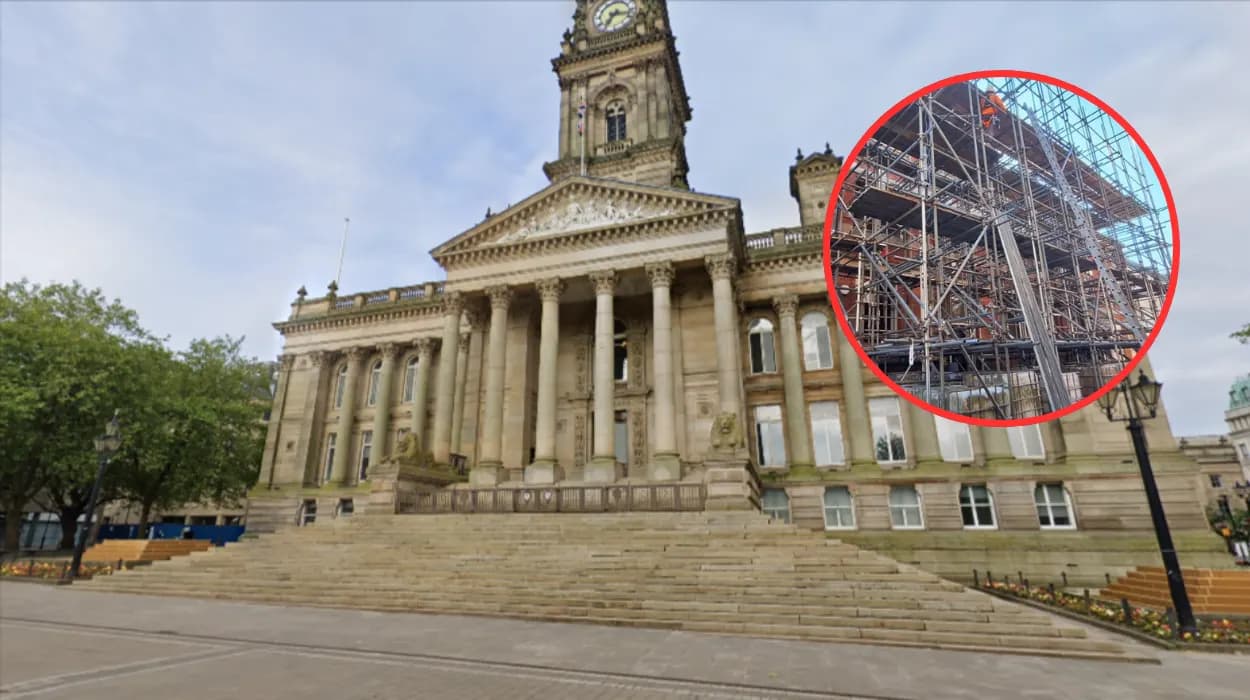
- Structural Engineering Works: Active maintenance measures feature heavy-duty front-and-rear structural scaffolding alongside a specialised temporary roof matrix to seal out rain.
- 19th-Century Heritage: The targeted Mawdsley Street corridor holds historical architecture constructed between 1800 and 1865, encompassing the former County Court and the old Technical School.
- Commercial Strategy: Municipal officials intend to transition these preserved assets to the open commercial market for "sensitive regeneration" initiatives.
- Strategic Regeneration Alignment: The preservation works sit adjacent to the major Crompton Place shopping centre development, where demolition is scheduled to commence later this year.
Bolton (Bolton Today) May 22, 2026 - Structural stabilization works are officially underway on a collection of historic town centre assets following a series of mandatory municipal building inspections that revealed an urgent need for physical protection. Bolton Council confirmed that the emergency preservation works have been prioritised to prevent any further deterioration of the local architectural fabric. The primary engineering focus has been directed toward No. 27 Mawdsley Street, where contractors have begun erecting scaffolding and protective roofing to shield the building from environmental damage. Local officials have underscored that these actions are being executed to guarantee that the borough's architectural past remains intact while the surrounding central business district undergoes a multi-million-pound modern transformation.
Why is Bolton Council taking immediate action at Mawdsley Street?
As reported by the editorial staff of The Bolton News, recent comprehensive building safety inspections conducted across the municipal portfolio identified an immediate requirement to deploy emergency structural preservation frameworks. No. 27 Mawdsley Street was flagged by inspectors as requiring rapid intervention to counter structural vulnerabilities that threatened the long-term viability of the building.
To mitigate these immediate structural concerns, the engineering strategy involves the comprehensive installation of external structural scaffolding. This scaffolding matrix is being built across both the front elevation and the rear facade of the building.
Furthermore, to combat the risks associated with water ingress and standard British weather patterns, engineers are installing a temporary overarching roof system. This secondary roof structure is designed to keep the internal framing and the masonry of the site completely dry while long-term internal repairs are mapped out.
What historical value does Mawdsley Street hold for Bolton?
The targeted street is recognized as a vital repository of the town’s civic and industrial evolution. Mawdsley Street is home to several historic buildings dating from approximately 1800 to 1865. This particular architectural timeline encapsulates the peak of Bolton's expansion during the nineteenth century, housing structures that served various societal roles as the town grew.
Among the prominent landmarks located along this thoroughfare are the former County Court and the historic Technical School, both of which represent institutional anchors from the Victorian era. Over the last two centuries, the properties lining Mawdsley Street have continuously evolved to meet local economic demands. The buildings have served as a mix of professional offices, light industrial workshops, and private town centre residences, making them highly valued by local historians and conservation officers.
Explore More Bolton Council News
Lidl Supermarket Plans Approved by Council: Bromley Cross 2026
Farnworth Padel and Tennis Centre Plans Submitted 2026
How does the council plan to balance history with future development?
In an official public declaration issued by the local authority, a spokesperson for Bolton Council stated that:
"We are lucky to have Mawdsley Street as an area with historic charm, sitting at the heart of our town centre and other redevelopment projects."
This statement highlights the council's ongoing desire to ensure that historical preservation is not decoupled from modern urban planning.
The municipal authority further expressed their long-term vision for the properties, stating:
"In preserving these properties, we hope to protect our proud history, while looking to a town centre with a bright future."
Local governance officials have also extended assurances to the existing business community and the local populace currently utilizing the street. The spokesperson for Bolton Council added that:
"We continue to work closely with residents and businesses in Mawdsley Street to ensure the work doesn't impact them or cause any issues."
What are the long-term commercial plans for these historic buildings?
Rather than retaining the stabilized properties solely as passive architectural monuments, Bolton Council has disclosed plans to reintroduce the assets into the active commercial marketplace. The local authority stated that they are looking closely at the possibility of opening the properties up to the market for what they termed "sensitive regeneration."
According to municipal planners, a sensitive regeneration model will directly benefit the internal and external integrity of the buildings by bringing them back into active daily use. Moreover, the council maintains that this commercial positioning sits in total alignment with the wider redevelopment goals established for the broader town centre. By utilizing private investment to adapt and reuse historic structures, the council seeks to alleviate the financial burden on the public purse while revitalizing underutilized spaces.
How does this preservation tie into the Crompton Place demolition?
The emergency works on Mawdsley Street cannot be viewed in isolation; they are geographically and strategically tied to the broader transformation of Bolton's retail core. Mawdsley Street is located in close proximity to the expansive Crompton Place development complex.
As documented within the local authority's master plan, the demolition of Crompton Place is officially scheduled to start later this year. The removal of the outdated shopping center will clear the land to pave the way for the town centre's flagship redevelopment project, which is poised to introduce new mixed-use spaces, modern retail units, housing, and public squares.
Because Mawdsley Street sits directly adjacent to this massive construction zone, the stabilization of No. 27 ensures that the historic fringe of the district remains structurally sound and visually distinct as heavy demolition machinery begins altering the neighboring skyline.
What is the wider context of heritage protection in Bolton?
The current structural enforcement actions on Mawdsley Street reflect a broader, systemic effort by Bolton Council to manage its historic built environment. According to official conservation records maintained by Bolton Council’s planning department, the borough boasts a rich legacy of historic buildings protected through the national listing system managed by the Department for Culture, Media and Sport (DCMS).
The borough’s heritage inventory includes three highly rare Grade I listed buildings of exceptional national interest, alongside 17 Grade II* listed buildings designated as particularly important properties of more than special interest. Furthermore, there are 335 Grade II listed buildings across Bolton that denote architecture of special local and national interest.
The local authority's planning guidelines emphasize that a listed building is protected in its entirety, meaning that both the exterior facades and internal historical features—such as original layout plans, staircases, and historic fireplaces—cannot be altered without strict municipal consent. For non-designated heritage assets that do not meet national criteria but still provide immense character, the Greater Manchester Archaeological Advice Service (GMAAS) maintains a comprehensive Historic Environment Record (HER) containing over 18,000 entries across the region to guide developers and prevent unauthorized destruction.
How have previous major restoration projects progressed in the town?
The ongoing intervention at Mawdsley Street follows a well-established precedent of significant capital investment into the borough’s historic architecture. In recent years, Bolton Council has partnered with major national contractors to execute complex refurbishments of its primary landmarks.
As recorded in project documentation published by construction firm Willmott Dixon, the council previously completed an extensive £5 million refurbishment and structural modernization of the Grade II listed Bolton Museum. That complex heritage project required repairing a severely compromised glazed roof matrix and upgrading a 1930s civic structure while maintaining public library operations on the ground floor.
Similarly, as reported by Local Democracy Reporter Chris Gee for the Manchester Evening News, the council previously initiated a major structural conservation project targeting the iconic Bolton Town Hall. That historic initiative focused heavily on the architectural pediment sculpture group above the main entrance, designed by the famed sculptor William Calder Marshall between 1866 and 1873.