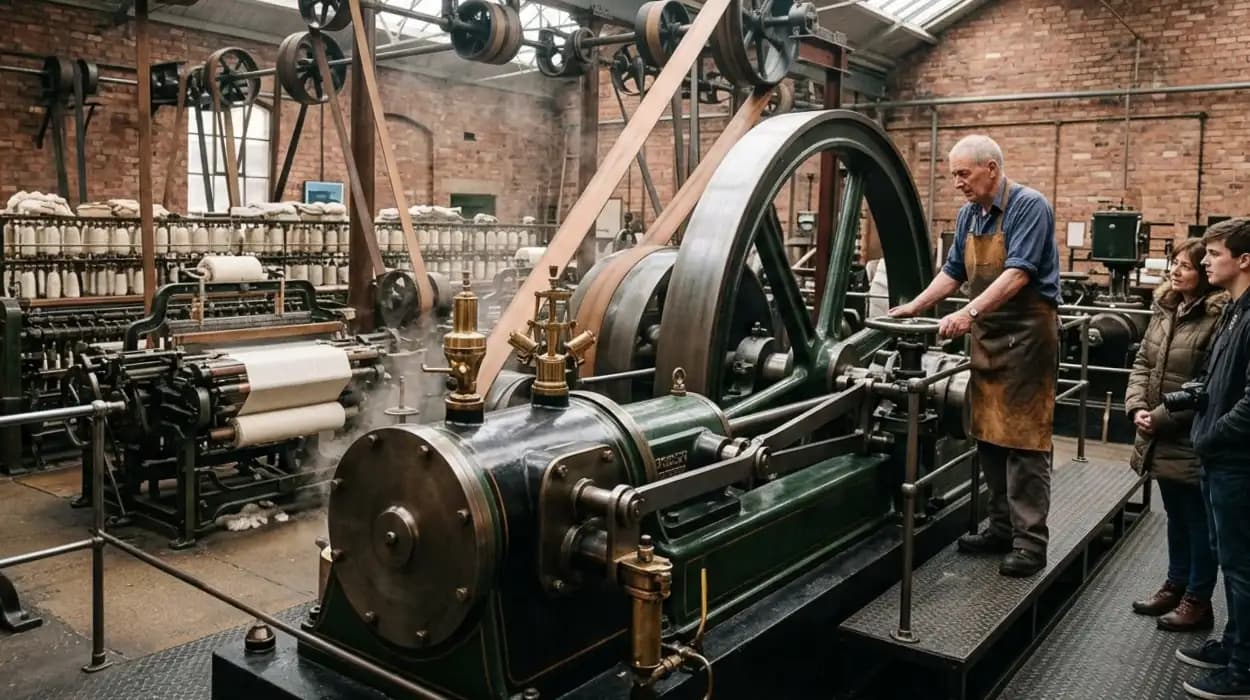
Bolton Steam Museum represents a vital repository of the textile processing infrastructure that established Greater Manchester as an international center of manufacturing during the nineteenth century. Located inside the preserved cotton store of the former Atlas Mills complex on Mornington Road, the site serves as the operational headquarters for the Northern Mill Engine Society. This charitable organization preserves, maintains, and runs the largest collection of stationary textile mill steam engines in the United Kingdom.
The industrial profile of Bolton Today features modern logistics, commercial services, and education, yet the town remains deeply anchored by its structural history. The museum provides an accurate, working look into the physical mechanisms that drove the global cotton trade. Visitors observe fully restored machinery that once powered hundreds of thousands of individual spindles and looms across the North West of England.
What is the history of the Bolton Steam Museum?
The Northern Mill Engine Society established the museum in 1966 to rescue stationary steam engines from destruction during the rapid decline of the Lancashire textile industry. The collection moved to its current location at Atlas Mills in the early 1990s.
The rapid decline of the British textile sector during the middle of the twentieth century triggered the widespread demolition of hundreds of brick cotton mills across Lancashire. As these multi-story factories closed down, the heavy cast-iron power plants housed within their engine rooms faced immediate destruction for scrap metal. Recognizing the imminent loss of this unique engineering technology, a group of volunteer engineers formed the Northern Mill Engine Society in 1966.
The volunteer group originally stored salvaged machinery at various temporary locations across Greater Manchester. A permanent home became available when the society acquired the single-story cotton warehouse at Atlas Mills on Mornington Road. The surrounding industrial site underwent commercial redevelopment, but the historical warehouse structure was preserved specifically to house the society’s growing collection. Volunteers spent years casting concrete foundations, aligning heavy flywheels, and installing custom piping infrastructure to make the building a fully operational museum.
The site officially opened its doors to the public as a dedicated museum space after completing major structural transformations. The venue now protects thirty major stationary steam engines, which represent a complete evolutionary timeline of industrial factory propulsion from 1840 to 1935. The entire facility operates through volunteer labor, with funding provided by public donations, structural grants, and society membership fees.
Which steam engines are preserved inside the collection?
The museum collection contains 30 distinct stationary engines including beam engines, horizontal cross-compounds, inverted vertical engines, and rare non-dead-centre designs. Key exhibits include the 1840 Crossfield Mill engine and the unique 1893 Musgrave non-dead-centre engine.
The physical inventory at the Mornington Road site covers every major architectural configuration of stationary steam technology used in British manufacturing history. The earliest era of mechanical textile propulsion is represented by the Crossfield Mill Beam Engine, constructed circa 1840 in Wardle, Lancashire. This specific machine utilizes a classic overhead oscillating beam layout to translate vertical piston motion into rotational force, demonstrating the foundational engineering framework derived from early designs by James Watt.
Advanced engineering concepts are visible in the Park Street Mill engine, a non-dead-centre inverted vertical compound engine built in 1893 by John Musgrave and Sons of Bolton. This mechanism uses two pistons connected to a single crank at specific geometric angles, eliminating the traditional mechanical vulnerability known as "dead centre" where an engine can stall when stopped at the exact top or bottom of its stroke. The museum also displays massive horizontal layouts, such as the 1902 Wasp Mill Tandem Compound Engine built by J & W McNaught Ltd of Rochdale, which features highly efficient Corliss valve gear.
Later eras of industrial engineering are preserved through compact, specialized power units designed for auxiliary tasks or high-speed operation. Examples include the 1914 Diamond Rope Works Engine, an inverted vertical compound engine built by Scott & Hodgson Ltd, and a 1926 Robey Uniflow horizontal engine. The collection also includes safety and support infrastructure, such as the 1890 Walker Steam Fire Pump, which provided high-pressure water layout for fire suppression at the Fern Mill in Shaw.
How do the mechanical processes inside a mill engine work?
Mill engines transform thermal energy from pressurized steam into mechanical rotational force through a structured sequence involving valves, pistons, connecting rods, and flywheels. Compound layouts pass the steam through multiple cylinders to maximize thermal efficiency.
The mechanical operation begins when a external boiler heats water to generate high-pressure steam, which travels through steel piping into the valve chest of the engine. Specialized valves, including slide valves, piston valves, or precision Corliss rotary valves, open and close at exact intervals regulated by an eccentric rod connected to the crankshaft. These timed adjustments admit pressurized steam into the cylinder, forcing the internal piston to slide horizontally or vertically along the smooth cylinder bore.
This linear motion transfers directly from the piston rod to a crosshead, which slides along rigid guide bars to prevent lateral deformation. A heavy iron connecting rod links the crosshead to a crank arm on the main driving shaft, converting the back-and-forth linear stroke into continuous rotational movement. A massive cast-iron flywheel, often weighing several tons, is mounted directly on the crankshaft to store kinetic energy, smooth out the power pulses of the strokes, and maintain a constant rotational velocity.
To lower fuel consumption and increase mechanical efficiency, many of the preserved machines utilize compound expansion processes. In a cross-compound or tandem compound engine, high-pressure steam executes its stroke inside a smaller high-pressure cylinder. The exhausting steam, which still retains significant thermal energy, then passes into a larger low-pressure cylinder where it expands a second time to deliver more power before entering a condenser unit.
When can visitors see the engines operating under steam?
The museum opens for static viewing on Wednesdays and Sundays from 11:00 to 15:00 throughout the year. Full operational demonstrations occur on specific Bank Holiday weekends, when an industrial boiler provides live steam to run the collection.
The facility operates under two distinct public accessibility modes due to the high financial and logistical costs of running historical steam boilers. On standard open days throughout the calendar year, visitors enter the building to examine the machinery from elevated viewing platforms while volunteers perform manual restoration, maintenance, and lubrication tasks. These regular public hours occur every Wednesday and Sunday between the hours of 11:00 and 15:00, with admission provided completely free of charge.
Full demonstration events, known as "Steam Days," happen on scheduled holiday weekends when the entire gallery of 30 engines runs simultaneously under live steam pressure. For the 2026 event calendar, these major public steamings are confirmed for the Spring Bank Holiday weekend on May 24 and May 25, the Summer Bank Holiday weekend on August 30 and August 31, the October holiday weekend on October 24 and October 25, and the traditional winter steaming event on December 28 and December 29. During these specific event dates, the doors open earlier at 10:00 and remain accessible until 16:00.
The live operations require hours of advance preparation by certified boiler operators who slowly raise the water temperature inside the museum's boiler system to prevent thermal shock to the old steel plates. Once operational pressure is reached, steam circulates through the entire overhead pipe network to warm up the cast-iron engine blocks before individual throttle valves open. The resulting public experience includes the complex audio profiles of metal valve gear operating, rhythmic exhaust pulses, and the visible motion of massive multi-ton flywheels spinning at full operating speeds.
Explore More Things To Do In Bolton
Explore Bolton Library Museum Aquarium Art Guide Greater Manchester
Free Museums, Parks & Historic Sites in Bolton
What role did Bolton play in the global Industrial Revolution?
Bolton served as a global center of the textile industry due to its damp climate, proximity to coal fields, and pioneering inventors like Samuel Crompton. The town pioneered factory-scale spinning, which required the development of heavy engineering firms.
The town of Bolton transformed from a rural market settlement into a global manufacturing center during the late eighteenth century due to specific geographic and technological factors. The local climate provided high humidity levels, which prevented delicate cotton fibers from snapping during the mechanical pulling and twisting processes. Furthermore, the geology of the Lancashire Coal Measures provided cheap, local fuel to run industrial steam boilers right next to the processing mills.
The technological catalyst for this expansion was the spinning mule, invented in Bolton by Samuel Crompton in 1779. This machine combined the drawing action of Richard Arkwright's water frame with the twisting action of James Hargreaves's spinning jenny, allowing the mass production of fine, strong cotton yarn. As weaving and spinning operations grew larger, manufacturers abandoned small water wheels along local rivers and built large urban mills powered by stationary steam engines.
This concentration of textile production created a parallel demand for local heavy engineering expertise to build, maintain, and repair factory machinery. Famous industrial foundries grew up within the borough, including Hick, Hargreaves & Co. at the Soho Foundry, and John Musgrave & Sons at the Globe Ironworks. These engineering firms exported large stationary engines, boilers, and millwork across the British Empire, establishing the town as a primary source of industrial innovation.
How did mill engines power the historic textile factories?
Textile mills distributed mechanical power from a single central steam engine to thousands of individual machines using a complex system of vertical shafts, bevel gears, line shafts, and rope drives connected to the main flywheel.
The architectural layout of a classic nineteenth-century Lancashire cotton mill was designed entirely around the physical requirements of mechanical power transmission. A single, massive steam engine sat inside a dedicated stone engine house built onto the side of the multi-story spinning mill. The main crankshaft extended directly through a structural firewall into a narrow, vertical space known as the rope race, which ran from the ground floor up to the roof line.
The outer rim of the massive engine flywheel featured multiple deep, parallel V-shaped grooves machined into its face. Large-diameter cotton ropes extended from these grooves, traveling up the vertical height of the rope race to loop around smaller pulleys installed on every individual floor of the building. This layout allowed the single revolving flywheel to turn horizontal line shafts that ran along the ceiling of every room in the factory.
Individual textile machines, such as carding engines, drawing frames, and spinning mules, connected to these spinning overhead line shafts using flexible leather belts. Operators engaged or disengaged individual machines by sliding the leather belt between a free-spinning idling pulley and a fixed driving pulley using a wooden lever. This mechanical setup meant that any variation in the speed of the central steam engine instantly altered the operation of thousands of spinning spindles across the entire factory complex.
Why is preserving industrial heritage important for future generations?
Preserving industrial artifacts provides concrete material evidence of historical manufacturing techniques, technological evolution, and the social history of the working class. These sites offer essential educational resources for mechanical engineering studies.
The preservation of physical machinery at the Mornington Road facility protects the tangible history of human technological development from being lost to time. Textbook diagrams and digital renderings cannot communicate the physical scale, material mass, thermal dynamics, and mechanical vibrations of real industrial machinery. Preserving these working artifacts allows historians, engineers, and researchers to verify historical manufacturing tolerances, lubrication methodologies, and metallurgical strengths.
The museum also functions as a historical monument to the generations of working-class citizens who spent their lives inside the noisy, dangerous environment of Lancashire textile factories. Understanding the sheer physical scale of the power systems highlights the strict discipline, long hours, and structural organization that defined everyday life during the rise of modern industrial society. The preservation of these machines honors the technical skills of the Victorian millwrights and engineers who built long-lasting infrastructure using manual calculations and simple machine tools.
From an educational standpoint, the museum provides a live learning environment for modern students studying science, technology, engineering, and mathematics. Observing the actions of centrifugal governors, slide valves, and condenser pumps helps young people understand the practical applications of classic thermodynamic principles. By maintaining these engines in operational condition, the volunteer staff ensures that rare industrial maintenance skills, such as pouring white-metal bearings and packing steam glands, are passed down to future generations.
What are the logistics and accessibility details for visiting the museum?
The museum is situated on Mornington Road in Bolton (postcode BL1 4EU), features full step-free wheelchair access across the entire exhibition floor, and provides free vehicle parking on site. Public transit links include local bus routes and rail services.
The volunteer-run facility is located just off Chorley Old Road, approximately 1.5 miles northwest of the center of town. Visitors arriving by personal vehicle can use the dedicated free parking area located directly outside the warehouse building, which shares space with the nearby commercial retail complex. For those utilizing public transit networks, the multi-frequency 125 bus route operated by Stagecoach stops regularly on Chorley Old Road, leaving a short two-minute walk down Mornington Road to reach the main museum entrance.
The building design accommodates individuals with limited mobility through a completely step-free, single-story floor layout across the entire display gallery. Concrete pathways and wide viewing aisles allow standard wheelchairs, motorized mobility scooters, and children's prams to navigate safely past the perimeter safety railings of each engine exhibit. Specially adapted accessible restroom facilities are located inside the main entrance hall, and clear educational signage is positioned at uniform viewing heights throughout the building.
While general admission remains free on both static and live steam days, the charity relies on voluntary financial contributions to cover the high costs of coal, treated water, insurance, and building maintenance. A small gift shop on site sells regional industrial history books, technical guides, and souvenir items to help fund ongoing restoration work. Educational groups, historical societies, and technical institutions can arrange specialized private tours outside of standard weekend hours by contacting the Northern Mill Engine Society administration directly.
FAQS
What is Bolton Steam Museum?
Bolton Steam Museum is a working industrial heritage museum located inside the former Atlas Mills cotton warehouse on Mornington Road in Bolton. The museum preserves the largest collection of stationary textile mill steam engines in the United Kingdom.