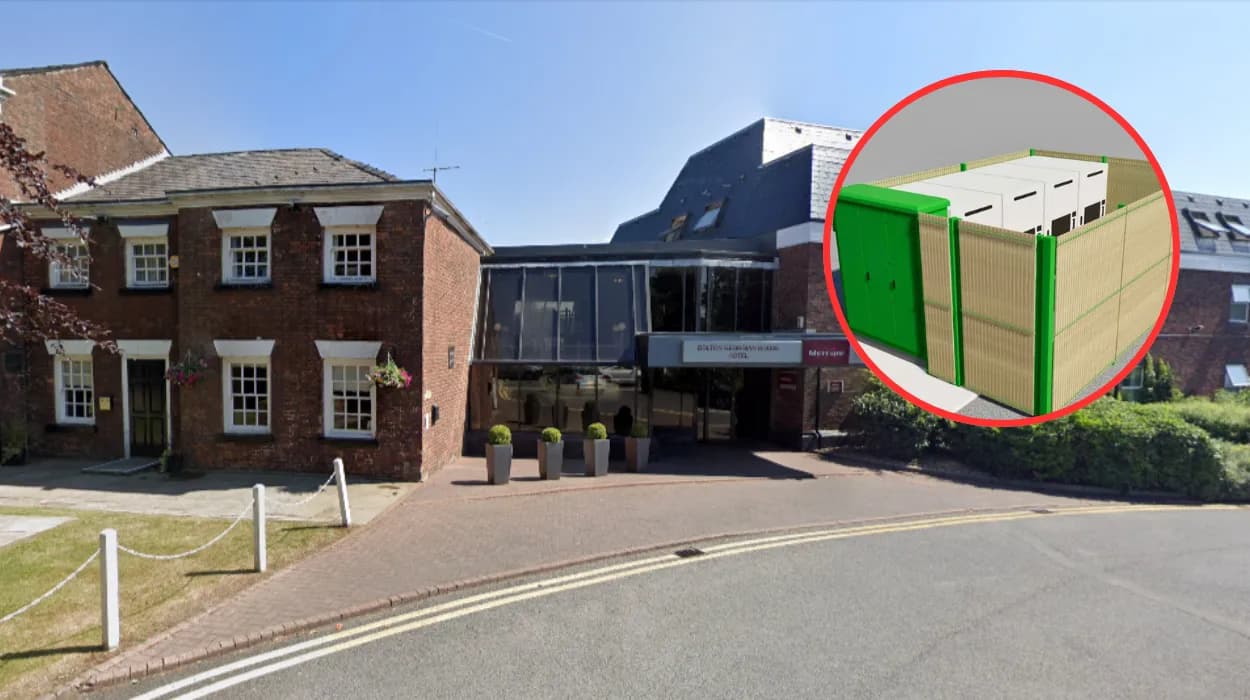
Key Points
- The Core Proposal: A planning application has been formally submitted to install a modern battery energy storage plant on a prominent roadside verge adjacent to the A6 Manchester Road in Bolton.
- The Exact Location: The designated development site is situated on a vacant grass verge directly by the turning for the Mercure Georgian House Hotel, positioned geographically between Middlebrook and Blackrod.
- The Project Proponent: The application has been brought forward by AMP Clean Energy (registered as AMC in official planning portal summaries), a major UK flexible power and renewable infrastructure operator.
- Technical Specifications: The infrastructure will feature a compact "battery box" layout with a physical footprint of approximately 24 square metres—roughly equivalent to the size of two standard vehicle parking spaces. It will consist of a concrete plinth foundation, battery cabinets, ancillary equipment, and a perimeter security fence.
- The Strategic Justification: The developers have strongly defended the choice of site, arguing that finding suitable land for modern grid-flexibility operations is exceptionally difficult due to strict requirements to be within 50 metres of an existing electrical substation or a high-capacity three-phase low-voltage cable.
- Grid Functionality: The facility is designed to act as a localized grid buffer, importing and storing electricity during periods of low local demand or peak renewable generation, and exporting it back to the grid during times of high consumption.
Bolton (Bolton Today) May 22, 2026 - A formal planning application has been submitted to Bolton Council outlining proposals to build a commercial battery energy storage facility directly adjacent to the A6 Manchester Road, located immediately by the turning for the Mercure Georgian House Hotel between Middlebrook and Blackrod. The green-infrastructure development, championed by clean technology specialist AMP Clean Energy, seeks to place localised battery storage cabinets on a prominent grass verge to balance the regional electricity grid. However, the choice of a location directly at the front of a well-known local hospitality asset has immediately brought the complex logistical challenges of deploying modern green infrastructure into sharp relief.
The proposed installation will occupy a compact layout, but its position on a visible roadside verge has highlighted the ongoing tension between essential net-zero utility deployments and the preservation of urban and semi-rural visual amenity. According to official planning documents published this week on Bolton Council's public planning portal, the development will feature specialized electrical battery boxes designed to stabilize localized grid fluctuations caused by the rise of intermittent renewable energy sources like wind and solar power.
The developer has stated that finding viable land is one of the most significant hurdles facing the green transition, forcing infrastructure closer to existing commercial assets and roadsides. As the local authority begins its formal review of the file, the case is expected to serve as a bellwether for how community planners navigate micro-utility developments adjacent to established commercial properties and historical landmarks.
Where Exactly Is the Proposed Battery Energy Storage Plant Location?
As detailed in the formal submissions published by Bolton Council, the project is targeted for a specific stretch of the A6 transport corridor. The proposed development site is located cleanly on a vacant grass verge on Manchester Road, positioned precisely at the turning leading into the Mercure Georgian House Hotel.
This specific location places the infrastructure directly between the major commercial and retail hub of Middlebrook and the town of Blackrod. The site currently sits as an open piece of managed turf near existing electrical infrastructure, meaning that while it does not require the clearing of deep woodland, its placement will change the immediate visual profile of the approach to the hotel property.
Who Is the Applicant Behind the A6 Battery Plant?
The corporate entity behind the planning submission is AMP Clean Energy (referred to in various planning portal summaries under the acronym AMC). In parallel documentation evaluated from recent regional infrastructure proposals, such as reportage by Local Democracy Reporter Chris Gee of The Bolton News, the firm is identified as a well-established developer, funder, builder, and operator of low-carbon energy facilities and flexible power assets across the United Kingdom.
The company maintains a significant industrial footprint nationwide, operating more than 225 flexible energy assets, managing service and maintenance contracts for roughly 1,000 separate customer sites, and employing an estimated 175 staff members across its operations. The company specialises in identifying micro-locations where small-scale grid interventions can prevent wider distribution network failures.
Why Did AMP Clean Energy Choose This Specific Roadside Verge?
The selection of a roadside verge directly adjacent to a hotel turning has raised questions from observers regarding site suitability. However, the developer has clarified that the selection process for battery storage is dictated entirely by rigid physical and electrical realities rather than aesthetic preference.
In a covering letter submitted alongside the formal application to Bolton Council, the planning team on behalf of AMP Clean Energy stated clearly that:
"Suitable land for energy developments is not easy to find. A suitable site must be within 50m of an existing substation or a large 3-phase low-voltage cable to allow for a viable electrical connection."
Because the grass verge on Manchester Road sits immediately adjacent to an operational, pre-existing electrical substation, it satisfies the strict technical criteria necessary to make a low-voltage grid injection system financially and loghetically viable.
Explore More Bolton News
Boots Opticians Opens Inside Morrisons Supermarket: New Store Hub in Bolton 2026
Zenub Misses Out On MasterChef Semi-Final: Bolton 2026
How Does the Proposed Battery Box Infrastructure Function?
The technical mechanism behind the proposed facility relies on high-speed, automated power balancing. As reported by the Manchester Evening News, a standard "battery box" unit operates by importing electricity directly from the local distribution network during off-peak hours—specifically when overall consumer demand is low or when there is an oversupply of green electricity generated by regional wind farms and solar arrays.
Conversely, when consumer demand spikes across the grid, the battery box rapidly reverses its flow, exporting the stored electricity back into the local network. The applicant has emphasised that this technology provides a vital cushion to the growing need for localized network flexibility, directly addressing modern grid reliability issues that have been prompted by an increasing reliance on intermittent renewable energy sources.
What Are the Physical Specifications and Dimensions of the Site?
Despite the industrial nature of the utility, the developer has emphasized that the physical footprint of the infrastructure has been kept to an absolute minimum to reduce ground disruption. Documents published this week on Bolton Council's planning portal state that each individual battery box features an incredibly small footprint of just 24 square metres.
To provide context for local planners and residents, the developers have noted that this total area is equivalent to roughly two standard car parking spaces. The complete physical installation will consist of:
- A stable, level concrete plinth foundation poured directly onto the verge.
- Weatherproofed, low-profile battery cabinets housing the lithium-ion or equivalent storage cells.
- Associated electrical control equipment, inverters, and localised safety systems.
- A secure perimeter fence surrounding the unit to prevent unauthorized public access and ensure health and safety compliance.
What Are the Local Concerns and Precedents for Similar Projects in Bolton?
While the application at Manchester Road is in its early consultative phases, it follows a highly similar development pattern within the region. As reported by Chris Gee of The Bolton News, Bolton Council recently approved a separate AMP Clean Energy application on January 19 for a micro-energy storage unit on a grass verge on Scot Lane, situated between Blackrod and Aspull.
In that case, a solitary local objection was formally logged, which raised concerns regarding potential fire risks, the wisdom of positioning electrical storage infrastructure close to a busy main road, and fears over the possible future expansion of the site.
During the Scot Lane application process, AMP Clean Energy successfully countered these arguments by demonstrating that because the site was low-profile and integrated into an area with pre-existing utility infrastructure, there would be no meaningful loss of usable open green space or broader disruption to the landscape. The local authority ultimately approved those plans subject to standard conditions, setting a clear procedural precedent for how these micro-utilities are treated in the Bolton planning ecosystem.
What Happens Next with the Planning Application?
The planning application for the A6 Manchester Road site is currently undergoing formal validation and public notice procedures by Bolton Council's planning department. Local residents, business owners—including the operators of the Mercure Georgian House Hotel—and environmental stakeholders are being given the opportunity to submit formal observations or objections via the public portal.
Planners will evaluate the submission against Greater Manchester's broader green energy targets alongside localized highways safety policies, visual amenity guidelines, and noise regulations before delivering a final decision or referring the matter to the planning committee later this year.