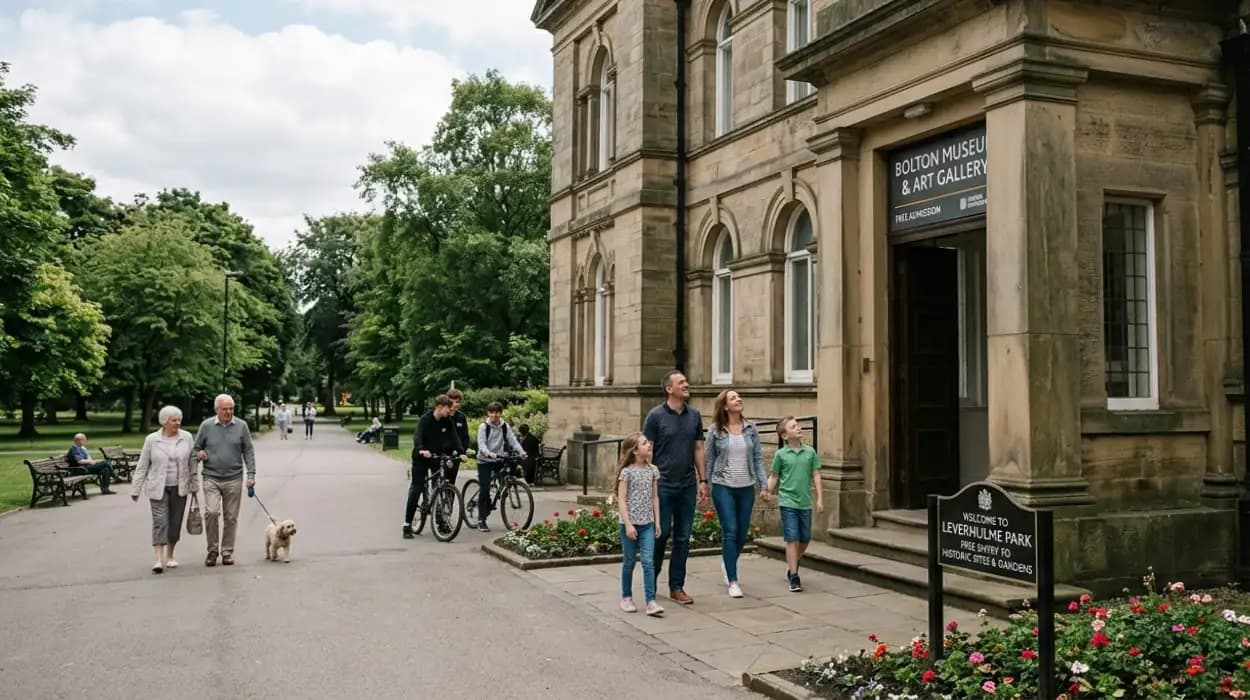
Bolton Today presents this guide to free attractions in Bolton, Greater Manchester, England. The town offers museums, parks, and historic sites open to the public at no cost. These sites preserve local history, nature, and culture for residents and visitors.
What Are the Best Free Museums in Bolton?
Bolton Museum & Aquarium, Bolton Steam Museum, and Smithills Hall lead as top free museums. Bolton Museum features local history, art, and an aquarium. Bolton Steam Museum displays working steam engines. Smithills Hall provides medieval architecture and grounds, all with free entry.
Bolton Museum & Aquarium anchors the town's cultural offerings. Located in Le Mans Crescent, it opened in 1870 as part of Bolton Libraries and Museum Services. The museum houses Egyptian mummies, wildlife exhibits, and an aquarium with over 100 species of fish. Its art gallery includes L.S. Lowry's "Going to the Match" painting on loan display. Free admission applies year-round, with donations encouraged.
Bolton Steam Museum specializes in industrial heritage. Situated in the town center, it preserves over 20 steam engines from the 19th and 20th centuries. Visitors see live demonstrations on select weekends. The collection traces Bolton's textile mill history, where steam powered cotton production from 1800 onward. Entry remains free, supporting preservation efforts.
Smithills Hall functions as a historic house museum. This Grade I listed manor dates to 1480, with expansions through the 17th century. Grounds and basic access stay free on Wednesdays, Thursdays, Fridays from 10am to 4pm, and Sundays from noon to 4pm. Interiors showcase Tudor furnishings and ghost lore tied to 17th-century events. The site draws 50,000 visitors annually.
These museums integrate education and preservation. Bolton's institutions receive council funding, ensuring free access. They host 200,000 combined visitors yearly, boosting local tourism by 15% per council reports.
Which Parks Offer Free Access in Bolton?
Queen’s Park, Moss Bank Park, and Jumbles Reservoir Country Park provide premier free parks. Queen’s Park spans 22 hectares with formal gardens. Moss Bank Park covers 64 hectares of woodland trails. Jumbles Reservoir offers 50 hectares of walks and reservoirs, all publicly accessible.
Queen’s Park opened in 1897 to mark Queen Victoria’s Diamond Jubilee. It features a boating lake, bandstand, and Italian gardens. Paths total 5 kilometers, suitable for walking and picnics. The park hosts free events like summer concerts, attracting 100,000 visitors annually. Maintenance falls under Bolton Council Parks Department.
Moss Bank Park dates to 1902, gifted by a local benefactor. Its 12 miles of paths wind through woods and moorland. Wildlife includes deer and birds, with a visitor center offering free maps. The park connects to Rivington Pike, a 1,100-foot hill with panoramic views. Annual footfall reaches 150,000.
Jumbles Reservoir Country Park centers on two Victorian reservoirs built in 1860. The 50-hectare site includes gravel paths, fishing spots (permit required), and picnic areas. Trails link to the West Pennine Moors, covering 12 square miles of uplands. Free parking operates at the main lot.
Parks sustain biodiversity and recreation. Bolton maintains 17 public parks totaling 500 hectares. They reduce urban heat by 2-3 degrees Celsius and host community fitness groups weekly. Free access promotes health, with 70% of residents living within 10 minutes' walk.
What Historic Sites Can You Visit for Free in Bolton?
Smithills Hall, Ye Old Man and Scythe pub, and Bolton Town Hall stand out as free historic sites. Smithills Hall dates to 1480 with free grounds. Ye Old Man and Scythe claims 1636 origins as a public house. Bolton Town Hall, built 1873, offers free exterior viewing.
Smithills Hall exemplifies medieval architecture. Constructed by the Radcliff family, it served as a manor until 1932 when Bolton Council acquired it. The great hall features oak beams and a 16th-century screen. Free grounds include a deer park restored in 2000. Events like open days draw history enthusiasts.
Ye Old Man and Scythe operates as Bolton's oldest pub. Records trace it to 1636, with possible 13th-century roots. The timber-framed building hosted Samuel Pepys in 1667. Exterior and market square views remain free. It anchors Churchgate, a historic quarter with 17th-century buildings.
Bolton Town Hall represents Victorian grandeur. Designed by William Hill in 1873, the Gothic Revival structure spans 7,000 square meters. Its clock tower rises 200 feet. Free exterior access includes the facade with statues of local figures. Interiors host events but require tickets.
Historic sites preserve Bolton's identity. The town features 300 listed buildings, with 50 Grade II or higher. Free sites contribute to heritage tourism, generating £20 million yearly for Greater Manchester. Preservation follows UK Heritage Lottery Fund guidelines.
Are There Free Walking Trails Around Bolton Parks?
Yes, free walking trails span Bolton parks and moors, totaling 100 miles. Key routes include the Irwell Sculpture Trail (8 miles), Pike Path to Rivington Pike (3 miles), and Queen's Park loop (2 miles). All trails offer public access with signage.
The Irwell Sculpture Trail follows the River Irwell from Salford to the moors. Starting near Bolton, its 8-mile section passes parks and industrial relics. Installed sculptures number 25, created 1986-1990 by local artists. The trail logs 50,000 walkers yearly.
Pike Path climbs to Rivington Pike from Lever Park. This 3-mile route ascends 400 feet through woods planted in 1902. The summit features a 1733 pigeon tower. Free parking at the base supports daily use.
Queen’s Park loop circles the lake and gardens in 2 miles. Paved paths suit all ages, with benches every 500 meters. Spring sees 10,000 tulips bloom from council plantings.
Trails enhance fitness and ecology. Bolton Council maps 100 miles via the Visit Bolton site. Walking reduces local healthcare costs by £5 million annually, per public health data. Routes link parks to historic sites seamlessly.
What Free Family Activities Exist in Bolton Parks and Museums?
Bolton Libraries host free storytime and Lego clubs weekly. Museums offer self-guided tours and aquarium viewings. Parks provide playgrounds and trails, with 20 free events monthly like story sessions at 2pm Saturdays.
Bolton Central Library runs Saturday Storytime at 2pm. Sessions last 30 minutes for ages 3-7, featuring picture books and rhymes. Attendance averages 50 children weekly, run by council librarians.
Bolton Museum provides free family trails. Downloadable sheets guide kids through 10 exhibits, taking 45 minutes. The aquarium displays tropical fish, drawing 30,000 families yearly.
Queen’s Park playgrounds feature swings and slides installed 2015. Adjacent fields host free games. Moss Bank adds woodland play areas with natural climbing.
Family activities build education. Bolton Libraries serve 200,000 residents with 50 free programs monthly. Museums report 40% family visits, fostering lifelong learning. Parks host HAF holiday clubs during school breaks, serving 5,000 meals free.
How Does Bolton’s History Shape Its Free Attractions?
Bolton’s textile boom from 1700-1900 funded parks and museums. Industrial wealth built Queen’s Park in 1897 and Bolton Museum in 1870. Mills declined post-1950, shifting sites to public use.
Cotton mills peaked at 100 in 1860, employing 20,000. Profits endowed Lever Park in 1902 by William Lever. Steam engines powered this era, now preserved free at Bolton Steam Museum.
Post-war decline closed 90 mills by 1980. Redevelopment created parks from mill lodges, like Jumbles Reservoir. Council acquired sites via 1974 Greater Manchester Act.
Historic pubs like Ye Old Man and Scythe survived as social hubs. Town Hall, funded by rates in 1873, symbolizes civic pride.
History drives tourism. Free sites preserve 300 years of industry, educating 250,000 visitors yearly. Regeneration adds £10 million to economy via heritage grants.
Why Visit Free Sites in Bolton Year-Round?
Free sites operate daily with seasonal highlights. Winter suits indoor museums; summer favors parks. All maintain free entry, with 38 attractions listed on Visit Bolton.
Museums stay open 10am-5pm weekdays. Smithills Hall adjusts for weather, prioritizing grounds. Parks dawn to dusk year-round.
Spring brings park blooms; 10,000 daffodils at Moss Bank. Autumn colors peak October on moors. Winter events include library films second Saturdays.
Accessibility defines appeal. 90% sites within 2 miles of center. Public transport links all via buses 1-9.
Year-round access sustains engagement. Bolton logs 1 million visits annually to free attractions. Economic impact hits £50 million, per tourism board data.
What Accessibility Features Do Bolton’s Free Attractions Have?
All major sites offer wheelchair paths, parking, and toilets. Bolton Museum has lifts and audio guides. Parks provide radar-key toilets. Council standards meet UK Disability Act 2010.
Bolton Museum installs elevators to all floors since 2015. Large-print guides and hearing loops serve 10% of visitors with needs.
Queen’s Park paths are tarmac, 2 meters wide. Blue Badge parking totals 50 spaces town-wide.
Smithills Hall grounds grade gently; interiors partial access. Jumbles Reservoir adds boardwalks.
Features comply with Equality Act 2010. 80% attractions fully accessible, audited yearly. Usage by disabled visitors rose 20% post-upgrades.
FAQS
What are the best free museums in Bolton?
Top free museums include Bolton Museum & Aquarium, Bolton Steam Museum, and Smithills Hall. They offer exhibits on history, art, and industrial heritage with no entry fee.