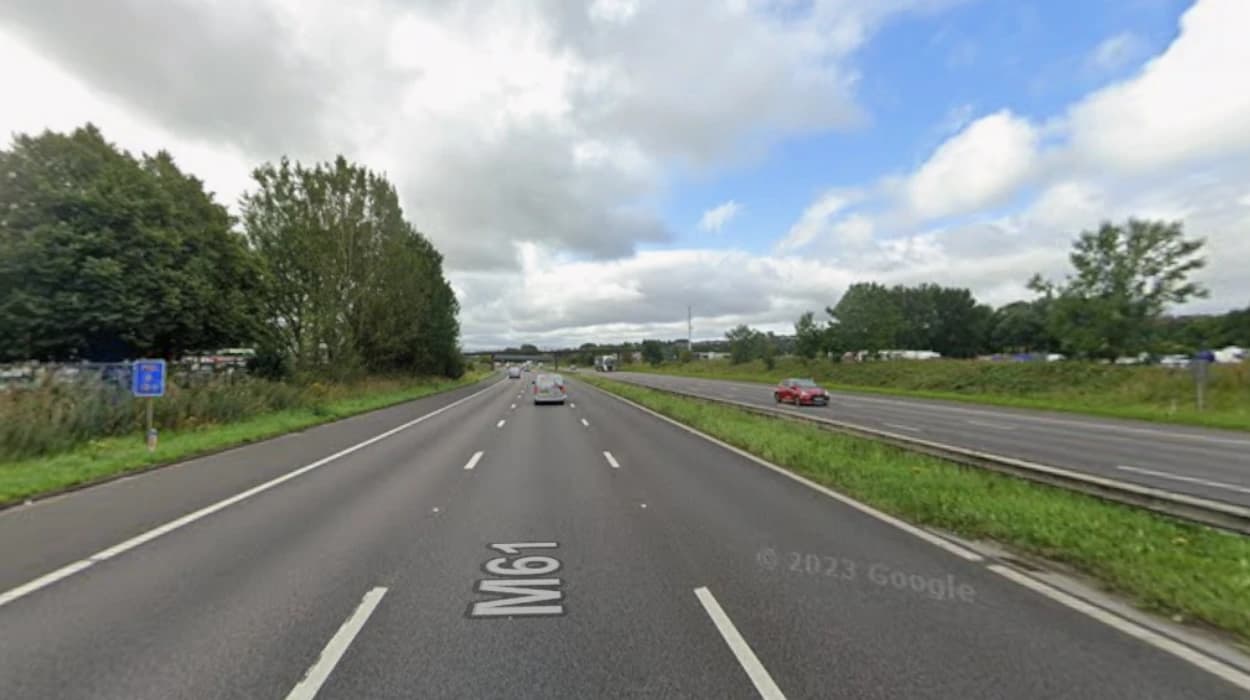
Key Points
- Location of Disruption: Severe traffic delays have heavily affected the M61 southbound corridor, specifically stretching from Junction 4 at the A6 Watergate Lane in Farnworth down to Junction 1 at the M60 Junction 15 Swinton Interchange.
- Impacted Motorways: The travel disruption has directly impacted motorists navigating the M61 and has had knock-on atmospheric implications for connecting regional routes, including the M62 and the wider M60 Manchester ring road network.
- Drastic Drop in Traffic Speeds: Vehicles passing through the affected southbound zones have seen travel speeds plummet dramatically, with traffic slowing down to a crawl of approximately 10mph during the peak morning commute.
- Commuter Alert issued: Regional highway data and local journalism have warned thousands of commuters to brace for significant journey extensions, advising road users to seek alternative routes to avoid the Swinton Interchange bottlenecks.
- Ongoing Monitoring: Highways authorities and local monitoring agencies continue to review the congestion patterns as traffic backlogs threaten to paralyze key commercial arteries linking Bolton, Bury, and Greater Manchester.
Bolton (Bolton Today) June 10, 2026 - Motorists navigating the regional transport network across Greater Manchester have been hit by substantial rush-hour disruptions this morning as severe delays take hold across critical stretches of both the M61 and M62 motorways. In coverage published by reporter Joe Harrigan of The Bolton News, it was confirmed that a massive buildup of congestion has severely throttled vehicular movement on the M61 Southbound, particularly impacting the heavily transited lanes between Junction 4 at the A6 Watergate Lane in Farnworth and Junction 1 at the M60 Junction 15, widely known as the Swinton Interchange. The gridlock has caused substantial tailbacks that have quickly rippled backward into connecting regional arteries, creating an administrative headache for transport authorities and leaving thousands of morning commuters trapped in long queues during one of the busiest periods of the working week.
Why are M61 and M62 motorists experiencing severe delays today?
The primary driver behind the severe delays currently gripping the region's motorway infrastructure is a combination of peak-time traffic volume and structural bottlenecks at key multi-lane highway intersections. As documented by reporter Joe Harrigan of The Bolton News, the geographical epicentre of the gridlock rests squarely on the southbound lanes of the M61, a vital pathway for motorists travelling out of Bolton and the surrounding Lancashire towns toward the employment hubs of Manchester and Salford.
When traffic reaches the Swinton Interchange at Junction 1, the merging of several high-volume roads creates a natural funneling effect. On mornings where volume exceeds the nominal capacity of these slip roads, the resulting braking waves quickly travel upstream. According to local transport logs and observational telemetry captured during the height of the congestion, the sheer density of vehicles has completely overwhelmed the standard morning discharge rate of the motorway network, turning what is usually a fast-flowing commuter corridor into a static parking lot.
What specific parts of the M61 southbound are closed or blocked?
While transport monitoring agencies have not confirmed any total closures or structural blockages along the route, the operational capacity of the highway has been fundamentally compromised. As reported by Joe Harrigan of The Bolton News, the physical parameters of the delay span the entirety of the M61 Southbound between Junction 4, which interfaces with the A6 Watergate Lane near Farnworth, all the way down to the Swinton Interchange.
This specific stretch covers several miles of critical tarmac that interfaces with local distribution roads. The absence of a formal lane closure suggests that the slowdown is entirely attributable to over-saturation and standard gridlock rather than an isolated road traffic collision or emergency infrastructure repair. However, the operational reality for drivers on the tarmac remains identical to a partial lane closure, as the available space to maneuver has been restricted by the bumper-to-bumper queue of idling vehicles.
Explore More Bolton Traffic News
M61 Bolton Crash Causes Traffic Hold and Delays Today
Deansgate Road Markings: Bolton Traffic Issues
How slow is the traffic moving on the M61 southbound this morning?
The velocity metrics coming from the affected motorway sections paint a stark picture for those attempting to calculate their arrival times this morning. In statements published by journalist Joe Harrigan within The Bolton News, traffic is understood to have slowed down to a mere crawl of around 10mph.
A drop of this magnitude effectively represents an 85 percent reduction in the standard operating speed of a UK motorway. For drivers, a 10mph average means that short journeys between local junctions that typically require only a few minutes to execute are now taking upwards of three-quarters of an hour, compounding stress levels and causing widespread institutional lateness across regional businesses.
Which connecting roads and motorways are affected by the Swinton Interchange backlog?
The Swinton Interchange, functioning as Junction 1 of the M61 and Junction 15 of the M60, is one of the most critical structural nodes in the North West of England's highway architecture. Because it links the M61 directly to the M60 orbital ring road and, by extension, the M62 trans-Pennine route, any failure in throughput at this location has immediate, compounding consequences for surrounding roads.
As vehicles fail to exit the M61 Southbound cleanly into the Swinton Interchange, the physical tailback blocks the slip lanes. This prevents drivers on the M62 from smoothly transitioning through the junction, causing the congestion to bleed onto the M62 eastbound and westbound corridors. Furthermore, local arterial roads feeding into Junction 4 at Farnworth and the A6 Watergate Lane have seen an influx of vehicles as frustrated drivers attempt to exit the motorway prematurely, shifting the burden of the motorway gridlock onto local municipal street networks.
What advice are transport authorities giving to commuters in Bolton and Farnworth?
With regional average speeds remaining pinned at the 10mph mark through the peak of the morning commute, transport analysts and local reporters are urging a approach of extreme caution and strategic diversion. While formal diversion signs have not been globally activated by National Highways, the data compiled by Joe Harrigan of The Bolton News clearly implies that continuing along the standard M61 southbound route will result in significant, unpredictable delays.
Commuters originating their journeys from the Bolton, Farnworth, Westhoughton, and Horwich areas are being advised to utilize real-time satellite navigation systems to spot micro-congestion patterns before joining the main carriage. Where possible, transport specialists suggest utilizing local rail links into Manchester Victoria or Manchester Piccadilly, or alternatively using secondary A-roads such as the A6 or A666 through Kearsley and Clifton, though these routes are also expected to experience heavier-than-normal volume as a direct result of the primary motorway failure.
How are local businesses and transport infrastructure reacting to the congestion?
The economic toll of a major transit failure along the M61 and M62 corridors is felt almost immediately across the Greater Manchester business landscape. With delivery fleets, commercial haulage vehicles, and standard service providers stuck in a 10mph crawl, supply chains experience minor, immediate friction.
Local distribution hubs situated near the motorway junctions face scheduling backlogs, while corporate environments face widespread workforce disruption as employees find themselves trapped in the gridlock. Transport authorities are continually monitoring the situation via CCTV networks and loop detectors embedded in the tarmac to determine if traffic light timings on connecting slip roads can be adjusted to favor the clearing of the M61 southbound base, though the sheer volume of vehicles makes any rapid resolution highly unlikely until the natural rush-hour peak begins to subside.
What should motorists do if they are caught in the current M61 tailbacks?
For those drivers who are already trapped in the queues between Farnworth and the Swinton Interchange, safety and mechanical preservation remain the primary objectives. Motorways policing units and regional safety advisories emphasize that motorists must maintain safe braking distances, even when moving at speeds as low as 10mph, to prevent low-speed shunts that would worsen the current delays by requiring lane closures.
Drivers are also reminded to monitor their vehicle fuel levels and engine temperatures, as prolonged idling in stop-start traffic places heightened strain on cooling systems. With no immediate end to the congestion in sight, maintaining a calm cabin environment and staying tuned to local radio traffic updates remains the most practical course of action for the thousands of motorists currently enduring this morning's severe transit disruption.