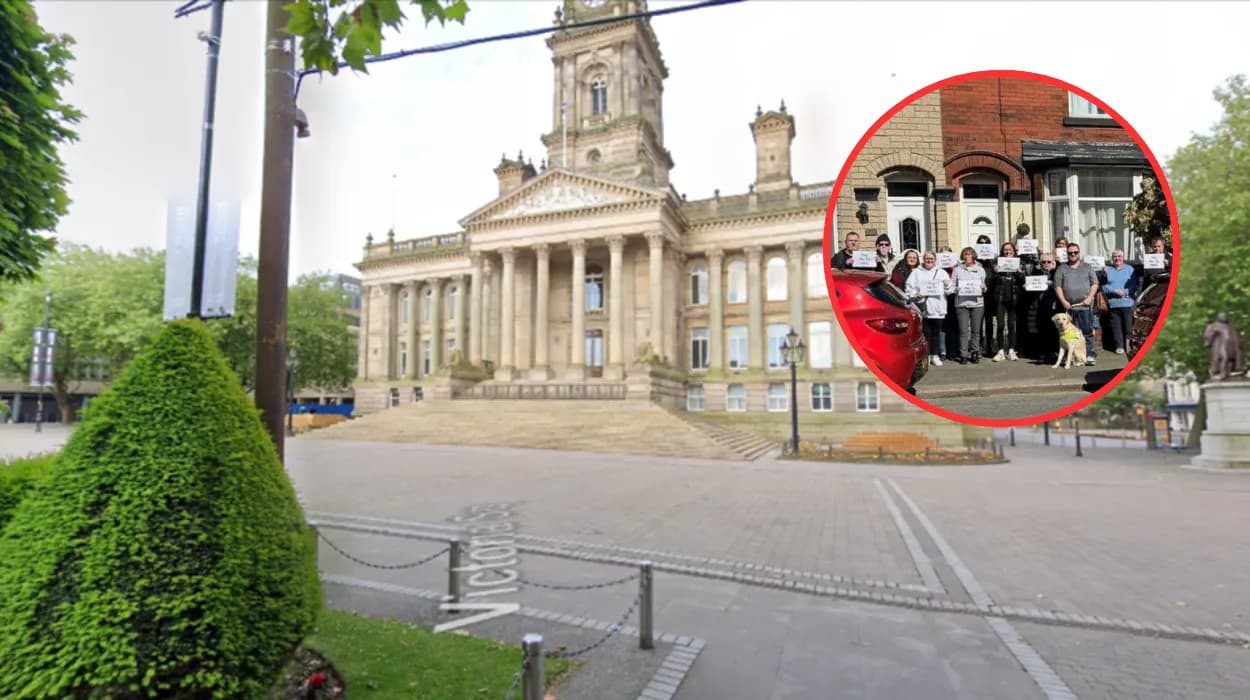
Key Points
- Town Hall Ballot: A controversial proposal to transform a residential property on Victoria Road, Horwich, into a multi-occupancy development is officially heading to a decisive planning committee vote at Bolton Town Hall.
- Mass Public Backlash: The property expansion scheme has sparked deep community resentment, drawing exactly 53 formal letters of objection from local residents and neighbours.
- Property Specifications: The developer's blueprint outlines a conversion from a standard residential dwelling house into a three-bedroom House in Multiple Occupancy (HMO), featuring a shared lounge, communal dining room, and a shared shower room.
- Official Recommendation: Despite extensive neighbourhood opposition, a detailed Bolton Council assessment report has officially recommended the planning committee grant structural approval for the project.
- Crime and Safety Anxiety: Local residents raised formal, documented grievances linking the high-density project to prospective declines in neighborhood safety, specifically citing heightened fears regarding anti-social behavior, safeguarding lapses, and localized crime rates.
- Council Rebuttal on Behaviour: Municipal planning officers dismissed tenant behavioral concerns as legally irrelevant to property use, declaring that prospective anti-social conduct remains an exclusive matter for the police rather than land-use planning.
- Political Call to Action: The development application was forced onto the public debating floor by former Horwich North Councillor Charlotte Moncado-Sears, who maintains structural objections regarding overdevelopment and substandard internal living metrics.
- Town Council Resistance: Horwich Town Council formally intervened against the proposal, registering an official recommendation for total refusal based on deficient internal room sizes and inadequate communal floor areas.
- Economic Defense of Design: Bolton Council planners defended the blueprint by arguing it delivers a critical supply of necessary, lower-cost housing that satisfies local and national strategic development targets.
Horwich (Bolton Today) June 18, 2026 – A contentious residential development scheme to establish a new House in Multiple Occupancy (HMO) on Victoria Road is set to face a definitive town hall ballot today, following an intense wave of public backlash that yielded more than 50 formal letters of objection from the surrounding community. The planning application, which seeks structural permission to convert an existing domestic house into a three-bedroom shared tenancy unit featuring a communal lounge, shared dining room, and an individual shower room, has exposed a sharp divide between local administrative policies and neighborhood preservation groups. While municipal planning officers at Bolton Council have formally recommended the structural plan for approval, the sheer volume of public anger has forced the application out of standard delegated decision channels and onto the floor of the local authority's planning committee for an open, democratic debate and vote.
The escalating gridlock centers heavily on a direct conflict between urban density targets and localized civic anxiety over neighborhood transformation. Exactly 53 formal letters of resistance were submitted to the local authority by nearby homeowners and residents, detailing extensive apprehensions regarding community safety, structural overdevelopment, and strain on public infrastructure. According to the official evaluation documents compiled by local authority planners, the submitted objections primarily targeted long-term sociological impacts, with nearby residents consistently outlining explicit concerns regarding safeguarding vulnerabilities, localized anti-social behaviour, and escalating crime patterns. However, municipal planning officers explicitly decoupled these human anxieties from structural land-use laws, clarifying that the hypothetical future conduct of incoming tenants holds zero legal weight in determining spatial planning consents, effectively shifting the burden of neighborhood management onto law enforcement agencies.
The formal political pushback that rescued the application from quiet administrative approval was initiated by Charlotte Moncado-Sears, who exercised her civic prerogative to demand a public committee vote prior to vacating her seat as a Horwich North representative in the recent municipal elections. Operating from her continuing platform as an active member of Horwich Town Council, Moncado-Sears has maintained a firm stance against the physical parameters of the development, warning that the layout compromises fundamental residential standards. Her localized legislative opposition is fully backed by Horwich Town Council, which collectively issued an official recommendation for outright refusal of the developer’s blueprint due to substandard interior space metrics. Despite this unified front from local representatives and immediate neighbors, the overarching executive apparatus of Bolton Council remains anchored to broader economic mandates, asserting that the creation of low-cost, high-density shared accommodation directly fulfills statutory national mandates designed to address modern housing shortages.
What are the key details of the Victoria Road HMO proposal?
The structural transformation of the property on Victoria Road from a traditional single-family residential unit into a multi-tenant shared complex forms the technical core of the planning dispute. Under the specific floor plans submitted to the local planning authority, the developer intends to partition the existing building layout to comfortably accommodate three independent tenancies within a single structure.
The interior blueprint establishes three dedicated bedrooms alongside a series of centralized communal zones. These shared facilities are restricted to a single communal lounge, one shared dining room, and a solitary shared shower room designed to service all occupants. By introducing a House in Multiple Occupancy framework into an established residential streetscape, the project represents a significant shift in local real estate density, transforming a standard domestic building into a multi-occupant rental property aimed at the lower-cost end of the local housing market.
Why are Horwich residents objecting to the new HMO?
The surrounding neighborhood has mounted a cohesive, structured campaign against the development, channeling their resistance through dozens of individual letters submitted directly to the municipal planning database. The overarching sentiment across the 53 formal objections reflects a deep-seated anxiety regarding how an influx of high-density transient rentals could alter the fundamental social and safety fabric of the Victoria Road community.
As detailed within the comprehensive council agenda documents, the written testimonies of local residents focus intensely on long-term neighborhood preservation. Homeowners expressed explicit fears that the high-turnover nature of HMO properties inherently acts as a catalyst for localized instability, citing direct risks associated with anti-social behaviour, general neighborhood disruption, and a potential rise in local crime statistics. Furthermore, safety and safeguarding concerns were prominently featured throughout the public submissions, with multiple objectors arguing that the introduction of unvetted, multi-family occupancies onto a traditional family-oriented street presents unacceptable risks to vulnerable residents and children residing in the immediate vicinity.
How did Bolton Council respond to community crime and safety concerns?
In the official evaluation report compiled ahead of the town hall debate, Bolton Council’s professional planning team systematically addressed the community's security fears by drawing a strict line between statutory land-use legislation and general social anxieties. The administrative assessment concluded that while the emotional and practical basis of the neighborhood's concerns is fully understood, the specific arguments regarding potential criminality cannot legally influence a structural planning decision.
Explore More Horwich News
Horwich Terraced Home Seeks Six-Bed HMO Conversion
Horwich Ghost Train Statue to Undergo £81k Refurbishment, Horwich 2026
What are the legal boundaries of a planning decision?
The professional planning officers explicitly clarified the narrow statutory limits governing municipal development approvals, writing:
"Objections have been received from local residents relating to safeguarding, anti-social behaviour and crime. Whilst officers understand the nature of the concerns, they are satisfied that the design and location of the building is suitable for the use proposed in planning terms and do not consider that it will necessarily lead to an increase in crime or have an undue impact on the safety of existing or future residents."
Why is tenant behavior excluded from planning considerations?
The local authority further emphasized that the planning committee is legally prohibited from speculating on the character or moral conduct of potential future residents when evaluating real estate developments. The council report stated:
"Planning decision must concern themselves with the use and development of land and buildings and therefore the potential future behaviour of an individual occupant or occupants is not a planning consideration of significant weight. Any matters that do arise relating to safeguarding or anti-social behaviour would be matters for the police and are not material to the consideration of a planning application."
What political actions brought this scheme to a committee vote?
The planning application would have likely progressed through standard administrative channels under delegated officer powers if not for the direct intervention of localized political figures. The formal mechanism to strip the application of its automatic approval trajectory and force a transparent public debate was executed by Charlotte Moncado-Sears, who served as a prominent Horwich North councillor up until the local elections held last month.
Although her tenure on the main borough council concluded at the recent ballot box, Moncado-Sears continues to exert significant local influence via her retained seat on the Horwich Town Council. Driven by a desire to defend the structural integrity of her constituency, she formally requested that the Victoria Road application be referred to the full planning committee for an open vote. Moncado-Sears based her political challenge on explicit structural grounds, publicizing her deep concerns regarding general urban overdevelopment, the imposition of substandard living conditions upon future tenants, and a visible, systematic conflict between the developer's submitted floor plans and Bolton Council's own long-term HMO development guidance policies.
Why did Horwich Town Council recommend refusal of the plan?
Aligning themselves fully with the resistance mounted by local neighborhood groups, the members of Horwich Town Council held an independent review of the Victoria Road application and issued a formal declaration urging the primary planning committee to reject the project entirely. The town-level council's institutional opposition does not rely on generalized social arguments, but rather focuses heavily on the internal physical dimensions of the proposed conversion.
Following a close inspection of the structural blueprints, Horwich Town Council officially recorded its recommendation for total refusal based on the restrictive interior layout of the property. The parish-level authority argued that the proposed room dimensions and the limited communal floor space allocations allocated for the shared lounge, dining area, and single shower room are fundamentally inadequate. They concluded that the developer's layout attempts to squeeze too many tenants into a confined space, resulting in an unacceptable compression of basic living conditions that violates local housing standards.
How does Bolton Council justify its recommendation for approval?
Despite the layers of political resistance and overwhelming public opposition, Bolton Council’s executive planning apparatus has maintained an unyielding defense of the Victoria Road project, aligning its final recommendations with broader regional and national socio-economic objectives. The borough's planning department concluded that the structural blueprints strictly satisfy the legal and regulatory mandates detailed within the wider region's overarching development plan.
The council’s administrative report defended the necessity of high-density housing options within the modern real estate market, stating:
"The proposal would provide a form of lower-cost housing which would meet a particular need, thereby making a small but positive contribution to the number of households and mix of housing available over the plan period in accordance with the above national and local policies."
By framing the three-bedroom HMO as a vital, low-cost solution to an ongoing regional housing shortage, the borough planners have prioritized strategic macroeconomic housing quotas over localized spatial preferences. This clear policy gap sets the stage for a high-stakes confrontation when the members of the planning committee gather to cast their final, binding votes at Bolton Town Hall.