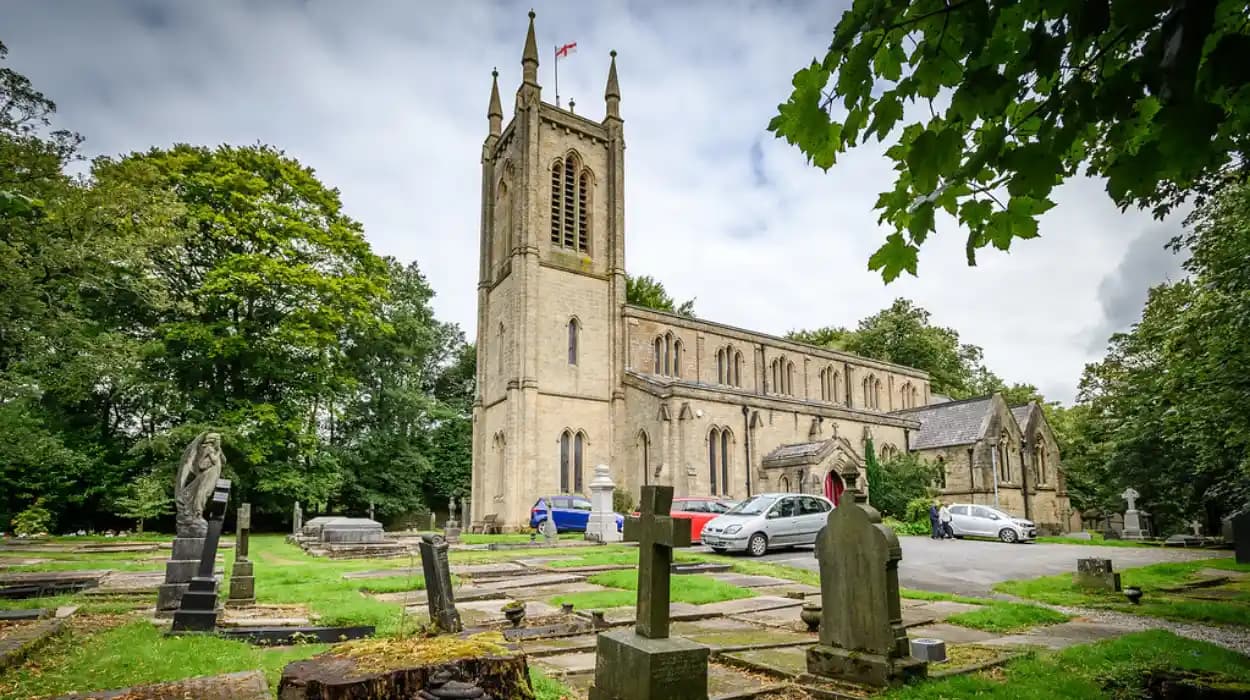
Bolton’s historic churches form an important record of religious, architectural, social, and industrial change in Greater Manchester. The borough’s surviving ecclesiastical buildings range from medieval parish churches and Georgian foundations to Victorian Gothic Revival landmarks and twentieth-century reconstructions.
These churches were not isolated religious buildings. They were centres of parish administration, education, burial, charitable activity, music, local governance, and community life. Their churchyards contain evidence for family history, while their architectural fabric records changing building techniques, religious practices, population patterns, and economic conditions.
For heritage travellers, Bolton offers an unusually broad chronological sequence. St Mary the Virgin at Deane preserves medieval fabric. Bolton Parish Church represents the nineteenth-century rebuilding of an ancient town-centre site. St George’s records Georgian expansion. All Souls in Astley Bridge reflects the industrial population boom. Christ Church at Walmsley represents nineteenth-century development on Bolton’s rural-industrial fringe. St Bartholomew’s at Westhoughton demonstrates how a historic church community survived catastrophic fire and reconstruction.
What makes Bolton’s historic churches important to heritage travellers?
Bolton’s historic churches record the town’s transformation from a medieval parish landscape into an industrial borough. Surviving buildings range from medieval fabric at St Mary’s, Deane, to Victorian Gothic churches built for expanding mill communities, with later reuse preserving heritage.
Bolton developed within the historic county of Lancashire before becoming part of Greater Manchester in 1974. Its ecclesiastical geography was much larger than the modern town centre. Ancient parishes and chapelries served communities that later developed into separate settlements, including Deane, Westhoughton, Horwich, Walmsley, and other townships.
Church buildings therefore provide a physical framework for understanding Bolton before and during industrialisation.
The medieval parish system connected worship with administration. Parish churches maintained registers, supervised burial grounds, supported charitable activity, and provided institutional structures for local communities. Parish boundaries also shaped how historical records were created.
The Industrial Revolution changed this pattern. Bolton’s cotton industry generated rapid population growth during the eighteenth and nineteenth centuries. New housing districts developed around mills, roads, canals, and later railways. Existing parish churches became insufficient for expanding populations, while new churches were established closer to industrial communities.
Architecture records this change. Medieval churches generally contain surviving stone fabric, traditional Gothic details, towers, and historic churchyards. Georgian churches introduced different spatial arrangements and materials. Victorian churches frequently adopted Gothic Revival designs with larger windows, taller towers, elaborate stonework, and seating arrangements designed for large congregations.
Bolton’s church heritage also demonstrates adaptation. Some churches remain active places of worship. Others have been conserved for alternative community uses. Some retain only important architectural elements following rebuilding.
This combination makes the borough valuable for heritage study because the buildings document continuity rather than a single historical period.
How far back does church history in Bolton go?
Christian worship in Bolton has medieval and earlier roots, while surviving church buildings reflect successive rebuilding campaigns. The strongest evidence includes pre-Norman stonework at Bolton Parish Church, medieval fabric at Deane, and parish expansion during industrial growth across surrounding townships.
The earliest surviving evidence is archaeological rather than architectural.
Bolton Parish Church reports a Saxon cross in its west porch dating from the early tenth century. Stone fragments discovered during the demolition of the previous church in the nineteenth century also indicate earlier phases of construction. The evidence establishes the site as an important early Christian location.
The precise foundation date of the first church on the site remains unknown. The existing foundations and surviving stonework demonstrate a long sequence of religious occupation. Bolton Parish Church states that fragments indicate a church existed by the eleventh century.
The medieval period established the parish structure that shaped local religious geography for centuries. Deane provides another important example. St Mary the Virgin at Deane occupies a site associated with an ancient ecclesiastical settlement. A surviving historical study records a written reference around 1205 to Robert, chaplain of St Marie, Dene. The church remained associated with the ancient parish structure before becoming an independent parish during the Tudor period.
The evidence also demonstrates why church buildings are important to genealogists. Bolton Libraries and Museums holds indexed records associated with St Mary’s, Deane, including baptisms, marriages, burials, and monumental inscriptions. Some records extend back to the seventeenth century, providing an important documentary resource for family-history research.
Church records must be interpreted alongside architectural evidence. A building can be medieval even when substantial parts have been rebuilt. Deane illustrates this principle because later alterations coexist with older fabric.
Bolton’s ecclesiastical history therefore begins before the industrial town visible today. The surviving buildings represent successive layers of settlement, religious organisation, construction, repair, and community use.
Why is Bolton Parish Church one of the most important historic churches in the town?
Bolton Parish Church preserves the clearest architectural record of the town centre’s long religious history. The present Gothic Revival building was designed by Edward Paley, begun in 1867, consecrated in 1871, and incorporates material from earlier churches on the site.
Bolton Parish Church, formally the Parish Church of St Peter, stands at Churchgate in the town centre. It is a Church of England parish church within the Diocese of Manchester.
The present building dates from the nineteenth century, but its site has a much older history. Bolton Parish Church describes approximately 1,200 years of Christian heritage at the location. A Saxon cross and fragments of earlier structures provide evidence for early medieval activity.
The earlier medieval church was replaced during the fifteenth century as Bolton expanded. The older building survived for several centuries before being demolished in 1866. Its replacement was designed by Edward Graham Paley of the architectural practice Paley and Austin.
The foundation stone of the current church was laid on 27 April 1867. The church was consecrated on 29 June 1871, St Peter’s Day, by James Fraser, Bishop of Manchester.
The building is an important example of Victorian Gothic Revival architecture. It uses Longridge stone and has a substantial tower. Bolton Parish Church records the tower height as 55 metres, or approximately 180 feet. The church measures approximately 47.5 metres in length and 20.5 metres in width.
The church also retains material associated with earlier structures. Historic objects include fifteenth-century wooden seating, a Jacobean lectern, an old wooden altar, and other reused elements.
The site demonstrates an important historical process: nineteenth-century church rebuilding did not necessarily erase the past. Earlier architectural material and objects were incorporated into the new building, allowing successive periods to remain visible.
For heritage travellers, the church provides a concentrated study of medieval continuity, Victorian architecture, civic identity, church music, memorial culture, and urban development.
The surrounding Churchgate area also retains historic structures associated with the parish. Historic England lists the churchyard gates and gate piers as Grade II structures, providing additional evidence of the historic setting.
To experience this historic landmark in person today, consult our comprehensive [Religious History and Historic Churches Across Bolton] for itineraries and visiting parameters.
Why should heritage travellers visit St Mary the Virgin, Deane?
St Mary the Virgin, Deane, is one of Bolton’s important medieval churches because its fabric incorporates late Perpendicular work and earlier elements. Its parish history also makes the churchyard and surviving registers valuable sources for genealogy, architecture, and social history.
St Mary the Virgin stands at Deane, southwest of Bolton town centre. Historic England lists the church at Grade II*, reflecting its special architectural and historic interest.
The building contains substantial late Perpendicular work. Perpendicular Gothic architecture developed in England during the late medieval period and is characterised by strong vertical lines, large windows, and elaborate panel and tracery patterns.
Historic England identifies an earlier building within the present structure and records a clerestory added in 1833. Restoration took place around 1880. The building includes a west tower, nave, clerestory, aisles, and chancel.
The church’s position is also historically significant. Deane developed around a valley landscape, and the church occupied a prominent location overlooking the surrounding area. The relationship between church, settlement, road network, and agricultural land demonstrates the spatial organisation of the medieval parish.
The churchyard adds another historical dimension.
Memorial inscriptions provide evidence for local families, occupations, social status, and mortality. Bolton Libraries and Museums records extensive parish material, including baptismal records from 1604, marriage records beginning in the seventeenth century, burial records, monumental inscriptions, and later indexes.
These records are particularly valuable for genealogical research. Before civil registration began in England and Wales in 1837, parish registers were among the principal sources for documenting baptisms, marriages, and burials.
The church therefore connects architectural heritage with documentary heritage. A researcher studying a nineteenth-century Bolton family can potentially examine parish registers alongside the surviving churchyard and memorial evidence.
The church’s historic setting also includes a listed lych gate. Historic England identifies the structure as a late nineteenth-century building with stone walls, a slate roof, an arched entrance, and an embattled parapet.
What does St George’s Church reveal about Georgian Bolton?
St George’s Church represents Bolton’s late Georgian expansion and the changing religious landscape of an industrial town. Completed in 1796, the brick church was designed by Samuel Hope, altered in 1907, listed Grade II, closed in 1975, and later reused.*
St George’s Church on Bath Street represents a different phase of Bolton’s architectural development.
The church was completed in 1796. Its original design is associated with architect Samuel Hope and reflects Georgian architectural principles rather than the medieval forms adopted by later Victorian churches.
Georgian churches developed during a period of substantial population and economic change. Bolton’s textile economy was expanding, and the town was moving from a predominantly agricultural and domestic manufacturing economy towards factory-based industrial production.
The architecture of St George’s therefore belongs to the period immediately before the most intense nineteenth-century urban expansion.
Its brick construction contrasts with the stone Gothic architecture found in several later Bolton churches. The building originally featured a shallow chancel and a galleried interior, reflecting contemporary approaches to Protestant worship.
A later phase of alteration occurred in 1907, when James Simpson added or rebuilt the shallow chancel and south chapel. This demonstrates how historic churches were repeatedly modified to accommodate changing liturgical requirements, congregational patterns, and architectural preferences.
St George’s was listed Grade II* in 1974. Grade II* is the middle of England’s three statutory listing grades and identifies buildings of particular importance with more than special interest.
The church ceased to function as an Anglican place of worship in 1975. It later operated as a craft centre and subsequently experienced further changes of use. Historical records also document the preservation and removal of its bells following closure.
Its history demonstrates that heritage significance does not depend exclusively on continuous religious use. The building remains evidence of Georgian Bolton, nineteenth-century modification, twentieth-century change, and modern adaptive reuse.
How does All Souls Church explain Bolton’s industrial expansion?
All Souls Church in Astley Bridge demonstrates how Victorian church architecture responded to population growth around Bolton’s mills. Built in 1878–1881 by Paley and Austin for a congregation, its Grade II Gothic Revival fabric survives through conservation and reuse today.*
All Souls Church stands on Astley Street in Astley Bridge, an area shaped strongly by nineteenth-century industrial development.
The church was built between 1878 and 1881. The architects were Paley and Austin, the same architectural practice associated with Bolton Parish Church. Historic England lists All Souls as Grade II*.
The building was funded by Thomas Greenhalgh, an Evangelical mill owner. Historical accounts connect its foundation with the growth of the surrounding community and the need for additional religious provision.
Its architecture follows the Gothic Revival tradition. The building uses brick with sandstone dressings and slate roofs. Its west tower, nave, and chancel create a substantial ecclesiastical composition within the former industrial district.
The interior is particularly significant because of its unusually broad uninterrupted space. Historical descriptions record an interior without conventional supporting pillars across the main area. This arrangement was designed to improve sightlines and audibility for worshippers.
The church also preserves evidence of Victorian religious culture through its architectural detailing, stained glass, memorials, fittings, and spatial organisation.
The twentieth century brought a major demographic change. As local population patterns changed, the church’s original congregational function declined. The building eventually closed as a church in 1986.
Conservation then became central to its survival.
All Souls underwent renovation beginning in September 2013. The work was completed in November 2014, and the building reopened to the public on 6 December 2014. The present use combines conference, office, learning, and community functions while retaining the historic structure.
This is a significant example of adaptive reuse. Adaptive reuse means retaining an existing historic structure while introducing a different function. The approach protects architectural fabric while allowing a building to remain useful.
All Souls therefore illustrates the relationship between industrialisation, population growth, Victorian church construction, demographic change, conservation, and community regeneration.
Why is Christ Church, Walmsley, significant in Bolton’s church heritage?
Christ Church, Walmsley, records the expansion of Anglican worship into Bolton’s rural-industrial fringe during the nineteenth century. Designed by Edmund Sharpe, construction began in 1837, consecration followed in 1839, enlargement came in 1867, and the Grade II building remains active.
Christ Church stands on Blackburn Road at Walmsley, within the northern part of the Bolton area.
The church was designed by Edmund Sharpe, an important nineteenth-century architect associated with church construction across Lancashire. Work began in 1837, and the building was consecrated on 3 October 1839 by John Bird Sumner, Bishop of Chester.
The church was constructed from locally sourced stone. The parish history records stone from Cox Green Quarry and notes the involvement of local stonemasons. This provides evidence of the relationship between regional geology, building materials, local skilled labour, and nineteenth-century church construction.
The original building was completed without debt at a reported cost of £3,557. An organ and gallery were subsequently added.
In 1867, the church was enlarged with a chancel, two transepts, an organ chamber, and a clergy vestry. The expansion demonstrates the effect of population growth on Victorian parish buildings.
The church is Grade II listed. Historic England describes the building as dating from 1839–1840 and identifies its nave, aisles, west tower, transepts, and chancel as significant architectural elements.
The churchyard also contains military heritage. Recorded Commonwealth War Graves include seven First World War casualties and three Second World War casualties. This adds twentieth-century military history to the building’s nineteenth-century architectural context.
Christ Church is also significant because it demonstrates the geographic spread of Anglican church building beyond Bolton’s densely industrial centre. Its location on the Blackburn Road corridor connected rural settlements with the growing urban economy.
For heritage travellers, the church provides evidence of the transition between rural parish landscapes and industrial-era settlement.
What happened to St Bartholomew’s Church in Westhoughton?
St Bartholomew’s, Westhoughton, illustrates continuity through destruction and reconstruction. An eighteenth-century chapel followed earlier worship, a new church was built in 1869–1870, fire destroyed most of that building in 1990, and the surviving tower anchors the church consecrated in 1995.
St Bartholomew’s Church in Westhoughton has one of the clearest examples of architectural continuity through catastrophic loss.
Westhoughton had an earlier chapel before the eighteenth century. Historical church records state that the earlier structure became extremely ruinous and was demolished. A replacement chapel was built in 1731. Parish registers began in the same year because the new building functioned as a district chapelry.
Before 1731, Westhoughton baptisms, marriages, and burials were recorded through Deane Church. This connection demonstrates how ancient parish structures influenced local record keeping.
The nineteenth century brought another major change.
A new St Bartholomew’s Church was constructed in 1869–1870. Its tower was designed by Cunliffe and Freeman and survives as a listed structure. Historic England records the tower as Grade II and dates it to 1869–1870.
The church suffered a major fire in November 1990. Most of the nineteenth-century building was destroyed, but the tower survived. The present church was rebuilt and consecrated on 28 October 1995.
This sequence demonstrates that heritage preservation does not always mean preserving an entire original building. The surviving tower retains the physical connection with the nineteenth-century church, while the reconstructed building represents the continuing history of the congregation.
St Bartholomew’s also remains relevant to genealogical research. Historical baptism, marriage, and burial records are preserved through the Manchester Diocesan Archive and local studies collections. Researchers tracing Westhoughton families therefore have documentary evidence extending across several centuries.
The church provides an especially clear case study for educators. Its history connects early chapel provision, parish administration, nineteenth-century church construction, industrial-era community development, fire damage, architectural survival, and post-fire reconstruction.
How can Bolton’s historic churches be understood as architectural evidence?
Bolton’s churches provide architectural evidence for changing religious practice, population growth, construction technology, and social organisation. Medieval stonework, Georgian brickwork, Victorian Gothic Revival architecture, church towers, stained glass, memorials, and adaptive reuse each identify distinct historical phases.
Architectural interpretation begins with materials.
Stone dominates several of Bolton’s older and Victorian ecclesiastical buildings. Locally available sandstone supported regional construction traditions. Christ Church, Walmsley, for example, used locally quarried stone, linking the church directly with the surrounding landscape and skilled stoneworking economy.
Brick became particularly important during the Georgian and industrial periods. St George’s Church provides a clear example of a Georgian brick church, contrasting with the stone Gothic Revival buildings constructed during the nineteenth century.
Architectural style also provides chronological evidence.
Perpendicular Gothic features at St Mary’s, Deane, belong to the late medieval architectural tradition. Georgian planning at St George’s reflects eighteenth-century Protestant church design. Victorian Gothic Revival architecture dominates buildings such as Bolton Parish Church and All Souls.
The Gothic Revival was a nineteenth-century architectural movement that revived medieval Gothic forms. Its use in churches reflected both architectural scholarship and changing Anglican attitudes towards medieval ecclesiastical traditions.
Towers are another important historical feature.
Church towers served practical and symbolic functions. Bells communicated information across settlements, while towers acted as prominent landmarks. Bolton Parish Church’s 55-metre tower is an especially significant component of the townscape.
Churchyards provide a separate layer of evidence.
Gravestones and memorials identify names, dates, occupations, family relationships, and social status. Parish registers provide documentary evidence that complements this physical record.
Listed-building status adds another layer of protection. Historic England’s National Heritage List for England records buildings considered to possess special architectural or historic interest. Grade II identifies buildings of special interest, while Grade II* identifies particularly important buildings with more than special interest.
Bolton’s churches therefore function as historical documents constructed from stone, brick, timber, glass, metal, and written records.
How have Bolton’s historic churches survived into the present?
Bolton’s historic churches survive through continuous worship, listing protection, conservation, restoration, reconstruction, and adaptive reuse. Examples include active St Peter’s and Christ Church, conserved All Souls, reused St George’s, and the reconstructed St Bartholomew’s at Westhoughton.
Survival has depended on different mechanisms.
Active worship provides one form of continuity. Bolton Parish Church remains a functioning Church of England parish church and describes itself as Bolton’s civic church. Christ Church, Walmsley, also remains an active parish church.
Statutory listing provides another mechanism. Listed buildings are recognised for their special architectural or historic interest, and listed-building controls regulate alterations that affect their significance.
All Souls demonstrates conservation combined with new use. Its nineteenth-century structure was conserved while the building was adapted for community, learning, conference, and office purposes.
St George’s illustrates another route. The church ceased Anglican worship but remained standing and experienced alternative uses. Its survival demonstrates the historical value of retaining substantial architectural fabric even after the original function changes.
St Bartholomew’s demonstrates reconstruction after disaster. The 1990 fire destroyed most of the nineteenth-century church, but the tower survived. The rebuilt church continued the site’s religious function after its 1995 consecration.
These examples demonstrate that heritage preservation is not a single process. Conservation can involve maintaining original fabric, repairing historic structures, adapting buildings to new functions, or reconstructing buildings after severe damage.
The future historical value of Bolton’s churches depends on maintaining both physical structures and documentary records. Architectural fabric without historical documentation loses contextual information. Records without surviving buildings lose much of their physical setting.
For educators and heritage researchers, the strongest approach combines both forms of evidence.
Bolton Libraries and Museums provides an important documentary resource through its archive and history collections. Parish records, monumental inscriptions, architectural information, photographs, maps, and local studies material can be compared with surviving buildings.
Why do Bolton’s historic churches matter for genealogy and local history?
Bolton’s historic churches preserve evidence essential to genealogy and local history. Parish registers document baptisms, marriages, and burials, while churchyards, memorials, architecture, and surviving buildings provide physical context for families, occupations, migration, population growth, and community development.
Genealogical research in Bolton often depends on parish records created before modern civil registration.
England and Wales introduced compulsory civil registration of births, marriages, and deaths in 1837. Before that date, parish registers were among the most important official sources for documenting major life events.
St Mary’s, Deane, provides particularly extensive material. Bolton Libraries and Museums records baptismal material beginning in 1604, marriage material from the seventeenth century, burial records, monumental inscriptions, and later indexes.
Westhoughton provides another valuable example. Its church records include baptisms, marriages, and burials extending across several centuries. The records are held through the Manchester Diocesan Archive and local studies services.
The architecture itself can also assist research.
A churchyard memorial can confirm a surname, date, occupation, family relationship, or residence. A church interior can contain commemorative plaques and war memorials. Church restoration records can identify donors, architects, craftsmen, and local organisations.
Industrial history is particularly visible through this evidence. Wealth generated by manufacturing supported church construction and expansion. All Souls, for example, was connected with the Greenhalgh family and the industrial community of Astley Bridge.
Church history therefore provides more than religious information. It documents the social structure of Bolton’s communities.
Researchers can use churches to investigate family migration between townships, changes in occupations, population expansion, religious affiliation, wartime casualties, and the development of neighbourhoods.
The combination of parish registers and surviving buildings is especially valuable because it connects individual names with physical places.
What can heritage travellers learn from Bolton’s church heritage today?
Bolton’s historic churches provide a chronological route through medieval parish life, Georgian urban development, Victorian industrial expansion, twentieth-century change, and modern conservation. Their buildings and records connect architecture with genealogy, social history, religious history, and the continuing identity of Bolton.
A heritage-focused visit to Bolton benefits from viewing churches as connected historical sites rather than isolated monuments.
St Mary’s, Deane, provides medieval context. Its late Perpendicular fabric and earlier elements demonstrate the long development of parish architecture. Its records connect the building with generations of local families.
Bolton Parish Church provides the strongest town-centre example. Its nineteenth-century Gothic Revival structure replaced an earlier church while retaining evidence from the ancient site. The building therefore connects early Christian history with Victorian urban development.
St George’s represents the Georgian period. Its 1796 construction demonstrates how religious architecture changed before the major Victorian church-building campaigns.
All Souls records the industrial age. Its construction in 1878–1881 reflects the demand for religious infrastructure within a rapidly growing mill district. Its later conservation demonstrates modern heritage adaptation.
Christ Church, Walmsley, extends the story into Bolton’s rural-industrial fringe. Its 1837–1839 construction and 1867 enlargement demonstrate how population growth affected communities beyond the town centre.
St Bartholomew’s, Westhoughton, adds a twentieth-century conservation lesson. The 1990 fire destroyed most of the historic church, but the surviving tower and rebuilt church preserved continuity on the site.
Together, these buildings form a historical sequence spanning more than a thousand years of religious and community development.
Their importance also extends beyond tourism. Schools can use the churches to teach chronology, architecture, industrialisation, local government, religious history, and genealogy. University students can study architectural conservation and urban development. Family historians can use parish records and memorials. Heritage organisations can use surviving fabric to understand changing approaches to preservation.
Bolton’s churches remain valuable because their history is visible in the buildings themselves. Stonework, towers, windows, roofs, churchyards, memorials, registers, and later adaptations preserve evidence that cannot be understood from dates alone.
The most important lesson is continuity. Bolton’s historic churches demonstrate how communities repeatedly adapted religious buildings to changing populations, architectural standards, economic conditions, and social needs. Their survival provides a direct connection between the medieval parish landscape and the modern borough.
For heritage travellers, these churches provide a factual and accessible route through Bolton’s development from an early Lancashire settlement to an industrial town and modern Greater Manchester borough.
FAQS
What is the oldest historic church in Bolton?
St Mary the Virgin at Deane is one of Bolton’s oldest surviving churches. Its history extends back to the medieval period, with surviving architectural fabric including late Perpendicular Gothic features and earlier elements.