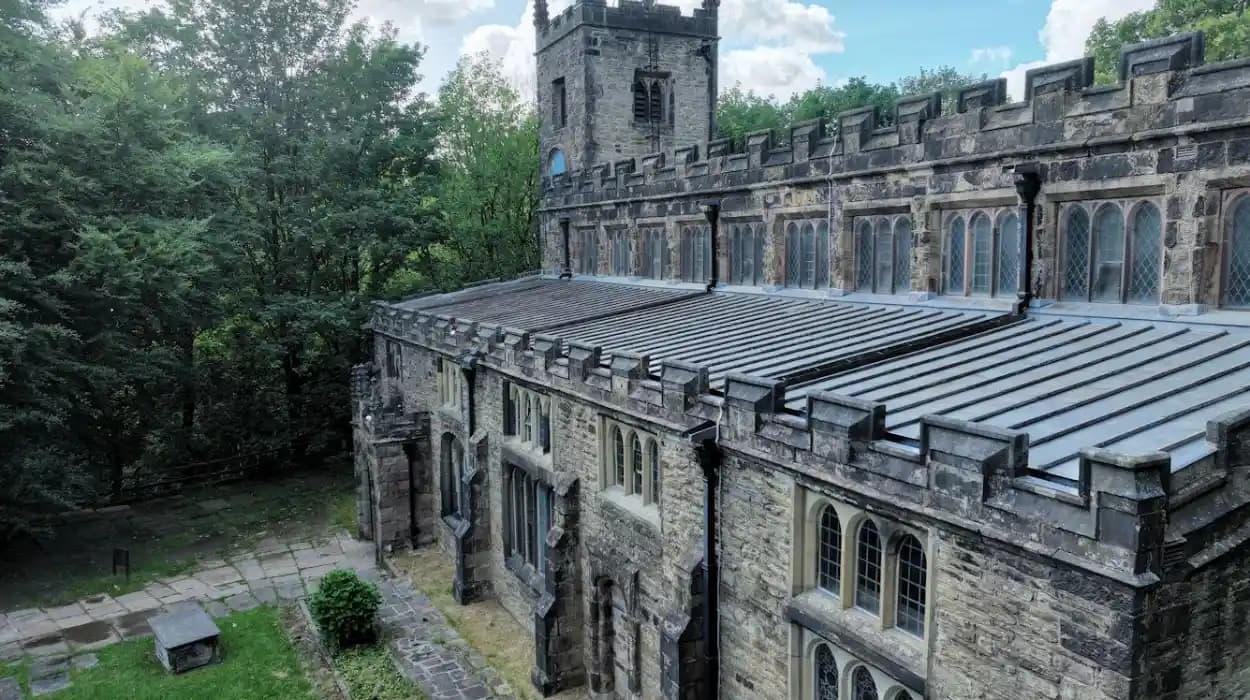
Bolton’s religious history is closely connected to the development of its settlements, institutions, industries, schools, burial grounds, and civic communities. The borough contains evidence of Christian worship from the early medieval period, alongside later Anglican, Roman Catholic, Methodist, Unitarian, Independent, Baptist, and other Nonconformist traditions.
Historic churches are especially valuable because they preserve several forms of evidence in one place. Buildings reveal architectural change. Churchyards preserve memorials and burial patterns. Parish registers document baptisms, marriages, and burials. Stained glass, fonts, organs, monuments, pews, bells, and memorials record changing religious practice and local patronage.
Bolton’s religious landscape also reflects the transition from a predominantly rural medieval economy to an industrial town dominated by cotton manufacturing, coal mining, engineering, transport, and expanding residential districts. The growth of population created demand for new churches, chapels, schools, Sunday schools, and charitable institutions.
The result is a religious heritage landscape extending from the ancient parish centre at Bolton Parish Church to churches in Deane, Halliwell, Bradshaw, Farnworth, Westhoughton, Daisy Hill, and other communities across the modern borough.
How did religious history begin in Bolton?
Bolton’s religious history stretches from early medieval Christianity through the Reformation, Nonconformism, Catholic revival, Methodism, and Victorian church building. Historic churches preserve evidence of changing population, industry, worship, education, philanthropy, architecture, burial customs, and community organisation throughout the borough town.
The earliest evidence is concentrated around Bolton Parish Church, formally the Parish Church of St Peter, Bolton-le-Moors. The precise date of the first church on the site is unknown, but archaeological evidence discovered during rebuilding establishes a substantially earlier religious landscape.
A Saxon cross preserved in the west porch dates from the early tenth century. Its presence indicates that the site was associated with a Christian burial ground, although the cross alone does not prove that a church building already stood there. Fragments of stonework recovered during the nineteenth-century rebuilding provide evidence for an eleventh-century church building.
The medieval religious geography of Bolton was not confined to the modern town centre. Ancient ecclesiastical parishes covered large rural areas. Deane, for example, developed as an important ecclesiastical centre serving communities around Rumworth and the surrounding countryside.
The parish system connected religious administration with everyday life. Parish churches were places for worship, baptism, marriage, burial, charitable activity, and the maintenance of community records. Before modern local government and civil registration, these institutions played a major administrative role.
Bolton and Deane appear in the Domesday Book of 1086. The surviving historical evidence therefore places both communities within the established administrative and settlement landscape of medieval Lancashire. Deane Church research records a religious foundation associated with the site from around 1111, although much of the documentary evidence has been lost.
The medieval church system changed fundamentally during the English Reformation of the sixteenth century. The break with papal authority under Henry VIII transformed religious institutions, church finances, chantries, liturgy, and the ownership of ecclesiastical property.
The Dissolution of the Monasteries between 1536 and 1541 removed England’s monastic institutions and transferred substantial property to the Crown and private owners. Bolton’s later religious landscape developed from this transformed settlement.
The seventeenth century introduced further religious conflict. Puritanism and Nonconformity became important features of Lancashire religious life. Later Presbyterian, Unitarian, Independent, Baptist, and Methodist congregations established their own institutions, creating a more diverse religious geography.
What makes Bolton Parish Church historically important?
Bolton Parish Church occupies the borough’s most historic Christian site, with evidence of a burial ground in the early tenth century and a church building by the eleventh century. The present Gothic Revival structure was consecrated in 1871 after reconstruction.
Bolton Parish Church stands at Churchgate in the historic centre. It is dedicated to St Peter and belongs to the Church of England’s Diocese of Manchester.
The church’s history is unusually long because the current building represents only the latest major phase of development on an ancient religious site. The earliest recorded incumbent was John de Sanwyog, whose name appears in 1254.
A larger church replaced the earlier Saxo-Norman structure around 1420. That medieval building served Bolton for approximately four centuries. Its replacement illustrates the way parish churches were repeatedly altered as populations, architectural expectations, religious practices, and local wealth changed.
The nineteenth century brought another transformation. The old church was demolished during the 1860s, and the foundation stone of the present building was laid on 27 April 1867. The architect was Edward Graham Paley of the architectural practice Paley and Austin.
The completed church was consecrated on St Peter’s Day, 29 June 1871, by James Fraser, Bishop of Manchester. It is constructed principally from Longridge stone and represents Victorian Gothic Revival architecture. The church is listed at Grade II*, recognising its special architectural and historic interest.
The building measures approximately 47.5 metres in length and 20.5 metres in width. Its interior reaches approximately 25 metres in height. The tower rises approximately 55 metres, or 180 feet. Bolton Parish Church describes it as the tallest parish church tower in the historic county of Lancashire.
The rebuilding also preserved earlier historical material. The church retains elements associated with the former building, including fifteenth-century wooden seats, a Jacobean lectern, an old wooden altar in the Ormrod Chapel, and a pulpit made from timber from the earlier church.
The nineteenth-century excavation produced additional archaeological evidence. Pre-Norman stones and fragments associated with eleventh-, twelfth-, and thirteenth-century crosses were recorded during the demolition process. These discoveries demonstrate that the site contains material evidence extending well beyond the date of the present structure.
The church therefore functions as both a Victorian architectural monument and a physical archive of earlier Bolton.
Which medieval and early historic churches survive across Bolton?
St Mary the Virgin at Deane and St Maxentius at Bradshaw preserve older layers of Bolton’s rural religious landscape. Their towers, churchyards, furnishings, and documentary records connect medieval and early modern worship with later Victorian rebuilding and expanding local communities.
St Mary the Virgin at Deane is one of the most important historic churches outside Bolton town centre. The church stands in the former township of Rumworth, on high ground above Church Brook.
The church originated in the medieval period. Its oldest surviving fabric includes the west tower associated with the earlier building. The structure has subsequently been enlarged and altered, reflecting the continuing development of the parish. It is a Grade II* listed building.
Deane’s ecclesiastical importance also relates to its former status as a chapel of ease of St Mary’s Church at Eccles. A chapel of ease was a subsidiary place of worship established to serve parishioners who lived too far from the principal parish church.
The church later became the mother church of the ancient ecclesiastical parish of Deane. This change illustrates how settlement growth gradually altered the organisation of religious administration.
Bradshaw provides another important example. St Maxentius Church stands beside the surviving tower of an earlier church. The earlier chapel was dedicated to St Mary. Documentary evidence places a church at Bradshaw in the seventeenth century, while a map from 1610 also indicates a chapel on the site.
The surviving tower dates from approximately 1640. It is built from coursed rubble and has two stages, diagonal buttresses, a cornice, and a battlemented parapet. Historic England lists the tower as Grade II.
A new church was built at Bradshaw in the nineteenth century after the earlier building became inadequate. The present St Maxentius Church is distinctive because it carries the dedication of Saint Maxentius, a French saint, and is identified by the church as the only church in England with this dedication.
Its surviving features include a cruciform plan, hammerbeam roof, octagonal font dated 1550, stained glass, and a mosaic depicting the life of Saint Maxentius. The combination of older tower fabric and later church architecture demonstrates how religious sites accumulated layers rather than simply replacing their history.
These churches are also significant for genealogical research. Their churchyards and associated registers preserve evidence of families who lived in rural settlements before the expansion of the industrial town.
How did Roman Catholic worship return to Bolton?
Roman Catholic worship returned openly to Bolton after the English Reformation, with Ss Peter and Paul established in 1794 and St Patrick’s opened in 1861. Catholic churches then expanded alongside industrial employment, migration, schools, charitable work, and growing urban neighbourhoods.
The English Reformation disrupted institutional Roman Catholic worship throughout England. Public Catholic church building remained restricted for generations, although Catholic communities continued to exist.
Bolton’s Catholic revival became visible in the late eighteenth century. A Roman Catholic church dedicated to Ss Peter and Paul was established in 1794, with a brick church built on Pilkington Street between 1798 and 1800. This is identified by the Catholic heritage organisation Taking Stock as Bolton’s first Catholic place of worship on that site after the Reformation.
The nineteenth century brought major demographic change. Industrial employment attracted workers into Bolton, increasing the demand for churches, schools, and social institutions serving different denominations.
St Patrick’s Church became a major Catholic landmark in central Bolton. The church was designed by architect Charles Holt and opened on Great Moor Street on 17 March 1861. Its Gothic Revival architecture reflects the nineteenth-century revival of medieval ecclesiastical forms.
The church is listed at Grade II. Its later development included a high altar and east-window stained glass installed between 1907 and 1911. The building therefore preserves evidence of both its nineteenth-century foundation and early twentieth-century religious decoration.
The original Ss Peter and Paul church was later replaced by a larger church built in 1896–1897. Taking Stock records the surviving building as a substantial red-brick church with a tall tower, granite-columned nave, Gothic reredos, and a Lady Chapel remodelled as a war memorial in the 1920s.
Catholic education developed alongside church building. St Patrick’s established a school, initially using a three-storey warehouse, before a purpose-built school opened on Dawes Street in 1884. This relationship between church, school, and parish demonstrates how religious institutions contributed to education and community organisation.
The Catholic heritage of Bolton therefore forms an important part of the borough’s industrial-era social history rather than existing separately from it.
How did Nonconformist and Methodist churches shape Bolton?
Bolton’s religious landscape expanded beyond Anglican and Catholic institutions through Presbyterian, Unitarian, Independent, Baptist, and Methodist congregations. Nonconformist chapels provided worship, education, social organisation, burial connections, and civic participation, leaving buildings and surviving registers throughout the borough and surrounding townships.
Nonconformity refers to Protestant traditions that rejected or operated outside the established Church of England. Bolton became an important centre for these movements, particularly as industrialisation transformed the town.
Methodism became especially significant. Bolton Methodist Mission traces its origins to the Ridgway Gates Chapel, opened in 1776–1777. John Wesley visited the chapel on 16 April 1777 and returned to Bolton during his final visit in 1790.
The Ridgway Gates Chapel was also connected to education. A Sunday school was established in 1785. The chapel itself was later demolished after being declared unsafe in 1932. Its history illustrates the close relationship between Methodist worship, mass education, and working-class community organisation.
Bolton’s Nonconformist heritage also survives through Unitarian buildings. The Unitarian tradition developed from earlier Protestant dissent and became an established part of Lancashire religious life.
Walmsley Unitarian Chapel at Dimple dates from 1713, with later nineteenth-century additions. Historic England lists the building at Grade II. Its surviving interior includes a gallery on slender columns, fielded panels, closed pews, and a historic pulpit.
The chapel is particularly valuable because its architecture preserves the spatial organisation of early eighteenth-century Nonconformist worship. The arrangement of seating and pulpit reflects a tradition in which preaching occupied a central position within religious practice.
Other surviving records demonstrate the breadth of Nonconformist activity. Manchester City Council’s archive catalogue includes registers for Duke’s Alley Independent Chapel, with baptism records dating from 1785 to 1836. It also records Ebenezer Methodist New Connexion registers from 1798 to 1837.
These archival records demonstrate that Bolton’s religious history cannot be understood through Anglican parish churches alone. Separate congregations created their own institutions and preserved their own records.
Why did Victorian Bolton build so many churches?
The nineteenth century produced a major expansion of church building across Bolton because industrial population growth created dense new neighbourhoods. St Thomas Halliwell, St John Farnworth, St James Daisy Hill, and St Bartholomew Westhoughton reflect this demographic and architectural transformation.
Bolton’s industrialisation accelerated during the nineteenth century. Cotton spinning, weaving, coal mining, engineering, transport, and related industries generated employment and encouraged population growth.
New housing districts appeared around factories, roads, mills, and transport routes. Religious institutions followed this expansion because established parish churches could not serve every growing neighbourhood efficiently.
St Thomas the Apostle in Halliwell is a significant example. The church was built in 1875 to designs by Paley and Austin. Historic England lists it at Grade II*. Its design uses brick with restrained stone dressings and a green slate roof.
The building contains a nave with clerestory and aisles, a chancel, vestry, bellcote, lady chapel, organ chamber, sanctuary woodwork, encaustic tiles, stained glass, and a later reredos. The east window dates from 1907, while several windows were produced by Shrigley and Hunt around 1920.
St John the Evangelist at Farnworth represents another phase of population-led church building. It was constructed as a Commissioners’ church between 1824 and 1826 to designs by Thomas Hardwick. Paley and Austin later added the chancel and porches in 1873.
The church contains Victorian stained glass, including an east window commemorating Thomas Bonsar Crompton, a paper-manufacturing pioneer. Its architectural history therefore connects religious construction with local industrial wealth and philanthropy.
St James the Great at Daisy Hill was built between 1879 and 1881 by Paley and Austin. The building was funded by two local sisters, Alice Makant and Margaret Haddock. Its foundation reflects the role of private philanthropy in Victorian church building.
The church is particularly important for stained glass. Its east window was designed by Sir Edward Burne-Jones and manufactured by Morris & Co. The building is listed at Grade II*.
Westhoughton provides a further example of religious architecture responding to community growth. St Bartholomew’s Church has a long local history, while its records remain important for family historians. Historic England’s archive contains a dedicated collection of photographs documenting the church and its architectural features.
The church was seriously damaged by fire in 1990. The historic tower survived, while a replacement church was subsequently built and consecrated in 1995. The survival of the tower demonstrates how a historic religious site can retain earlier fabric while accommodating modern reconstruction.
What can historic church records reveal about Bolton families?
Historic churches remain valuable sources for family and local history because parish registers record baptisms, marriages, burials, confirmations, and related events. Bolton’s surviving records are distributed among church archives, Manchester Central Library, Lancashire repositories, and specialist genealogical collections for research.
Before civil registration began in England and Wales in 1837, parish registers were among the principal sources for documenting births through baptism, marriages, and deaths through burial.
Church registers therefore provide a direct connection between religious history and genealogy. A baptism entry can identify a child, parents, date, and parish. A marriage entry can identify spouses and witnesses. Burial records can establish residence, family relationships, and approximate chronology.
Bolton’s archival material is extensive. Manchester City Council provides catalogue information for numerous church collections, including registers from All Saints, St Mark, St Matthew, St Peter Halliwell, Bradshaw Chapel, and other institutions.
The records are particularly important for tracing families through the industrial period. Population movement between Bolton, surrounding townships, Lancashire mill districts, and other parts of Britain produced complex family histories.
St Bartholomew’s Westhoughton states that baptism, marriage, and burial records are held with the Manchester Diocesan Archive at the Local Studies Unit of Manchester Central Library. This provides a formal archival route for researchers examining the parish’s historical population.
Churchyards provide another layer of evidence. Gravestones can contain names, occupations, ages, family relationships, military service, religious affiliations, and dates. Memorial inscriptions therefore complement written registers.
For academic research, church buildings also provide evidence that cannot be extracted from registers alone. Architectural phases, memorials, benefactors, inscriptions, stained glass, and church furnishings reveal how communities expressed identity and commemorated important individuals.
This makes Bolton’s historic churches valuable resources for genealogists, local historians, students, heritage researchers, and educators.
How can Bolton’s historic churches be experienced as heritage today?
Preserving Bolton’s religious heritage requires attention to listed buildings, churchyards, archives, fittings, memorials, stained glass, and living congregations. Historic England listing, local stewardship, heritage recording, and responsible reuse help retain evidence of worship while adapting buildings to contemporary community needs.
Religious heritage survives through both physical preservation and continued community use. A historic church is not simply an old building. Its significance also rests in its archives, furnishings, memorials, rituals, music, churchyard, and relationship with its surrounding neighbourhood.
Listed-building designation provides an important layer of statutory protection. Historic England maintains the National Heritage List for England, which records buildings and structures considered to have special architectural or historic interest. Bolton contains numerous listed religious buildings and associated heritage structures.
Bolton Parish Church is listed Grade II*. St Thomas the Apostle is Grade II*. St Patrick’s is Grade II. The surviving Bradshaw tower is Grade II. Walmsley Unitarian Chapel is Grade II. These designations identify buildings whose historical and architectural significance requires particular consideration.
Preservation also extends beyond buildings. Historic churchyards contain memorials and archaeological evidence. The relationship between a church, its burial ground, roads, housing, schools, and industrial sites helps researchers understand how communities developed.
St Bartholomew’s Westhoughton provides a clear example of continuity after disaster. The twentieth-century fire destroyed much of the historic building, but the tower survived and the church community returned to the site after reconstruction.
Daisy Hill demonstrates another form of heritage continuity. The church remains connected to its historic stained glass, donor history, war memorials, and community activities. Its heritage resources include research into the building, the east window, and memorials.
Bolton Parish Church also actively supports heritage interpretation. The church provides guided tours for historical, educational, and architectural groups, demonstrating the continuing role of historic churches as places of public learning.
To experience this historic religious landscape in person today, consult our comprehensive [Discover Historic Churches Across Bolton Every Heritage Traveller Should Explore and Appreciate] for itineraries and visiting parameters.
The future historical value of Bolton’s churches depends on accurate documentation and careful stewardship. Photographic surveys, architectural records, archival cataloguing, conservation of stained glass, maintenance of churchyards, and preservation of registers all contribute to long-term research value.
Religious history also remains relevant to understanding Bolton’s wider industrial development. Churches and chapels followed population growth, supported schools, created social networks, commemorated workers and benefactors, and recorded generations of residents.
The surviving buildings therefore provide a chronological framework for the borough’s development. The early medieval evidence at Bolton Parish Church represents the oldest layer. Deane and Bradshaw preserve medieval and early modern traditions. Catholic and Nonconformist institutions document religious change after the Reformation. Methodist and Victorian churches record the population expansion of the industrial era.
Bolton’s historic churches are consequently both religious monuments and historical records. Their architecture documents changing tastes. Their registers preserve family histories. Their memorials record local events. Their churchyards preserve generations of burial evidence. Their schools and charitable institutions reveal the social functions of organised religion.
For history enthusiasts, these sites provide direct evidence of Bolton’s past. For cultural tourists, they provide accessible architectural landmarks. For educators, they provide local case studies in medieval religion, Reformation history, industrialisation, architecture, migration, and social organisation. For genealogists, they provide essential records for reconstructing family networks.
The religious history of Bolton is therefore not confined to one denomination or one period. It is a continuous historical record extending from early Christian activity to the living heritage institutions of the present day.
FAQS
What is the oldest church in Bolton?
Bolton Parish Church, dedicated to St Peter, stands on one of Bolton’s oldest Christian sites. Evidence includes a Saxon cross dating from the early tenth century and archaeological evidence for an eleventh-century church.