Bolton has a museum network that documents the town’s medieval foundations, textile industrialisation, engineering development, domestic life, archaeology, global cultures and local communities. The strongest historical experience combines Bolton Museum and Art Gallery with historic houses, industrial collections and community heritage centres.
The modern Metropolitan Borough of Bolton was created on 1 April 1974. It brought together the former County Borough of Bolton with Farnworth, Kearsley, Horwich, Blackrod, Westhoughton, Little Lever and South Turton. The borough therefore contains a wider historical landscape than the town centre alone.
Bolton’s museum tradition also has deep Victorian roots. The first public museum in Bolton was the Chadwick Museum, opened on 12 June 1884 following a £5,000 bequest from Dr Samuel Taylor Chadwick in 1876. Its original emphasis was natural history, but archaeology, Egyptology and world cultures soon expanded its collecting programme.
Today, Bolton Library and Museum Services manages major collections covering Egyptology, archaeology, local history, industrial history, textiles, natural history, art and decorative art. The council also manages historic properties including Smithills Hall and Hall i’ th’ Wood.
Which museum should history enthusiasts visit first in Bolton?
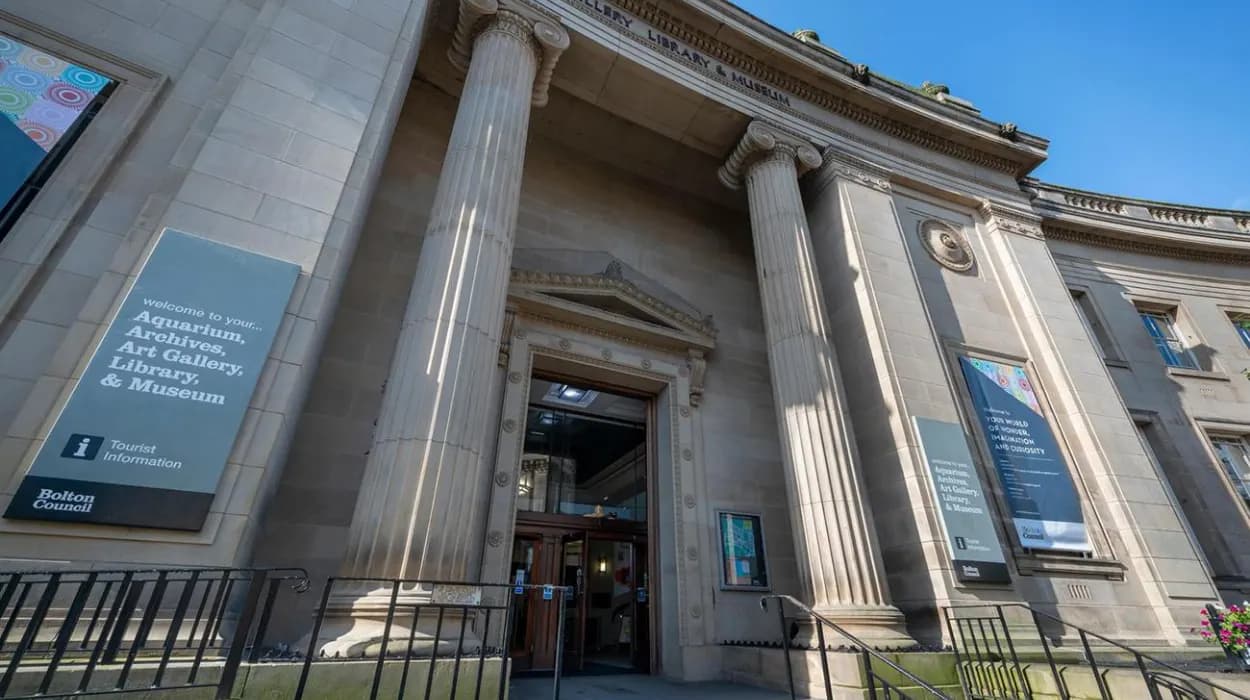
Bolton Museum and Art Gallery is the strongest starting point because it combines local history, archaeology, Egyptology, natural history and art within one central Grade II listed building, providing visitors with the broadest chronological and thematic introduction to Bolton and its wider historical connections.
Bolton Museum and Art Gallery stands on Le Mans Crescent in the centre of Bolton. It forms part of a wider cultural complex containing the Central Library, History Centre, museum galleries and aquarium. The building is Grade II listed and represents an important phase in the development of municipal cultural institutions.
The museum’s significance extends beyond local history. Its Egyptology collection contains about 15,000 ancient Egyptian artefacts, making it one of the most important Egyptology collections held by a local authority museum in the United Kingdom. The collection includes material from more than 65 sites in Egypt, with much of the archaeological material retaining provenance information.
The Egyptology collection developed through nineteenth-century connections between Bolton’s industrial community and archaeological work in Egypt. Annie Barlow, the daughter of a Bolton mill owner, was associated with the Egypt Exploration Society and helped raise funds for excavations. Finds subsequently entered the Chadwick Museum and later became part of Bolton’s Egyptology collection.
The modern “Bolton’s Egypt” gallery opened in 2018 after a £3.8 million refurbishment. The gallery has capacity for 2,000 objects and includes a full-size reproduction of the burial chamber of Thutmose III. The museum states that the wider collection includes the oldest sample of mummification in the world.
The museum also preserves material connected with Bolton itself. Local history collections document industrialisation, domestic life, social change, political development and community history. Archaeological holdings provide evidence for human activity across earlier periods, while natural history collections document the region’s biological and geological environment.
The art collection adds another historical dimension. Paintings, sculpture, decorative objects and other works demonstrate changing artistic tastes and collecting practices. The museum therefore functions as both a historical repository and an art institution.
For researchers, the adjacent History Centre provides additional resources. Bolton’s special collections include approximately 500 rare books, around 3,000 special periodicals and substantial textile and Lancashire collections. The Lancashire Collection covers social, political, environmental, industrial and economic development from the earliest periods to the present.
The museum’s educational value is particularly strong because physical objects provide evidence that complements written records. A textile sample, archaeological artefact, household object or industrial machine component can establish connections between economic history and everyday life.
Why is Smithills Hall one of the most important historical museums near Bolton?
Smithills Hall is one of North West England’s oldest and best-preserved manor houses, combining medieval architecture, Tudor additions and Victorian alterations to document changing domestic life from the fourteenth century through the nineteenth century within one surviving historic estate.
Smithills Hall stands on the edge of the West Pennine Moors. Bolton Council describes it as a Grade I listed historic house and one of the oldest and best-preserved manor houses in the North West.
The earliest phase of Smithills Hall dates from the fourteenth century. Its medieval Great Hall provides evidence of the architectural and social organisation of a substantial rural residence. Later owners expanded the building, producing a complex structure rather than a single-period monument.
A fifteenth- or sixteenth-century east wing and a late sixteenth-century west wing demonstrate the continuing adaptation of the property. Victorian owner Richard Ainsworth commissioned architect George Devey to undertake substantial improvements, including alterations to the west wing.
This architectural sequence gives Smithills Hall unusual historical value. Visitors can examine how domestic architecture changed as household expectations, wealth, technology and social structures developed.
The hall was acquired by Bolton Council in the 1930s. Conservation work allowed part of the building to open as a museum in 1963. The museum later expanded into Victorian sections during the 1990s. Further restoration has continued to protect historic rooms and architectural features.
Smithills Hall is also important for understanding the relationship between a historic building and its surrounding landscape. Bolton Council identifies Smithills Hall among the borough’s five registered parks and gardens, alongside Queen’s Park, Farnworth Park, Hulton Park and Tonge Cemetery.
The hall therefore provides more than an indoor museum visit. Its grounds form part of the heritage setting. The relationship between building, gardens and surrounding upland landscape helps explain how historic estates operated.
Current visitor arrangements should be checked before travelling. Bolton Libraries and Museums currently lists free public access on Wednesday, Thursday and Friday from 10am to 4pm and Sunday from noon to 4pm.
The hall also demonstrates the importance of conservation in preserving historic evidence. Original architectural fabric, restored interiors and surviving spatial arrangements provide researchers with evidence that cannot be obtained from documents alone.
What makes Hall i’ th’ Wood Museum important to Bolton’s industrial history?
Hall i’ th’ Wood connects Tudor domestic architecture with the Industrial Revolution because Samuel Crompton developed the Spinning Mule while living there, while the preserved house documents domestic life, furniture and material culture from earlier centuries.
Hall i' th' Wood Museum is one of Bolton’s most important historic buildings. It is a surviving Tudor timber-framed house that was originally constructed as a half-timbered hall during the early sixteenth century.
During the seventeenth century, wealthy yeomen and merchants owned the property and added a substantial Jacobean-style stone extension. The building consequently contains evidence from different architectural periods.
Its most important industrial connection is Samuel Crompton. Crompton was an eighteenth-century Bolton inventor who developed the Spinning Mule while living at Hall i’ th’ Wood. The machine combined principles associated with earlier spinning technologies and enabled the production of fine yarn on multiple spindles.
The Spinning Mule became a significant technology in the mechanisation of cotton spinning. Its development helped transform textile production and contributed to the industrial growth of Bolton and Lancashire.
The museum presents this industrial story alongside domestic history. Displays include seventeenth- and early eighteenth-century furniture, household objects and artefacts. The preserved interiors include a Lancashire kitchen, the Brownlow bedroom, oak panelling and decorative plasterwork.
The building also demonstrates how industrial history developed within ordinary residential environments. Industrial innovation did not occur only inside purpose-built factories. Inventors, skilled workers and manufacturers lived within houses and communities that were connected to the wider textile economy.
William Hesketh Lever, later Lord Leverhulme, purchased Hall i’ th’ Wood in 1899. He financed its restoration and presented the property to Bolton Corporation in 1902. The museum was established as a memorial to Samuel Crompton and his contribution to Bolton’s textile industry.
The preservation story is significant because the building had deteriorated before Lever’s intervention. The restoration converted a threatened historic structure into a public heritage site.
Hall i’ th’ Wood is currently closed for essential maintenance according to Bolton Libraries and Museums. Its future reopening should therefore be checked through the official museum service before a holiday itinerary is finalised.
For visitors interested in industrial history, the building remains essential even when access is temporarily restricted because its historical significance is directly connected with the development of mechanised cotton spinning.
Where can visitors explore Bolton’s textile and steam-engine heritage?
Bolton Steam Museum preserves stationary steam engines that once powered textile mills across northern England, providing direct evidence of the mechanical systems behind Lancashire’s industrial economy and showing how engineering technology supported large-scale cotton production.
Bolton Steam Museum provides a specialised form of industrial history. It is operated by the Northern Mill Engine Society, a registered charity established in 1966 to preserve stationary steam engines associated particularly with northern textile production.
The Northern Mill Engine Society emerged when textile mills were closing and historic machinery was being dismantled or scrapped. Its preservation programme focused on rescuing engines before industrial sites disappeared.
The original museum opened at Atlas Mills in 1983. The collection later faced relocation when the former mill complex was redeveloped. The engines were dismantled and transferred to a nineteenth-century cotton warehouse on the site. The museum subsequently reopened in its new location.
The collection contains around 30 steam engines according to heritage visitor information, while the Charity Commission currently describes a collection of some 29 steam engines. The difference reflects changing collection records rather than a different historical purpose.
The machines demonstrate the engineering systems that powered textile production. Stationary steam engines converted energy from steam into mechanical motion. That motion drove machinery through shafts, belts and related transmission systems across mill buildings.
Several engines have particularly strong regional connections. The collection includes a unique non-dead-centre vertical engine built by Musgraves of Bolton, as well as beam engines and compound engines associated with northern industrial production.
The museum’s value extends beyond engineering. Textile mills were major economic institutions in Lancashire. Their machinery affected employment, urban growth, transport, housing, working conditions and patterns of migration.
The Atlas Mills setting is itself historically significant. The former complex was a large spinning operation associated with the scale of Lancashire’s nineteenth- and twentieth-century textile economy. The preserved machinery provides physical evidence of an industrial system that once dominated Bolton’s economic geography.
Steam days are particularly important because the engines can operate rather than remain static exhibits. Operating machinery demonstrates movement, mechanical coordination and the relationship between engine power and industrial production.
The museum is therefore especially valuable for visitors studying the Industrial Revolution, textile engineering, industrial archaeology or the decline of Lancashire’s cotton industry.
Which heritage centre is best for researching Horwich and local family history?
Horwich Heritage Centre is the strongest specialist destination for Horwich history because its volunteer-led collection documents the locomotive works, local industries, transport, wartime experiences, domestic life and family history through exhibitions, photographs, archives and community research.
Horwich Heritage Centre provides a more community-focused historical experience. Horwich Heritage was formed in 1985 after public meetings responding to the closure of Horwich Locomotive Works the previous year.
The original Heritage Centre opened within Horwich Resource Centre in 1995. The organisation moved into its current premises in 2006. Horwich Town Council records that the expanded centre received more than £100,000 from Big Lottery funding and approximately £50,000 from Horwich Town Council resources.
The centre concentrates on Horwich rather than attempting to represent the entire history of Bolton. Its displays include material concerning Horwich Locomotive Works, Victorian domestic life, local industry, transport and the Second World War.
Horwich Locomotive Works is particularly important. Established as a major railway engineering complex, it became central to Horwich’s industrial identity. The closure of the works in the 1980s represented a major economic and social transition for the town.
The Heritage Centre also supports family-history research. Its resources and volunteers provide a useful starting point for genealogical researchers investigating Horwich families, occupations, workplaces and community connections.
Its community-based collecting model is historically significant. Museums are not dependent only on government archives or large archaeological collections. Photographs, household objects, oral memories and locally produced records also preserve evidence of everyday life.
The centre’s 2026 programme illustrates this continuing role. Exhibitions include Rivington Pike during June to August, the 20th anniversary of the Heritage Centre from September to November, and the Mechanics Institute from November 2026 into February 2027.
Opening hours currently listed by the centre are Monday to Friday from 2pm to 4pm and Saturday from 10am to 12.30pm. Admission is free. Group visits can also be arranged.
For genealogical research, visitors should treat the centre as a specialist local-history resource rather than a replacement for formal civil registration or archival research. Its strength lies in local context, community knowledge and material relating specifically to Horwich.
How should a history enthusiast plan a museum holiday in Bolton?
A productive Bolton history itinerary should begin with the central museum, continue to Smithills Hall and Hall i’ th’ Wood for historic architecture, and then explore specialist industrial or community collections such as Bolton Steam Museum and Horwich Heritage Centre.
Bolton’s museums represent different historical scales. Bolton Museum and Art Gallery provides the widest chronological coverage. Smithills Hall concentrates on elite domestic architecture and estate history. Hall i’ th’ Wood connects domestic history with textile invention. Bolton Steam Museum documents industrial engineering. Horwich Heritage Centre focuses on community and industrial memory.
This distribution makes Bolton suitable for several types of historical research. A visitor studying ancient civilisations can begin with the Egyptology collection. A student examining the Industrial Revolution can compare Hall i’ th’ Wood, Bolton Steam Museum and local textile collections. A genealogist researching nineteenth- and twentieth-century Bolton can combine museum evidence with the History Centre and local studies resources.
The borough’s history also demonstrates the relationship between industrialisation and civic investment. Bolton’s nineteenth-century economic expansion produced wealth, institutions and collecting networks. The Chadwick Museum developed during this period, while later municipal investment created larger museum and library facilities.
The present museum network reflects another historical process: preservation after industrial decline. Buildings and machines that once served economic purposes became heritage assets. Hall i’ th’ Wood became a museum after restoration. Steam engines were rescued from threatened mill sites. Horwich Heritage developed after the closure of a major railway works.
To experience this historic landscape in person today, consult our comprehensive [Origins of Bolton's Museums and Their Collections] for itineraries and visiting parameters.
The relationship between museums and preservation is particularly important in Bolton because many historical sources are dispersed. A museum object preserves physical evidence. An archive preserves documentary evidence. A historic building preserves architectural evidence. A heritage centre preserves community memory. Together, these sources provide a stronger historical record than any single institution.
Bolton Council’s collections policy identifies fine and decorative art, Egyptology, local history, archaeology, natural history and archives among the principal museum holdings. The same policy records the historical importance of the Chadwick Museum, which opened in 1884 and developed beyond its original natural-history purpose.
The scale of Bolton’s cultural tourism also demonstrates the public importance of these institutions. In 2016, Bolton recorded 6.6 million visitors and £431.8 million in tourism-related economic impact. Bolton Museum, Aquarium and Archive ranked among Greater Manchester’s ten most visited attractions at that time.
For educators, museums provide opportunities to connect curriculum themes with physical evidence. Industrial history becomes visible through machinery. Architectural history becomes measurable through surviving structures. Archaeology becomes tangible through excavated objects. Social history becomes accessible through domestic artefacts, photographs and personal records.
For heritage preservationists, the museums demonstrate several preservation mechanisms. These include acquisition, documentation, conservation, restoration, interpretation and public access. Each mechanism protects a different part of the historical record.
For genealogists, the most useful approach is to connect museum evidence with archival research. Bolton’s special collections include textile literature, Lancashire material, rare books and historic periodicals. Access to sensitive or fragile material is supervised through the Bolton History Centre.
Bolton’s museums also retain future historical relevance. Industrial buildings continue to be redeveloped, local communities change and physical objects become increasingly rare. Preserving representative machinery, documents, domestic objects and buildings ensures that future researchers can examine evidence from periods that otherwise survive mainly through photographs and written accounts.
The most effective holiday therefore treats Bolton as a connected historical landscape rather than a collection of isolated attractions. The central museum establishes the broad chronology. Smithills Hall provides medieval and later architectural evidence. Hall i’ th’ Wood links domestic life to textile invention. Bolton Steam Museum demonstrates industrial power systems. Horwich Heritage Centre records the community history of a major railway and engineering town.
Together, these institutions document the transformation of Bolton from a historic Lancashire settlement into a major textile and engineering centre and then into a modern metropolitan borough whose heritage remains visible through collections, buildings, archives and community-led preservation.
For a history enthusiast, that continuity is the central reason to include Bolton’s museums on a cultural holiday. The surviving evidence covers ancient Egypt, archaeology, medieval architecture, Tudor domestic life, eighteenth-century invention, Victorian industrialisation, railway engineering, twentieth-century social history and contemporary heritage preservation.
The result is a museum landscape with both national and local significance. Bolton’s Egyptology collection provides international archaeological context. Smithills Hall and Hall i’ th’ Wood preserve nationally significant historic buildings. Bolton Steam Museum protects industrial engineering heritage. Horwich Heritage Centre preserves community memory and specialist local research.
A visit to these institutions therefore provides a structured way to understand how people, buildings, industries and communities shaped Bolton across centuries. The historical record is preserved not only in written archives but also in the physical objects, machinery, rooms and landscapes that remain accessible today.
FAQS
What is the best museum to visit in Bolton?
Bolton Museum and Art Gallery is the best starting point for most visitors because it covers local history, archaeology, Egyptology, natural history, art and decorative collections in one central location.