Bolton’s museums developed from the nineteenth-century expansion of public education, scientific collecting, civic reform and philanthropy. Their origins predate the construction of a dedicated museum building. The earliest institutional foundation came through Bolton’s free library movement, which began in 1852 after the town adopted the Libraries Act.
The history of Bolton Museum therefore begins with a broader civic programme. The library became a place where residents could access knowledge and encounter specimens. Natural history material entered the collection alongside books. The first item recorded in the library register was a small collection of fossils rather than a book.
This early collecting activity established the principle that a municipal cultural institution could preserve physical evidence as well as written information. Over subsequent decades, Bolton developed dedicated museum buildings, professional curatorial practices and increasingly specialised collections.
The most important early milestone came with the Chadwick Museum in Queen’s Park. It opened on 12 June 1884 and became Bolton’s first purpose-built museum. Its foundation depended on a £5,000 bequest from local physician and philanthropist Samuel Taylor Chadwick.
The museum initially emphasised natural history. Its collections soon expanded into archaeology, Egyptology, anthropology, industrial technology and other subjects. The development reflected Bolton’s position as a major Lancashire textile centre and the growing nineteenth-century interest in science, archaeology and public education.
The present Bolton Museum on Le Mans Crescent represents a later stage of this institutional development. The civic centre was designed by Bolton architectural practice Bradshaw, Gass and Hope between 1931 and 1939. The Second World War delayed the fitting out of the museum, and the building eventually opened to the public in October 1947.
Today, Bolton’s collections extend from Egyptian archaeology and fine art to botany, zoology, geology, decorative art, social history and industrial heritage. The collection is therefore both local and international. It records Bolton’s own development while also preserving evidence from cultures and environments far beyond Lancashire.
When did Bolton’s museum tradition begin?
Bolton’s museum tradition began with a library established in 1852 after the town adopted the Libraries Act. Natural science specimens entered its holdings. The Chadwick Museum opened in Queen’s Park in 1884, creating Bolton’s first museum and expanding civic collecting.
The year 1852 provides the earliest clear institutional starting point for Bolton’s modern museum history. Following adoption of the Libraries Act, Bolton established a free public library in Victoria Square. The institution was designed to make knowledge accessible beyond private collections and subscription-based organisations.
The library quickly became more than a repository for printed material. Its collections included specimens associated with natural science and ethnography. This development was significant because Victorian museums increasingly used physical objects to support public education.
A fossil collection held by the early library illustrates this transition. Bolton’s museum history records that the first item in the library register was a “small collection of fossils.”
The collecting of fossils introduced a scientific dimension to the institution. Fossils provided evidence for geological study, while other natural-history specimens supported the classification of plants, animals and minerals.
This approach reflected a wider nineteenth-century movement. Industrial towns established libraries, mechanics’ institutes, museums and educational societies as part of civic improvement. Bolton’s growing population and industrial economy created demand for institutions that supported technical knowledge and general education.
The early collections also established an important principle that remained central to Bolton’s museums: objects could provide evidence. A fossil documented geological history. A textile sample documented manufacturing technology. An archaeological object documented an ancient society. A painting documented artistic practice or a local landscape.
This principle eventually produced a much larger and more systematic collecting programme.
Why was the Chadwick Museum created in Queen’s Park?
Bolton’s early museums developed during rapid industrial growth, when cotton manufacturing, civic reform, public education, and philanthropy shaped the town. The museum movement provided structured access to natural history, archaeology, industry, art, and world cultures for an expanding urban population.
The Chadwick Museum emerged from this Victorian civic environment. Samuel Taylor Chadwick was a local medical doctor and philanthropist whose interests included public welfare and education. When he died in 1876, he left a £5,000 bequest to Bolton Corporation for the construction, furnishing and maintenance of a museum of natural history.
The bequest contained specific conditions. The museum had to provide free entry, and construction had to begin within four years. Bolton Corporation accepted the money and began construction in 1878.
The museum was built in Queen’s Park, one of Bolton’s important Victorian public spaces. The location connected cultural education with public recreation and civic improvement.
Sir Benjamin Alfred Dobson played an important administrative role in the project. Dobson belonged to the family associated with Dobson and Barlow, a major Bolton manufacturer of textile machinery. He chaired the committee overseeing the museum and supported the development of its collections.
The foundation stone was laid on 27 June 1878. The completed Chadwick Museum opened to the public on 12 June 1884. Benjamin Alfred Dobson formally opened the museum.
The building contained three principal levels with collections arranged by subject. Minerals, rocks and fossils occupied the basement. Zoological material, including taxidermied birds and animals, nests, eggs, shells and insects, occupied the ground floor. Anthropology, Egyptology, antiquities and a room of curiosities occupied the upper level.
This arrangement demonstrates the intellectual structure of the Victorian museum. Natural objects were arranged according to scientific disciplines. Human-made objects were placed within anthropology, archaeology and antiquities. Visitors therefore encountered an organised progression from geological material through living nature to human culture.
The Chadwick Museum became the institutional centre for Bolton’s expanding collections.
Who were the people responsible for Bolton’s early museum collections?
Samuel Taylor Chadwick funded Bolton’s first purpose-built museum through a £5,000 bequest in 1876. Sir Benjamin Alfred Dobson supervised its development, while William Midgley became the first professional curator in 1883. Their philanthropy, administration, and collecting transformed Bolton’s museum foundations.
Chadwick established the financial foundation. His £5,000 bequest created the capital needed for the museum building and its initial development. His earlier philanthropy included support for the Chadwick Orphanage and other public welfare initiatives.
Dobson provided organisational leadership. His involvement extended beyond the construction project. He donated objects and facilitated donations from other collectors and industrialists.
William Waller Midgley became particularly important because he introduced professional curatorial practice. Bolton Corporation appointed him in 1883, before the Chadwick Museum opened. His responsibility was to organise the museum displays using collections that had previously accumulated through the library and private donations.
Thomas Midgley, William’s son, later succeeded him. William served as curator from 1883 to 1906, while Thomas served from 1906 to 1934. The father-and-son curatorial partnership lasted more than five decades.
William Midgley expanded the museum beyond its original natural-history emphasis. His collecting interests included Egyptian antiquities, textile machinery and textile samples. His knowledge of textiles was particularly important because Bolton’s industrial economy was centred on cotton manufacturing.
The Midgleys also helped create the research value of the collections. Objects were not simply accumulated for display. Specimens were classified, documented and interpreted within specialist fields.
Their work established a professional model for municipal collecting. Museum collections required curators, records, storage, conservation and systematic acquisition. This model remains fundamental to modern museums.
The growth of Bolton’s collections also depended on networks beyond the town. Archaeological societies, scientific organisations, industrialists, private collectors and individual donors contributed material. These networks explain why a local authority museum in Lancashire developed collections of international significance.
How did Bolton’s museum collections grow beyond natural history?
Bolton’s collections grew through systematic collecting, private donations, archaeological distributions, scientific fieldwork, and industrial expertise. William and Thomas Midgley expanded natural history into Egyptology, textiles, machinery, and ethnography. Manufacturers, researchers, collectors, and societies supplied objects with educational and research value.
The expansion followed Bolton’s economic and intellectual development. Natural history remained important, but the museum increasingly documented human activity.
Industrial collections reflected Bolton’s role in cotton manufacturing. Textile machinery, textile samples and related material preserved evidence of manufacturing processes. Such objects provide information about technology, labour, design and industrial development.
The museum also collected archaeological material. Egyptology became the most internationally recognised part of the collection, but archaeology formed part of a broader interest in human cultures and material evidence.
The Midgleys played an important role in this expansion. Both William and Thomas specialised in ancient textiles. Their expertise allowed the museum to participate in archaeological research and to evaluate textile material recovered during excavations in Egypt.
The museum also received objects through donations. Private collectors could transfer material into a public institution where it became available for research and education. This process transformed personal collections into public heritage resources.
Scientific collecting created another major strand. The botanical collection now contains about 60,000 specimens, most consisting of herbarium material pressed and mounted on sheets or dried and stored in packets.
The palaeontology collection contains approximately 15,000 specimens, predominantly British in origin. It includes material representing different geological horizons and localities. The collection also contains scientifically important groups, including specimens associated with the George Vine collection and cave material from Derbyshire.
Mineralogy provides another scientific component. Bolton’s collections policy records approximately 4,000 mineral specimens. These reference collections support identification, comparison and research.
Fine art became another major collecting field. Bolton Museum now holds more than 3,500 fine-art items, with most works produced by British artists from the eighteenth century to the present.
Decorative art also forms part of the holdings. The collection includes around 100 contemporary ceramics dating from the 1970s to the mid-1990s and about 150 Japanese netsuke, inro and scent bottles bequeathed in 1959.
These examples show that Bolton’s museum collections developed through multiple acquisition mechanisms rather than a single founding donation.
Why is Egyptology central to the origins of Bolton Museum?
Bolton’s Egyptology collection became nationally important through nineteenth-century links between Lancashire’s textile industry and archaeological excavation. Annie Barlow supported the Egypt Exploration Society and donated Egyptian finds to Chadwick Museum. Today, about 12,000 objects from 65 Egyptian sites remain documented.
The origins of Bolton’s Egyptology collection are closely connected with the Egypt Exploration Society. Amelia Edwards founded the society in 1882 after travelling in Egypt and campaigning for the recording and preservation of Egyptian heritage.
Annie Barlow became Bolton’s key connection with the organisation. She belonged to a prominent local industrial family. Her father, James Barlow, was associated with the Barlow and Jones cotton business. Annie supported archaeological excavation by raising funds for the Egypt Exploration Society.
Barlow’s support resulted in Egyptian archaeological material reaching Bolton. Finds distributed through the Egypt Exploration Society entered the Chadwick Museum and became part of the growing collection.
The connection was strengthened by Bolton’s industrial expertise. The town’s textile economy created local knowledge about fibres, weaving and textile production. William and Thomas Midgley were specialists in ancient textiles and contributed their expertise to the study of Egyptian archaeological material.
Bolton Museum’s current Egyptology collection contains around 12,000 objects from more than 65 sites in Egypt. The material represents Egyptian history from the Neolithic period, around 5,000 BC, through the Arab period from the seventh century AD onwards.
A significant proportion of the objects were excavated rather than purchased as isolated antiquities. This distinction is important because excavated material often retains archaeological provenance. Bolton Museum states that the majority of its Egyptian objects retain full provenance information, increasing their value for research and interpretation.
The collection includes textiles, papyri, pottery, jewellery, funerary objects, sculpture and other archaeological material. Textiles form a particular strength.
The museum also supported archaeological work beyond Egypt Exploration Society excavations. Its records identify links with the British School of Archaeology in Egypt and the British Museum, as well as donations from institutions including the Petrie Museum and Wellcome Trust.
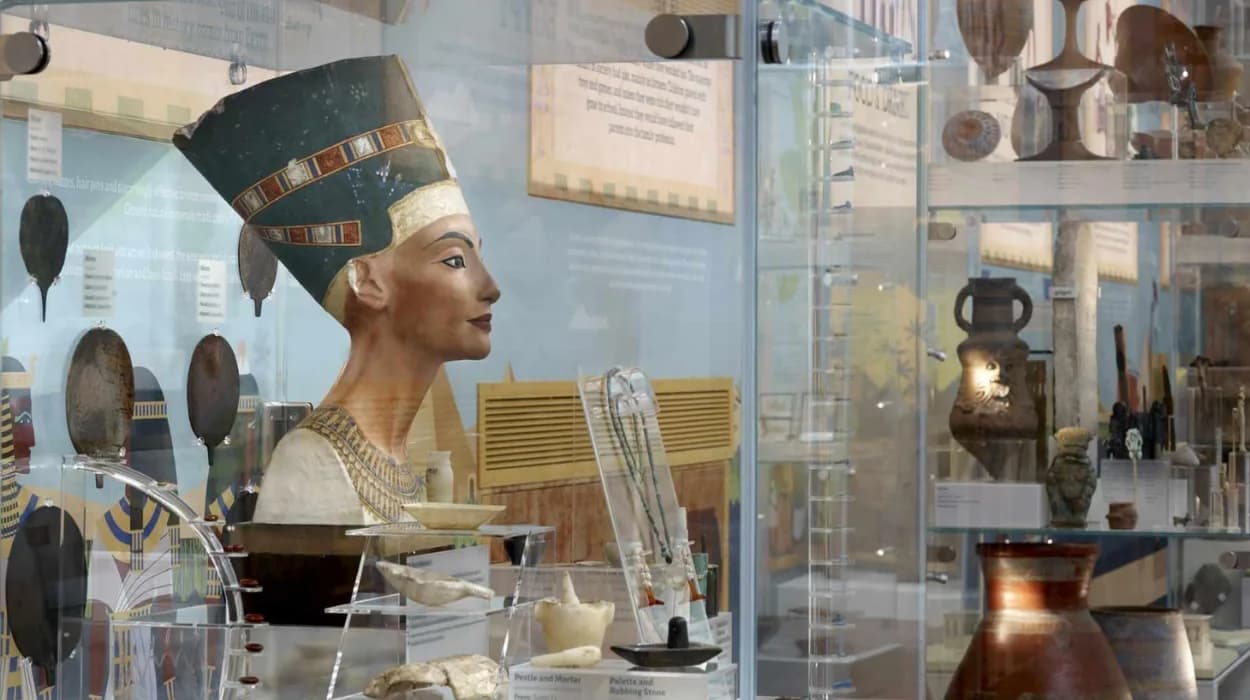
The importance of the collection continued into the twenty-first century. In 2018, Bolton Museum reopened after a £3.8 million refurbishment. The new Bolton’s Egypt gallery provided display space for more than 2,000 objects from the wider collection.
The gallery includes a full-scale reproduction of the burial chamber of Pharaoh Thutmose III. The replica provides an interpretation of ancient Egyptian funerary architecture while protecting the original archaeological material from unnecessary exposure.
The museum’s Egyptian collection therefore represents more than a group of ancient objects. It documents the relationship between Victorian philanthropy, Lancashire industry, archaeological excavation, professional museum practice and international scholarly networks.
How did Le Mans Crescent change the development of Bolton Museum?
Bolton’s museum collections eventually required a larger civic building. Le Mans Crescent was designed by Bradshaw, Gass and Hope as part of a 1931–1939 civic centre. Wartime disruption delayed museum opening until 1947, when collections were reorganised across new galleries.
The Chadwick Museum served Bolton for more than seven decades, but its building became inadequate for the growing collections. By the late 1930s, the town required a larger museum with modern exhibition facilities.
Le Mans Crescent formed part of a major civic development. The complex was designed by Bolton architectural practice Bradshaw, Gass and Hope for Bolton Borough Council between 1931 and 1939. Historic England lists the Civic Centre as a Grade II listed building.
The architectural complex included the library, museum, art gallery, magistrates’ court and central police station. Its design created a formal civic setting around Bolton Town Hall.
The museum component was intended to provide substantially more space than the Chadwick building. Construction began before the Second World War, but wartime conditions disrupted the project.
The building did not open as a public museum until October 1947. The official opening took place on Saturday 18 October, with public access beginning on Monday 20 October.
The original post-war arrangement divided the collections between the new museum and the older Chadwick Museum. Natural history and art were initially displayed at Le Mans Crescent, while Egyptian, industrial and local-history material remained at Chadwick Museum.
This arrangement did not last permanently. The Chadwick building deteriorated and required substantial repairs. In 1956, the council concluded that repair and renovation would cost too much, and the building was demolished.
The Egyptian collection subsequently moved into the central museum. Industrial collections were displayed temporarily at Tonge Moor Library. The demolition ended the physical existence of the building that had housed Bolton’s first purpose-built museum.
The surviving collections, however, preserved the intellectual legacy of Chadwick Museum.
Le Mans Crescent remains the principal home of Bolton Museum and Art Gallery. The building continues to combine museum, library and civic functions. Its Grade II listing recognises the architectural and historical importance of the civic ensemble.
The building also provides an example of how municipal museums changed during the twentieth century. The institution moved from a Victorian museum organised around scientific classification to a modern civic museum with dedicated galleries for art, history, archaeology and natural history.
What collections preserve Bolton’s industrial and social history?
Bolton’s museum collections now connect local history with international archaeology, fine art, botany, zoology, geology, decorative art, social history, and industrial heritage. The holdings preserve evidence of Bolton’s people, landscapes, industries, scientific interests, cultural relationships, and patterns of public collecting.
Local history is central to the museum’s identity. Bolton’s industrial heritage strongly influenced the development of its people, landscape and economy. The collections therefore preserve evidence of manufacturing, employment, technology and everyday life.
Textile material is particularly important. Bolton’s cotton industry shaped the town during the Industrial Revolution, and the museum’s collections preserve examples of machinery, textiles and related technology.
Social history collections extend the record beyond industrial production. Domestic objects, photographs, documents and personal material provide evidence about how residents lived and how communities changed.
The museum also holds material connected with the Mass Observation project. During the late 1930s, observers documented everyday life in Bolton, which became known as “Worktown.” The project recorded working life, leisure, public behaviour and social conditions through photographs, paintings, sketches and written observations.
Bolton’s Worktown collection contains more than 1,000 photographs and artworks associated with observers including Humphrey Spender, Humphrey Jennings and Julian Trevelyan. In 2017, the museum acquired Trevelyan’s 1937 artwork Bolton, which depicts an industrial mill scene.
This material has particular research value because it records ordinary social life rather than only major civic events. It provides visual evidence of working-class communities, industrial environments and public spaces during the interwar period.
The museum’s architectural archive adds another layer. In 2022, Bolton Library and Museum Service acquired the archive of Bradshaw Gass & Hope. The archive covers the practice’s work from its foundation in 1862 through the 1960s and contains several thousand architectural commissions.
The archive provides evidence for the architectural development of Bolton and other places. It includes drawings, correspondence and material associated with the practice’s commissions.
The museum and archive collections therefore operate together. Objects document physical life. Photographs document people and places. Architectural drawings document buildings. Written records document institutions and decisions.
For genealogical researchers, these resources are especially relevant because local collections can provide contextual evidence surrounding individual families. Museum objects, photographs, local studies material and archival records can help explain occupations, neighbourhoods, industries and social networks.
The History Centre provides access to archive collections and reference material, including family-history resources and specialist collections.
Bolton’s special collections also include approximately 500 rare books, around 3,000 special periodicals, textile-related publications and a Lancashire Collection covering social, political, environmental, industrial and economic development from the earliest periods to the present.
These resources expand the meaning of a museum collection. Heritage preservation is not limited to objects placed inside glass cases. It also includes documents, photographs, books, scientific specimens, architectural records and material evidence.
How are Bolton’s original museum collections preserved today?
Bolton’s museum history remains important because its collections document how a nineteenth-century industrial town built cultural institutions through legislation, philanthropy, professional curation, scientific collecting, and civic investment. The surviving collections provide primary evidence for research, education, conservation, and local identity.
The original Chadwick Museum building no longer survives, but many of the collections created within it remain part of Bolton Museum’s holdings.
This continuity is especially clear in the Egyptology collection. Objects acquired through nineteenth-century archaeological networks remain available for research and public interpretation. The current collection includes approximately 12,000 Egyptian objects with material from more than 65 sites.
Natural-history collections provide another direct connection with the nineteenth-century museum. Botanical specimens, fossils and minerals continue to serve as reference material.
The botanical collection contains about 60,000 specimens. The palaeontology collection contains approximately 15,000 specimens, while mineralogy includes around 4,000 specimens.
These collections have scientific value because they preserve physical specimens that can be compared, identified and studied over long periods.
Museum preservation also involves controlled access and conservation. Objects are stored under conditions designed to reduce physical deterioration. Fragile materials such as textiles, paper, biological specimens and archaeological objects require specialist handling.
Recent acquisitions demonstrate that collecting did not end with the Victorian period. Bolton Council’s 2024–25 statement of accounts records 50 museum-object donations during the financial year. The acquisitions included an England international football cap awarded to Nat Lofthouse in 1955 and a painting of Dean Mills, Barrow Bridge, dating from 1790.
The same report records the purchase of an Egyptian block statue for £12,000, supported by a grant from the Bradshaw Gass & Hope Trust.
These acquisitions demonstrate the continuing development of the collections. Modern collecting adds evidence that future researchers will use to understand contemporary and earlier Bolton.
The museum also continues to reinterpret older material. The 2018 refurbishment created new galleries for Bolton’s Egypt, Bolton’s Art and Bolton’s Nature. The Egypt gallery incorporated more than 2,000 objects from the wider Egyptology collection.
The museum’s approach therefore combines preservation with interpretation. Collections remain protected while selected objects are placed within new historical and educational contexts.
To experience this historic museum legacy in person today, consult our comprehensive [Best Museums in Bolton Every History Enthusiast Should Visit During Their Holiday] for itineraries and visiting parameters.
What is the long-term historical significance of Bolton’s museums?
Bolton’s museums demonstrate how municipal collecting transformed an industrial town’s physical evidence into public heritage. Their collections preserve scientific specimens, archaeological objects, artworks, industrial technology, photographs, documents, and social-history material that support research across generations.
The origins of Bolton’s museums show a clear institutional progression.
The first stage began with the free library and its natural-science specimens in 1852. The second stage came with the Chadwick Museum, funded by Samuel Taylor Chadwick and opened in 1884. The third stage involved professional curators such as William and Thomas Midgley and the rapid expansion of specialised collections.
The fourth stage involved the construction of the Le Mans Crescent civic centre and the relocation of major museum functions after 1947. The fifth stage is the modern museum, which combines permanent collections, temporary exhibitions, digital interpretation, conservation and research.
Each stage added a different layer to Bolton’s cultural infrastructure.
The museum’s Egyptology collection demonstrates how local industrial wealth became connected with international archaeology. The natural-history collections demonstrate how Victorian scientific interests produced long-term research resources. The industrial collections document Bolton’s manufacturing economy. The Worktown material records everyday social life. Fine art collections document British artistic production. Architectural archives preserve evidence of the town’s built environment.
The collections also demonstrate the importance of provenance. Provenance identifies where an object came from, how it was excavated or acquired, and how it entered a museum. Bolton’s Egyptology collection is particularly valuable because most objects retain archaeological provenance.
This evidence supports academic research. Archaeologists can examine excavated material. Historians can study industrial objects. Botanists can examine herbarium specimens. Art historians can analyse paintings. Social historians can interpret photographs and personal objects. Genealogists can use archives and local-history resources to reconstruct family and community contexts.
The museum also remains an educational institution. Its galleries connect physical objects with historical explanations. This makes complex subjects accessible to school groups, university students, researchers and general visitors.
The preservation of the collections has long-term implications for Bolton’s heritage. The Chadwick Museum itself disappeared in 1956, but the objects collected there continue to survive. The building was temporary; the collections became enduring historical evidence.
The same principle applies to contemporary collecting. Objects acquired today document modern life for future researchers. The 1955 Nat Lofthouse football cap, for example, connects sport, celebrity, local identity and twentieth-century popular culture. The Bradshaw Gass & Hope architectural archive connects drawings and professional records with the physical development of Bolton.
Bolton’s museums therefore represent a continuous process rather than a single founding event. The institutional history began with civic education in 1852, developed through the Chadwick Museum in 1884, expanded through professional curators and international archaeological networks, and moved into the Le Mans Crescent civic complex after the Second World War.
The surviving collections provide the strongest link between these periods. They preserve physical evidence of Bolton’s scientific interests, industrial economy, cultural relationships and social history.
For history enthusiasts, the collections explain how Bolton developed from a nineteenth-century industrial town into a modern cultural centre. For educators, they provide primary material for teaching local and global history. For researchers, they offer specimens, artefacts, artworks, archives and documented provenance.
The origins of Bolton’s museums are therefore also the origins of a long-term public record. Their collections preserve evidence that cannot be reconstructed solely from written histories. They document objects, materials, environments, technologies and human activity.
The continuing significance of Bolton Museum rests on this accumulated evidence. The institution preserves the results of more than 170 years of civic collecting, beginning with the fossil specimens associated with the 1852 library and continuing through modern acquisitions, conservation projects and exhibitions.
That historical continuity explains why Bolton’s museums remain an important part of the town’s heritage infrastructure. The buildings have changed, the galleries have changed and collecting priorities have changed, but the central purpose remains consistent: preserving physical evidence so that Bolton’s history can be examined, interpreted and understood by future generations.
FAQS
When did Bolton's museum history begin?
Bolton’s museum history began in 1852, when the town established a free public library after adopting the Libraries Act. The library’s holdings included natural-history material, including a recorded collection of fossils.