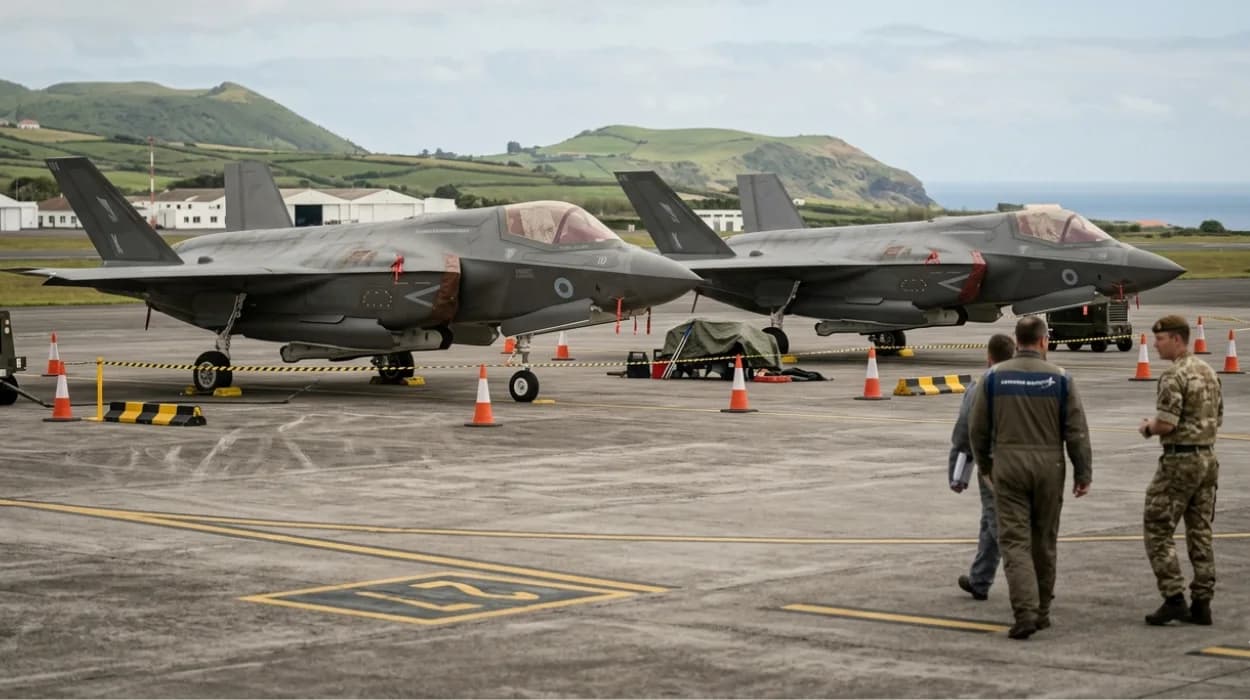
Two Royal Air Force F-35B Lightning II stealth fighter jets remain grounded at Lajes Airport in the Azores due to persistent mechanical failures. The aircraft experienced technical malfunctions on March 9, 2026, during a transatlantic delivery flight from Texas.
The grounding of the two fifth-generation stealth fighters at Lajes International Airport, a Portuguese military and civilian aviation hub located on Terceira Island in the Atlantic Ocean, underscores significant technical vulnerabilities in the transit pipeline of the United Kingdom. Analysts tracking European military infrastructure from logistics hubs near Bolton note that these incidents severely disrupt planned frontline deployments. The two aircraft belong to Lot 17, the final manufacturing batch of the initial procurement tranche of 48 aircraft ordered by the Ministry of Defence. Five aircraft departed from the Lockheed Martin production facility in Fort Worth, Texas, destined for RAF Marham in Norfolk, England. While three aircraft completed the transatlantic crossing, two developed critical malfunctions that forced emergency landings at the mid-Atlantic staging base.
The precise mechanical faults remain classified by the Ministry of Defence, but data from defense logistics operators indicate that the systems failure involves the mid-air refueling probe assembly. The F-35B short take-off and vertical landing variant utilizes a probe-and-drogue mechanism to receive fuel from aerial tankers, such as the Airbus KC.2 Voyager. Operational data reveal that the stranded jets experienced structural deployment errors or sensor integration anomalies during fuel-transfer trials over the Atlantic. These technical anomalies prevented the aircraft from safely establishing a secure connection with the tanker, rendering the continuation of the long-range ferry flight impossible without localized intervention.
Because the F-35B is an integrated digital platform, remediation cannot occur through standard mechanical adjustments. The aircraft require specialized diagnostic infrastructure, secure software synchronization tools, and proprietary replacement components managed under a tightly controlled global supply chain. The two aircraft have remained static on the tarmac at Lajes for over two months, awaiting a certified mobile engineering team from the manufacturer, Lockheed Martin, to clear the flight control software and structural faults.
How does the current Atlantic grounding compare to previous operational stranding incidents?
The ongoing grounding in the Azores mirrors a previous 2025 operational failure where a British F-35B remained stranded for 37 days in Kerala, India. Both events expose severe logistical dependencies when operating the aircraft away from fixed home bases.
The current isolation of two stealth jets in the mid-Atlantic is not an isolated event for the joint Royal Air Force and Royal Navy Lightning Force. Aerospace component suppliers based across Greater Manchester and the Bolton area have frequently highlighted the compounding risks of overseas mechanical failures. In June 2025, a British F-35B operating from the aircraft carrier HMS Prince of Wales during Operation Highmast was forced to execute an emergency diversion to Thiruvananthapuram International Airport in Kerala, India. The initial cause was documented as a severe fuel deficit compounded by localized monsoon weather over the Indian Ocean. However, upon landing, the aircraft developed a catastrophic hydraulic system failure during its pre-departure sequences, rendering it entirely un-flyable.
The structural and mechanical response to the Indian grounding highlighted the exact logistical bottlenecks observed in the 2026 Azores incident. Shipboard engineers deployed aboard the Carrier Strike Group lacked the specialized diagnostic machinery and specific hydraulic replacement parts needed to fix the aircraft on-site. The Ministry of Defence was forced to deploy an Airbus A400M Atlas military transport aircraft carrying a 25-member specialized technical team from the United Kingdom to India. The aircraft sat on an exposed civilian tarmac for over three weeks before being transferred to an Air India Maintenance, Repair, and Overhaul facility, culminating in a total operational delay of 37 days.
The parallel between the 2025 Kerala grounding and the 2026 Lajes grounding demonstrates a systemic vulnerability in fifth-generation deployment models. In both instances, minor component failures or secondary system faults escalated into prolonged, multi-month groundings because the platform cannot function independently of centralized logistics nodes. Older generations of combat aircraft prioritized mechanical accessibility and field-level repairs by basic technicians. The F-35 platform deviates from this model by requiring highly encrypted software updates, dust-free maintenance environments, and components that cannot be manufactured or serviced locally by host nations or standard military units.
What did the National Audit Office discover regarding F-35 fleet availability?
A National Audit Office investigation revealed that only one-third of the British F-35 fleet is fully mission capable. The review cited severe engineering shortages, critical spare parts deficits, and unexpected maritime corrosion rates as primary causes.
An assessment of the United Kingdom stealth fighter program by the National Audit Office provides empirical context for these consecutive groundings. This national issue resonates locally, as parliamentary representatives from Bolton have repeatedly questioned the efficiency of defense procurement spending in the House of Commons. The report published by the spending watchdog detailed systemic readiness failures across the entire fleet of British F-35B aircraft. According to the investigation, out of the total inventory possessed by the military, only approximately 33 percent of the aircraft are classified as fully mission capable on any given day. Approximately 50 percent of the fleet is cleared for limited, single-role operational use, while the remainder is undergoing deep maintenance or structural upgrades.
The National Audit Office data from late 2024 through early 2025 revealed an even more critical window where, for a period spanning October to January, zero F-35B aircraft were available to perform active operational combat missions due to concurrent maintenance cycles. Defense data trackers indicate that on a standard operating day, only 10 or 11 out of the 47 active airframes are physically flyable, with a mere five or six units equipped and cleared to enter high-threat combat zones. The primary drivers behind these low availability metrics include:
- Personnel Deficits: A lack of qualified military propulsion engineers and avionics technicians trained to handle fifth-generation carbon-fiber composites and complex low-observable coatings.
- Supply Chain Consolidation: Global parts shortages driven by the centralized production model of the multinational Joint Strike Fighter program, creating multi-month delays for routine items.
- Environmental Degradation: Unexpectedly high rates of galvanic corrosion affecting structural joints and electronic bay doors when the aircraft are deployed long-term on aircraft carriers at sea.
The fiscal reality of these maintenance requirements is substantial. Each individual F-35B airframe represents a capital investment of approximately €100 million (£85 million), meaning that tens of millions of pounds in defense capability remain non-operational during these prolonged technical hold periods.
Explore More Things To Do In Bolton
Guide to Independent Boutiques and Local Markets in Bolton
Octagon Theatre Ticket and Performance Guide: Bolton
How do global supply chains and foreign controls impact Royal Air Force operations?
The United States government retains proprietary digital locks and critical controls over all global F-35 variants. This centralized framework prevents independent sovereign maintenance, allowing foreign policies to dictate aircraft operability.
The structural architecture of the F-35 program relies on a computerized logistics network known as the Operational Data Integrated Network. This system tracks the health, maintenance telemetry, and parts requirements of every F-35 operating globally, transmitting data back to centralized servers located in the United States. Because the software and mission data files are proprietary property of the United States defense apparatus and Lockheed Martin, the Royal Air Force cannot modify, reverse-engineer, or independently troubleshoot core software anomalies discovered during overseas deployments.
This operational arrangement creates a mechanism of foreign control that directly affects UK defense autonomy. Precision manufacturing facilities near Bolton that service older military platforms are frequently excluded from producing components for this highly centralized supply chain. European allies, including Portugal, have cited these specific sovereign limitations when evaluating whether to purchase the F-35 platform to replace older inventories like the General Dynamics F-16 Fighting Falcon. The United States government maintains the technical and legal authority to restrict software updates, withhold critical spare parts, or disable digital maintenance systems if a purchasing nation operates the aircraft in a manner inconsistent with American foreign policy or security directives.
This model creates significant bottlenecks during unexpected forward deployments. When the British Parliament's Public Accounts Committee examined a recent deployment of the aircraft carrier HMS Prince of Wales to the Middle East, investigators found that the ship carried spare parts packages sized for only 12 F-35B aircraft, despite embarking a full complement of 24 fighters. If a component fails outside of the pre-calculated logistics envelope, an aircraft becomes instantly non-mission capable until the United States system approves, packages, and ships the specific serial-numbered component from global storage depots.
What are the strategic implications for NATO defense capabilities?
Prolonged groundings and low fleet readiness directly weaken NATO conventional deterrence against expanding regional threats. These systemic maintenance failures occur amidst heightened aerial confrontations with the Russian Federation.
The degradation of the short take-off and vertical landing fleet carries immediate strategic consequences for the North Atlantic Treaty Organisation, particularly along its eastern flank. The Royal Air Force is a primary provider of airborne electronic reconnaissance and conventional air superiority platforms tasked with countering aggressive maneuvers by the Russian Air Force. Recent defense disclosures from May 2026 highlighted a severe aerial confrontation over the Black Sea, where two Russian Su-35 and Su-27 fighter jets intercepted an unarmed British RC-135W Rivet Joint intelligence aircraft.
During that international airspace encounter, the Russian Su-35 closed to within six meters of the British aircraft, generating wake turbulence that triggered the automated onboard emergency systems and disengaged the Rivet Joint’s autopilot. The frequency of these high-risk intercepts requires a highly reliable, responsive fleet of escort fighters to maintain conventional deterrence. When a significant percentage of the United Kingdom's primary stealth fighter fleet is non-operational due to technical faults in the Azores or undergoing lengthy anti-corrosion overhauls in domestic shipyards, the total volume of airframes available to patrol NATO boundaries decreases.
The strategic plan for the Ministry of Defence involves executing a second procurement phase to purchase an additional 27 F-35 fighters, aiming to elevate the total national inventory to 74 airframes. This future purchase is intended to offset historical losses, including an F-35B that crashed into the Mediterranean Sea in 2021 after a plastic intake blanking cap was left inside the engine during take-off from the aircraft carrier HMS Queen Elizabeth. However, until these additional procurement tranches are delivered and integrated alongside localized engineering facilities, the structural reliance on an over-extended global supply chain leaves NATO’s premier carrier-borne strike asset highly vulnerable to localized mechanical disruptions.
FAQS
Why are two RAF F-35B fighter jets stranded in the Azores?
Two Royal Air Force F-35B Lightning II stealth fighters remain grounded at Lajes Airport in the Azores after developing serious mechanical faults during a transatlantic delivery flight from Texas on March 9, 2026. The aircraft were unable to safely continue their journey to RAF Marham in England.