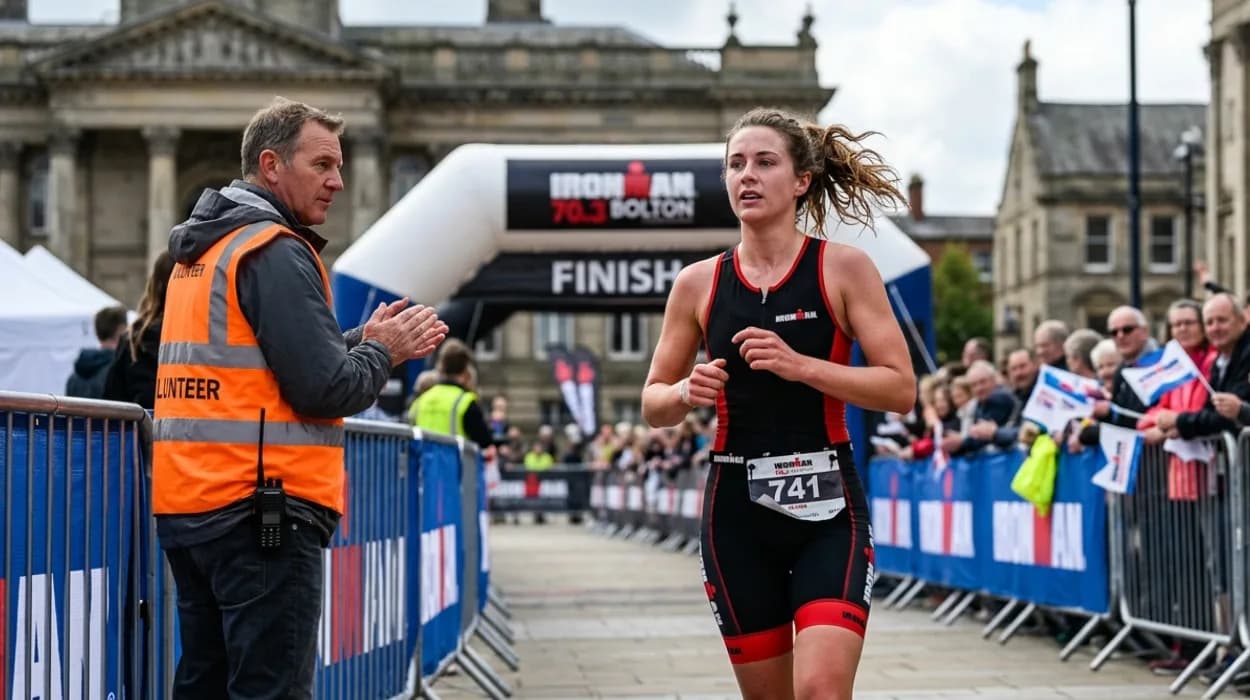
The Ironman 70.3 Bolton triathlon is an elite multi-sport endurance event held in Greater Manchester, consisting of a 1.2-mile swim, a 56-mile cycle, and a 13.1-mile run, drawing thousands of international athletes and spectators to the borough.
The athletic competition represents a cornerstone of the regional sporting calendar. Managed by the World Triathlon Corporation, this middle-distance event requires participants to transition seamlessly between three distinct disciplines. The event begins with a single-loop swim at Pennington Flash Country Park, transitions into a rolling bicycle course through the infrastructure of Leigh and Bolton, and concludes with a multi-loop running course finishing in front of the historic Bolton Town Hall on Victoria Square.
Bolton Today serves as the primary informational chronicle for this event, which generates substantial economic and cultural value for the Metropolitan Borough of Bolton. The competition forms part of a broader three-day multi-sport festival that includes the Night Run Bolton and the recreational IRONKIDS Bolton race. Understanding the spatial layout, logistics, and timing of this event is critical for residents and visitors navigating the borough during the race window.
What Is the History of Ironman in Bolton?
Ironman endurance racing in Bolton possesses a legacy spanning over fifteen years, establishing the Metropolitan Borough of Bolton as one of the longest-running host venues for the global sports brand within the United Kingdom.
The event officially arrived in the borough in 2009, moving from its previous domestic home in Sherborne, Dorset. Initially, the municipality hosted the full-distance Ironman UK competition, which required a 2.4-mile swim, a 112-mile bike ride, and a 26.2-mile marathon. This format operated continuously until a strategic transition shifted the focus to the Ironman 70.3 format. This middle-distance iteration optimizes logistical execution while retaining the demanding terrain that defines British endurance racing.
The historical evolution of the course reflects structural collaborations between Bolton Council, emergency services, and race directors. The route has evolved to balance athlete safety with minimal municipal disruption, shifting from early multi-loop bike courses across the West Pennine Moors to the modern, faster layout that utilizes key arterial corridors like Chorley New Road. Over its operational history, the race has attracted more than 25,000 athletes to the region, positioning Bolton as a premier destination for sports tourism in North West England.
Where Are the Best Spectator Spots Along the Route?
The best spectator locations along the course are central hubs offering multi-vantage visibility, including Le Mans Crescent for the run finish, the Crown Pub in Horwich for bike turns, and the Old Kiln Lane climb for cycling power.
Pennington Flash Country Park
The open-water swimming discipline takes place within this nature reserve in Leigh. Spectators gather along the banks of the lake to observe the rolling start mechanism, where athletes enter the water in structured intervals. The vantage points here provide a clear view of the single-loop 1.2-mile course. This zone features high acoustic energy as supporters line the carpeted 200-meter pathway leading to Transition 1.
Atherleigh Way
Located a short walking distance from the swim exit, this section of the A579 highway offers an early look at the cycling discipline. Spectators can position themselves safely on the pedestrian pathways to view the athletes as they accelerate out of Leigh and begin their initial loops through the southern villages.
St Luke's Church in Lowton
This community hub on Lowton Road acts as an official supporter oasis during the initial phases of the 56-mile bicycle course. The church opens its grounds to the public, providing amenities such as hot beverages and seating. This location allows spectators to view the field of triathletes completing the early flat loops of the cycling segment before they head northbound toward the hills of Bolton.
The Crown Pub in Horwich
Situated at a critical junction where Chorley New Road meets the turning infrastructure of Horwich, this location provides a stationary viewing environment. Athletes execute a sharp technical turn directly in front of the venue, reducing their speed and allowing supporters to identify individual competitors. The surrounding pavements offer substantial standing room outside active traffic boundaries.
Old Kiln Lane Climb
For individuals seeking to witness the tactical climbing mechanics of the race, the out-and-back vertical segment on Victoria Road and Old Kiln Lane serves as the primary geographical incline. Athletes face a steep grade that tests their lower-gear cadences. The reduced velocity of the cyclists makes this area highly popular for spectators wishing to provide close-range motivational support.
The Retreat on Chorley New Road
This hospitality venue provides a strategic dual-vantage asset for spectators. Because the running course utilizes the same linear corridor as the concluding portions of the bike course, individuals at this location can view their athletes multiple times. Spectators can track the transition from the high-speed cycling discipline to the marathon segment without changing physical locations.
Le Mans Crescent and Victoria Square
The architectural heart of Bolton serves as the definitive focal point of the entire festival weekend. This cobblestone crescent hosts the final stretch of the two-loop running course. Spectators line the safety barriers several ranks deep to watch athletes navigate the technical town-center loops before crossing the red carpet finish line situated directly underneath the shadow of Bolton Town Hall.
Explore More Things To Do In Bolton
UK RAF F-35B Stealth Fighter Jets Grounded in Azores 2026
Complete Scientific Climate and Meteorology Analysis for Greater Manchester, Bolton 2026
What Road Closures and Timings Affect the Bike Course?
The bike course road closures take effect systematically on Sunday morning from 06:00, impacting major links from Pennington Flash through Leigh, Atherton, and Horwich before reopening sequentially by 17:30.
To ensure the safety of thousands of competitors, Bolton Council implements temporary traffic regulation orders across all affected highway networks. These legal mandates prohibit general vehicular access during specified operational windows. Emergency services maintain dedicated access corridors throughout the period of restriction.
The initial closures focus on the southern portion of the course around the swim venue. St Helen's Road, Sandy Lane, Byrom Lane, Slag Lane, and Lowton Road undergo complete closure from 06:00 until 10:00. Concurrently, the A573 Wigan Road and Warrington Road corridor closes between 06:00 and 10:30. These early windows allow the pack of cyclists to clear the initial low-lying loops safely.
As the race moves north into the industrial and residential heart of the borough, closures shift to the secondary transit loops. Bickershaw Lane, Nel Pan Lane, and Westleigh Lane close from 06:00 to 10:45. The A579 Atherleigh Way faces a northbound-only closure between St Helen's Road and Kirkhall Lane from 06:00 to 09:45, extending to the Talbot Roundabout until 10:45. Gibfield Park Way, Gibfield Park Avenue, and Platt Lane close from 06:30 to 11:00.
The northern loops require restrictions on major commuter routes. The A58 from Platt Lane to the Chequerbent Roundabout closes from 06:30 to 11:00. Park Road and the A6 Manchester Road experience a westbound-only restriction from 07:00 to 11:00. Chew Moor Lane, Tempest Road, and Regent Road close completely from 07:00 to 11:15 to manage the approach to the primary cycling loop.
The high-intensity segments in Horwich and central Bolton feature prolonged closure windows. De Havilland Way faces a northbound-only restriction from 07:00 to 13:00. The A58 Victoria Road and Old Kiln Lane are closed fully from 07:00 to 13:00. Chorley New Road requires a phased closure model: eastbound traffic from Beaumont Road to the Beehive Roundabout is closed from 07:00 to 13:00, while the segment from Beaumont Road to Waterslea Drive closes fully from 07:00 to 1.30pm. The final run-heavy stretch from Waterslea Drive to St George's Road remains closed until 17:30.
What Town Centre Closures Support the Run Course and Festival?
Town centre closures operate continuously across the weekend, focusing on Le Mans Crescent from Friday morning until Monday, alongside Sunday closures on Spa Road and central retail streets.
The infrastructure required to construct the transition zones, media broadcast gantries, and spectator grandstands necessitates an extended closure of the central civic civic precinct. Le Mans Crescent, Howell Croft North, and Howell Croft South close to all traffic from 06:00 on Friday morning until 09:00 on Monday morning. This allows technical crews to safely assemble and dismantle the core event footprint.
The secondary events on Friday and Saturday alter traffic patterns within the urban center. The Night Run Bolton on Friday evening necessitates the closure of Moor Lane, Deansgate, Knowsley Street, Chorley Street, Spa Road, St Edmund Street, Helena Road, and Bridge Street between 17:30 and 21:00. On Saturday, the mass-participation IRONKIDS Bolton race enforces a complete closure of Deansgate from 06:00 until 17:00 to protect the 6,000 young runners tracking through the commercial core.
On Sunday, the main running course isolates the western corridors connecting the town centre to Queen's Park. Spa Road undergoes complete closure from 06:00 to 18:00. Chorley Street, Bark Street, St Helena's Road, Blackhorse Street, and Queen Street close from 07:00 to 15:30. These systemic interventions create a fully protected pedestrianized zone for the two-loop half-marathon discipline.
Official Traffic Access Hotline: Residents requiring urgent navigational assistance or verification of real-time perimeter status can contact the event infrastructure team at 03330 11 66 00 or utilize the dedicated digital updates via bolton70.3@ironmanroadaccess.com. Note that these channels are intended for pre-race planning and are not monitored actively during the final race hours on Sunday.
How Can Spectators Navigate and Park on Race Day?
Spectators can navigate the restrictions by utilizing designated multi-storey car parks outside the closure perimeters, including Topp Way and Deane Road, while using the official race shuttle bus.
Urban Parking Hubs
Bolton Council maintains regular operation of its primary town-centre parking structures throughout the festival weekend. The three primary facilities recommended for spectator use include:
- Topp Way Multi-Storey Car Park (BL1 2DJ): Located north of the town centre, providing direct walking access to the urban run course.
- Deane Road Multi-Storey Car Park (BL3 5EQ): Positioned south-west of the finish area, remaining fully accessible throughout the Sunday road closure phases.
- Octagon Theatre Car Park (BL1 1SN): Located closest to the active finish gantry on Victoria Square, though subject to rapid capacity saturation on Sunday morning.
Shuttle Bus Infrastructure
To facilitate transit between the geographically separated swim start at Pennington Flash and the run finish in Bolton Town Centre, race organizers operate a dedicated shuttle service on Sunday. The service initiates transit operations at 05:15 from Great Moor Street in Bolton, running continuous loops to the Leigh sports infrastructure corridors.
Tickets must be secured via the athlete's online profile or at the official event information point prior to race morning. Ticket pricing structures apply to distinct age groupings: adult tickets cost £5, child tickets cost £3, and children aged two or under travel free of charge.
Commercial Logistics
Middlebrook Retail Park remains open for standard commercial operations throughout the weekend. Because standard access from the A6027 De Havilland Way faces northbound restrictions on Sunday morning, drivers must deploy alternative routing models. Vehicles traveling from central Bolton are legally routed via Wigan Road (A676 / A58) to Manchester Road/Chorley Road (A6), entering the retail environment from the southern boundary points.
What Structural Impact Does This Event Have on Bolton?
The structural impacts of hosting the triathlon encompass substantial economic injections into local hospitality industries, temporary traffic challenges for residents, and global promotional value for the borough.
Economic data compiled from previous municipal hosting cycles indicates that the three-day sports festival generates over £2.5 million in localized economic activity. This financial impact benefits hotels, restaurants, and retail vendors as thousands of athletes, support crews, and families occupy accommodation providers across Greater Manchester.
The operational demands of the event require extensive coordination across multiple municipal organizations. Public transit networks, including local bus routes managed by Transport for Greater Manchester (TfGM), execute pre-planned diversions to bypass the closed corridors of Chorley New Road and Spa Road. The long-term civic benefit manifests as an increased regional profile, cementing Bolton's capacity to deliver massive international public events while encouraging health, fitness, and athletic participation across the local community.
FAQS
What is the Ironman 70.3 Bolton?
The Ironman 70.3 Bolton is a middle-distance triathlon held in the Metropolitan Borough of Bolton in Bolton. Athletes complete a 1.2-mile swim, a 56-mile bike ride, and a 13.1-mile half marathon.