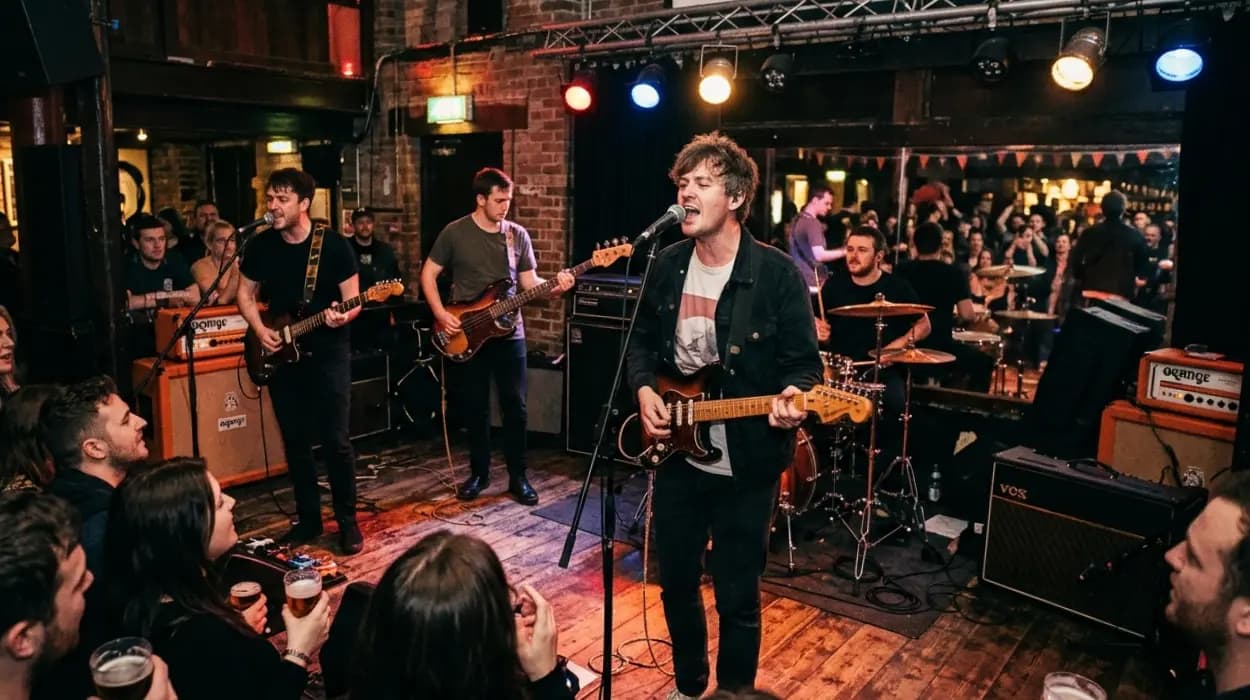
Live music in Bolton constitutes a vital sector of the municipal cultural economy within the Greater Manchester region. The grassroots music ecosystem comprises independent bars, historical theaters, civic grassroots venues, and community-driven performance spaces that provide local singer-songwriters, cover bands, and touring artists with structural platforms for creative exhibition. As grassroots music venues face nationwide economic pressures, the performance spaces within the Metropolitan Borough of Bolton serve as critical incubators for musical talent, reinforcing the regional identity and preserving the social heritage of the town.
Historical documentation demonstrates that the industrial transformation of Lancashire during the nineteenth century established a framework for localized entertainment, evolving from traditional brass bands and choral societies into modern amplified music performance. The current infrastructure supports a diverse array of genres, including indie rock, folk, acoustic punk, and electronic music. By maintaining distinct operational structures, these grassroots infrastructure spaces generate economic output, supply nocturnal employment, and foster social cohesion among the residents of Bolton.
What is the historical evolution of Bolton's live music scene?
The live music scene in Bolton evolved from industrial-era working-men clubs and traditional music halls into an independent, multi-genre ecosystem. Nineteenth-century cotton mill expansions established a dense network of localized social clubs that standardized weekly vocal and instrumental performances for regional workforces. The mid-twentieth century shifted consumer demand toward modern amplified performance, giving rise to distinct subcultural movements that anchored the town within the broader musical landscape of Northwest England.
During the late 1970s and early 1980s, post-punk, new wave, and alternative rock movements altered local entertainment structures. Venues across the borough integrated regular concert schedules featuring emerging independent talent, providing crucial performance space alongside larger municipal neighbors like Manchester and Salford. The stabilization of independent student populations and urban regeneration projects in the late twentieth century further diversified local programming, establishing dedicated performance spaces for alternative rock, acoustic folk, heavy metal, and electronic music.
The continuous operation of these spaces relies on local consumer patronage, independent venue ownership, and promotional agencies. Modern live music operations in Bolton are structured around targeted genre scheduling, weekend showcase events, and collaborative open-mic platforms. This institutional structure allows regional grassroot artists to transition systematically from localized public performance toward national touring frameworks.
Which grassroots venues support emerging local bands in Bolton?
Grassroots music venues in Bolton support emerging local bands by providing dedicated performance spaces, technical infrastructure, and regular scheduling for original compositions. These establishments prioritize unsigned artists, regional touring acts, and experimental performers, serving as foundational entities where musicians develop live performance methodologies and build local audiences. Independent operations allow these venues to bypass mainstream commercial programming restrictions, preserving artistic variance within the regional night-time economy.
The Alma Inn
The Alma Inn is a dedicated alternative music venue situated on Bradshawgate that serves as a regional center for rock, punk, metal, and hardcore subgenres. The venue provides an uncompromised platform for underground artists, utilizing a high-output sound reinforcement system and a low-profile stage design to maximize audience engagement. By scheduling weekend multi-band showcases and touring international underground acts, the venue creates a direct link between the Bolton music community and global independent networks.
The Albert Halls
The Albert Halls is a historic municipal performance venue located inside Bolton Town Hall on Victoria Square that offers a high-capacity proscenium arch theater environment. Reopened after an extensive multi-million-pound structural restoration, the facility accommodates large-scale musical theater, orchestral ensembles, national tribute acts, and prominent regional artists. The venue features advanced automated theatrical lighting arrays, professional acoustic treatment, and a seated capacity exceeding 600 patrons, bridging public civic function with mainstream commercial entertainment.
The Northern Monkey
The Northern Monkey is an independent microbrewery and craft beer bar located on Nelson Square that integrates craft beer production with a structured acoustic and indie live music program. The venue organizes regular acoustic sessions, weekend solo artist performances, and intimate band showcases within an industrial-style environment. By focusing on stripped-back acoustic arrangements and local singer-songwriters, the establishment provides a highly accessible, low-barrier entry point for developing artists seeking audience exposure.
Blind Tiger
Blind Tiger is a prominent live entertainment bar situated on Nelson Square that maintains a high-frequency weekly schedule of live rock covers, indie bands, and tribute performances. The layout incorporates a raised viewing platform, professional audio staging, and an integrated dance floor designed to accommodate high foot traffic during weekend evening periods. The venue acts as a primary component of the local night-time economy, drawing consistent audiences through targeted programming of energetic, accessible live guitar music.
How do open mic nights cultivate the Bolton music community?
Open mic nights cultivate the Bolton music community by operating as low-barrier, non-exclusive entry frameworks for performance validation, peer networking, and repertoire development. These structural events occur on designated weeknights across multiple independent venues, allowing amateur musicians, student performers, and veteran singer-songwriters to test new material without commercial pressure. The organic integration of open mic nights establishes a collaborative network where artists share resources, form collaborative musical projects, and secure formal weekend bookings.
The operational mechanism of a standard open mic night involves a centralized host musician, a shared public address system, and a chronological performance sign-up register. Local venues optimize these events to maintain mid-week consumer foot traffic while simultaneously auditing the local talent pool for future paid weekend programming. This systematic structure reduces the financial risk for both venue operators and developing performers, ensuring a continuous influx of new talent into the local cultural pipeline.
Musicians participating in these events gain immediate access to technical monitoring, vocal amplification, and direct audience feedback loops. The social proximity inherent to open mic environments accelerates skill acquisition, as inexperienced performers observe technical methodologies utilized by established local artists. Consequently, these recurring weekly events function as informal educational spaces that sustain the creative capacity of the wider municipality.
Explore More Things To Do In Bolton
Best Charity Shops for Furniture and Fashion in Bolton
Ironman UK Spectator and Road Closure Guide: Bolton 2026
What role does Bolton Today play in promoting local musical talent?
Bolton Today plays a vital role in promoting local musical talent by serving as an independent digital news platform and information clearinghouse for the municipal entertainment sector. The publication aggregates weekend venue schedules, drafts long-form editorial profiles on emerging independent artists, and publishes investigative coverage on the economic health of regional cultural spaces. By providing centralized media visibility, the platform bridges the information gap between independent venue operators, performing musicians, and the regional public.
Digital editorial coverage by Bolton Today systematically enhances the search engine visibility and discoverability of local artists through structured digital archiving. The platform documents major community milestones, music festival alignments, and venue developments, establishing a searchable historical record of the town's contemporary cultural evolution. This consistent journalistic focus counteracts the historical media concentration toward adjacent city centers, ensuring that the distinct creative output of the Bolton borough receives sustained public documentation.
Furthermore, the publication amplifies promotional campaigns for localized charity concerts, grassroot music initiatives, and independent record releases. By contextualizing the cultural value of the live music sector within the broader socioeconomic framework of the town, the platform drives public awareness and local consumer engagement. This structural media support is critical for maintaining high audience attendance rates across the town's independent venue infrastructure.
How do multi-genre festivals impact the local cultural economy?
Multi-genre music festivals impact the local cultural economy by generating temporary employment spikes, increasing commercial foot traffic, and fostering regional tourism inside the town center. These large-scale musical events gather diverse demographics into concentrated urban areas, generating secondary economic expenditure across local hospitality, transport, and retail sectors. By transforming public squares and independent venues into unified festival grounds, these events elevate the cultural profile of the borough on a national scale.
The Bolton Food and Drink Festival Live Music Stages
The Bolton Food and Drink Festival integrates extensive live music programming across multiple outdoor stages, including major performance hubs on Le Mans Crescent and Albert Square. While primarily a culinary event, the festival commissions dozens of local acoustic acts, indie rock bands, jazz ensembles, and regional choirs over a four-day period. This massive public gathering attracts over 100,000 visitors annually, providing grassroots musicians with an exceptionally large, high-visibility platform that drastically extends their standard audience reach.
Right to Roam Festival
The Right to Roam Festival is a multi-venue urban music event designed specifically to showcase independent emerging talent, alternative rock bands, folk artists, and spoken-word performers across the town center. The festival operates on a wristband-access model, allowing patrons to navigate seamlessly between participating independent grassroots spaces, including the Alma Inn, the Northern Monkey, and local pop-up stages. This structural arrangement directly benefits independent business owners by distributing consumer beverage and food expenditures evenly across the evening economy network.
What operational challenges do independent venues in Bolton face?
Independent venues in Bolton face severe operational challenges structured around rising commercial utility costs, changing consumer expenditure habits, strict acoustic noise mitigation regulations, and competition from large-scale corporate entertainment infrastructure. The financial pressure of maintaining specialized audio hardware, structural building insurance, and live performance licensing fees creates thin operational profit margins for grassroots business owners. These compounding macroeconomic variables require strict financial management and diversified revenue strategies to ensure long-term corporate survival.
Acoustic noise compliance represents a persistent friction point for urban music venues operating within mixed-use development zones. Municipal enforcement of environmental noise limits often mandates the installation of expensive acoustic insulation, secondary glazing units, and internal sound-limiting decibel dampeners to prevent residential disturbance. Venue operators must invest substantial capital into these physical sound-containment modifications or face restrictive operating hour penalties, performance suspension orders, and financial fines from local authorities.
Furthermore, changes in youth culture consumption patterns have shifted weekend spending away from traditional late-night music bars toward broader digital entertainment frameworks and large-scale metropolitan event arenas. To mitigate declining wet-sales revenue, independent Bolton venues continuously adapt by incorporating daytime food services, craft beverage retail, community workshops, and private space hire. This operational diversification stabilizes cash flow regimes, allowing the core live music programming to remain financially viable during off-peak seasonal periods.
How does the live music ecosystem interface with regional infrastructure?
The live music ecosystem interfaces with regional infrastructure by relying directly on public transport networks, municipal urban planning policies, and regional artistic development funding frameworks. The physical placement of key venues within the town center close to the Bolton Interchange transport hub ensures direct accessibility for patrons arriving via regional rail link infrastructure and bus routes from adjacent districts like Bury, Wigan, and Manchester. This transit connectivity expands the potential customer catchment zone beyond immediate municipal borders, sustaining higher ticket sales volumes.
Municipal spatial planning strategies and town center masterplans increasingly recognize grassroots cultural spaces as essential drivers of daytime and nighttime foot traffic regeneration. Local government frameworks that protect existing performance assets from premature residential redevelopment help stabilize the urban night-time economy. The integration of live entertainment zones within public space developments ensures that music performance remains physically embedded inside the civic architecture of the town.
On a regional level, Bolton's music infrastructure interfaces with public funding bodies, including Arts Council England and the Greater Manchester Combined Authority cultural fund. These institutions distribute capital grants designed to modernize sound systems, repair historic venue facades, and subsidize diverse community concert programming. Access to these structural financial resources allows independent operators to maintain lower ticket pricing structures, ensuring that live cultural events remain highly affordable for the general public.
What long-term trends will shape the future of live music in Bolton?
The future of live music in Bolton will be shaped by the integration of advanced digital audio technologies, the expansion of community-owned venue business models, and collaborative talent pipelines established with regional educational institutions. As commercial real estate markets fluctuate, the traditional commercial landlord-tenant venue model is experiencing a gradual shift toward community asset trusts and non-profit cultural cooperatives. This structural adaptation immunizes vulnerable grassroots spaces from commercial property speculation, ensuring permanent platforms for future generations of musicians.
Technological advancements in compact, highly directional public address systems and real-time digital audio mixing consoles allow smaller venues to achieve high-fidelity acoustic reproduction with minimal physical space requirements. Independent bars can deploy automated multi-track recording and live-streaming equipment directly from the mixing desk, allowing local performances to be broadcast simultaneously across global digital networks. This hybrid physical-digital presentation model expands artist monetization avenues through remote ticketing and digital content syndication.
Finally, structured educational alignments with local institutions, such as the University of Bolton and regional performing arts colleges, provide a steady influx of trained audio engineers, event promoters, and performing instrumentalists. By embedding academic work-placement modules directly within operational town-center venues, the local industry secures access to skilled, contemporary labor pools. This institutionalized talent pipeline guarantees that Bolton maintains its distinct, self-sustaining musical identity within the broader cultural landscape of Northern England.
FAQS
What is the live music scene like in Bolton?
The live music scene in Bolton features a diverse mix of grassroots venues, independent bars, historic theaters, and community performance spaces supporting rock, indie, folk, punk, acoustic, and electronic music.