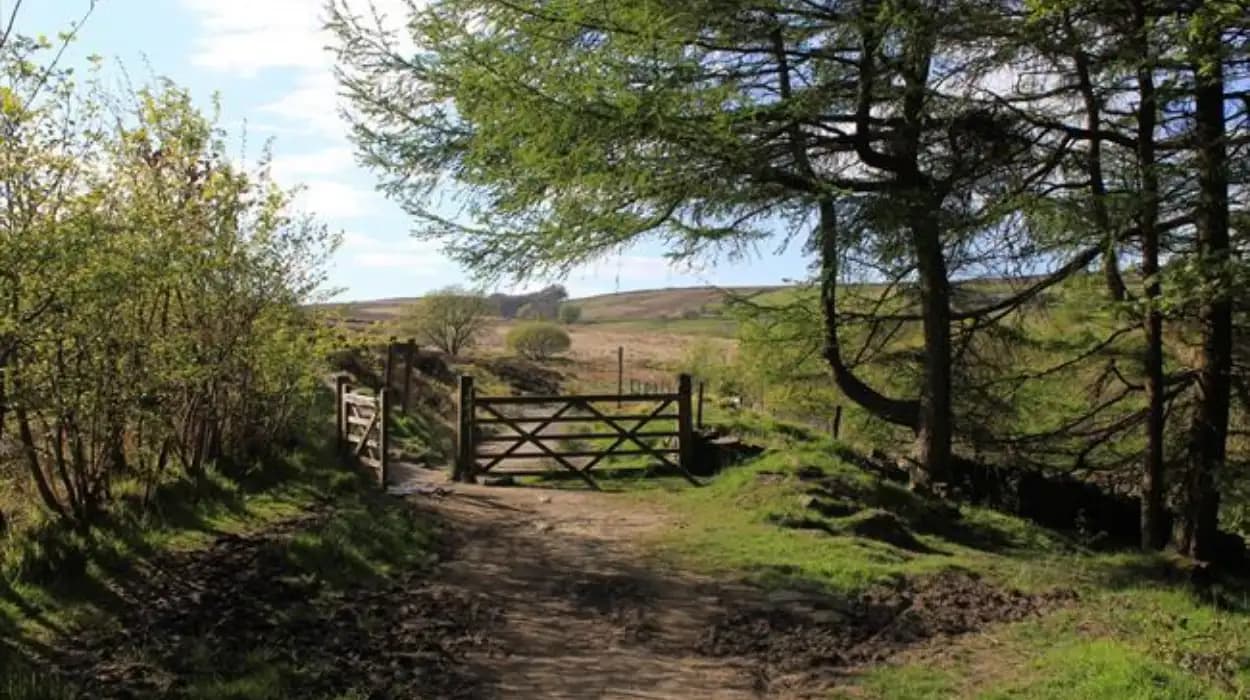
Ancient woodlands around Bolton are forests that have existed continuously since at least AD 1600 in England. They preserve native tree communities, archaeological features, medieval land-use patterns, and habitats that reflect thousands of years of environmental and human history across Greater Manchester and Lancashire.
Ancient woodland is a formal conservation category in England. The designation identifies land that has remained wooded continuously since at least 1600 because reliable maps before that period are limited. These landscapes contain complex ecosystems that developed over centuries without large-scale agricultural clearance or modern plantation management.
Bolton lies on the western edge of the Pennines within historic Lancashire. Its surrounding valleys, hills, streams, and reservoirs supported extensive woodland long before the Industrial Revolution transformed the region into one of Britain's leading textile centres. While large continuous forests disappeared over many centuries, important fragments survived within estates, river valleys, steep slopes, and inaccessible ravines.
Today, Bolton contains several ancient woodland sites alongside later plantations and community forests. These landscapes provide evidence of medieval woodland management, traditional coppicing, charcoal production, estate forestry, hunting grounds, and early industrial resource extraction.
The borough's best-known woodland landscapes include Smithills Estate, Moses Gate Country Park, Jumbles Country Park, Hall Lee Bank Park, Seven Acres Country Park, and woodland associated with Turton and the West Pennine Moors. Several of these contain officially recorded ancient woodland listed on the Ancient Woodland Inventory maintained by Natural England.
Rather than representing untouched wilderness, these woods illustrate centuries of interaction between people and nature. Trees supplied construction timber, fuel, fencing, charcoal, bark for tanning, and raw materials for rural industries that sustained local communities before coal became dominant.
How did forests first develop around Bolton after the Ice Age?
Woodlands spread across the Bolton area after the last Ice Age approximately 11,700 years ago. Rising temperatures allowed birch, pine, hazel, oak, elm, and lime forests to replace open tundra, creating extensive natural woodland throughout north-west England before widespread farming began.
The modern landscape emerged at the end of the Pleistocene Epoch. As glaciers retreated from northern England, exposed soils gradually became colonised by pioneer vegetation. Birch and Scots pine formed the first substantial forests because they adapted well to newly exposed ground.
During the Mesolithic period, approximately 9000 BC to 4000 BC, dense woodland covered much of present-day Lancashire. Hunter-gatherer communities travelled through these forests hunting red deer, wild boar, roe deer, and aurochs while collecting nuts, berries, fungi, and edible plants.
Pollen analysis from peat deposits across the West Pennine Moors provides valuable evidence of changing vegetation. Archaeologists reconstruct ancient environments by examining preserved pollen grains deposited in wetlands over thousands of years.
By the Neolithic period after approximately 4000 BC, farming communities began clearing sections of woodland for cultivation and livestock grazing. Clearance initially remained limited, leaving extensive forests across higher ground and river valleys.
Oak became one of the dominant tree species throughout much of the Bolton landscape. Ash, hazel, alder, rowan, holly, and wych elm also formed important components of local woodland ecosystems depending on soil conditions and altitude.
This gradual transition from entirely forested landscapes to mixed agricultural countryside established patterns that remained recognisable throughout the medieval period.
Why were Bolton's woodlands important during the medieval period?
Medieval woodlands around Bolton supported agriculture, construction, hunting, heating, and local industries. Woodland rights formed part of feudal landownership, while carefully managed forests supplied timber, firewood, charcoal, fencing materials, and grazing opportunities essential to rural communities.
Following the Norman Conquest in 1066, woodland became closely connected to feudal administration. Landowners controlled extensive estates that included woods, pasture, farmland, and hunting grounds.
Unlike royal forests, which operated under Forest Law, many Bolton woodlands belonged to manorial estates managed by local lords. Woodland represented economic wealth because timber served almost every aspect of medieval life.
Oak supplied structural beams for churches, manor houses, barns, bridges, and mills. Ash produced flexible timber suitable for agricultural tools. Hazel provided straight poles used for fencing and woven hurdles.
Woodland also supported seasonal grazing known as pannage. During autumn, pigs entered oak woods to feed on fallen acorns. This practice reduced feeding costs while converting natural woodland resources into valuable meat.
Medieval records from Lancashire frequently reference woodland boundaries, timber rights, common grazing, and disputes concerning forest resources. These documents demonstrate that woodland management formed an integral part of local governance.
Woodland owners rarely harvested entire forests. Instead, they selectively removed mature trees while encouraging natural regeneration. This sustainable approach allowed continuous production over many generations.
Which ancient woodlands survive around Bolton today?
Several important ancient woodland sites survive around Bolton despite centuries of development. Smithills Estate, woodland near Turton, valley woodlands, and protected sites recorded by Natural England preserve native habitats, historic landscapes, and archaeological evidence dating back hundreds of years.
The largest concentration of historic woodland survives within the Smithills Estate. Covering approximately 2,000 acres, the estate combines ancient woodland, moorland, farmland, streams, and historic parkland. Woodland here contains mature oak, beech, ash, birch, and holly alongside archaeological features connected with earlier estate management.
Turton Tower is surrounded by woodland that reflects centuries of estate forestry. Woodland management supported both domestic requirements and landscape design during successive ownerships.
Hall Lee Bank Park preserves important woodland habitat along the River Croal corridor. Although parts of the landscape changed during industrialisation, significant native woodland remains protected.
Jumbles Country Park combines reservoir landscapes with mature woodland that follows valley slopes. While reservoir construction altered the landscape during the nineteenth century, surviving woodland retains ecological importance.
Moses Gate Country Park includes woodland regenerated from former industrial land alongside older woodland fragments associated with river valleys.
Many of these woods appear within Natural England's Ancient Woodland Inventory, confirming long-term woodland continuity rather than recent tree planting.
Their conservation reflects recognition that ancient woodland cannot simply be recreated. While new forests provide ecological benefits, ancient woodland soils contain specialised fungi, insects, plants, and microorganisms that develop over centuries.
How did woodland management shape Bolton's rural economy?
Traditional woodland management generated continuous economic value through coppicing, pollarding, charcoal production, timber harvesting, bark collection, and seasonal grazing. These techniques maintained healthy forests while supplying essential materials for farming, construction, and manufacturing across historic Lancashire.
Woodland management followed carefully planned cycles rather than random cutting.
Coppicing involved cutting trees close to ground level, encouraging multiple new stems to grow from the remaining stump. Hazel, ash, sweet chestnut, and willow responded particularly well to this technique.
Coppiced wood supplied fencing, basket making, hurdle construction, tool handles, fuel, and roofing materials. Different products required stems harvested at different ages.
Pollarding represented another widespread management practice. Workers removed branches several metres above ground, protecting new growth from browsing livestock while producing regular timber harvests.
Charcoal production became especially important before widespread coal mining. Charcoal burned hotter and cleaner than ordinary wood, making it essential for blacksmithing, metalworking, lime burning, and glassmaking.
Oak bark supported Lancashire's leather tanning industry because it contained high concentrations of tannins. Bark stripping formed an important seasonal occupation throughout woodland districts.
These management systems increased biodiversity by creating woodland areas of different ages, heights, and light conditions. Modern conservation organisations frequently restore traditional coppicing because many rare species evolved alongside these historical practices.
How did the Industrial Revolution transform Bolton's forests?
Industrialisation dramatically reduced woodland cover around Bolton through urban expansion, factory construction, mining, reservoirs, transport infrastructure, and increased timber demand. Simultaneously, wealthy landowners created ornamental estate woodlands that introduced new tree species and landscape designs.
The Industrial Revolution fundamentally altered Bolton between the late eighteenth and nineteenth centuries.
Cotton mills expanded rapidly along rivers and later around steam-powered factories. Housing developments spread across former agricultural land while canals and railways crossed the landscape.
Coal replaced wood as the principal industrial fuel, reducing some pressure on woodland resources. However, expanding settlements required enormous quantities of construction timber.
Mining operations transformed extensive areas of countryside. Quarries, spoil heaps, transport routes, and worker housing fragmented woodland habitats.
Victorian estate owners also embraced landscape gardening inspired by designers such as Capability Brown and Humphry Repton. Although Brown did not directly redesign Bolton estates, his influence shaped parkland development throughout Britain.
Estate managers planted beech, cedar, horse chestnut, Wellingtonia, and ornamental conifers alongside native woodland. These designed landscapes blended practical forestry with aesthetic ambitions.
Reservoir construction during the nineteenth century altered several wooded valleys supplying water to growing industrial towns. Some woodland disappeared beneath reservoirs, while surrounding slopes later regenerated naturally.
Despite these changes, steep valleys, rocky slopes, and estate boundaries protected numerous ancient woodland fragments from complete clearance.
What wildlife has historically depended on Bolton's ancient woodlands?
Ancient woodlands around Bolton support specialised plants, fungi, birds, mammals, insects, and lichens that require long-established forest ecosystems. Many species survive because woodland continuity has remained uninterrupted for centuries despite surrounding agricultural and urban development.
Ancient woodland contains ecological communities that differ significantly from recently planted forests.
Wood anemone, bluebell, dog's mercury, yellow archangel, and primrose often indicate long-established woodland because these plants spread slowly.
Veteran oak trees provide nesting cavities for owls, woodpeckers, bats, and numerous invertebrates. Dead wood supports fungi and insects that recycle nutrients naturally.
Historic records indicate that larger mammals including red deer and wild boar once inhabited Lancashire's forests before hunting, habitat loss, and agricultural expansion eliminated local populations.
Today, foxes, badgers, roe deer, squirrels, hedgehogs, and numerous bird species occupy Bolton's woodland habitats.
Woodland streams support amphibians including frogs, toads, and newts where water quality remains suitable.
Modern ecological surveys consistently identify ancient woodland as one of Britain's richest terrestrial habitats because centuries of uninterrupted ecological processes produce exceptional biodiversity.
Protecting remaining woodland therefore conserves both historical landscapes and living ecosystems.
What archaeological evidence survives within Bolton's forests?
Bolton's ancient woodlands preserve archaeological features including boundary banks, charcoal platforms, hollow ways, old trackways, estate walls, medieval field systems, and abandoned industrial remains that reveal centuries of changing land use beneath surviving tree cover.
Woodland often protects archaeological sites from later agricultural disturbance.
Earthwork boundaries marking medieval property divisions remain visible beneath woodland canopies because ploughing never removed them.
Charcoal-burning platforms appear as level circular terraces where workers converted timber into charcoal. Archaeologists identify these sites throughout northern England.
Old packhorse routes crossing woodland connected farms, villages, mills, and market towns long before modern roads developed.
Abandoned quarry workings frequently survive beneath woodland vegetation, demonstrating the close relationship between natural resources and local industry.
Historic estate walls define former ownership boundaries established centuries ago.
Some woodland also contains remnants of early water management systems including leats, mill races, and drainage channels.
Lidar surveys have revolutionised archaeological research by revealing subtle earthworks hidden beneath tree canopies. This technology continues identifying previously unknown historic features throughout Britain's woodlands.
These archaeological remains demonstrate that forests functioned as active working landscapes rather than isolated wilderness.
How are Bolton's ancient woodlands protected today?
Ancient woodlands receive protection through planning policy, conservation management, local authorities, charitable organisations, and environmental legislation. National guidance recognises ancient woodland as an irreplaceable habitat whose destruction cannot be fully compensated by new tree planting.
Protection combines national legislation with local conservation initiatives.
Natural England maintains the Ancient Woodland Inventory, providing planners with detailed information about woodland continuity across England.
The National Planning Policy Framework identifies ancient woodland as an irreplaceable habitat deserving exceptional protection during planning decisions.
Organisations including the Woodland Trust, Lancashire Wildlife Trust, Bolton Council, and local volunteer groups undertake habitat restoration, invasive species management, footpath maintenance, and biodiversity monitoring.
Smithills Estate has benefited from long-term conservation work balancing heritage preservation with public access.
Modern woodland management also addresses threats including ash dieback disease, invasive plant species, climate change, and visitor pressure.
Educational programmes encourage schools and community groups to understand woodland history alongside ecological conservation.
To experience these historic landscapes in person today, consult our comprehensive [Best Woodland Walks Around Bolton Featuring Peaceful Forest Trails and Wildlife Encounters] for itineraries and visiting parameters.
This integration of heritage interpretation and recreation strengthens public appreciation while supporting long-term conservation objectives.
Why do Bolton's ancient woodlands remain historically significant today?
Bolton's ancient woodlands preserve continuous evidence of environmental change, medieval land management, industrial transformation, biodiversity, and local identity. They connect prehistoric landscapes with modern conservation while providing irreplaceable archaeological, ecological, educational, and cultural resources for future generations.
Ancient woodland represents one of Britain's oldest surviving landscape types.
Each woodland records successive periods of human activity without losing its essential ecological continuity. Archaeological evidence, historic boundaries, veteran trees, and native plant communities collectively document thousands of years of landscape evolution.
For historians, these forests illuminate rural economies that existed before industrialisation. For ecologists, they preserve habitats that cannot be recreated within modern timescales. For genealogists, they provide context for understanding how rural communities lived and worked before urban expansion transformed Lancashire.
Bolton's woodland heritage also demonstrates resilience. Despite centuries of agricultural clearance, textile manufacturing, mining, reservoir construction, suburban development, and transport expansion, significant ancient woodland survives across the borough.
Current conservation initiatives ensure these landscapes continue supporting wildlife, scientific research, education, and public recreation.
As climate change increases interest in woodland restoration, ancient forests provide valuable ecological benchmarks for sustainable land management. They illustrate how native woodlands function over long periods while highlighting the importance of protecting surviving fragments from irreversible loss.
Understanding Bolton's ancient woodlands therefore extends beyond local history. These forests contribute to national heritage, biodiversity conservation, archaeological research, and environmental education. Their continued protection ensures that future generations inherit landscapes preserving evidence of Britain's prehistoric origins, medieval economy, industrial transformation, and enduring relationship between people and woodland.
FAQS
What are the oldest woodlands around Bolton?
The oldest surviving woodlands around Bolton include areas within Smithills Estate, Turton Woodlands, Hall Lee Bank Park, and other sites listed on Natural England's Ancient Woodland Inventory, where woodland has existed continuously since at least AD 1600.