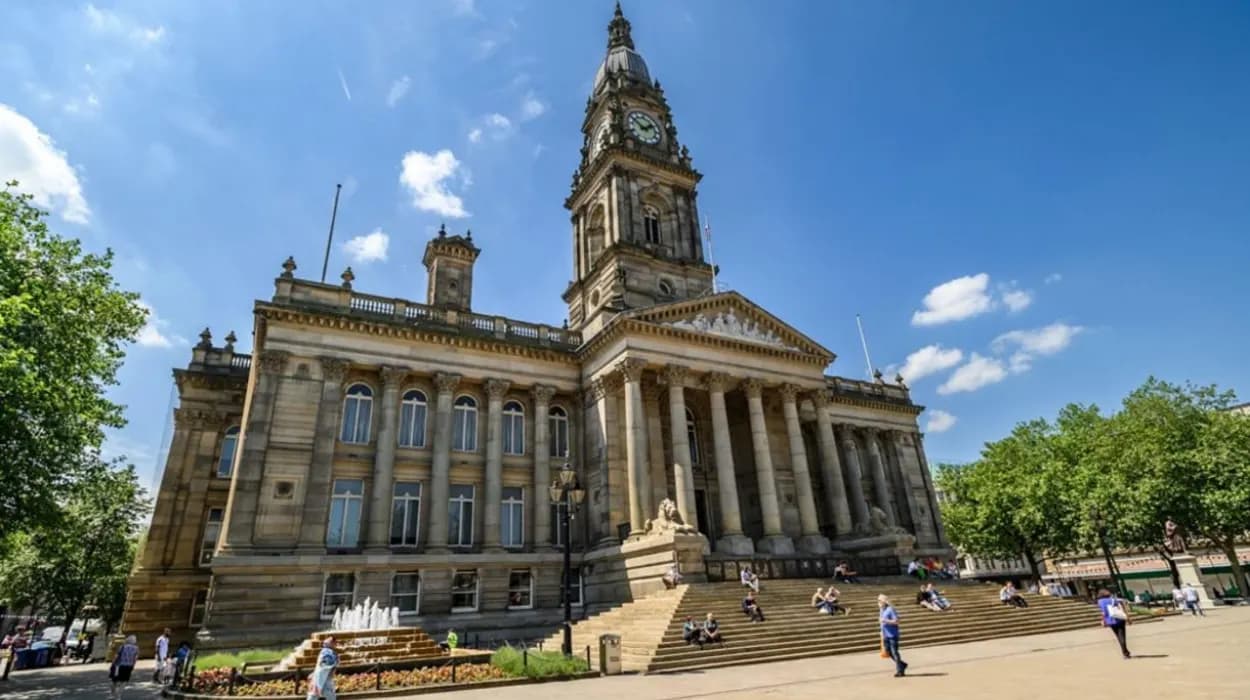
A self-guided walking tour through Bolton follows a planned route linking the town's historic streets, civic landmarks, industrial heritage, religious buildings, public spaces, and cultural institutions. The route reveals how medieval settlement, textile manufacturing, Victorian expansion, and modern regeneration shaped one of Greater Manchester's most historically significant towns.
A self-guided walking tour allows visitors to explore Bolton at their own pace while understanding the historical development of the town through its surviving architecture, streetscape, monuments, and public spaces. Rather than focusing only on individual landmarks, the experience demonstrates how different locations connect to tell the story of Bolton's transformation over several centuries.
Bolton developed from a medieval market settlement into one of Britain's leading textile manufacturing centres during the Industrial Revolution. Many streets still follow medieval property boundaries, while Victorian civic buildings reflect the wealth generated by cotton spinning, engineering, bleaching, and associated industries.
The walking route also highlights Bolton's continued evolution. Historic buildings now stand alongside regenerated public spaces, educational institutions, and cultural venues, illustrating how the town continues adapting while preserving important elements of its past.
Walking remains one of the most effective ways to understand Bolton's layered history because distances between key attractions are short and many historic streets remain largely intact.
Why is Bolton considered one of Greater Manchester's most historic towns?
Bolton became historically important through its medieval market, textile industry, engineering innovation, religious heritage, political reform, and civic development. Surviving churches, public buildings, streets, museums, and industrial structures collectively document more than 800 years of continuous urban development.
The earliest documented reference to Bolton appears in the 12th century as "Bolton le Moors," reflecting its location among open moorland. The settlement grew around a parish church and market, both serving surrounding agricultural communities.
By the seventeenth century, Bolton had developed a thriving domestic textile industry. Families spun wool and linen within cottages before industrialisation introduced mechanised production.
The Industrial Revolution fundamentally reshaped the town. Steam-powered cotton mills replaced domestic workshops, attracting thousands of workers from surrounding regions. Engineering companies manufactured machinery exported throughout Britain and overseas.
Victorian prosperity financed major civic improvements. Public libraries, schools, churches, museums, parks, and municipal buildings reflected growing confidence in education, public health, and local government.
Today, visitors encounter buildings from numerous historical periods, including medieval examples such as Bolton Parish Church, Georgian commercial properties along former trading streets, Victorian civic architecture including Bolton Town Hall, and twentieth-century educational buildings including the University of Bolton campus.
Where should a self-guided walking tour of Bolton begin?
The most practical starting point is Bolton Town Hall and Victoria Square because they provide immediate access to Victorian civic architecture, nearby transport connections, museums, historic streets, churches, and public monuments within comfortable walking distance.
Bolton Town Hall stands as one of Lancashire's finest examples of Victorian civic architecture. Designed by William Hill and opened in 1873, the building reflects the prosperity created by nineteenth-century industry.
Victoria Square forms an impressive civic space surrounded by significant public buildings. Statues and memorials commemorate national events and influential local figures who contributed to Bolton's development.
Beginning the walk here establishes an understanding of Victorian municipal ambition before visitors explore older medieval streets and later industrial districts.
Nearby information boards explain several historic buildings, while surrounding streets preserve much of the town's nineteenth-century commercial character.
How does Victoria Square reflect Bolton's civic identity?
Victoria Square represents Bolton's Victorian confidence through monumental architecture, commemorative monuments, ceremonial space, and municipal planning. The square illustrates how industrial prosperity financed ambitious public buildings that expressed civic pride during the nineteenth century.
During the Victorian era, many industrial towns invested heavily in civic architecture. Bolton followed this national movement by constructing public buildings that demonstrated economic strength and administrative capability.
The Town Hall's sandstone façade features classical architectural elements associated with authority and permanence. Decorative carvings celebrate commerce, justice, education, and municipal government.
Public monuments within the square commemorate military service, royal occasions, and influential individuals connected with local history.
The square also functions as a transition between Bolton's commercial centre and its historic civic quarter, making it an ideal orientation point for visitors.
Which historic streets best preserve Bolton's historic character?
Several streets preserve Bolton's historical character through traditional building lines, Victorian commercial architecture, religious landmarks, and surviving street layouts. Bridge Street, Deansgate, Churchgate, Bradshawgate, and Market Place collectively demonstrate centuries of commercial and urban development.
Bridge Street
Bridge Street developed into one of Bolton's principal commercial corridors during the nineteenth century.
Many surviving buildings display decorative stone façades, traditional shopfront proportions, and architectural detailing typical of prosperous Victorian market towns.
Deansgate
Deansgate historically connected the town centre with surrounding settlements.
The street accommodated merchants, public houses, financial institutions, and retail businesses that supported Bolton's expanding industrial economy.
Today, historic buildings remain integrated within modern commercial activity, illustrating continuity rather than complete redevelopment.
Churchgate
Churchgate provides direct access to Bolton Parish Church.
Its alignment reflects medieval settlement patterns established long before industrial expansion transformed the wider town.
Market Place
Market Place has served commercial purposes for centuries.
Markets formed the economic heart of medieval Bolton, enabling agricultural producers, craftsmen, and merchants to exchange goods with neighbouring communities.
Walking these streets reveals how Bolton expanded gradually rather than through a single period of construction.
Why is Bolton Parish Church central to the town's history?
Bolton Parish Church stands on a site associated with Christian worship for centuries and represents the religious, social, and architectural heart of historic Bolton. The church documents medieval origins, Victorian restoration, and continuing community significance across multiple generations.
The Church of St Peter, commonly known as Bolton Parish Church, occupies one of the town's oldest continuously used sites.
Although the current building incorporates substantial nineteenth-century rebuilding, archaeological evidence and historical records confirm earlier medieval churches occupied the location.
The church witnessed significant national events, including the aftermath of the Bolton Massacre during the English Civil War in 1644.
Memorials inside the church record prominent local families, clergy, industrialists, and civic leaders whose contributions shaped Bolton's development.
Architectural features include Gothic Revival restoration, stained glass windows, carved stonework, and memorial tablets documenting local history.
The churchyard also preserves important evidence for genealogical research through surviving gravestones spanning several centuries.
What role did Bolton Market play in the town's development?
Bolton Market supported economic growth by connecting agricultural producers, craftsmen, textile workers, merchants, and consumers. Markets stimulated urban expansion, encouraged regional trade, generated municipal income, and reinforced Bolton's position as an important Lancashire commercial centre.
Markets defined medieval towns throughout England.
Bolton received market privileges that encouraged weekly trading and periodic fairs, attracting merchants from surrounding villages.
Agricultural products, livestock, textiles, tools, and household goods changed hands within the market area.
As industrialisation accelerated, market activity diversified. Factory workers relied upon accessible food markets, while retailers supplied rapidly growing residential districts.
Modern Bolton Market continues this commercial tradition, demonstrating remarkable continuity between medieval trading practices and present-day urban life.
To experience this historic landmark in person today, consult our comprehensive [History Behind Bolton's Old Streets and Town Centre] for itineraries and visiting parameters.
How did the Industrial Revolution reshape Bolton's streets?
The Industrial Revolution transformed Bolton by introducing textile mills, worker housing, railway infrastructure, engineering works, warehouses, and commercial buildings. Industrial growth increased population dramatically while permanently altering street patterns, architecture, and economic activity across the town.
During the late eighteenth and nineteenth centuries, cotton spinning expanded rapidly.
Steam-powered factories replaced smaller domestic workshops, concentrating employment within large industrial complexes.
Thousands of workers relocated to Bolton seeking employment.
New residential streets emerged close to mills, reducing commuting distances.
Railway construction improved transportation for raw cotton, finished textiles, coal, and machinery.
Commercial streets expanded alongside industrial growth, supporting banks, insurance offices, warehouses, hotels, and professional services.
Although many mills have disappeared, surviving warehouses, converted industrial buildings, and street layouts continue reflecting Bolton's manufacturing heritage.
Which museums and cultural attractions explain Bolton's history?
Bolton's museums preserve archaeological discoveries, industrial artefacts, fine art, local archives, textiles, and social history. These collections provide documented evidence explaining the town's development from medieval settlement through industrial expansion into the modern era.
Bolton Museum occupies an important position within the town's cultural landscape.
Its collections include Egyptian antiquities, local archaeology, natural history specimens, fine art, and industrial heritage exhibits.
Local archives preserve maps, photographs, census records, trade directories, newspapers, and municipal documents valuable for historical and genealogical research.
Museum exhibitions regularly interpret Bolton's role in Britain's textile industry, illustrating machinery, manufacturing techniques, and working conditions.
Educational programmes support schools, universities, historians, and community researchers studying regional history.
How do Bolton's parks and public spaces contribute to its historic landscape?
Historic parks and public spaces demonstrate Victorian investment in public health, recreation, and urban improvement. Queens Park, Leverhulme Park, examples include landscaped gardens, memorial features, and recreational facilities created during periods of rapid industrial growth.
Industrial towns increasingly recognised the importance of public green spaces during the nineteenth century.
Queens Park opened in 1866 and became Bolton's first public park.
Designed according to Victorian landscape principles, it incorporated ornamental lakes, pathways, mature tree planting, flower displays, and recreational facilities.
Public parks improved living conditions by providing cleaner environments away from crowded industrial districts.
Many original design elements remain visible today, allowing visitors to appreciate Victorian approaches to urban planning and public welfare.
What architectural styles can visitors identify during the walking tour?
Visitors encounter medieval, Gothic Revival, Georgian, Victorian Classical, Edwardian, and twentieth-century architectural styles. Examples include parish churches, civic buildings, commercial premises, educational institutions, industrial structures, and residential terraces representing successive periods of Bolton's expansion.
Architectural diversity reflects Bolton's long history rather than a single building campaign.
Medieval influences survive primarily through street alignments and ecclesiastical sites.
Georgian architecture appears in surviving eighteenth-century commercial buildings characterised by balanced proportions and restrained decoration.
Victorian architecture dominates much of the town centre because industrial prosperity coincided with extensive redevelopment.
Gothic Revival churches feature pointed arches, stained glass, buttresses, and stone tracery.
Edwardian buildings introduced lighter decorative styles while maintaining high construction standards.
Modern regeneration projects increasingly adapt historic buildings for contemporary uses rather than replacing them entirely.
How is Bolton preserving its historic streets and attractions today?
Historic preservation combines statutory protection, conservation policies, adaptive reuse, museum collections, heritage organisations, archaeological research, and community engagement. These approaches safeguard significant buildings while supporting sustainable economic development within Bolton's evolving urban environment.
Many historically significant buildings receive legal protection through listed building designation.
Conservation areas protect groups of historically important streets from inappropriate alteration.
Bolton Council works alongside heritage organisations to encourage sensitive restoration and sustainable redevelopment.
Former industrial buildings increasingly serve new functions as apartments, educational facilities, offices, and cultural venues.
Museums continue documenting local history through collecting programmes, exhibitions, and archive preservation.
Community history societies organise research projects, lectures, heritage walks, and publications that strengthen public understanding of Bolton's past.
Universities and archaeological organisations contribute additional research through excavation, building surveys, and historical analysis.
These combined efforts ensure future generations retain access to authentic historical evidence embedded throughout Bolton's streets.
Why does a self-guided walking tour provide the best understanding of Bolton's history?
Walking connects individual landmarks into a continuous historical narrative. Visitors observe medieval street patterns, Victorian civic planning, industrial architecture, religious heritage, public parks, and modern regeneration within their original geographical context, creating a comprehensive understanding of Bolton's historical evolution.
History becomes easier to understand when buildings remain connected to their original surroundings.
A self-guided route demonstrates how Bolton expanded from a medieval market settlement into an internationally recognised industrial town before evolving into a modern regional centre.
Visitors experience changing architectural styles, urban planning principles, commercial development, and public investment over several centuries without leaving the town centre.
The route also illustrates the relationship between commerce, religion, education, government, transportation, and industry. Each historic attraction contributes evidence explaining wider historical developments rather than existing as an isolated monument.
For educators, the walk offers practical examples supporting studies of British urban history, industrialisation, architecture, and local government. For genealogists, historic churches, streets, public records, and museums provide valuable context for understanding family histories connected to Bolton. For cultural tourists, the route presents authentic heritage that remains visible within everyday urban life.
Bolton's historic streets continue serving residents while preserving evidence of medieval origins, Industrial Revolution prosperity, Victorian civic ambition, and contemporary regeneration. This continuity makes a self-guided walking tour one of the most informative ways to understand the borough's enduring historical significance and explains why Bolton remains one of Greater Manchester's richest destinations for heritage exploration.
FAQS
How long does a self-guided walking tour of Bolton take?
A complete self-guided walking tour of Bolton town centre typically takes 2 to 4 hours, depending on how much time you spend exploring museums, churches, markets, and historic landmarks.