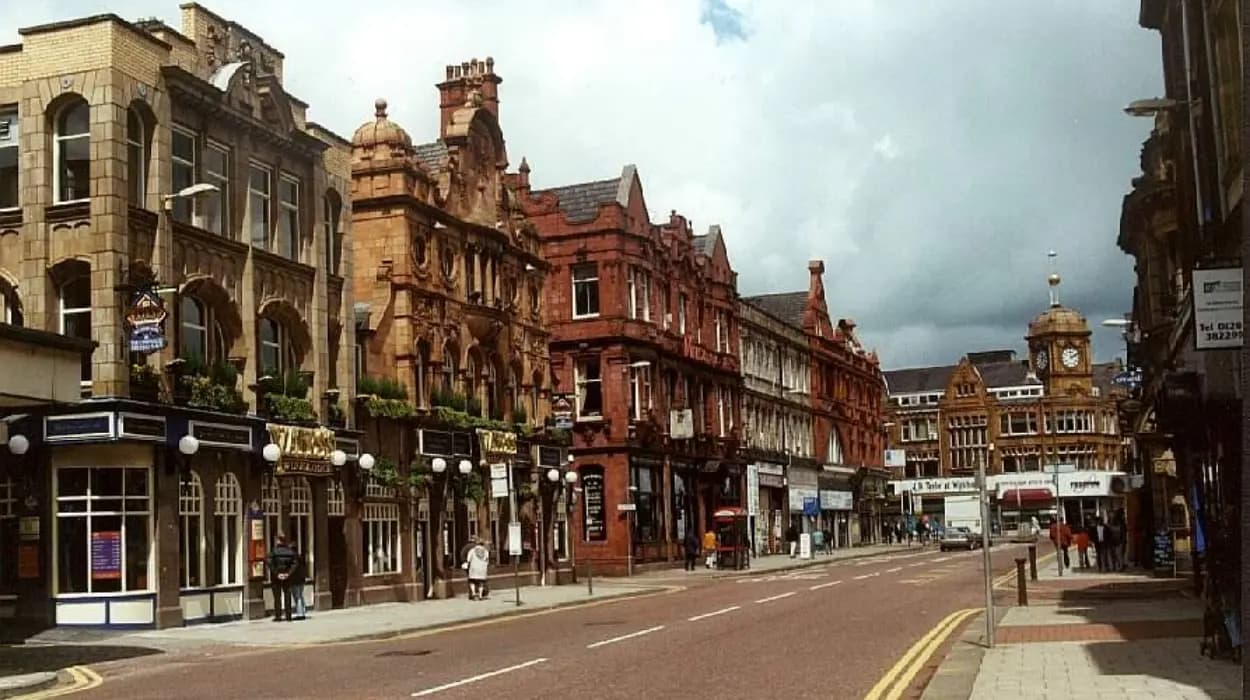
Bolton's old streets and town centre preserve more than 800 years of urban development, reflecting the transformation of a medieval market settlement into one of Britain's leading industrial towns. Historic routes, market spaces, religious buildings, civic architecture, and surviving commercial streets reveal how trade, textile manufacturing, transport, and local government shaped the borough. Today, these streets remain essential historical assets that document Bolton's social, economic, and architectural evolution across successive centuries.
What is the historical significance of Bolton's old streets and town centre?
Bolton's old streets and town centre represent the continuous evolution of an English market settlement from the medieval period through the Industrial Revolution into the modern era. Their street pattern, public buildings, and commercial spaces preserve evidence of over eight centuries of economic, architectural, and civic development.
The historic centre of Bolton occupies the area surrounding the medieval parish church, market place, and principal trading streets. Although many buildings have changed through redevelopment, the underlying street network follows routes established during the Middle Ages.
Bolton emerged as an important settlement within Lancashire because of its position between Manchester, Preston, Wigan, and Blackburn. Medieval roads converged on the town, encouraging weekly markets and regional commerce. These transport connections enabled Bolton to develop into one of northwest England's most significant textile centres.
Unlike many planned Victorian towns, Bolton expanded organically. Medieval lanes gradually widened into commercial streets as population growth increased demand for housing, workshops, inns, warehouses, and public institutions.
The town centre therefore illustrates multiple historical periods rather than one single architectural era. Medieval foundations coexist with Georgian commercial buildings, Victorian civic architecture, Edwardian retail premises, twentieth-century developments, and twenty-first-century regeneration projects.
Historic England identifies Bolton's surviving historic environment as an important record of Lancashire's industrial heritage because the urban form demonstrates how textile production reshaped provincial English towns during the eighteenth and nineteenth centuries.
How did Bolton's medieval streets first develop?
Bolton's medieval streets developed around the manor, parish church, and market place between the twelfth and fourteenth centuries. Trade, agriculture, and local administration determined the layout, creating narrow routes that later formed the foundation of the modern town centre.
Bolton is recorded in medieval documents following the Norman period, although archaeological evidence indicates earlier settlement activity in the surrounding area.
The medieval town centred on the parish church, today's Bolton Parish Church, dedicated to St Peter. Churches functioned as religious, administrative, and social centres throughout medieval England. Markets commonly developed beside churches because they attracted regular visitors.
Bolton received a market charter during the thirteenth century, formalising commercial activity and encouraging merchants from neighbouring communities to trade within the town.
The earliest streets connected important destinations rather than following geometric planning principles. Roads linked farms, mills, churches, bridges, and market spaces. Their irregular alignment explains why parts of Bolton's historic street pattern differ from later Victorian grid layouts.
Many medieval buildings disappeared during later redevelopment, but archaeological investigations continue to identify foundations, property boundaries, and artefacts beneath the modern streetscape.
The medieval economy focused on agriculture, wool production, local crafts, and regional trade before textile manufacturing transformed the settlement.
Why did Bolton's market become the centre of urban growth?
Bolton's market concentrated trade, employment, and civic activity in one location, attracting merchants, farmers, craftsmen, and residents. Continuous commercial exchange encouraged surrounding streets to develop into permanent retail, residential, and administrative districts over several centuries.
Markets formed the economic heart of medieval English towns.
Bolton's market enabled farmers from surrounding villages to sell grain, livestock, dairy products, vegetables, wool, and household goods. Regular trading days created predictable commercial activity that stimulated investment in shops, inns, workshops, and storage facilities.
As commerce expanded, adjoining streets developed specialised functions. Some accommodated merchants, while others contained blacksmiths, textile workers, food sellers, or legal professionals.
Market taxation generated income for local authorities, enabling investment in roads, drainage, bridges, and public buildings.
The market also strengthened Bolton's regional influence. Residents from communities including Horwich, Blackrod, Farnworth, Turton, Halliwell, and Westhoughton travelled into Bolton for trade and administrative services.
Even after industrialisation, Bolton Market remained central to local life, adapting from agricultural trading towards manufactured goods, clothing, food retail, and household products.
How did the textile industry transform Bolton's historic streets?
The textile industry transformed Bolton's historic streets by replacing small-scale medieval commerce with industrial manufacturing, warehouses, workers' housing, banking institutions, and transport infrastructure. Rapid industrialisation fundamentally altered the town's economy, architecture, and population during the eighteenth and nineteenth centuries.
Bolton became internationally recognised as one of Britain's foremost cotton-spinning towns.
The Industrial Revolution accelerated after technological innovations including the spinning mule, developed by Samuel Crompton in nearby Hall i' th' Wood during the late eighteenth century.
Cotton mills required reliable transport, skilled labour, engineering workshops, financial services, and commercial premises. Historic streets that once served local markets increasingly supported industrial production.
Banks financed mill construction.
Insurance companies protected valuable machinery.
Warehouses stored imported raw cotton and exported finished textiles.
Engineering firms manufactured machinery for spinning and weaving.
Population growth transformed the town dramatically.
Around 5,000 people lived in Bolton during the early eighteenth century. By the mid-nineteenth century, the population exceeded 70,000 before continuing to rise throughout the Victorian era.
Urban expansion created new streets while older routes accommodated heavier commercial traffic.
Many surviving nineteenth-century buildings within the town centre date from this remarkable period of industrial prosperity.
Which historic streets shaped Bolton's commercial identity?
Several historic streets established Bolton's commercial identity by concentrating retail trade, banking, professional services, entertainment, and public administration. These streets collectively illustrate how the town evolved from a medieval marketplace into a thriving industrial and commercial centre.
Deansgate became one of Bolton's principal commercial routes during the eighteenth and nineteenth centuries. Shops, financial institutions, hotels, and civic buildings lined the street, reflecting increasing prosperity.
Bradshawgate connected commercial districts with residential neighbourhoods while supporting retail growth throughout the Victorian period.
Bridge Street expanded alongside industrial development, linking important transport routes with manufacturing districts.
Churchgate retained close associations with Bolton Parish Church and the medieval core of the settlement.
Victoria Square emerged during nineteenth-century civic improvements, providing space for significant public buildings and monuments.
Many original shopfronts changed during twentieth-century redevelopment, yet the historic alignment of these streets continues to define movement through the town centre.
What architectural styles can still be seen in Bolton's town centre?
Bolton's town centre displays medieval foundations, Georgian commercial architecture, Victorian civic buildings, Edwardian retail premises, twentieth-century public structures, and contemporary regeneration. Together these architectural periods illustrate more than three centuries of continuous urban development.
The oldest surviving architectural influence appears in the historic parish church, although extensive rebuilding occurred over successive centuries.
Georgian architecture introduced symmetrical façades, brick construction, sash windows, and proportionate commercial buildings.
Victorian architecture dominates much of the surviving historic townscape. Public confidence generated by industrial wealth encouraged construction of elaborate civic buildings using sandstone, terracotta, decorative brickwork, and Gothic Revival detailing.
Examples include civic offices, educational institutions, libraries, banks, and former commercial premises.
Edwardian buildings introduced lighter decorative styles while expanding retail opportunities for an increasingly prosperous urban population.
Twentieth-century redevelopment replaced some historic buildings with modern commercial structures. Recent regeneration continues to balance economic development with conservation priorities.
How did transport influence the layout of Bolton's old streets?
Transport networks reshaped Bolton's historic streets by improving regional connectivity, increasing commercial traffic, and supporting industrial expansion. Roads, canals, railways, and later motor transport each altered how the town centre functioned without completely replacing its medieval foundations.
Early movement relied on horse-drawn transport using medieval roads.
Turnpike trusts improved road quality during the eighteenth century through organised maintenance funded by tolls.
The opening of nearby canals strengthened connections with Manchester, Liverpool, and Lancashire's industrial districts, reducing transport costs for raw cotton and finished textiles.
Railway expansion during the nineteenth century fundamentally transformed Bolton's accessibility.
Bolton railway station connected the town with national markets, encouraging additional commercial investment within the town centre.
Transport improvements stimulated hotel construction, warehousing, wholesale trade, banking, and professional services.
Motor vehicles introduced wider roads, traffic management systems, and parking infrastructure during the twentieth century, although the historic street pattern remained recognisable.
What role did civic buildings play in shaping Bolton's town centre?
Civic buildings demonstrated Bolton's growing economic strength, administrative importance, and public confidence. Town halls, libraries, courts, schools, museums, and religious institutions established the town centre as both a commercial and governmental hub.
Industrial prosperity enabled substantial public investment throughout the nineteenth century.
Municipal government expanded responsibilities for sanitation, education, policing, public health, and infrastructure.
Purpose-built civic architecture reflected these responsibilities.
The Town Hall became a visible symbol of local government and democratic administration.
Public libraries promoted literacy and lifelong education during rapid industrialisation.
Museums preserved scientific, artistic, and historical collections while encouraging public learning.
Religious institutions continued serving spiritual, educational, and charitable functions despite increasing urbanisation.
These buildings created distinctive landmarks that remain important components of Bolton's historic identity.
How have Bolton's old streets survived redevelopment?
Bolton's old streets survived successive redevelopment through conservation efforts, adaptive reuse, planning controls, archaeological investigation, and continued commercial use. Although many historic buildings disappeared, the underlying street pattern and significant landmarks continue preserving the town's historical character.
Urban renewal during the twentieth century removed numerous industrial buildings considered obsolete.
Retail redevelopment introduced shopping centres and modern commercial premises.
Despite these changes, conservation policies increasingly recognised the importance of protecting historic environments.
Historic buildings gained statutory protection through listing.
Conservation areas encouraged sensitive management of surviving architectural heritage.
Adaptive reuse enabled former banks, warehouses, mills, and civic buildings to serve new commercial, cultural, residential, or educational purposes.
Archaeological recording before redevelopment documented buried remains, ensuring historical evidence survived even where construction altered the visible landscape.
Current regeneration programmes continue integrating heritage conservation with economic development.
Why do Bolton's historic streets remain important today?
Bolton's historic streets remain important because they preserve evidence of medieval settlement, industrial innovation, civic development, and community identity. They support education, tourism, heritage conservation, local business, and historical research while connecting modern Bolton with its past.
Historic streets provide primary evidence for researchers studying urban development, industrialisation, architecture, genealogy, and regional history.
Educational institutions regularly use the town centre to explain Britain's Industrial Revolution and Victorian municipal development.
Genealogists tracing family history benefit from preserved churches, cemeteries, archives, census records, trade directories, and historic maps that document generations of Bolton residents.
Heritage tourism also contributes to the local economy.
Visitors explore churches, museums, historic public buildings, markets, and surviving commercial streets that illustrate Bolton's transformation across eight centuries.
To experience these historic landmarks in person today, consult our comprehensive [Self-Guided Walking Tour Through Bolton's Most Beautiful Streets and Historic Attractions] for itineraries and visiting parameters.
Historic environments additionally strengthen community identity by connecting contemporary residents with previous generations who shaped the borough through commerce, manufacturing, public service, education, and civic leadership.
What does the future hold for Bolton's historic town centre?
Bolton's historic town centre combines heritage conservation with urban regeneration, ensuring significant historic streets and buildings remain relevant within a modern regional economy. Sustainable preservation protects architectural character while supporting commercial investment, education, tourism, and community life.
Bolton continues implementing long-term regeneration strategies that seek to revitalise commercial activity while respecting historic character.
Major redevelopment projects increasingly incorporate heritage assessments before construction begins.
Digital mapping, archival digitisation, and archaeological research continue expanding historical understanding of the town centre.
Historic England, Bolton Council, local museums, archives, universities, and community heritage organisations collaborate to preserve significant structures and historical records.
Climate adaptation also influences future conservation through improved maintenance of historic masonry, drainage systems, and public spaces.
As Britain's industrial heritage gains increasing international recognition, Bolton's surviving streets and civic landscape remain valuable examples of how medieval settlements evolved into globally significant manufacturing centres.
The history preserved within Bolton's old streets extends beyond individual buildings. Their layout reflects centuries of commerce, religion, governance, engineering, transport, and community development. From medieval market lanes to Victorian civic avenues and modern regeneration projects, the town centre continues illustrating the enduring relationship between place, people, and economic change. Preserving these streets ensures future generations can understand how Bolton contributed to Lancashire's development, Britain's Industrial Revolution, and the wider history of urban Britain.
FAQS
What is the oldest street in Bolton?
While the exact oldest street cannot be confirmed, Churchgate, Deansgate, and streets surrounding Bolton Parish Church and the historic Market Place follow medieval routes that have existed for centuries.