Key Points
- Safety Fears Trigger Clearance: A Bolton property owner has cleared a heavily overgrown parcel of land adjacent to his home, citing immediate concerns over public safety and the welfare of local schoolchildren.
- Discovery of Hazardous Waste: The landowner uncovered dangerous drug paraphernalia, including multiple discarded hypodermic needles, hidden within the dense vegetation.
- Proximity to Local School: The site’s close location to a local educational facility sparked acute anxieties that children could easily access the area and suffer needle-stick injuries or encounter anti-social behavior.
- Retrospective Planning Action: Having completed the unapproved excavation and laid down a gravel parking area, the resident has submitted a retrospective planning application to Bolton Council to regularise the structural changes.
- Community and Infrastructure Impact: Prior to the clearance, the neglected plot attracted fly-tipping, dog fouling, and anti-social gatherings, while overgrown trees damaged local property and leaf build-up threatened a nearby electricity generator.
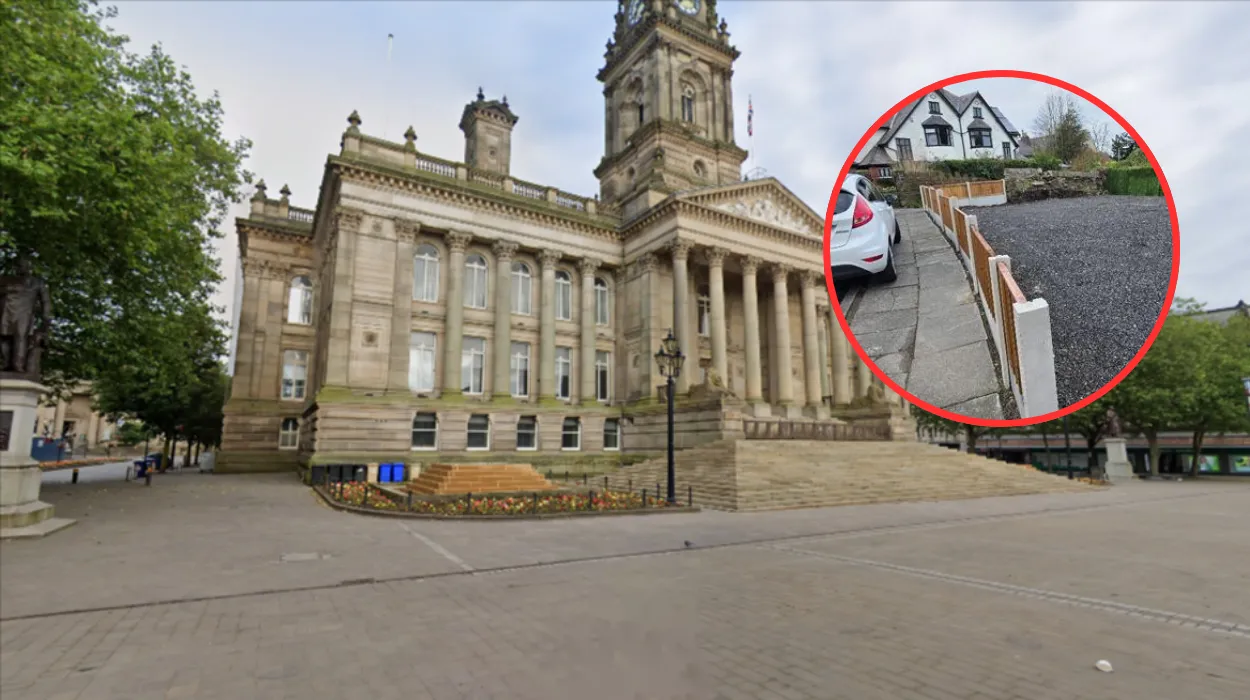
Astley Bridge (Bolton Today) June 6, 2026 - A local homeowner in the Astley Bridge area has undertaken an emergency clearance of a heavily neglected parcel of land next to his property, claiming that the discovery of discarded hypodermic needles and severe threats to the safety of nearby schoolchildren left him with no choice but to act before seeking formal municipal approval. The resident, whose property sits at Sweetloves Grove, has subsequently submitted a retrospective planning application to Bolton Council after completely removing the dense vegetation and converting the troubled plot into a formal gravel parking area. Municipal planning documents reveal that the site had deteriorated into a severe localized hazard, frequently acting as a magnet for illicit anti-social behavior, persistent littering, and fly-tipping.
According to formal planning representations, the homeowner acted in good faith, firmly believing at the time that formal administrative permission was not legally required to clear vegetation from land within his possession. The subsequent discovery of hazardous chemical and biological waste, combined with longstanding structural complaints from neighboring residents regarding property damage caused by overhanging branches, ultimately accelerated the unauthorized works. Bolton Council’s planning department is now tasked with reviewing the retrospective application, which seeks formal permission to retain the newly laid gravel surface, formalize the parking usage, and implement a comprehensive perimeter hedge scheme to restore local biodiversity and soften the visual impact of the development.
Why Was The Overgrown Land Near A Bolton School Cleared Safely Without Prior Planning Permission?
As reported by Isobel Forbes of The Bolton News, the core justification underpinning the unapproved engineering and clearance works was an immediate, high-risk threat to community safety, particularly regarding the vulnerable youth population attending a nearby school. The layout of the plot meant that local children were at constant risk of gaining unauthorized access to a zone that had effectively become an unmonitored sanctuary for illicit activity.
In the official Design and Access Statement submitted to the local authority, the applicant highlighted the extreme proximity of the site to the local school gates, noting that the risk of a child wandering into the dense undergrowth and suffering a catastrophic injury was an unacceptable hazard that required immediate intervention.
Beyond the social dangers, the physical state of the vegetation had begun to compromise critical infrastructure. As documented by Isobel Forbes of The Bolton News, the structural neglect of the site had led to an extraordinary accumulation of leaf litter and organic debris, which was actively disrupting and compromising the operational safety of a nearby electricity generator. Faced with a compounding mix of infrastructural risk, biological hazards, and child safety concerns, the landowner elected to execute the site cleanup to stabilize the neighborhood block.
Explore More Astley Bridge
Residents Slam Council Over Overgrown Cemetery Grass: Bolton 2026
Homeowner Faces Forced Removal of Refused Blackburn Road Fence, Astley Bridge 2026
What Types Of Hazardous Waste And Anti-Social Behavior Were Discovered On The Astley Bridge Site?
The internal environmental conditions of the Sweetloves Grove plot prior to its clearance were described in municipal documents as both volatile and hazardous. As reported by Isobel Forbes of The Bolton News, the applicant explicitly detailed the discovery of "hazardous waste" scattered throughout the dense thickets, a classification that specifically included discarded hypodermic needles left behind by substance abusers.
The presence of drug paraphernalia near an educational path created an immediate safeguarding crisis for the community. The planning files underscore that the area was experiencing a severe decline in public order, characterized by:
- Persistent anti-social behavior and unauthorized nocturnal gatherings.
- Chronic fly-tipping and the illegal dumping of household and industrial litter.
- Systemic dog fouling that rendered the public borders of the land unusable for pedestrians.
The combination of dense cover and zero visibility allowed these illicit activities to continue entirely unpoliced, transforming a standard plot of domestic land into an active neighborhood biohazard.
How Did The Overgrown Vegetation Affect Sweetloves Grove Residents And Local Infrastructure?
The consequences of the site’s long-term neglect extended far beyond the boundaries of the plot itself, directly impacting the material property and peace of mind of neighboring residents. As reported by Isobel Forbes of The Bolton News, local neighbors had repeatedly voiced severe anxieties regarding the structural integrity of overhanging branches emanating from the dense canopy.
These uncontrolled branches had transitioned from a simple visual nuisance into an active financial liability, with documented instances of branches falling onto and causing physical damage to local vehicles parked nearby, as well as striking adjacent residential properties during periods of high winds.
Furthermore, the environmental degradation of the plot had started to affect the local power grid's resilience. The massive volume of falling leaves and unmanaged organic detritus had begun to encroach upon a nearby electricity substation generator, creating a distinct mechanical and fire hazard through air intake blockages and localized dampness. The homeowner emphasized that the clearance operations were heavily motivated by a neighborly duty to eliminate these escalating physical risks to private vehicles, homes, and utility infrastructure.
What Does The Homeowner’s Retrospective Planning Application To Bolton Council Actually Propose?
Following the total removal of the problematic thickets, the Sweetloves Grove resident has moved to regularize the site’s status within the bounds of UK planning law. As reported by Isobel Forbes of The Bolton News, the retrospective planning application filed with Bolton Council details a dual strategy focused on domestic utility and ecological remediation. The application formally requests the legal retention of the cleared land and the newly established gravel parking surface, which now serves as a clean, highly visible vehicle staging area next to his home.
To address any potential visual or environmental criticisms from the municipal planning board, the homeowner has integrated a comprehensive landscaping mitigation strategy into his proposal. As reported by Isobel Forbes of The Bolton News, the applicant intends to plant a managed hedge around the entire perimeter of the newly graveled parking area. This architectural addition is designed to achieve two distinct goals:
- Biodiversity Enhancement: To introduce native plant species that support local urban wildlife and pollinators, offsetting the loss of the wild undergrowth.
- Visual Softening: To replace a stark gravel boundary with a clean, green aesthetic that aligns with the residential character of Astley Bridge.
The applicant has explicitly provided legal assurances within the documentation that no permanent buildings or outstructures have been erected on the parcel, and the application confirms there are absolutely no plans for future commercial or residential development on the site.
What Are The Legal Ramifications Of Retrospective Planning Applications In Municipal Development?
Under the framework of the Town and Country Planning Act 1990, executing engineering works or material changes of use to land without prior municipal authorization technically constitutes a breach of planning control. However, as local government administrative guidelines dictate, a breach of planning control is not a criminal offense in its initial stages. The retrospective planning process utilized by the Sweetloves Grove homeowner is a legitimate legal avenue provided by UK law, allowing property owners to request formal validation for works that have already been carried out in real-time.
When evaluating a retrospective application of this nature, Bolton Council's planning committee must disregard the fact that the work has already been completed and assess the development strictly on its planning merits. The key legal tests applied will determine whether the conversion of the overgrown plot into a gravel parking area complies with the Bolton Local Plan, focusing on highway safety, residential amenity, and environmental preservation.
Should Bolton Council choose to refuse retrospective permission, the local authority retains the legal power to issue a formal Planning Enforcement Notice. Such an action would legally compel the homeowner to dismantle the gravel parking structure, remove the aggregate material, and restore the land to its original, overgrown state—an outcome that would strip the neighborhood of its newly established parking security and potentially reopen the site to the historical issues of anti-social behavior and hazardous waste accumulation. A definitive decision on the matter remains pending with municipal officers.