Key Points
- Growing Confusion: Westhoughton Town Councillors have expressed severe frustration and confusion regarding ongoing delays and rising structural issues at the historic Westhoughton Town Hall.
- Significant Financial Investment: Despite an initial budget allocation of £3.5 million—which later rose to a £3.9 million restoration project package funded by Bolton Council—the landmark building remains non-operational for standard municipal services.
- Massive Secondary Faults: Although over £900,000 had already been expended on specific repair works, a subsequent structural review revealed that the 1903 Grade II-listed building requires a total roof replacement due to ongoing water ingress.
- High Scaffolding Overhead Costs: Local representatives have raised concerns over the compounding economic impact of structural delays, notably the scaffolding surrounding the redbrick building, which is reportedly costing taxpayers approximately £1,700 per week.
- Long-Term Repurposing Proposals: Amidst structural delays, the site has been proposed by Bolton Council as a potential location for a new Neighbourhood Health Centre to meet the healthcare needs of Westhoughton's growing population.
Westhoughton (Bolton Today) June 9, 2026 - Local municipal authorities have launched an emergency review into the prolonged and costly refurbishment of Westhoughton Town Hall, amidst intensifying community anger over escalating taxpayer outlays. Members of the Westhoughton Town Council have openly challenged the management of the restoration project, following disclosures that the landmark civic hub remains structurally compromised despite millions of pounds in committed funding. The dispute centers on extensive delays in internal and external masonry work, a newly discovered need for a full roof overhaul, and the continuous financial drain of external equipment hire. With the landmark remaining under wraps for an extended duration, local representatives are demanding absolute transparency from the upper-tier authority, Bolton Council, regarding the timeline and exact allocation of public resources.
Why Is Confusion Growing Over the Westhoughton Town Hall Delays?
The structural dilemma surrounding the Edwardian civic building has become a flashpoint for intense political debate between town officials and metropolitan planners. Built in 1903, the redbrick landmark on Market Street has long served as the civic heart of Westhoughton. However, its continued closure has left local councillors searching for definitive answers from the borough administration.
As reported by reporter Dan Dougherty of The Bolton News, structural confusion has escalated rapidly among Westhoughton town councillors regarding repairs to the town hall. The primary source of friction stems from a disconnect between the visible lack of construction progress and the immense financial obligations accumulating against the public purse.
Local representatives have voiced deep concerns that the initial structural remediation plans have stalled significantly, leaving the building unusable for community groups and local administration alike. While initial phases were intended to stabilize the exterior and refurbish the interior council chambers, the extended presence of heavy-duty construction infrastructure has signalled deeper, underlying issues to the public.
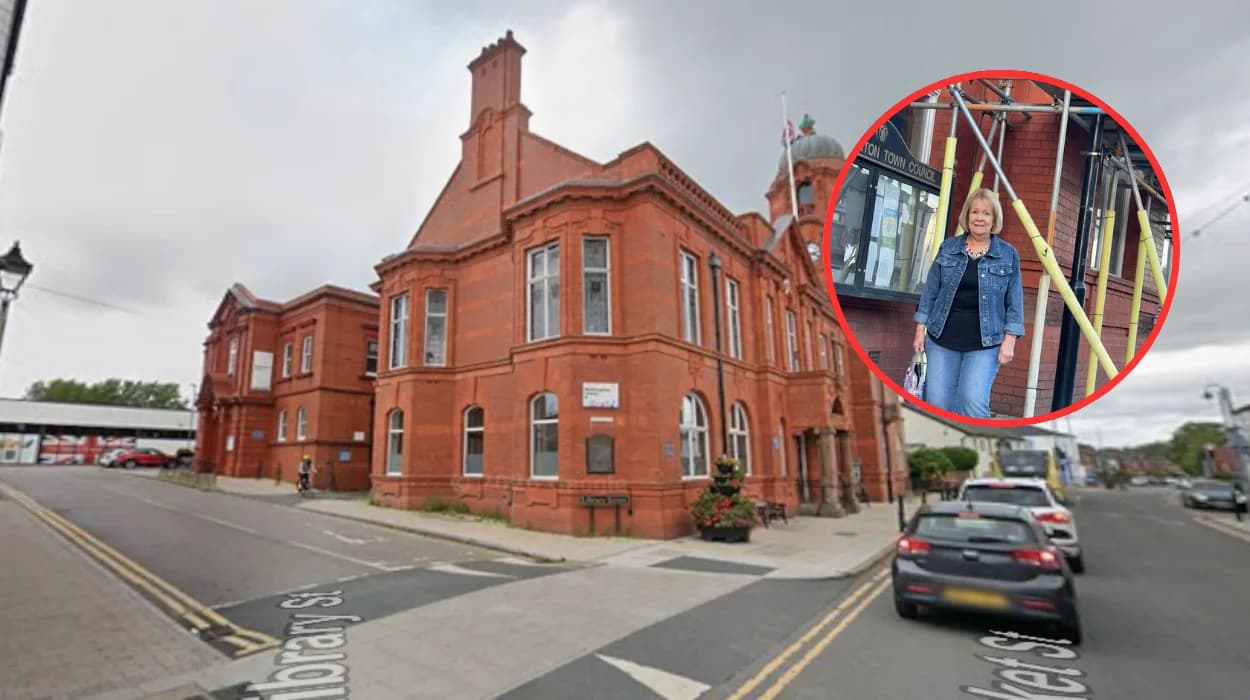
"It doesn't make sense," observed Westhoughton Town Councillor Deirdre McGowan while standing outside the heavily scaffolded Westhoughton Town Hall, as captured by photojournalist David Wilkinson of The Bolton News.
The visual state of the building, completely encased in steel tubes and protective sheets, has drawn widespread criticism from residents who frequent the high street. For a community fiercely proud of its local heritage, the sight of their primary municipal asset languishing in a state of perpetual maintenance has prompted formal demands for administrative accountability.
How Much Is the Town Hall Scaffolding Costing Taxpayers Each Week?
A major source of financial anxiety for the local council is the specialized scaffolding wrapping the structure. Because the building is a Grade II-listed public asset, the scaffolding cannot simply be anchored using standard mechanical procedures; it requires protective padding and custom engineering to safeguard the historic 123-year-old redbrick facade and its central clock tower.
As reported by Dan Dougherty of The Bolton News, frustration has intensified specifically over the scaffolding hire fees, which are estimated to be drawing approximately £1,700 per week from local council reserves.
Councillors have pointed out that every month the project stalls, nearly £7,000 of public money is effectively spent purely on maintaining the steel framework, rather than executing actual physical repairs on the brickwork or internal systems. This ongoing weekly expenditure has amplified demands for the contractor to either accelerate operations or provide a fixed end date for the external phase of the restoration.
Explore More Westhoughton News
Health Centre Planned for Westhoughton Town Hall: Bolton 2026
Westhoughton Town Hall Health Centre Proposal: Bolton Care Report 2026
Why Does the Historic Civic Building Require a Complete New Roof?
The financial equation grew significantly more complex following a comprehensive survey of the upper building envelope. Initially, the renovation schedule concentrated on window replacements, masonry cleaning, and repairing localised leaks in the guttering and downpipes. However, these localized efforts proved entirely inadequate against systemic water ingress that has plagued the upper deck of the council chambers.
As recorded by the editorial team at the Howfen Journal in their community report, Westhoughton Town Hall will remain closed for the foreseeable future after a thorough inspection revealed that the building requires a full roof replacement. This catastrophic diagnosis came to light despite the fact that more than £900,000 had already been systematically spent on various remedial works across the property.
The structural revelation occurred during an official Bolton Council session, where engineering briefs confirmed that water is continuing to leak heavily into the main halls. Planners determined that patch-repairing the century-old slate tiles was no longer viable. To preserve the integrity of the internal plasterwork and prevent structural dry rot, the entire roof must be stripped back to its timber rafters and completely refitted with modern insulation and complementary Welsh slate. Until this entire roof replacement is executed and verified as weather-tight, internal cosmetic and structural joinery work cannot safely proceed.
What Are the Long-Term Funding Plans for the Renovation Project?
The financing of the town hall is tied to a multi-layered funding framework overseen by the metropolitan borough. The capital works are integrated into the broader Westhoughton Town Centre Masterplan, a strategic initiative designed to revitalize commercial and civic spaces across the region.
According to official administrative statements released by Bolton Council, the local authority initially allocated a total of £3.5 million to secure the long-term future of the historic building. Of this total capital injection, a dedicated tranche of £1.5 million was sourced directly from the regional District Centres Fund—a specialised economic pot that is simultaneously delivering major infrastructure upgrades in neighbouring towns such as Farnworth, Horwich, and Little Lever.
As the full extent of the structural degradation became apparent, the total funding package was adjusted upward to a £3.9 million raft of comprehensive improvements. As noted by Bolton Council Leader Councillor Nick Peel during an open public brief:
"We know how proud Westhoughton residents are of this historic building, and what an important role it plays in the local community. This project is a significant investment and allows us to carry out the necessary repair work while also securing the town hall's long-term future."
To ensure the building does not become a permanent financial drain on taxpayers once reopened, the master plan dictates that surplus internal spaces will be converted into modern, functional office suites. These commercial zones will be leased out to local businesses and startups, creating a reliable, long-term revenue stream specifically ring-fenced for the ongoing maintenance and upkeep of the civic site.
Could the Town Hall Be Repurposed Into a Health Centre?
As the structural delays persist, intense discussions have emerged regarding the future occupancy and utility of the building. With Westhoughton experiencing a massive residential expansion over the past two decades due to large-scale housing developments, local infrastructure has come under severe strain, particularly in the primary healthcare sector.
As reported in a recent parliamentary updates column by The Bolton News, the Greater Manchester Integrated Care Board has officially confirmed that Westhoughton Town Hall is currently one of Bolton Council’s primary proposed locations for a brand-new Neighbourhood Health Centre.
This development follows sustained political intervention from local Member of Parliament Phil Brickell, who has actively campaigned for a comprehensive medical facility within the township. Commenting on the strategic viability of the site, Mr Brickell stated:
"With the rapid increase in population in Westhoughton over the past two decades, the need for additional health services has become increasingly urgent. That's why I'm continuing to push for a Neighbourhood Health Centre to be located in Westhoughton. If the Westhoughton Town Council building is deemed to be a suitable location, I believe it could be an excellent option. The building is well placed on a bus route, making it easily accessible for residents, while also giving the site a valuable new long-term purpose at the heart of the community."
The proposed integration of a health centre would sit alongside the preserved civic spaces, such as the historic council chamber. Proponents of the plan emphasize that the town hall's central location on Market Street—positioned directly on major bus routes and situated less than a minute away from the public car park adjacent to the local Aldi supermarket—makes it an ideal location for elderly and vulnerable patients who currently face travel barriers when accessing care.
What Are the Next Steps for the Town Council and Residents?
The immediate focus for Westhoughton’s local representatives is to extract a definitive, binding timeline from the principal contractors and Bolton Council's asset management team. The Town Council's Planning, Finance, and General Purposes Committee has continued to log ongoing resident complaints regarding both the physical unsightliness of the prolonged construction site and the lack of access to municipal resources.
As recorded within the official approved minutes of the Westhoughton Town Council Planning, Finance, and General Purposes Committee, elected members have formally debated the necessity of hosting an open public forum. The committee decided to instruct the Town Clerk to write directly to Bolton Council to formally convey the deep anxieties of local residents. These anxieties encompass not only the physical delays at the town hall but also how the building's prolonged closure impacts wider town planning, parking reallocations, and local economic development.
For now, the scaffolding remains in place, the weekly £1,700 bill continues to accumulate, and the town hall's slate roof awaits the critical interventions needed to save the historic structure from further environmental decay. Local councillors have vowed to maintain pressure on borough officials until the doors of the 1903 landmark are safely thrown open to the public once more.