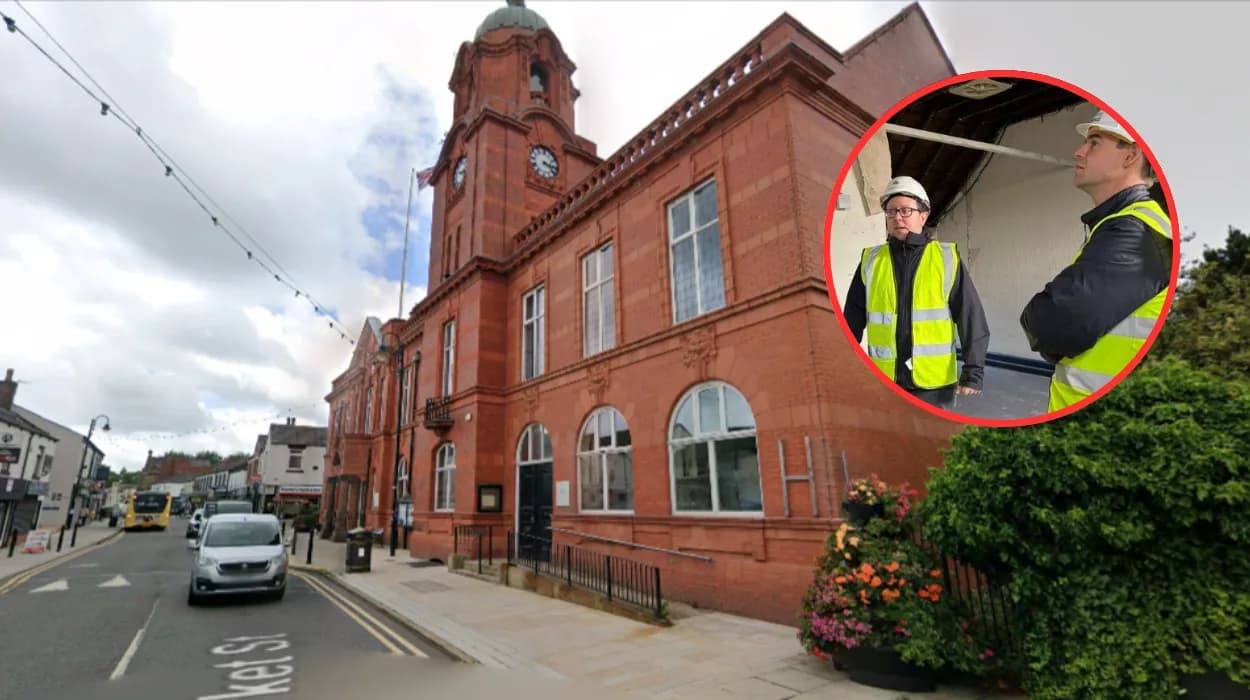
Key Points
- Proposed Location: Westhoughton Town Hall has been officially designated by the Greater Manchester Integrated Care Board as one of Bolton Council’s proposed locations for a brand-new neighborhood health centre.
- Political Driving Force: The initiative has been spearheaded by local Member of Parliament (MP) Phil Brickell, who has actively lobbied the Health Secretary and the Manchester Integrated Care Board to advance the development since 2025.
- Refurbishment and Infrastructure: The historic, Grade II listed redbrick town hall building underwent a substantial £3.9 million refurbishment programme to repair its structure and convert surplus municipal space into usable premises for community and healthcare services.
- Population Demographics: Westhoughton currently supports a growing population of approximately 25,000 residents, a figure projected to increase significantly due to multiple pending residential housing developments.
- Existing Care Provision: Local primary medical care is presently restricted to three main facilities: the Winifred Kettle Health Centre, the Unsworth Group Practice, and the Westhoughton branch of the Pike View Health Centre.
- Impending Housing Expansion: Major infrastructural anxiety stems from imminent housing projects, notably Peel Land’s proposed Lee Hall development, which is expected to construct 1,450 new properties, threatening to increase the town’s footprint by up to 60 per cent.
Westhoughton (Bolton Today) June 1, 2026 — Executive discussions are officially underway between municipal leaders and regional medical authorities to establish a new, state-of-the-art neighbourhood health hub within the historic walls of Westhoughton Town Hall, signaling a major structural overhaul for primary care delivery across the region. The Greater Manchester Integrated Care Board formally confirmed that the landmark municipal building on Market Street stands as one of Bolton Council’s primary proposed sites for an expanded healthcare facility. This crucial administrative step follows multi-year political lobbying by local Member of Parliament, Phil Brickell, who has aggressively championed the repurposing of the town's civic asset to resolve localized health service deficits. Municipal planners believe that integrating a modern clinical environment within the recently modernized, century-old building will effectively centralize critical physiological services, providing an accessible, long-term civic purpose for the Grade II listed landmark at the geographic core of the community.
Why is a new health centre being proposed for Westhoughton Town Hall?
The core motivation behind the proposed facility centers directly on an acute imbalance between Westhoughton's rapidly climbing population and its legacy medical infrastructure. As reported by local journalists covering the Bolton metropolitan borough, the town of roughly 25,000 residents has experienced persistent, compounding strain on its primary care systems.
In an official public briefing documented by the regional press, Phil Brickell MP outlined the escalating structural challenges facing his constituency:
"With the rapid increase in population in Westhoughton over the past two decades, the need for additional health services has become increasingly urgent. That's why I'm continuing to push for a Neighbourhood Health Centre to be located in Westhoughton."
According to the parliamentary representative, a unified facility represents the most logical solution to modernizing municipal care delivery. In statements compiled from his official correspondence to health authorities, Phil Brickell MP further argued:
"A neighbourhood health centre would bring a range of health services together under one roof, making it easier and more convenient for local residents to access the care they need closer to home."
The push to convert parts of the town hall is not entirely unprecedented. In historical council records maintained by Bolton Council, it was noted that as early as August 2025, local representatives were actively searching for sustainable occupiers to occupy excess square footage inside the municipal building. As reported at the time by regional journalists, Councillor John McHugh of the Westhoughton South ward disclosed that he had independently initiated speculative talks with the National Health Service (NHS) regarding the commercial and civic utilization of the vacant upper floors. The overarching strategy, as outlined by executive cabinet members, was to systematically address community grievances regarding a lack of localized clinical access while simultaneously generating a reliable, long-term revenue stream to cover the building's high operational and maintenance costs.
How will the town hall's infrastructure accommodate a medical facility?
Architectural suitability and logistical accessibility are two of the primary reasons why the civic building has emerged as the leading candidate for the Integrated Care Board's health hub project. The building offers localized transport linkages that are highly favorable for elderly, disabled, or low-mobility patients.
The structural asset sits prominently on Westhoughton’s bustling Market Street, placing it squarely on the active routes of several major local transport networks, including the high-frequency 607 bus line. Furthermore, the site is positioned within comfortable, flat walking distance of Westhoughton Railway Station, ensuring that patients traveling from outer rural settlements can access appointments without relying on private vehicles. For individuals who do choose to drive, the site offers substantial parking provisions. A spacious public car park is situated less than a sixty-second walk from the town hall entrance, directly adjacent to the neighborhood's large Aldi supermarket.
Structurally, the building is in its prime condition following an intensive, multi-million-pound engineering intervention. As documented in structural reports by Bolton Council, the landmark underwent a massive £3.9 million raft of capital improvements and restorations. The wide-ranging maintenance project, which initially saw extensive scaffolding erected around the Grade II listed redbrick facade, targeted critical structural vulnerabilities that had plagued the 1903 building for years.
The capital expenditure fully repaired the town hall's aging roof, its historic clock tower, external guttering, downpipes, and the primary brick facade. Internally, the project meticulously renovated the historic council chamber while completely stripping out and modernizing surplus office rooms on the upper floors. Consequently, the building now features clean, highly adaptable spaces that conform to modern building regulations, making it uniquely prepared for transition into clinical examination rooms, administrative offices, and diagnostic suites.
Explore More Westhoughton News
Westhoughton Forms New Working Group to Combat Overdevelopment: Westhoughton 2026
Gates Primary Westhoughton Unveils Old Bus Reading Space, Westhoughton 2026
What are the population and housing pressures driving this development?
The urgency behind the health board’s current feasibility talks is heavily underscored by a looming wave of major housing developments threatening to overwhelm Westhoughton's public services. Local planning records indicate that if a series of impending residential applications are approved alongside the broader Bolton Local Plan, the town's geographic and demographic footprint could skyrocket by up to 60 per cent.
The most prominent variable in these expansion anxieties is a massive master plan spearheaded by property developers Peel Land. Known as the Lee Hall development, this single project seeks to construct an astonishing 1,450 new homes near the northwestern boundary of the town. While Peel Land's current blueprints do technically incorporate provisions for integrated onsite health facilities, regional planners and independent watchdogs express deep skepticism regarding whether such private provisions can keep pace with the sheer volume of new incoming residents.
When coupled with several smaller, separate residential planning bids interspersed throughout the district, the total number of new homes currently looming on Westhoughton’s immediate horizon easily clears the 2,000-property threshold. This projected influx of thousands of new families has triggered widespread concern among local community groups, who argue that the town’s existing civic infrastructure is fundamentally incapable of absorbing such rapid growth without a corresponding, proactive expansion of statutory medical services.
Which medical facilities currently serve the Westhoughton community?
At present, Westhoughton's 25,000 citizens are dependent on a highly consolidated network of primary care providers. This network consists almost entirely of three traditional practices:
- The Winifred Kettle Health Centre: A long-standing local community health hub providing localized clinical treatment.
- The Unsworth Group Practice: A major primary care practice that recently underwent modern administrative shifts, including transitioning to formalized digital triaging systems to manage high patient volumes.
- The Pike View Health Centre (Westhoughton Branch): A secondary branch office providing essential general practitioner services to the local populace.
Additionally, the area is home to specialized medical providers such as the Time Wellness Clinic. However, because this private establishment deals exclusively with sports-related physiotherapy and musculoskeletal rehabilitation, it cannot legally or practically absorb any portion of the town’s escalating general practitioner, pediatric, or acute triage burdens.
The three core GP facilities have historically reported immense pressure on appointment availability. The strain has been a frequent point of contention during municipal political debates, with local cross-party politicians frequently citing lengthy telephone hold times and limited face-to-face consultations as a primary source of frustration for their constituents.
What political obstacles and debates preceded the health hub talks?
The road to utilizing Westhoughton Town Hall for healthcare services has been marked by fierce political debate, fiscal scrutiny, and friction within the local authority. The £3.9 million restoration budget, while ultimately successful, faced intense pushback from opposition politicians who questioned the council's financial management of the historic asset.
As recorded in official municipal transcripts, Councillor David Wilkinson, representing the Westhoughton South ward, repeatedly raised serious concerns during formal council sessions regarding the efficiency of the building works. At a heated council meeting, Councillor Wilkinson openly challenged the executive leadership, stating that he was deeply concerned the local authority may have effectively "wasted" an estimated £900,000 on early, unsuccessful attempts to repair the town hall's roof, which had continued to suffer from persistent, destructive leaks despite the significant public expenditure.
Councillor Wilkinson continued to exert pressure on the ruling cabinet throughout the process, formally demanding that Westhoughton’s local elected officials be granted much greater transparency and more frequent, detailed briefings regarding the true scale and internal progression of the engineering works.
The project also suffered from administrative errors that fueled local political skepticism. Municipal diaries show that the council had to publicly acknowledge and correct administrative mistakes after an error occurred concerning the scheduling and notifications for a vital town hall renovation meeting. The mistake drew sharp criticism from local representatives who argued that the upper floors were being systematically "ripped out" without adequate communication or firm guarantees regarding what would ultimately replace the old municipal offices.
The funding mechanism itself required careful negotiation. The capital was eventually secured by the local authority through a structured allocation, with £1.5 million explicitly drawn from the council's specialized District Centres Fund. This fund is part of a broader, highly competitive regional regeneration initiative that has simultaneously been utilized to bankroll major high street overhauls in neighboring townships, including Farnworth, Horwich, and Little Lever.
What are the next steps for the proposed health centre?
While the formal confirmation from the Greater Manchester Integrated Care Board represents a massive bureaucratic milestone for the project, the transition from empty municipal rooms to an active, regulated clinical workspace requires the navigation of several complex administrative stages.
The immediate next phase involves an exhaustive structural and clinical feasibility assessment. Medical officers and healthcare architects must thoroughly audit the town hall's newly refurbished interior layout to verify that it can legally accommodate rigorous NHS clinical safety standards, patient confidentiality requirements, and modern infection control measures. Furthermore, the Integrated Care Board must negotiate formal lease or transfer agreements with Bolton Council to legally define how the building's operational costs and ongoing maintenance liabilities will be split between the health service and the local authority.
On the political front, Phil Brickell MP has vowed to maintain maximum pressure on both a regional and national level to ensure the project does not stall within the bureaucratic pipeline. Commenting on the positive initial feedback from health executives, Mr Brickell MP stated:
"I was encouraged by the positive response from the Manchester Integrated Care Board after I wrote to them and the Health Secretary to make the case, having also met with a number of other important stakeholders."
The Member of Parliament concluded his public briefing by reaffirming his long-term commitment to the infrastructural campaign, asserting:
"If the Westhoughton Town Council building is deemed to be a suitable location, I believe it could be an excellent option... I will continue pressing for progress so that such a facility can be delivered as quickly as possible for our community."
As the Integrated Care Board moves closer to finalizing its geographic evaluations, the residents of Westhoughton remain watchful. For a community facing rapid urban expansion and intensifying public service strain, the successful conversion of their historic town hall represents more than just the preservation of a century-old landmark—it stands as a vital lifeline for the future of their local healthcare.