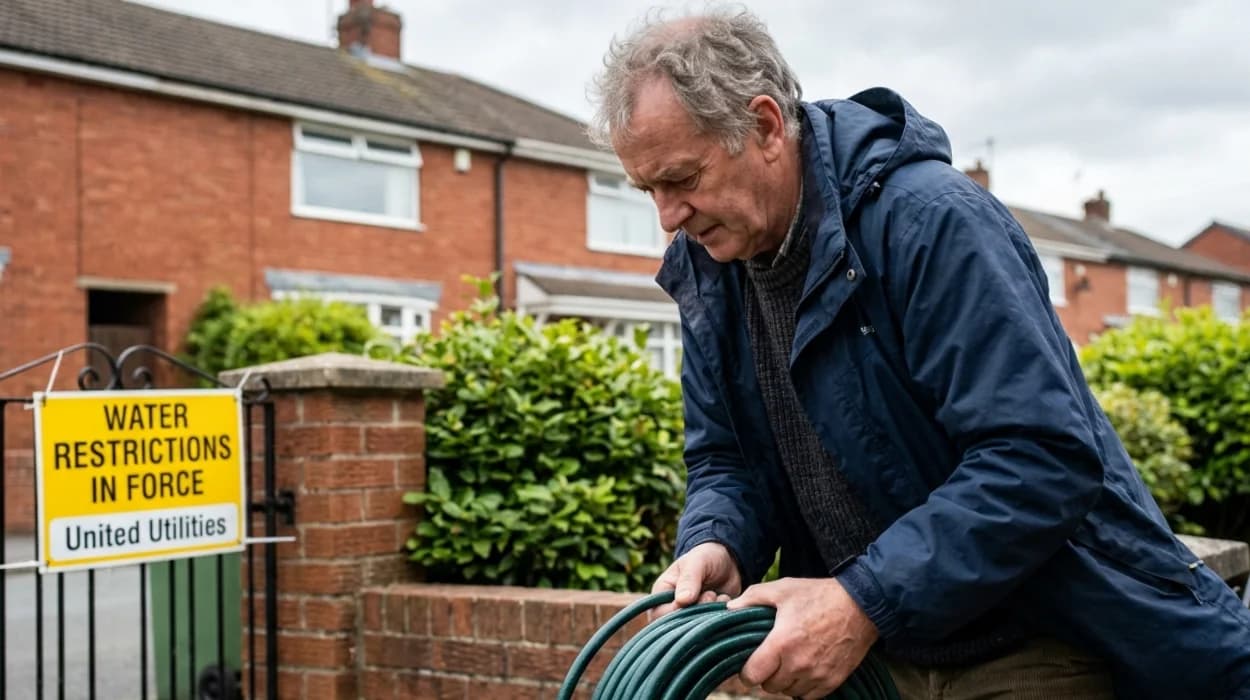
Water resource management in the United Kingdom directly impacts local communities during extended periods of dry weather. For residents across Greater Manchester, understanding the specific regulations, mechanisms, and legal frameworks surrounding a temporary use ban ensures civic compliance and environmental preservation. This definitive guide by Bolton Today outlines the comprehensive legal structure, enforcement processes, and household exemptions regarding what is publicly termed a Bolton hosepipe ban.
What Is a Legal Bolton Hosepipe Ban?
A Bolton hosepipe ban is a legally enforceable restriction called a Temporary Use Ban enacted by water companies under the Water Industry Act 1991 to restrict specified water-use activities. The restriction targets non-essential mains water usage via hosepipes, sprinklers, and pressure washers to safeguard local drinking water supplies.
The statutory mechanism modernizing these powers is Section 76 of the Water Industry Act 1991, which was amended by Section 36 of the Flood and Water Management Act 2010. These legislative acts grant regional water utility companies, such as United Utilities in the North West, the explicit legal power to prohibit or restrict specific uses of water without requiring parliamentary approval. A Bolton hosepipe ban applies explicitly to water drawn through a hosepipe or similar apparatus connected to the public mains supply network.
The legislation designates 11 specific categories of water use that utility companies can legally restrict. These 11 statutory categories are:
- Watering a garden using a hosepipe.
- Cleaning a private motor vehicle using a hosepipe.
- Watering plants on domestic or other non-commercial premises using a hosepipe.
- Cleaning a private leisure boat using a hosepipe.
- Filling or maintaining a domestic swimming or paddling pool.
- Drawing water for domestic recreational use.
- Filling or maintaining a domestic pond.
- Filling or maintaining an ornamental fountain.
- Cleaning walls or windows of domestic premises using a hosepipe.
- Cleaning paths or patios using a hosepipe.
- Cleaning other artificial outdoor surfaces using a hosepipe.
The term "hosepipe" within the statutory definitions encompasses any flexible tube, pressure washer, trickle irrigation line, or automated sprinkler system that directs mains water onto an outdoor surface or object within residential properties.
Why Do Water Companies Enact Temporary Use Bans?
Water companies enact temporary use bans when prolonged lack of rainfall combined with exceptionally high consumer demand depletes regional reservoirs and groundwater resources. The restrictions lower peak daily water demand, ensuring adequate water pressure for essential drinking, sanitation, and emergency firefighting services.
The implementation of a Bolton hosepipe ban is rarely triggered by short-term weather fluctuations. The decision rests on long-term hydrological data collected over multiple months. Regional water networks rely on a combination of surface reservoirs, such as those located across the West Pennine Moors and the Lake District, and underground aquifers, which are deep geological water storage layers. When winter and spring rainfall drops below historical averages, these natural storage facilities fail to recharge adequately.
During a heatwave, consumer demand rises exponentially. United Utilities must increase water production by up to 30% to maintain baseline network pressure. When demand outpaces the speed at which treatment works can process raw water, localized water pressure drops, which threatens supply to hospitals, care facilities, and standard domestic taps. By cutting out high-volume outdoor water apparatuses, water companies can reduce overall network demand by 10% to 15%, conserving millions of liters of water daily.
What Are the Penalties for Breaking a Bolton Hosepipe Ban?
Individuals who breach a Bolton hosepipe ban commit a criminal offense under Section 76 of the Water Industry Act 1991 and face a maximum fine of £1,000. Enforcing water authorities prosecute non-compliant individuals through the magistrates' court system following formal investigations.
The legal framework explicitly positions the unauthorized use of a mains-fed hosepipe during a ban as a summary offense. While water providers like United Utilities typically prioritize public education and issue written warnings initially, persistent non-compliance results in formal prosecution. Evidence of a breach is compiled via direct observations by utility field staff, digital photographic submissions from members of the public, or localized water meter data surges.
If a water company chooses to prosecute, the case is referred to the local magistrates' court. A conviction results in a non-custodial criminal record and a financial penalty up to level 3 on the standard scale, which equals £1,000. All financial penalties collected from these prosecutions go directly to the court system rather than inflating the profits of the private water utility company.
Which Core Activities Are Explicitly Prohibited?
The primary prohibited activities under a standard Bolton hosepipe ban involve any outdoor task utilizing a hosepipe connected to the mains water supply. These restrictions cover domestic lawn watering, vehicle cleaning, patio pressure-washing, and the filling of recreational water structures.
The statutory language leaves no ambiguity regarding the types of domestic apparatuses banned. Sprinklers, which distribute water into the air via mechanical motion, are banned due to high evaporation rates. Pressure washers, which use high-velocity streams, are restricted for all non-commercial residential cleaning tasks.
The specific domestic prohibitions enforced during a standard ban include:
- Lawn and Garden Upkeep: Operating a hosepipe or sprinkler to water grass, flower beds, shrubs, or decorative residential foliage.
- Private Vehicle Valeting: Washing cars, vans, motorbikes, trailers, or caravans using a hosepipe or attached brush accessory.
- Property Maintenance: Cleaning external residential brickwork, windows, roof tiles, fascia boards, or guttering using a hosepipe.
- Grounds Cleaning: Spraying down driveways, stone patios, wooden decking, garden pathways, or artificial lawns with mains water.
- Recreational Water Accumulation: Filling, topping up, or maintaining domestic swimming pools, hot tubs, paddling pools, water slides, or garden fountains.
What Specific Exceptions Exist for Households and Businesses?
Statutory exemptions protect commercial businesses, animal welfare, public health and safety, and vulnerable individuals registered on utility priority water services. These individuals can legally use a hosepipe for specified purposes without facing prosecution under the Water Industry Act.
The Flood and Water Management Act 2010 provides clear statutory exceptions to ensure that necessary economic activity, public safety, and animal health are not compromised by environmental restrictions. These exceptions do not require a formal application process; they apply automatically to individuals who meet the precise criteria.
Commercial and Professional Exceptions
Commercial operations whose primary revenue depends directly on hosepipe use are exempt from a Bolton hosepipe ban. Examples of commercial exemptions include commercial car washes using fixed professional machinery, professional landscaping businesses maintaining commercial nursery stock, and commercial agricultural operations growing food crops for market sale. Public service vehicles, such as ambulances, fire engines, and commercial goods transport trucks, are completely exempt from cleaning restrictions to maintain safety standards.
Health, Accessibility, and Welfare Exceptions
Vulnerable individuals face different conditions under the law. Households registered on the United Utilities Priority Services Register, Blue Badge holders, and individuals on the WaterSure tariff who are physically incapable of lifting a watering can are automatically granted an exemption to use a hosepipe for essential domestic garden maintenance. Furthermore, using a hosepipe is permitted if it is strictly necessary for health and safety reasons, such as removing biohazardous material from a path or preventing the spread of a declared transmissible disease.
How Can Residents Maintain Properties Without a Hosepipe?
Residents can maintain their gardens and properties during a ban by utilizing non-mains water sources, applying manual delivery systems, and harvesting rainwater. Greywater reuse and structural modifications to outdoor spaces minimize dependency on the primary public water supply network.
Compliance with a Bolton hosepipe ban does not require homeowners to abandon property care. The restriction applies to mains water delivered via a hosepipe; it does not ban manual watering or the use of recycled water sources.
Manual Water Delivery Systems
The use of standard watering cans and buckets filled directly from an indoor or outdoor tap remains legal. Manual watering forces the user to target the roots of individual plants, which reduces overall water volume and eliminates the massive evaporation losses associated with automated aerial sprinklers. Property owners can legally wash private motor vehicles using the traditional bucket-and-sponge method, which uses an average of 30 liters of water compared to the 250 liters consumed during a standard hosepipe wash.
Alternative Water Harvesting
Homeowners can bypass mains water restrictions entirely by capturing alternative water resources. Installing water butts onto downpipes collects untreated rainwater from residential roofs, providing an optimal, chlorine-free asset for garden irrigation.
Furthermore, domestic greywater, which is wastewater derived from baths, showers, and washing-up bowls, can be safely applied to established garden soil and mature plants. Residents must ensure that greywater does not contain harsh chemical bleaches or industrial cleaners before applying it to outdoor foliage.
What Is the Historical Context of Hosepipe Bans in the UK?
The historical deployment of hosepipe bans in the United Kingdom dates back to the mid-twentieth century as a response to severe drought cycles. Notable national bans occurred during the historic droughts of 1976, 2018, and 2022, shaping modern water conservation legislation.
The implementation of water restrictions has evolved alongside the modernization of the UK water infrastructure. The benchmark for severe drought management remains the summer of 1976, which recorded some of the lowest rainfall totals and highest sustained temperatures in a century. The government responded by passing the Emergency Drought Act 1976, leading to widespread hosepipe bans, the installation of street standpipes, and the appointment of a dedicated Minister for Drought.
Following the privatization of the water sector, the Water Industry Act 1991 standardized how water companies could manage regional shortages. In the summer of 2018, an extended heatwave prompted United Utilities to announce a Temporary Use Ban affecting approximately seven million customers across Greater Manchester, Lancashire, and Cumbria, though late summer rainfall ultimately permitted the lifting of restrictions before full enforcement fines were issued.
The nationwide heatwave of 2022 saw record-breaking temperatures exceeding 40°C, causing Southern Water, South East Water, and Anglian Water to enforce months-long bans to prevent total depletion of southern and eastern aquifer systems.
How Do Temporary Use Bans Impact Infrastructure and Environment?
Temporary use bans exert a direct, stabilizing effect on municipal infrastructure by preventing hydraulic failure across water distribution networks. Environmentally, reducing domestic consumption protects local river systems, prevents critical drops in water tables, and stops low-flow ecological damage.
The implications of a Bolton hosepipe ban extend far beyond residential gardening constraints. When water infrastructure operates at peak capacity for extended periods, the physical integrity of underground mains networks is severely compromised. High velocity and altered pressures within cast-iron or plastic pipes accelerate the development of trunk bursts and minor localized leaks. Implementing a ban normalizes network pressure fluctuations, lowering the rate of structural failures.
From an environmental standpoint, water utilities draw water directly from natural ecosystems during shortages. If domestic consumption remains high, utilities must increase abstraction rates from local rivers and underground tables. This reduction in water levels can severely damage local river systems by raising water temperatures, concentrating pollutants, and lowering oxygen levels, which threatens native fish and aquatic plants.
By suppressing demand via statutory bans, water suppliers allow natural channels to maintain sustainable flows, preserving vulnerable freshwater ecosystems across the UK.
FAQS
What is a Bolton hosepipe ban?
A Bolton hosepipe ban is a Temporary Use Ban (TUB) introduced by United Utilities under the Water Industry Act 1991 to restrict certain non-essential uses of mains water during periods of drought or exceptionally high demand.