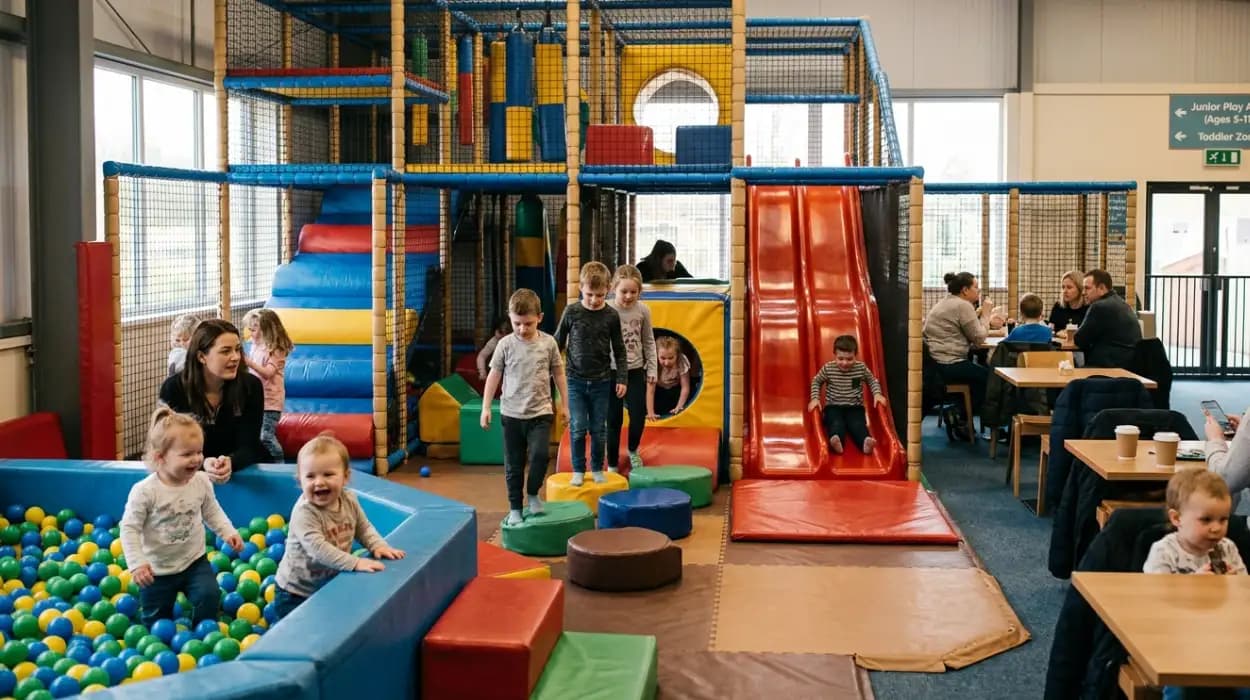
A soft play centre is a dedicated indoor recreational facility designed for infants, toddlers, and young children. It features custom-built play structures manufactured from high-density foam and covered in durable, wipe-clean polyurethane vinyl to ensure maximum impact absorption and child safety.
Indoor soft play environments emerged as a direct response to the growth of the "safety lobby" in the late 20th century, which sought to minimize childhood injuries and subsequent legal liabilities associated with traditional, hard-surfaced outdoor playgrounds (EVERETT, 2023). These facilities enclose children in a controlled "safe space" where they can engage in high-energy physical exertion under adult supervision, completely isolated from external environmental hazards or structural risks (EVERETT, 2023).
The primary structural components of a modern soft play framework include a multi-level steel chassis wrapped in safety padding, interlocking nylon netting, and integrated play features. These features are meticulously engineered to facilitate specific motor skills. For example, three primary components found in these facilities are:
- Ball pools: Large basins filled with thousands of hollow, air-filled plastic spheres that provide deep pressure sensory input and multi-planar physical resistance as children navigate through them.
- Foam obstacles: Padded cylinders, wedges, and blocks that require children to step, crawl, and balance, strengthening core muscle groups and enhancing vestibular development.
- Wavy slides: Low-friction plastic slides available in open or tubular configurations that allow children to experience controlled acceleration, teaching spatial awareness and gravitational mechanics.
The operational mechanism relies on a centralized admission gate and zoned play sections segregated by age groups, typically dividing infants under 1 year, toddlers under 4 years, and juniors up to age 11. This structural separation prevents larger children from accidentally colliding with smaller infants, satisfying municipal health and safety compliance protocols.
Why do parents need indoor play centres in Bolton?
Parents need indoor play centres in Bolton to provide children with essential physical exercise and socialization opportunities during periods of inclement weather. The local climate frequently prevents outdoor recreation, making indoor facilities crucial for continuous childhood physiological and psychological development.
Bolton, located within Greater Manchester in the Northwest of England, experiences high average annual rainfall, which historically restricts consistent access to outdoor public parks and open-air playgrounds. For instance, continuous precipitation often renders traditional turf and modern outdoor asphalt play zones slick, cold, and hazardous for young children. Soft play centres solve this geographical challenge by offering climate-controlled, dry microenvironments available 365 days a year.
Physiologically, young children require a minimum of 180 minutes of daily physical activity distributed across various intensities. Indoor soft play centres facilitate "exercise play"—which encompasses whole-body gross motor movements such as running, climbing, jumping, swinging, and walking—as well as "rough-and-tumble play," including chasing and playful wrestling (EVERETT, 2023). These movements are vital for cardiovascular health, skeletal density, and the mitigation of childhood obesity trends in urban areas.
Psychologically, these centres act as essential community hubs for parental support and peer-to-peer child interaction. When children are confined indoors at home, their opportunities for physical exploration and social engagement drop significantly (EVERETT, 2023). Soft play facilities offer an expansive spatial layout that encourages cooperative play, negotiation, and verbal communication among peers, directly supporting linguistic and conceptual advancement (Kennedy, 2001). For parents, these facilities provide a shared social space that alleviates the isolation often associated with early-years childcare.
What are the top soft play centres in the Bolton area?
The top soft play centres in the Bolton area include universally recognized local facilities such as Air Vault Inflatable & Trampoline Park, Soft Play at the Bolton Arena, and the dedicated indoor play frames at local community hubs.
Air Vault Inflatable & Trampoline Park, located within the Westhoughton industrial sector of Bolton, represents a structural evolution of the classic soft play concept. The venue features an expansive, interconnected inflatable arena alongside traditional trampoline beds. This configuration integrates giant air-filled slides, climbing walls, and obstacle courses, making it highly suited for older children who have outgrown standard foam frames.
Bolton Arena, situated in Horwich directly opposite the University of Bolton Stadium, hosts a specialised multi-level indoor soft play zone. This facility targets infants and young toddlers, focusing on foundational gross motor skills. The structural layout uses low-profile steps, soft balance beams, and small enclosed slides, allowing parents to maintain line-of-sight supervision from an adjacent seating area.
Smaller local community hubs and commercial play spaces distributed across the borough, such as those in Farnworth and central Bolton, utilize standard multi-tiered modular steel frames. These systems optimize vertical space, incorporating vertical cargo nets, hanging foam bags, and spiral tube slides. Each venue serves a distinct neighbourhood demographic, reducing the necessity for parents to travel long distances across the borough for indoor recreation.
How do soft play centres benefit child development?
Soft play centres benefit child development by accelerating gross motor skill acquisition, enhancing vestibular and proprioceptive sensory integration, and fostering critical executive functioning skills. The varied physical architecture forces the brain to solve real-time spatial and balance problems.
Gross motor development accelerates as children navigate the irregular, multi-tiered typography of a soft play frame. Climbing vertical vinyl ladders, crawling through narrow padded tunnels, and balancing on suspended foam logs require coordinated bilateral movements and reciprocal limb coordination. These actions strengthen the skeletal muscle system, improve core stability, and refine overall physical agility.
Sensory integration occurs simultaneously through the intense activation of the proprioceptive and vestibular systems. The proprioceptive system, which regulates body awareness, receives constant feedback as a child pushes through high-resistance environments like ball pools or heavy hanging foam bags. The vestibular system, which controls balance and spatial orientation, is stimulated by the rapid shifts in head position that occur during sliding, rolling, and swinging activities.
Executive functioning and cognitive problem-solving are tested through spatial navigation challenges. Children must map out paths through complex, three-dimensional structures, judge distances accurately, and calculate the physical risks of stepping onto unstable surfaces. This environmental interaction fosters spatial intelligence, independent risk assessment, and cognitive resilience as children repeatedly attempt and master difficult physical pathways.
Explore More Things To Do In Bolton
Complete Guide to Birdwatching, Fishing, and Trails at Moses Gate, Farnworth
Best Picnic Spots with Pennine Views This Summer in Bolton
What safety standards govern indoor play areas in the UK?
Indoor play areas in the UK are governed by the strict British and European safety standards BS EN 1176 and BS EN 1177. These regulations dictate the structural design, manufacturing materials, impact attenuation of flooring, and mandatory inspection intervals.
The primary regulatory framework is BS EN 1176, which covers playground equipment and surfacing for commercial operations. This standard dictates specific structural dimensions to prevent accidents, detailing precise gaps allowed between components to eliminate the risk of finger, head, or torso entrapment. It also dictates the tensile strength of the safety netting used to enclose high-level platforms, ensuring it can withstand heavy impacts without tearing.
The secondary standard, BS EN 1177, specifies the requirements for impact-attenuating playground surfacing. This regulation mandates that all floor surfaces beneath play equipment with a potential fall height must possess a certified Critical Fall Height rating. In soft play centres, this is achieved by installing thick, high-density impact foams beneath the outer vinyl flooring sheets, ensuring that if a child falls, the impact force transferred to their skeletal frame is safely minimized.
Operational compliance requires a rigorous, multi-tiered inspection protocol. Operators must perform three distinct levels of safety checks:
- Daily visual inspections: Staff members check for torn vinyl, exposed foam, loose netting, or foreign debris inside ball pools before opening to the public.
- Monthly operational checks: Managers inspect structural stability, connection points, and wear patterns on high-use items like slides and ladders.
- Annual independent certifications: A fully qualified, independent safety inspector certified by organisations like the Register of Play Inspectors International (RPII) conducts a comprehensive structural audit to issue a formal safety certificate.
How should parents prepare for a soft play visit?
Parents should prepare for a soft play visit by dressing children in long-sleeved clothing made from natural fibres, enforcing the use of specialist grip socks, and packing standard hydration and sanitation kits. These measures minimize the risk of friction burns, viral transmission, and physical exhaustion.
Clothing selection directly impacts child safety and physical comfort inside the play frame. Children must wear long trousers and long-sleeved tops, preferably made from breathable cotton, to prevent friction burns. These burns can occur when bare skin slides down high-velocity plastic slides or rubs against tight PVC vinyl padding. Synthetic materials like nylon or polyester should be avoided, as they generate static electricity and increase friction heat.
Footwear protocols are strictly enforced across all UK soft play venues for hygiene and traction control. Shoes are barred past the entry gate, and children must wear socks at all times. Standard casual socks can slide easily on polished plastic or vinyl surfaces, so specialized grip socks featuring silicone tread patterns on the sole are highly recommended to provide traction during climbing activities.
Sanitation and hydration management are critical components of a successful visit. The high physical exertion of indoor play requires constant hydration, so parents should bring dedicated water flasks to prevent dehydration. Additionally, given the communal nature of these facilities, carrying antibacterial hand sanitisers or skin-safe wipes allows for immediate hand cleaning before eating, lowering the risk of transmitting common childhood pathogens.
What amenities should an excellent soft play centre provide?
An excellent soft play centre should provide a comprehensive suite of secondary amenities, including a full-service café with clear sightlines, dedicated baby changing and nursing facilities, secure locker storage, and integrated climate control systems.
A strategically positioned café area is essential for proper parental supervision. The seating layout must feature an open, unobstructed configuration that gives parents a clear line of sight to the primary play zones. This allows adults to monitor their children continuously without needing to enter the physical play frames. The café menu should provide nutritional balance, offering high-protein, low-sugar food and beverage options alongside standard refreshments.
Sanitation infrastructure must accommodate large numbers of infants and young families. Excellent facilities provide spacious, regularly cleaned baby changing suites equipped with hands-free waste disposal bins, automated hand sanitizers, and dedicated private cubicles for breastfeeding mothers. The integration of low-level sinks and automated step stools in the main restrooms allows young children to practice independent hygiene.
Environmental and security systems protect both comfort and personal property. Due to the high heat generated by dozens of physically active children, an industrial-grade Heating, Ventilation, and Air Conditioning (HVAC) system with continuous air filtration is mandatory to regulate ambient temperature and control humidity. Furthermore, providing digital or key-locked storage lockers allows parents to secure personal items, electronics, and outerwear, leaving them free to focus entirely on child safety.
How can parents save money on soft play entry fees?
Parents can save money on soft play entry fees by purchasing off-peak term-time passes, buying multi-visit punch cards, utilizing corporate reward platforms, and monitoring local community group allocations published by Bolton Today.
Peak pricing structures typically apply during school holidays, bank holidays, and weekends, when consumer demand reaches maximum capacity. Parents can reduce their entry costs by scheduling visits during off-peak windows, such as weekday mornings or early afternoons during school term times. Many venues reduce admission fees by up to 50% during these periods, frequently bundling the entry ticket with a complimentary hot beverage or toddler snack meal.
For families who visit regularly, multi-visit passes or monthly membership subscriptions offer significant discounts over standard single-entry prices. These loyalty programs reduce the average cost per visit by securing advance bulk payments. For example, a five-visit punch card often discounts the total cost by 20% to 30%, and it typically does not carry a strict expiration date, giving families flexibility across the season.
Digital reward platforms and local community initiatives provide additional ways to save. Many corporate employee benefit programs, health insurance policies, and banking apps offer discounted vouchers for regional leisure groups and indoor play spaces. Parents in the Greater Manchester area can also check the dedicated community notices and family discount directories published regularly by Bolton Today to find promotional codes and seasonal open-day offers.
FAQS
What is a soft play centre?
A soft play centre is an indoor recreational facility designed for infants, toddlers, and young children. It uses padded foam structures, safety netting, ball pools, and slides to provide a controlled environment for physical activity and social play.