Bolton combines centuries of industrial heritage, Victorian architecture, landscaped country parks, medieval landmarks, and panoramic moorland scenery within a compact area of Greater Manchester. The town's diverse landscapes create outstanding photographic opportunities throughout every season. Historic textile mills, Gothic churches, reservoirs, woodland estates, conservation villages, and regenerated public spaces provide visually distinctive settings that appeal to travel photographers, history enthusiasts, educators, and cultural tourists.
Unlike destinations that rely on a single attraction, Bolton offers a varied visual identity shaped by more than 800 years of documented history. Medieval religious sites stand beside nineteenth-century civic architecture, while former industrial landscapes have evolved into protected nature reserves and heritage parks. This combination allows photographers to document both Britain's industrial transformation and its environmental restoration.
For visitors documenting northern England through photography, Bolton presents authentic historic landscapes that remain closely connected to their original cultural purpose.
Why is Bolton considered one of Greater Manchester's most photogenic historic destinations?
Bolton combines medieval heritage, Victorian civic architecture, preserved country estates, reservoirs, moorland landscapes, historic villages, public parks, and industrial landmarks within a compact borough, creating exceptional photographic diversity across every season while reflecting more than eight centuries of documented Lancashire history.
Bolton developed from a medieval market settlement into one of Britain's leading textile manufacturing centres during the Industrial Revolution. Its prosperity funded grand public buildings, churches, libraries, schools, parks, and civic monuments that continue defining the townscape.
Unlike heavily modernised cities, Bolton retains numerous architectural periods within short travelling distances. Medieval stone churches, Georgian houses, Victorian mills, Edwardian civic buildings, twentieth-century memorials, and modern regeneration projects coexist without losing their historical context.
Photographers benefit from varied lighting conditions throughout the year. Spring highlights flowering parklands, summer enhances woodland landscapes, autumn transforms ancient estates with colour, while winter emphasises dramatic stone architecture against clear northern skies.
The surrounding West Pennine Moors provide elevated viewpoints overlooking the town, creating opportunities for wide landscape photography alongside detailed architectural studies.
Which historic landmark produces Bolton's most iconic photographs?
Smithills Hall remains Bolton's most photographed historic landmark because its medieval origins, Tudor extensions, Georgian alterations, landscaped grounds, ancient woodland, and preserved estate architecture collectively illustrate over six centuries of continuous English domestic history.
Smithills Hall dates largely from the fifteenth century, although archaeological evidence indicates occupation before the surviving structure. The manor belonged to influential Lancashire families before later ownership by industrialist William Hesketh Lever, later the first Viscount Leverhulme.
The building demonstrates architectural development across successive historical periods. Timber framing, sandstone construction, mullioned windows, decorative chimneys, and enclosed courtyards provide strong visual compositions for architectural photography.
The surrounding estate includes formal gardens, woodland paths, agricultural buildings, and extensive open countryside. These landscapes illustrate how historic country estates functioned economically as well as socially.
Morning sunlight illuminates the eastern façade, while evening light enhances the sandstone textures and surrounding mature trees.
The estate also preserves traditional farm buildings that demonstrate historic agricultural practices associated with large Lancashire estates.
To experience this historic landmark in person today, consult our comprehensive [Historic Landmarks Behind Bolton's Most Famous Photo Locations] for itineraries and visiting parameters.
Why does Rivington attract landscape photographers throughout the year?
Rivington combines historic reservoirs, woodland plantations, heritage monuments, panoramic moorland scenery, ornamental gardens, and Victorian engineering achievements, creating one of northwest England's most visually diverse landscape photography destinations across every season.
Although administratively associated with Chorley, Rivington forms an essential part of Bolton's wider cultural landscape.
The construction of Rivington Reservoirs during the nineteenth century represented one of Britain's significant municipal water engineering projects. Liverpool Corporation developed an extensive network of reservoirs, dams, aqueducts, and embankments to supply clean drinking water.
The reservoirs introduced expansive reflective water surfaces surrounded by forests and open moorland. These features produce striking compositions during sunrise, sunset, mist, and calm weather.
The nearby Lever Park reflects the philanthropic vision of William Hesketh Lever, who opened extensive countryside for public recreation.
Historic stone bridges, ornamental structures, terraced gardens, woodland paths, and the remains of Liverpool Castle create varied photographic subjects within walking distance.
Higher viewpoints including Rivington Pike provide sweeping panoramas extending across Greater Manchester, Lancashire, Cheshire, and North Wales during clear weather.
What makes Bolton Town Hall one of the borough's finest architectural photography locations?
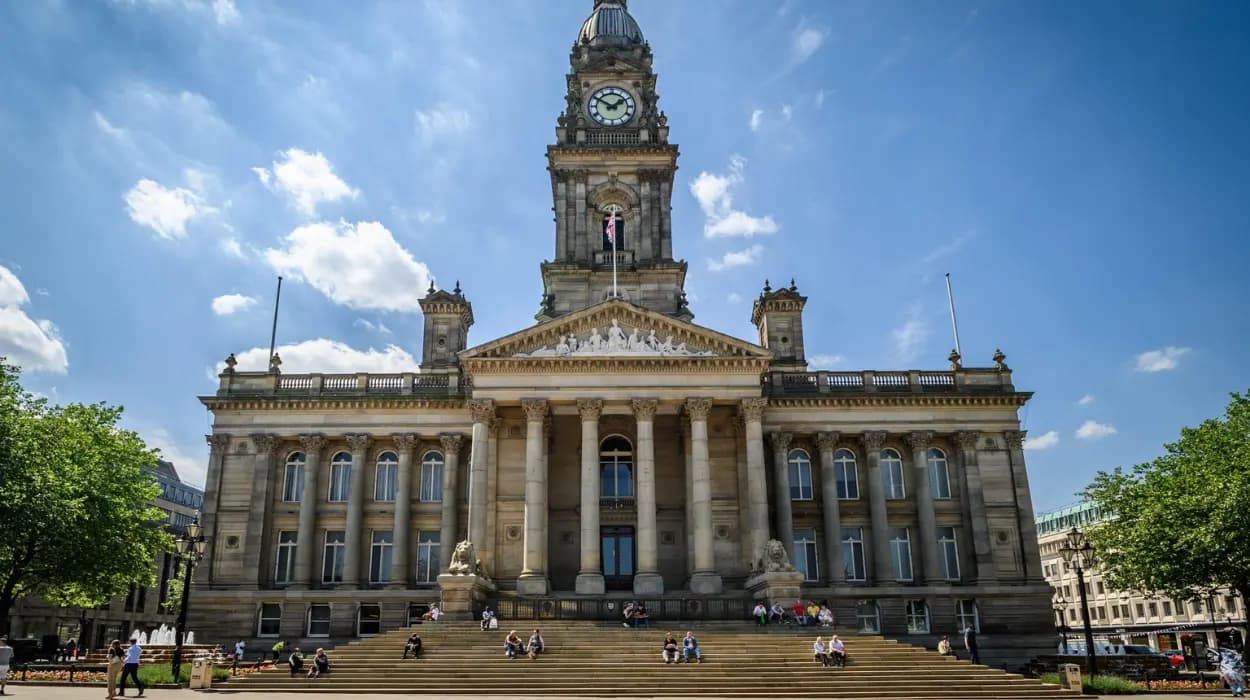
Bolton Town Hall represents Victorian civic confidence through elaborate Neo-Classical architecture, monumental stonework, ornate interiors, grand staircases, civic sculptures, and symmetrical design that create exceptional architectural photography opportunities throughout the year.
Completed in 1873 and designed by William Hill, Bolton Town Hall symbolised the prosperity generated by the cotton industry.
Its imposing façade incorporates Corinthian columns, carved stone ornamentation, decorative pediments, clock towers, and formal civic proportions typical of Britain's major municipal buildings during the Victorian period.
Internally, decorative ceilings, stained glass, polished stone, carved woodwork, and ceremonial chambers reflect nineteenth-century municipal ambition.
The surrounding civic square offers balanced perspectives ideal for wide-angle architectural photography.
Evening illumination emphasises architectural details while preserving the building's historic character.
The Town Hall continues serving its original civic function, demonstrating successful preservation through active public use.
How does Jumbles Country Park combine natural beauty with industrial heritage?
Jumbles Country Park preserves former industrial landscapes alongside woodland, reservoirs, wildlife habitats, historic transport routes, and recreational trails, illustrating how nineteenth-century engineering infrastructure evolved into protected environmental landscapes through successful conservation programmes.
Jumbles Reservoir formed during the Industrial Revolution to support expanding textile production.
Water management became essential for powering mills, maintaining manufacturing processes, and supplying growing urban populations.
Today, the reservoir forms the centrepiece of a protected country park where woodland surrounds open water.
Walking routes follow historic infrastructure originally designed for industrial purposes before later adaptation for public recreation.
The combination of reflective water, mature woodland, wildlife habitats, and surviving engineering features creates varied compositions suitable for landscape and documentary photography.
Seasonal migration introduces changing birdlife, increasing photographic opportunities throughout the year.
Why is Turton Tower important for heritage photography?
Turton Tower preserves medieval defensive architecture, Tudor domestic expansion, Jacobean interiors, historic gardens, and surviving estate landscapes that document centuries of social, architectural, and political change within Lancashire's rural aristocratic communities.
Turton Tower originated as a fortified manor house before expanding into a comfortable country residence.
Its evolution reflects changing security requirements, domestic lifestyles, and architectural preferences across successive centuries.
The building displays medieval stone construction alongside later timber framing and Tudor additions.
Historic interiors preserve period furniture, decorative plasterwork, fireplaces, and domestic arrangements illustrating elite household life.
The surrounding gardens provide attractive foreground compositions that complement the tower's historic silhouette.
Educational interpretation throughout the site explains architectural development, conservation techniques, and regional history.
Which religious heritage sites create Bolton's strongest historic images?
Bolton Parish Church, historic chapels, and preserved cemeteries collectively document medieval Christianity, Victorian religious expansion, memorial traditions, architectural craftsmanship, and community identity through centuries of continuous worship and conservation.
Bolton Parish Church, officially dedicated to St Peter, traces its origins to the medieval period.
Although rebuilt and expanded over centuries, the church remains the borough's principal religious landmark.
Its Gothic Revival features include pointed arches, stained-glass windows, carved stonework, vaulted interiors, and an imposing tower visible across central Bolton.
Historic churchyards preserve memorials documenting generations of local families, offering valuable resources for genealogical researchers.
Other historic churches throughout the borough illustrate denominational diversity during industrial expansion.
Examples include Anglican churches, Methodist chapels, and Roman Catholic churches that reflect nineteenth-century population growth.
These religious buildings preserve craftsmanship in stained glass, masonry, wood carving, and memorial sculpture.
How do the West Pennine Moors create Bolton's most dramatic landscape photographs?
The West Pennine Moors provide elevated viewpoints, ancient grazing landscapes, reservoirs, peatland habitats, stone tracks, and expansive skies that reveal the geographical setting shaping Bolton's historical agricultural and industrial development.
The moors formed through thousands of years of geological and environmental processes.
Historically, upland landscapes supported sheep grazing, limited farming, quarrying, and transport routes connecting Lancashire settlements.
During the Industrial Revolution, elevated reservoirs became essential for regional water supply.
Today, protected moorland habitats support biodiversity while preserving historic pathways.
Photographers frequently capture sunrise above rolling hills, dramatic cloud formations, and long-distance panoramas.
Stone walls, ancient boundary markers, and historic tracks provide foreground interest within wider landscape compositions.
Seasonal heather flowering adds distinctive colour during late summer.
Why does Moss Bank Park remain one of Bolton's best urban photography locations?
Moss Bank Park combines Victorian park design, ornamental gardens, mature woodland, recreational landscapes, historic monuments, and seasonal planting schemes that illustrate nineteenth-century public health reforms through carefully planned urban green space.
Victorian municipalities invested heavily in public parks to improve living conditions for industrial populations.
Moss Bank Park reflects this movement through formal landscaping, tree-lined avenues, ornamental lakes, and recreational facilities.
Its mature tree collection creates changing seasonal colour that attracts landscape photographers throughout the year.
Historic monuments within the park commemorate civic achievements and community memory.
Wildlife habitats coexist alongside formal gardens, allowing photographers to combine natural and architectural subjects.
Morning mist frequently enhances woodland scenes during autumn.
What makes Bolton's industrial heritage visually distinctive?
Bolton's surviving mills, warehouses, canals, railway infrastructure, and workers' housing collectively illustrate Britain's Industrial Revolution through authentic urban landscapes that preserve manufacturing history alongside modern regeneration initiatives.
During the nineteenth century, Bolton became internationally recognised for cotton spinning, engineering, bleaching, and textile machinery manufacturing.
Industrial success transformed both the skyline and urban layout.
Although numerous mills disappeared during twentieth-century redevelopment, surviving structures remain architecturally significant.
Tall brick chimneys, large mill windows, cast-iron framing, and robust engineering demonstrate industrial construction techniques.
Former railway infrastructure reflects expanding transport networks supporting textile exports.
Modern regeneration increasingly adapts historic industrial buildings for residential, educational, commercial, and cultural purposes while preserving their architectural character.
These adaptations document changing urban priorities without erasing industrial heritage.
Which seasonal conditions produce Bolton's best travel photographs?
Spring blossoms, summer woodland, autumn foliage, winter architecture, golden-hour lighting, misty reservoirs, and changing moorland weather collectively provide year-round photographic opportunities that emphasise Bolton's historic landscapes under contrasting natural conditions.
Spring transforms parks, estates, and woodland with flowering trees and renewed vegetation.
Summer extends daylight hours, allowing extended exploration across country parks and reservoirs.
Autumn remains particularly popular because mature woodland surrounding Smithills, Jumbles, Turton, and Rivington displays rich seasonal colour.
Winter removes dense foliage, revealing historic building details often hidden during summer.
Early morning mist enhances reservoirs and valleys.
Golden-hour sunlight highlights sandstone buildings, historic churches, and civic monuments through warm natural illumination.
Variable northern weather introduces dramatic cloud formations that strengthen landscape compositions.
How is Bolton preserving its most photogenic historic places for future generations?
Bolton protects historic buildings, parks, conservation areas, archaeological landscapes, and industrial heritage through statutory listing, conservation policies, heritage partnerships, restoration funding, and sustainable public access that balances preservation with educational tourism.
Historic England lists numerous buildings across the borough because of their architectural and historic significance.
Conservation areas safeguard the character of historic settlements and townscapes.
Bolton Council works alongside heritage organisations to restore public buildings, improve historic parks, and encourage adaptive reuse of significant structures.
Museums, archives, local history societies, and educational institutions document changing landscapes through photographs, maps, oral histories, and archaeological research.
Environmental management protects woodland, reservoirs, peatland, and wildlife habitats that contribute equally to Bolton's photographic appeal.
Digital heritage initiatives increasingly preserve historical records for researchers, genealogists, educators, and future conservation planning.
These combined efforts ensure Bolton's architectural and natural heritage remains accessible while retaining historical authenticity.
Bolton offers one of Greater Manchester's richest combinations of architectural heritage, industrial history, countryside scenery, and preserved public landscapes. Medieval halls, Victorian civic landmarks, historic churches, reservoirs, country parks, and panoramic moorland together present a visual record of more than eight centuries of local development.
For travel photographers, every location tells part of a larger historical narrative. Smithills Hall illustrates medieval domestic life, Bolton Town Hall reflects Victorian prosperity, Jumbles Reservoir records industrial engineering, Turton Tower demonstrates centuries of architectural evolution, and the West Pennine Moors reveal the natural landscape that shaped settlement and industry. Combined with ongoing conservation and regeneration, these places ensure Bolton remains an outstanding destination for creating compelling images while exploring the borough's enduring cultural and historical legacy.
FAQS
What are the most Instagrammable places in Bolton?
Some of the most Instagrammable places in Bolton include Smithills Hall, Rivington Pike, Jumbles Country Park, Bolton Town Hall, Turton Tower, Moss Bank Park, Bolton Parish Church, Lever Park, and the West Pennine Moors.