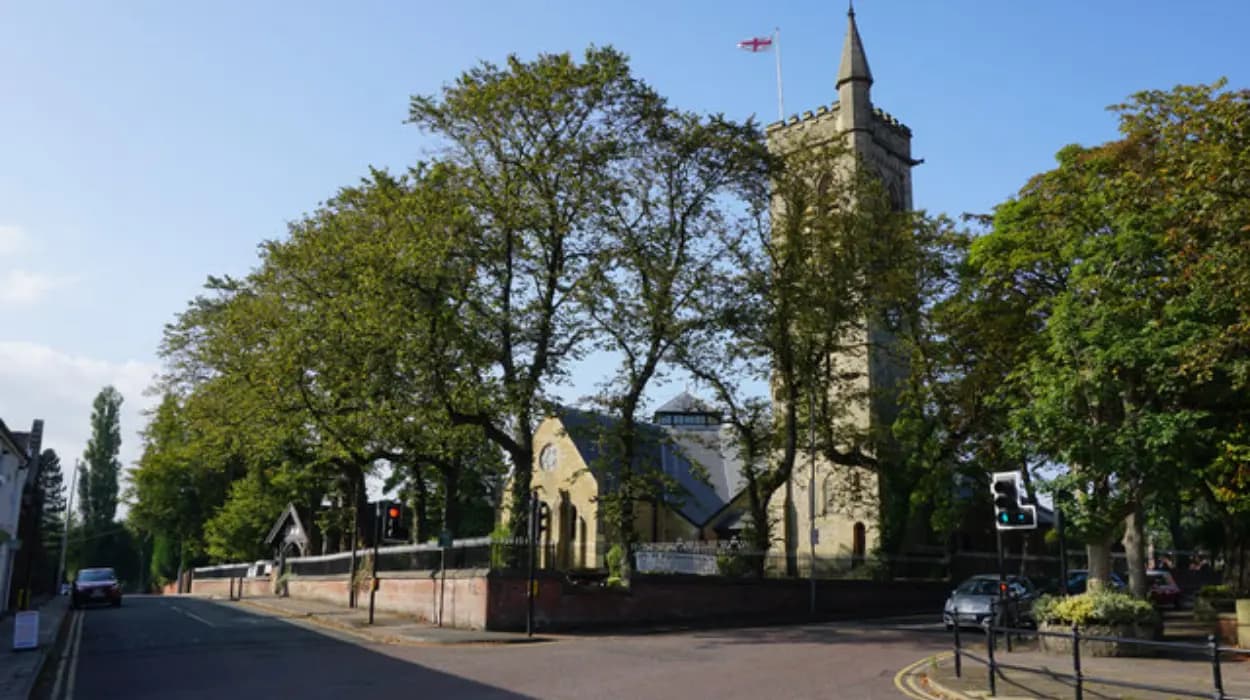
Westhoughton is a historic town in the Metropolitan Borough of Bolton, Greater Manchester, where family activities connect directly with local heritage, public parks, civic architecture, nature, and community history. A weekend visit offers children and adults opportunities to explore outdoor spaces while learning about the area's development.
The town sits within a landscape shaped by agriculture, textile manufacturing, coal mining, transport, civic government, and twentieth-century suburban growth. These changes remain visible in its parks, historic buildings, church heritage, memorials, woodland, and town-centre streets.
For visitors planning a family weekend, Westhoughton provides attractions that combine recreation with education. Hall Lee Bank Park offers a nature trail, woodland walks, a playground, and woodland play features. Westhoughton Central Park provides open space and organised community activities. The town centre contains the Grade II-listed Tower of St Bartholomew and the Grade II-listed Westhoughton War Memorial. The historic Town Hall and Carnegie Library provide further evidence of the town's civic development.
This guide focuses on attractions that families can experience together while understanding how Westhoughton developed from a Lancashire township into a modern Bolton community.
What makes Westhoughton a good family destination for a weekend visit?
Westhoughton combines parks, woodland, playgrounds, heritage buildings, local history, and community spaces within a compact town setting, giving families opportunities for outdoor recreation and historical learning without separating entertainment from education during a weekend visit.
Westhoughton is particularly suitable for families who want varied activities during one short visit. The town's attractions cover several types of experience, including nature walks, children's play, civic architecture, religious heritage, local memorials, and community history.
The geographical scale of Westhoughton also supports a flexible itinerary. Families can combine outdoor recreation with a heritage-focused town-centre visit. Younger children can use play areas and nature trails, while older children and adults can examine historic buildings and understand the social changes that shaped the community.
The town's historical importance developed through several connected processes. Agricultural settlement provided the early economic base. Industrialisation increased employment and population. Cotton manufacturing expanded the urban area. Coal mining created another major source of employment. Improved roads and railways strengthened connections with neighbouring towns.
The civic structure also changed over time. A Local Board of Health was established in 1872. Westhoughton became an Urban District in 1894. The area later became part of the Metropolitan Borough of Bolton in 1974, while Westhoughton Town Council was re-established in 1985. These administrative changes explain why the town combines a distinct local identity with its modern position within Bolton.
The best family visits therefore treat Westhoughton as both a destination and a historical landscape. A playground, park, church tower, library, or memorial each provides a different entry point into the town's past.
How did Westhoughton develop into the town families visit today?
Westhoughton developed from a Lancashire township into an industrial urban district through nineteenth-century public administration, cotton manufacturing, coal mining, improved transport, and population growth before becoming part of Bolton Metropolitan Borough in 1974.
The historical development of Westhoughton explains the character of its attractions today. The town was historically located within Lancashire and developed as a township and civil parish before acquiring stronger municipal institutions during the nineteenth century.
A major administrative milestone came in 1872, when the Westhoughton Local Board of Health was formed. Local boards were Victorian institutions responsible for public-health and environmental improvements, including sanitation and infrastructure. Their establishment reflected the growing need to manage expanding communities during industrialisation.
Westhoughton's Local Board became an Urban District in 1894. The area was extended in 1898 through the addition of a large part of Over Hulton. The Urban District structure gave local government greater responsibility for managing a growing industrial community.
The town's industrial economy was closely connected with cotton manufacturing. Industrial growth increased the importance of civic services and created demand for improved public buildings. Westhoughton Town Hall was subsequently constructed in the early twentieth century as a visible expression of local government.
The industrial economy also included coal mining. The Pretoria Pit disaster of 1910 became one of the most significant events in Westhoughton's modern history. The disaster had a lasting effect on local memory and remains an important subject for local historians and families researching Westhoughton's genealogy.
Administrative change continued in the twentieth century. In 1974, the whole of Westhoughton became part of the newly created Metropolitan Borough of Bolton. Westhoughton Town Council was established again in 1985 after a ten-year interval.
This timeline provides important context for visitors. Westhoughton's family attractions are not isolated recreational facilities. They exist within a landscape created by industrialisation, municipal reform, community institutions, and changing patterns of urban development.
What can families do at Hall Lee Bank Park?
Hall Lee Bank Park provides families with a playground, nature trail, woodland walks, and an integrated woodland play area, combining active recreation with opportunities to observe local natural surroundings and experience one of Westhoughton's accessible green spaces.
Hall Lee Bank Park is one of the strongest choices for families seeking an outdoor attraction. Bolton Council identifies the site as a local nature reserve with woodland walks, a nature trail, a playground, and an integrated woodland play area.
The park's layout supports different age groups. Younger children can use the play facilities, while families can explore the woodland environment together. The nature trail provides an educational dimension because it encourages visitors to observe vegetation, habitats, and seasonal changes.
Woodland environments also provide a useful setting for environmental education. Parents and educators can introduce children to basic concepts such as habitats, biodiversity, seasonal cycles, and responsible access to green spaces.
The park demonstrates how modern recreation can coexist with local landscape history. Westhoughton's historical development involved significant changes to land use as agricultural areas gave way to industry, housing, roads, and public infrastructure. Remaining green spaces provide a different perspective on that transformation.
For a weekend family visit, Hall Lee Bank Park works well as an early-day outdoor destination. Families can allow children time for play before following the nature trail and woodland routes.
The park also provides a useful contrast with Westhoughton's historic town centre. A family can move from natural landscape to civic architecture within the same wider town area, creating a visit that covers both environmental and cultural heritage.
Why should families visit Westhoughton Central Park?
Westhoughton Central Park is an important family recreation space where children can participate in outdoor activities while visitors experience a central part of the town's modern community infrastructure and its continuing role in supporting public events and family activities.
Westhoughton Central Park provides another important family-focused outdoor space. Its central position makes it relevant to visitors combining recreation with a walk through the town.
The park's role extends beyond ordinary open space. Bolton Council's current parks programme lists Westhoughton Central Park as a venue for family-friendly community activities, demonstrating its continuing function as a place for organised recreation and local engagement.
The historical importance of public parks developed alongside Victorian and Edwardian ideas about municipal improvement. As industrial towns expanded, public authorities increasingly recognised the value of accessible open spaces for recreation and community life.
Westhoughton experienced this broader pattern of urban development. Industrial employment, residential growth, and municipal administration created demand for public facilities that served residents beyond private homes and workplaces.
Families visiting Central Park can therefore consider the site as part of a wider history of public recreation. The modern park represents the continuation of an established principle: community spaces provide physical activity, social interaction, and access to outdoor environments.
The park is also practical for families because it can function as a flexible part of a wider itinerary. Visitors can combine time outdoors with a heritage walk around the town centre, creating a balanced day without relying entirely on indoor attractions.
What can families learn from Westhoughton Town Hall and Carnegie Library?
Westhoughton Town Hall and Carnegie Library demonstrate how industrial-era prosperity, municipal government, public education, and civic ambition shaped the town, providing families with historic buildings that explain the development of local democracy, public services, and free access to knowledge.
Westhoughton Town Hall is one of the town's most important civic landmarks. The building was constructed in 1903 for Westhoughton Urban District Council and officially opened in December 1904. The architects were the Bolton firm of Bradshaw and Gass, with the design probably associated with Arthur Hope.
The Town Hall represents the expansion of local government during the industrial period. Westhoughton's industrial growth, including the expansion of cotton mills, contributed to the need for a dedicated civic building.
The architectural importance of the building is connected with its civic purpose. Town halls provided spaces for council administration, public meetings, and local decision-making. Their design often communicated the growing status of urban districts.
Westhoughton Town Hall later became part of Bolton's wider administrative structure. After the creation of Bolton Metropolitan Borough in 1974, the building was used as council offices. Westhoughton Town Council later established its base there following its re-formation in 1985.
The adjoining Carnegie Library represents another important aspect of social history. Carnegie libraries were funded through philanthropy associated with Andrew Carnegie, the Scottish-American industrialist and philanthropist who supported thousands of libraries internationally.
Westhoughton's library officially opened on 24 March 1906. It was part of the early wave of Carnegie libraries in England and reflected the expanding belief that public libraries should provide free access to books and education.
For families, the library is especially significant because it connects childhood education with local heritage. Storytelling, reading, historical research, and community activities all continue the principle behind the original public library movement.
The building's heritage also remains active rather than purely historical. In 2026, Bolton Council reported the rediscovery of a ceremonial golden key associated with the opening of the library in 1906. The key was returned to the library for permanent display as part of the 120th-anniversary commemorations.
The Town Hall has also been subject to plans for investment and refurbishment. Bolton Council announced a £3.5 million project intended to secure the building's future and support continued civic and community use.
To experience this historic civic landscape in person today, consult our comprehensive [History of Westhoughton from Medieval Village to Modern Town] for itineraries and visiting parameters.
Why is St Bartholomew's Church important for families interested in history?
St Bartholomew's Church provides families with a direct connection to Westhoughton's religious and architectural heritage, while its surviving historic tower demonstrates the importance of parish institutions in shaping local identity, community organisation, education, burial practices, and the town's historic landscape.
The Tower of St Bartholomew's Church is a Grade II-listed structure on School Street. Historic England records the tower as a designated heritage asset, with its listing first recorded in 1966 and amended in 2003.
The church is important because parish institutions historically served multiple functions. Religious buildings were centres of worship, burial, community organisation, and local identity. Parish records also provide valuable evidence for genealogical research.
For families interested in ancestry, historic churches are particularly significant. Baptism, marriage, and burial records can provide evidence about earlier generations. These records help researchers trace family relationships and understand population changes.
The church tower also forms part of a wider historic group within the town centre. Its architectural setting connects it with other designated buildings and the Westhoughton War Memorial.
A visit can therefore introduce children to the idea of heritage designation. Grade II listing recognises buildings of special architectural or historic interest and provides statutory protection through the planning system.
The church should be viewed as part of Westhoughton's wider historical environment rather than as an isolated building. Its presence helps explain the continuity between the historic township and the modern town.
What does the Westhoughton War Memorial teach visitors about local history?
Westhoughton War Memorial records the local human cost of twentieth-century conflict, commemorating 197 servicemen who died in the First World War and providing families with a place to examine remembrance, community sacrifice, architecture, and the long-term impact of global events.
The Westhoughton War Memorial stands at the junction of Church Street and Market Street. Historic England lists it at Grade II and dates the memorial to 1923, with later additions commemorating subsequent conflicts.
The memorial was unveiled on 3 August 1923 by Colonel Crossfield. Its construction cost £1,800, raised through public subscription. The memorial commemorated 197 local servicemen who died during the First World War.
The scale of the commemoration demonstrates how international conflicts affected individual communities. Families in Westhoughton experienced the consequences of military mobilisation through the loss of relatives, neighbours, colleagues, and friends.
The memorial's architectural significance is also recognised by Historic England. It is described as a tall and elegant memorial cross and has group value with nearby historic buildings, including the Tower of St Bartholomew.
For younger visitors, the memorial provides an opportunity to explain remembrance in a factual way. Parents and educators can discuss the First World War, the role of local communities, and the purpose of public memorials.
The site also demonstrates how historical memory becomes part of the physical environment. A memorial is both a structure and a historical record. Its inscriptions preserve names that connect national events with individual families.
Visitors should treat the site respectfully because it remains a place of remembrance rather than simply a tourist attraction.
How can families explore Westhoughton's industrial heritage?
Families can explore Westhoughton's industrial heritage by connecting surviving civic buildings, historic streets, church landmarks, memorials, and local archives with the town's former cotton and coal industries, creating a practical understanding of how industrialisation transformed employment, population, government, and everyday life.
Westhoughton's industrial heritage developed through several economic sectors, including cotton manufacturing and coal mining. The expansion of these industries influenced the town's physical growth and strengthened demand for public administration.
Cotton mills were particularly important to the town's nineteenth-century economic development. Historic England's assessment of Westhoughton Town Hall records substantial industrial growth and increasing numbers of cotton mills as factors behind the establishment of the Urban District in 1894.
Coal mining created another important part of local identity. The Pretoria Pit disaster of 1910 remains a significant subject in Westhoughton historical research and community remembrance. Local historian Brian Clare lectured extensively on the disaster and helped organise centenary commemorations in 2010.
The industrial past is not always represented by surviving factory buildings. Historical landscapes also preserve evidence through street patterns, workers' housing, transport routes, public institutions, memorials, and archives.
Families can use this approach to teach children how historians reconstruct the past. A building provides physical evidence. A memorial provides names and dates. A library provides written sources. A local archive provides photographs and documents.
This method also benefits genealogical researchers. Industrial communities generated extensive records connected with employment, housing, education, religion, and public administration. Westhoughton's local history collections can therefore support research into family connections and occupational history.
The town's industrial story is consequently broader than the history of individual mills or mines. It explains the social and administrative structures that produced the Westhoughton visible today.
Which Westhoughton attractions best combine outdoor play and historical learning?
Hall Lee Bank Park, Westhoughton Central Park, the historic town centre, St Bartholomew's Tower, the War Memorial, Town Hall, and Carnegie Library together provide a balanced family itinerary combining outdoor recreation, environmental education, civic history, religious heritage, remembrance, and local research.
A successful family weekend in Westhoughton benefits from combining different types of attraction. Outdoor spaces provide physical activity, while historic landmarks provide educational context.
Hall Lee Bank Park is particularly suited to nature-based recreation because Bolton Council identifies its nature trail, woodland walks, playground, and woodland play area.
Westhoughton Central Park provides another open-air setting and has a continuing role in community activities. Its position within the town makes it practical to combine with a town-centre visit.
The historic centre provides the strongest concentration of heritage themes. The Tower of St Bartholomew represents religious and architectural history. The War Memorial represents twentieth-century conflict and remembrance. The Town Hall represents municipal government. The Carnegie Library represents public education and access to knowledge.
These attractions create a clear educational sequence. Children can first understand the physical environment, then examine how people organised communities, and finally consider how historical events affected local families.
The approach also reflects the needs of different visitors. History enthusiasts can examine architectural details. Cultural tourists can explore civic and religious landmarks. Educators can use the town as an outdoor learning environment. Genealogical researchers can connect local institutions with family records.
The result is a destination where recreation and historical interpretation complement one another.
How should families plan a historical weekend in Westhoughton?
Families should plan a Westhoughton weekend around one outdoor attraction, one heritage-focused town-centre walk, and time for local community facilities, allowing children to experience recreation first and then connect those places with the town's industrial and civic history.
A practical itinerary begins with an outdoor location such as Hall Lee Bank Park. The nature trail and woodland environment provide an active start and introduce children to local landscapes.
The next stage can focus on Westhoughton Central Park or another suitable open space. This keeps the visit flexible and allows families to adjust the pace according to children's needs.
A heritage walk through the town centre can then introduce St Bartholomew's Tower, the War Memorial, Town Hall, and Carnegie Library. These sites represent different aspects of Westhoughton's development.
The historical sequence is important. The church represents long-term parish heritage. The Town Hall reflects nineteenth- and early twentieth-century municipal development. The Carnegie Library reflects public education. The War Memorial records the impact of global conflict.
Families should distinguish between attractions that are freely accessible from the outside and buildings with specific opening arrangements. Historic structures can have changing access arrangements because of conservation work, refurbishment, community use, or private ownership.
The town's history also supports a research-based visit. Families interested in genealogy can use local library and archive resources to investigate surnames, occupations, and community connections.
This approach creates a weekend experience based on direct observation and reliable historical evidence rather than a simple checklist of attractions.
Why is preserving Westhoughton's heritage important for future generations?
Preserving Westhoughton's heritage protects evidence of industrialisation, civic government, community memory, public education, religious life, and wartime sacrifice, ensuring that future generations can study how local people shaped the town and responded to wider economic and political change.
Heritage preservation has practical educational value. Historic buildings provide evidence that written sources alone cannot supply. Architectural materials, building layouts, memorial inscriptions, and surviving streetscapes reveal how communities developed.
Westhoughton's Town Hall illustrates this principle. Constructed in 1903 and opened in 1904, it represents the period when local government was becoming increasingly important in managing industrial communities. Its continued preservation allows future visitors to understand that administrative history through a surviving civic structure.
The Carnegie Library provides another example. Its opening in 1906 demonstrates the expansion of free public access to knowledge during the early twentieth century. Its 120th anniversary in 2026 confirms the building's long-term connection with community education and local memory.
The War Memorial preserves a different category of heritage. Its 197 commemorated servicemen connect Westhoughton directly with the First World War. The memorial therefore functions as both an architectural object and a record of community loss.
Natural spaces also require preservation. Hall Lee Bank Park demonstrates how woodland and public recreation can form part of the modern heritage landscape. Protecting accessible green spaces supports environmental education and maintains opportunities for families to experience nature alongside historic sites.
Westhoughton's future historical relevance therefore depends on maintaining both built and natural environments. The town's heritage is not limited to one landmark. It consists of connected evidence covering agriculture, industry, administration, education, religion, recreation, remembrance, and community identity.
For families visiting this weekend, the significance is immediate. Children can play in a woodland, walk through a park, observe a historic tower, see a memorial, and encounter a civic building. Each experience contributes to an understanding of how Westhoughton became the community it is today.
The town's attractions are consequently valuable because they connect past and present. Westhoughton remains a living community, while its parks, civic buildings, historic landmarks, and memorials preserve the evidence required to understand its development. A family visit can therefore combine recreation with meaningful historical learning, making the town a useful destination for visitors interested in local heritage and the wider history of Greater Manchester.
FAQS
What are the best family-friendly attractions in Westhoughton?
The best family-friendly attractions in Westhoughton include Hall Lee Bank Park, Westhoughton Central Park, St Bartholomew's Church, Westhoughton Town Hall, Carnegie Library, and the Westhoughton War Memorial.