Westhoughton is a historic town in the Metropolitan Borough of Bolton, Greater Manchester, with roots extending into the medieval period. Its history reflects the wider transformation of north-west England from an agricultural society into an industrial economy and, later, a predominantly residential community.
The town developed through several connected phases. Medieval manorial estates established the foundations of settlement and land ownership. Early modern agriculture and hand weaving supported local households. The Industrial Revolution introduced textile mills, coal mining, transport infrastructure, and rapid population growth. Civic institutions followed, including local government, schools, libraries, churches, and a purpose-built town hall.
The 19th and early 20th centuries created the physical and social character of modern Westhoughton. Coal mining became particularly important, but it also brought significant danger. The Pretoria Pit disaster of 21 December 1910 killed 344 men and boys and remains one of the defining events in the town's history. Historic England identifies the disaster as the worst mining disaster in the historic county of Lancashire.
Today, Westhoughton combines historic buildings, surviving industrial landscapes, civic architecture, community institutions, green spaces, and residential development. Its heritage provides a direct record of how a Lancashire settlement adapted to industrialisation, municipal reform, economic decline, and modern regeneration.
When did Westhoughton first develop as a settled community?
Westhoughton developed from a medieval rural settlement shaped by manorial estates, agricultural landholding, local roads, and religious institutions. Records associated with places such as Snydale and Hulton demonstrate established land ownership by the early 13th century.
The medieval history of Westhoughton is closely connected to the organisation of land. The settlement stood within the historic county of Lancashire, in a landscape where agricultural estates, commons, farms, and manorial rights determined economic and social life.
One important medieval place was Snydale. Westhoughton Town Council records state that Snydale Hall Farm represents the surviving part of an older manor held by Ellis de Pendlebury by 1212. The Pendlebury family retained the property for centuries before it passed through marriage and later ownership changes.
Hulton also became an important landholding centre. The Hulton family had long-established connections with the area. Historical material associated with Hulton Park records the family's presence in the medieval period and its later importance in local landownership and administration. By 1521, Adam Hulton served as deputy steward of the Lordship of Westhoughton for Cockersand Abbey.
These estates helped establish the framework within which Westhoughton developed. Medieval settlement was not concentrated entirely in a modern-style town centre. Instead, people lived across farms, hamlets, folds, and agricultural holdings connected by local routes.
The landscape also contained religious connections. Brinsop Hall Farm occupies the site of an older estate farm or grange associated with Cockersand Abbey from the early 13th century until the 16th century. The Dissolution of the Monasteries under Henry VIII ended the abbey's ownership, after which its property was transferred into private hands.
This transition illustrates a major historical change. Medieval Westhoughton was organised through religious institutions, manorial estates, agricultural production, and customary land rights. The Tudor period began the redistribution of some of these properties and created new patterns of private ownership.
How did medieval land ownership shape Westhoughton's early history?
Medieval land ownership shaped Westhoughton's development by determining who controlled farms, commons, manors, and local resources. Estates linked to families such as the Hultons and Pendleburys influenced settlement patterns, agriculture, political authority, and later industrial expansion.
Land ownership was central to Westhoughton's economic development. Before industrialisation, agricultural land provided employment and food production, while commons supported grazing and other customary activities.
The manor of Snydale demonstrates the continuity of local landholding. Its documented association with Ellis de Pendlebury in 1212 provides evidence of established medieval property structures. Later inheritance and marriage transferred the estate between families, showing how landownership shaped local social power.
Hulton Park represents another important strand of Westhoughton's history. The Hulton family's estate interests extended across the area, while documents preserved in the Hulton Muniments provide valuable evidence about local land, commons, and infrastructure. These records are particularly important for researchers studying the transition from agricultural society to industrial economy.
The enclosure of common land became another significant development. The Westhoughton area experienced enclosure in the 18th century, changing how land was controlled and used. The process reduced the importance of traditional common rights and strengthened private ownership.
The Enclosure Award of 1726 is particularly relevant to the area's historical geography. It provides evidence of property ownership and estate boundaries at a time when Westhoughton was still predominantly rural.
These changes affected later industrialisation. Private estates controlled land where roads, canals, railways, mills, and mines were subsequently developed. Industrial growth therefore did not replace the old landscape completely. It often built upon existing property boundaries and transport routes.
The medieval landholding system left a long-term legacy. Modern Westhoughton contains streets, farms, buildings, and landscape features that preserve traces of earlier estates.
What was Westhoughton like before the Industrial Revolution?
Before industrialisation, Westhoughton was a rural Lancashire community based on farming, small-scale textile production, hand weaving, local trade, and estate agriculture. Its population lived across farms and hamlets connected by roads and tracks rather than a dense industrial town centre.
Agriculture dominated the local economy for centuries. Farms produced food and raw materials, while landowners controlled substantial estates.
Textile production also existed before the arrival of large factories. Westhoughton became associated with hand weaving, particularly cotton-related work. The transition from domestic hand weaving to mechanised factory production later transformed the town's economy and built environment.
The local dialect provides a cultural reminder of this textile heritage. Westhoughton Town Council records the term "Keaw Yed" as a local Lancashire expression connected to the town's weaving tradition. The explanation relates to the appearance of a hand weaver carrying a roll of cloth across the shoulders.
The landscape remained predominantly rural during the early modern period. Farms, folds, halls, cottages, mills, and small workshops formed the physical environment.
The Battle of Westhoughton Common during the English Civil War added a political and military dimension to the area's history. The conflict began in 1642 between supporters of King Charles I and Parliament. Westhoughton Common became associated with local military activity during the conflict.
The Civil War demonstrated the strategic importance of local communities and transport routes. Westhoughton was part of a wider Lancashire landscape affected by national political conflict.
By the 18th century, the balance between agriculture and manufacturing was changing. Improved roads and turnpikes strengthened connections between settlements. Bolton, Wigan, Leigh, and Manchester became increasingly important commercial centres.
Westhoughton's geographical position helped it participate in this regional economy. The town later became closely connected to coalfields and textile manufacturing, providing the conditions for rapid industrial expansion.
How did the Industrial Revolution transform Westhoughton?
The Industrial Revolution transformed Westhoughton through mechanised textile production, coal mining, improved transport, population growth, and urban development. Industrial employment replaced much traditional rural work and created the economic foundations of the modern town.
The Industrial Revolution was the most important structural change in Westhoughton's history. From the late 18th century and throughout the 19th century, mechanisation changed production and employment.
Textile manufacturing expanded rapidly. Powered machinery increased production and reduced reliance on domestic hand weaving. Mills became major employers and altered the town's physical appearance.
This transformation also generated social conflict. The destruction of Westhoughton Mill in 1812 formed part of the wider Luddite unrest across northern England. Luddites opposed the economic effects of mechanised production and attacked factories in several industrial regions.
Westhoughton Mill was regarded as an important local industrial site. On 28 April 1812, a crowd gathered at the mill. The building was subsequently set on fire, and much of the machinery and mill structure was destroyed. Four men were later executed following convictions connected with the attack, according to the historical account preserved by Westhoughton Town Council.
The event demonstrates the social consequences of industrialisation. Mechanisation created greater productive capacity but also generated insecurity among workers whose livelihoods depended on traditional production methods.
Industrial development continued despite this unrest. Cotton mills and other factories became central to Westhoughton's economy during the 19th century.
The growth of industry required workers. New houses were constructed near mills and transport routes. Streets became denser, and the settlement gradually developed the characteristics of an industrial town.
The process also encouraged the creation of civic services. A larger population required schools, churches, public health measures, local administration, libraries, and improved roads.
Westhoughton's transformation therefore involved more than factories. Industrialisation changed almost every aspect of daily life, from employment and housing to education and local government.
Why was coal mining important to Westhoughton's development?
Coal mining became a major part of Westhoughton's industrial economy because local collieries supplied fuel for factories, transport, and regional industry. Mining created employment, supported working-class communities, and permanently shaped the town's identity and historical memory.
Coal mining expanded alongside textile manufacturing. The industrial economy depended heavily on coal because steam engines required large quantities of fuel.
The Hulton Colliery Company became one of the area's major employers. The Pretoria Pit complex operated on the boundary between Westhoughton and Atherton and became one of the largest mining operations in the district.
The colliery employed approximately 2,500 people in 1910. Its workforce reflected the regional importance of coal mining and the close connection between employment, housing, and family life in mining communities.
Mining also created a distinctive social structure. Employment often extended across generations, with sons following fathers into the pits. The risks of underground work were therefore experienced by entire families and communities.
The industrial landscape included shafts, winding engines, workshops, rail connections, spoil heaps, and workers' housing. Many of these features disappeared after the decline of coal mining, but their influence remains visible in the town's geography and collective memory.
Coal mining also affected local politics. Industrial workers formed a significant part of the population, while employers and landowners remained important economic forces. The resulting social structure contributed to the development of organised labour and working-class political activity.
Mining was therefore not a separate industry operating outside the town. It influenced Westhoughton's housing, population, transport, civic institutions, and cultural identity.
What happened during the Pretoria Pit disaster of 1910?
The Pretoria Pit disaster occurred on 21 December 1910 when an underground explosion at Hulton Colliery killed 344 men and boys. It became Lancashire's worst mining disaster and remains central to Westhoughton's heritage and collective memory.
The Pretoria Pit disaster is the defining tragedy of Westhoughton's industrial history.
On 21 December 1910, an explosion occurred at the Hulton Colliery's No. 3 Bank Pit, commonly known as Pretoria Pit. A total of 344 men and boys died. Historic England records the disaster as the worst mining disaster in the historic county of Lancashire.
The scale of the disaster was immense. Mining families across Westhoughton and neighbouring communities lost fathers, sons, brothers, and relatives.
The disaster also had a major genealogical impact. Detailed historical records identify the victims by name, age, occupation, address, family connections, and burial information. The Lancashire Online Parish Clerk Project describes its victim database as a comprehensive record developed from primary historical sources.
For family historians, these records provide important evidence about working-class life in early 20th-century Lancashire. They connect individual miners to addresses, occupations, relatives, cemeteries, and local institutions.
The disaster also demonstrates the risks created by industrial employment. Coal mining provided wages and supported communities, but underground explosions could destroy entire families within minutes.
The original memorial in the churchyard of St Bartholomew's Church commemorates all 344 victims. Historic England designated the memorial Grade II and records that it also serves as the gravestone for 24 unidentified bodies.
The memorial remains an important historical structure. It connects Westhoughton's industrial past with the present and provides a permanent place for commemoration.
Annual remembrance ceremonies continue to demonstrate the disaster's significance. Westhoughton Town Council has documented commemorative services held at the memorial and at St Bartholomew's Church.
How did Westhoughton develop its own civic identity?
Westhoughton developed a distinct civic identity during the late Victorian and Edwardian periods through local government, public buildings, education, libraries, churches, and organised community institutions that reflected its expanding industrial population.
The growth of industry created demand for formal local administration.
A Local Board of Health was established in 1872. This institution represented an important stage in the development of municipal services, particularly as industrial towns required organised approaches to sanitation, roads, drainage, and public health.
Westhoughton became an Urban District in 1894. This change reflected the area's population growth and industrial importance. The Urban District Council subsequently became responsible for a wider range of local administrative functions.
The creation of a dedicated town hall followed this civic expansion.
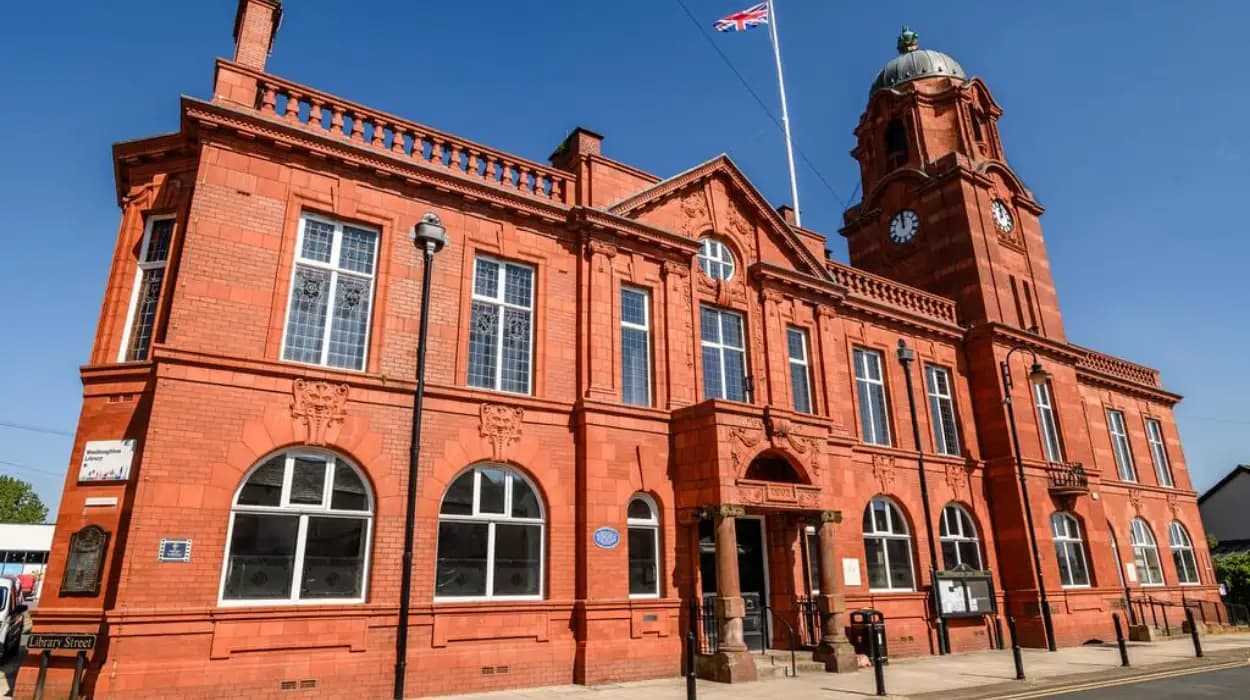
Westhoughton Town Hall was built in 1903 for the Westhoughton Urban District Council. The building was designed by Bradshaw and Gass in a Mannerist Renaissance style using red brick, terracotta detailing, and a prominent clock tower.
The town hall represented more than administrative convenience. It demonstrated the confidence of a growing industrial community and provided a permanent architectural expression of local government.
Roger Walker, a long-serving local official and farmer, was among those associated with the laying of the town hall cornerstone on 18 April 1903. Samuel Taylor, chairman of the Urban District Council in 1904–05, opened the building on 4 December 1904.
The building remains one of Westhoughton's most important civic landmarks.
Why is Westhoughton Carnegie Library historically significant?
Westhoughton Carnegie Library represents the expansion of public education and self-improvement during the early 20th century. It officially opened in 1906 and remains an important example of how industrial communities invested in learning, reading, and civic culture.
The Carnegie Library formed part of the town's civic development.
Andrew Carnegie was a Scottish-American industrialist and philanthropist who funded public libraries across Britain and other countries. Carnegie grants supported library buildings, although local authorities generally had to provide a suitable site and meet associated costs.
Westhoughton's library project received Carnegie funding. Historical records associated with the building indicate a grant of £3,750 in 1906. The library officially opened on 24 March 1906, with a formal opening ceremony later recorded for 1 August.
The building was designed to serve different educational needs. The original plans included separate reading rooms, a reference room, a lending department, and a lecture hall capable of seating 500 people.
This design reveals the wider purpose of Edwardian public libraries. They were not simply book-lending facilities. They provided spaces for education, lectures, community activities, and access to information.
The library also has a direct connection to local civic leadership. George Grundy, chairman of Westhoughton Urban District Council from 1905 to 1908, opened the library and received a ceremonial golden key. Bolton Council records state that the key was later rediscovered and placed on display as part of the library's 120th-anniversary commemorations in 2026.
For historians and genealogists, the library remains particularly important because local libraries often preserve newspapers, photographs, maps, local studies material, and community records.
Which historic buildings and landmarks survive in Westhoughton?
Westhoughton's surviving heritage includes the town hall, Carnegie Library, St Bartholomew's Church, Pretoria Pit memorial, historic farms, former industrial sites, and other structures that preserve evidence of medieval landholding, Victorian expansion, industrialisation, and civic development.
The historic environment provides physical evidence of Westhoughton's development.
Westhoughton Town Hall remains a major example of Edwardian civic architecture. Its 1903 construction reflects the town's status as an Urban District and its expanding administrative responsibilities. Historic England's assessment describes its Renaissance-influenced architectural character and distinctive clock tower.
The Carnegie Library provides another important civic landmark. Its architecture and original functions reflect the educational ambitions of the early 20th century.
St Bartholomew's Church also forms part of the town's historic core. The surviving church tower is Grade II listed and dates from 1869–70. The main 19th-century church was severely damaged by fire in 1990 and subsequently rebuilt, with the new church consecrated in 1995.
The Pretoria Pit memorial is one of the most significant industrial heritage monuments. Its inscription commemorates the 344 men and boys who died in the 1910 disaster.
Other historic sites include Brinsop Hall Farm, Snydale Hall Farm, Hulton Park, Warcock Hill, and surviving historic houses. These places illustrate the continuity between medieval landholding, agricultural society, industrial development, and modern Westhoughton.
The town's heritage is therefore not limited to one building or one period. It is a layered historic environment.
To experience this historic landscape in person today, consult our comprehensive guide for itineraries and visiting parameters.
Family-Friendly Attractions in Westhoughton Every Visitor Should Experience Together This Weekend
How did Westhoughton change after the decline of coal mining and manufacturing?
After coal mining and traditional manufacturing declined, Westhoughton shifted from an industrial economy toward residential development, services, education, commuting, and community facilities while retaining historic buildings and memorials that preserve its industrial identity.
The decline of heavy industry transformed the town during the 20th century.
Coal mining gradually disappeared as Britain's energy system changed and uneconomic pits closed. Textile manufacturing also declined as production became increasingly competitive and industrial employment moved elsewhere.
The result was a fundamental change in Westhoughton's economic structure. The town moved away from dependence on mills and collieries and became increasingly residential.
This transformation changed the landscape. Former industrial land was redeveloped, transport patterns shifted, and housing expanded.
Westhoughton Town Council describes the modern settlement as having evolved from a small industrial community into a largely residential town. The historic relationship between industrial employment and urban form remains visible in surviving streets, buildings, and landmarks.
The change did not erase the town's industrial past. Instead, industrial heritage became part of local identity and historical research.
The Pretoria Pit disaster remains commemorated. The Carnegie Library continues to represent public education. The town hall continues to symbolise civic government.
Local history organisations also preserve photographs, maps, oral histories, documents, and artefacts. These materials allow researchers to reconstruct the experiences of ordinary residents, including miners, mill workers, farmers, shopkeepers, teachers, and civic officials.
The post-industrial period therefore created a new relationship with history. Buildings and landscapes once associated with everyday economic activity became heritage resources.
How is Westhoughton's history preserved for future generations?
Westhoughton's history is preserved through listed buildings, memorials, libraries, local history groups, archival collections, community projects, commemorative events, and regeneration schemes that maintain connections between the town's medieval, industrial, civic, and modern identities.
Heritage preservation in Westhoughton operates through several connected systems.
Historic England protects nationally important buildings and monuments through statutory listing. The Pretoria Pit memorial, for example, is Grade II listed because of its historic significance.
Local archives provide another layer of preservation. Westhoughton Library and local history organisations hold material that supports research into family history, industrial development, local government, and community life.
The 1910 disaster is particularly well documented. The surviving records of the 344 victims provide valuable evidence for genealogists tracing Lancashire families. Names, addresses, occupations, and family relationships create connections between individual lives and wider industrial history.
Public commemoration also preserves historical memory. Annual services ensure that the Pretoria Pit disaster remains part of the town's civic calendar.
Education provides another mechanism. Heritage projects involving local schools have connected students with the history of the disaster through research, artefacts, workshops, and creative activities. Westhoughton Town Council has documented projects designed to remember individual victims and introduce younger generations to local industrial heritage.
The town hall also illustrates the relationship between preservation and modern use. Bolton Council announced a £3.5 million programme intended to repair and secure the future of the historic building while maintaining civic and community functions.
This approach is significant because historic buildings survive best when they retain practical purposes. Westhoughton's heritage is therefore preserved not only through monuments but also through continued community use.
Why does Westhoughton's history matter today?
Westhoughton's history matters because it explains how medieval landholding, agricultural society, textile manufacturing, coal mining, civic government, and post-industrial redevelopment combined to create the modern town and its distinctive cultural identity.
The history of Westhoughton reflects wider changes across Lancashire and northern England.
The medieval period established patterns of landownership and settlement. The early modern period brought changes in estate management, religious ownership, and private property. The Industrial Revolution introduced factories and mechanised production. Coal mining created new employment and communities. Victorian municipal reform established organised local government. Edwardian civic architecture expressed confidence in the growing town.
The Pretoria Pit disaster demonstrated the human cost of industrialisation. Its 344 victims remain central to the town's historical consciousness.
The later decline of mining and manufacturing produced another major transition. Westhoughton became predominantly residential while maintaining its connection with Bolton and the wider Greater Manchester region.
The town's history also has significant value for genealogical research. Industrial employment created extensive documentary records, while mining disasters generated detailed victim lists and compensation records. Local libraries and archives provide further evidence about individual families and community life.
For cultural tourists, Westhoughton offers a compact historical landscape where different periods remain connected. Medieval estate sites, historic farms, industrial memories, civic buildings, churches, and memorials demonstrate the town's long development.
For educators, the town provides a clear case study of industrialisation. Its history links national processes to specific local consequences. The transition from hand weaving to mechanised production, the expansion of coal mining, the growth of municipal government, and the decline of heavy industry can all be examined through local evidence.
For heritage preservationists, Westhoughton demonstrates the importance of protecting both individual buildings and wider historical context. The town hall has value because of its architecture and civic history. The Pretoria memorial has value because it represents individual lives and a major industrial tragedy. The library has value because it represents public education and community memory.
The modern town is therefore not separate from its medieval and industrial past. Its streets, institutions, memorials, surviving buildings, archives, and community traditions preserve evidence of earlier generations.
Westhoughton's story is ultimately a history of transformation. It began as a rural Lancashire settlement shaped by land, agriculture, and medieval estates. It became an industrial community driven by cotton manufacturing and coal mining. It developed its own civic institutions and public buildings. It experienced one of Lancashire's greatest industrial tragedies. It later adapted to the decline of heavy industry and emerged as a modern residential town.
That sequence explains the character of Westhoughton today. The town's historic identity is preserved not by one single landmark but by the accumulated evidence of centuries of change. From Snydale and Hulton to the mills, collieries, town hall, library, churches, and Pretoria memorial, each surviving element contributes to a broader historical record.
FAQS
What is the history of Westhoughton?
Westhoughton developed from a medieval rural settlement into an industrial Lancashire town. Its history includes medieval estates, agriculture, hand weaving, cotton mills, coal mining, Victorian local government, the 1910 Pretoria Pit disaster, and later residential development.