Westhoughton’s bakery history is closely connected with its development from a rural Lancashire settlement into an industrial community shaped by weaving, coal mining, railways, cooperative retail and high-street commerce. Traditional baking became part of everyday working-class life, with bread, cakes, pies and confectionery sold through local shops and cooperative businesses.
How did Westhoughton develop before traditional bakeries became established?
Westhoughton developed from an agricultural settlement into an industrial Lancashire town where cotton, silk, coal mining, transport and retail created the population and commercial demand that supported food shops, including bakeries and cooperative baking operations.
Westhoughton has medieval origins. Historical records preserve earlier forms of the place-name, including Halcton in 1210 and Westhalcton in 1240. The name derives from Old English elements associated with a settlement on a corner or nook of land. The settlement existed long before the modern high street developed.
The economic structure changed substantially between the eighteenth and nineteenth centuries. Westhoughton became associated with silk and cotton weaving and later with coal mining. These industries created regular employment and concentrated workers around mills, pits, streets and commercial centres. The Westhoughton Local History Group identifies weaving, cotton production and coal mining as major forces in the town's development.
This industrial growth created conditions for a more developed food-retail economy. Workers required regular supplies of bread and other staple foods. Shops therefore became increasingly important to daily household life.
The arrival of railway infrastructure strengthened this commercial transformation. Westhoughton railway station opened in 1848 under the Liverpool and Bury Railway Company. Daisy Hill station followed in 1857. Improved transport connected the district with neighbouring industrial communities and supported movement of people and goods.
Market Street became a particularly important commercial corridor. Historical photographs and local research demonstrate that food retailers occupied a prominent position along the street. The concentration of shops reflected a retail system in which households purchased food frequently rather than relying on large weekly supermarket-style shopping trips.
Bakeries fitted naturally into this environment because bread was a daily food. Unlike durable manufactured goods, fresh bread required repeated purchasing. A bakery therefore depended on proximity to households, workers and other high-street businesses.
When did cooperative baking become important in Westhoughton?
Cooperative retail became a major part of Westhoughton’s commercial history during the nineteenth and twentieth centuries, with the United Industrial Co-op operating a bakery alongside grocery, confectionery, butchery and other departments serving local households.
The Westhoughton Friendly Cooperative Society was registered in April 1858. It was founded by workers who had migrated from Rochdale to work at Westhoughton Old Mill. Its first grocery shop opened on Good Friday. This development placed food retail within the wider cooperative movement.
Cooperative societies were consumer-owned organisations designed to provide goods to members through collective retailing. In industrial towns, the model connected household consumption with local working communities.
Westhoughton's cooperative development expanded beyond grocery retail. Local historical research records the Westhoughton United Industrial Co-op as operating several departments around Market Street, including grocery, drapery, shoe retail, confectionery, a café, coal, garage services, furniture, fruit and vegetables, men's clothing, butchery and a bakery.
The bakery therefore formed part of a larger integrated retail system. Bread production did not exist as an isolated trade. It operated alongside other household necessities.
This model also reduced the distance between production and retail. The cooperative could manufacture or obtain bakery products and sell them through its own food outlets. Such integration was particularly significant in a town where households purchased many essentials locally.
Historical evidence provides a detailed account of the cooperative bakery during the twentieth century. A recollection of shopping in Westhoughton during the 1930s records that the Co-op café and confectionery shop sold bread and cakes baked in a bakery behind Market Street. The account also records catering for weddings and funerals.
This evidence demonstrates that traditional bakery production served several parts of community life. Bread represented everyday food, while cakes and confectionery supplied social occasions.
The bakery also illustrates the importance of back-of-shop and rear-premises production. Customers encountered the retail counter on Market Street, while baking activity took place away from the main frontage.
What did traditional bakeries sell in historic Westhoughton?
Traditional Westhoughton bakeries supplied staple bread alongside cakes, confectionery and savoury foods, reflecting household needs and local commercial customs. Cooperative bakery records specifically document bread and cakes, while later family bakeries expanded the traditional range.
Bread formed the basic product category. Fresh loaves were essential household purchases in an industrial community because domestic kitchens did not replace commercial bakeries for every household.
Cakes and confectionery occupied another important part of the traditional bakery trade. The documented Westhoughton Co-op bakery supplied both categories. Its café and confectionery shop became part of the town's retail landscape.
The historical record also identifies vanilla slices as a recognised product of the Westhoughton cooperative bakery. The surviving recollection describes their local reputation, demonstrating that individual bakery products could become associated with particular shops and communities.
Bakery products also supported community events. Wedding and funeral catering formed part of the cooperative's activities. This extended the bakery's economic role beyond ordinary household purchases.
The distinction between bakery products and confectionery was also less rigid in local retail. A single business could sell bread, cakes, sweet goods and refreshments. This explains why historical descriptions of Westhoughton's shops often refer to cafés, confectionery departments and bakeries within the same commercial system.
Modern traditional bakeries retain elements of this product structure. Waterfields, for example, describes its range as including bread, savouries, cream cakes and sandwiches. Its Westhoughton operation demonstrates the continuing relationship between baking, takeaway food and high-street retail.
How did industrialisation change the bakery trade in Westhoughton?
Industrialisation increased the importance of commercial food production because Westhoughton’s growing workforce required reliable supplies of everyday food. Railways, mills, coal mines and high-street shops connected bakery production with a larger and more organised local economy.
Industrialisation changed Westhoughton's population, employment patterns and shopping habits. Cotton and silk production created factory employment, while coal mining became another major source of work.
The Westhoughton Local History Group identifies several defining industrial milestones. The Bolton-Leigh railway was constructed through Chequerbent in 1828, while the town's industrial economy continued expanding during the nineteenth century.
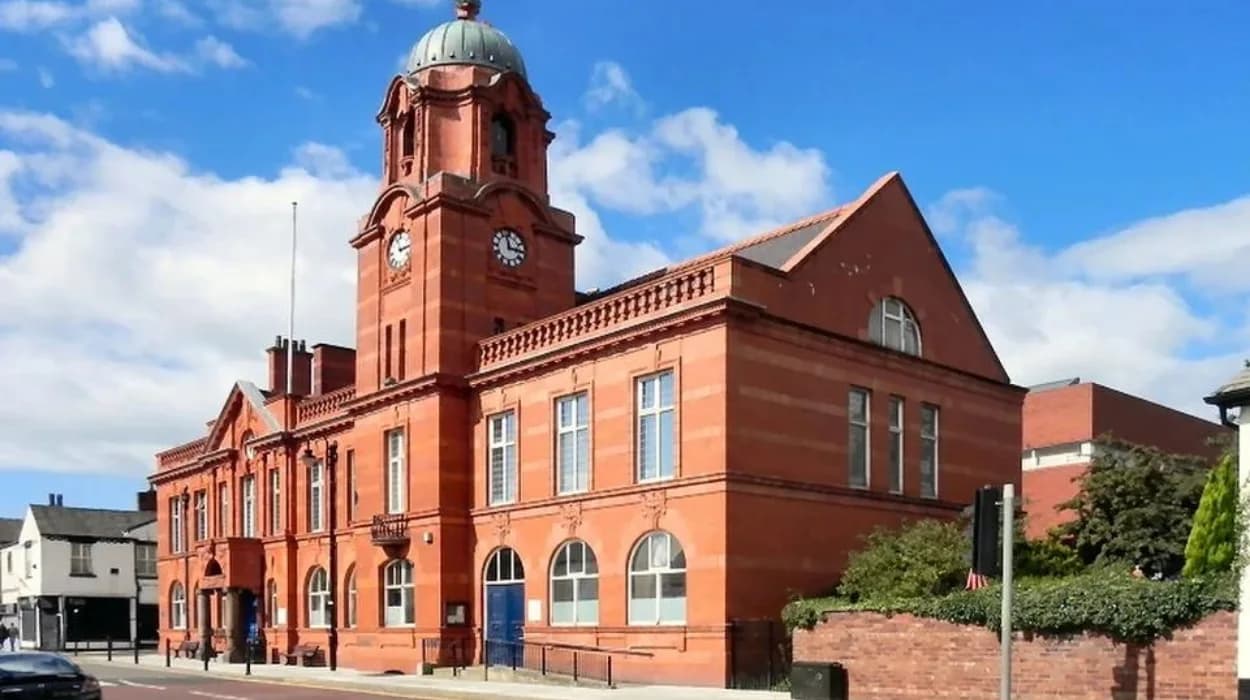
Westhoughton Town Hall provides architectural evidence of this expansion. The building was constructed in 1903 for Westhoughton Urban District Council. Historic England's consultation report states that substantial industrial growth, particularly the growth in cotton mills, contributed to the establishment of the urban district in 1894.
This urban development supported denser commercial streets. Market Street became a principal shopping environment, with food shops occupying significant space.
Bakeries benefited from this concentration because bread had a short shelf life compared with many manufactured goods. A bakery located close to customers could produce fresh products and sell them rapidly.
Industrialisation also changed bakery technology. Commercial bakeries increasingly adopted improved ovens, mixing equipment, milling systems, transport and later mechanical production. The result was greater consistency and higher production capacity.
The traditional bakery did not disappear immediately. Instead, small and medium-scale bakeries combined established recipes and craft skills with newer equipment.
This pattern continued into the twentieth century. Greenhalgh's Craft Bakery, founded in 1957, describes its development as a combination of traditional baking values and modern technology. The company later moved production to the former Beehive Mill site at Lostock in 1971.
How did food regulation affect traditional bakeries?
Food regulation transformed bakery working conditions by introducing requirements for cleanliness, working hours and inspection. The 1863 Bakehouses Regulation Act represented an important national step toward controlling sanitary conditions and protecting workers in commercial baking premises.
Nineteenth-century bakery production operated within an expanding framework of industrial and public-health regulation.
Parliament debated the Bakehouses Regulation Bill in 1863. The legislation addressed conditions in bakehouses, including restrictions on the employment of young people during prohibited night hours and requirements concerning cleaning and sanitation.
The parliamentary debate specifically referred to inspections and the cleaning, painting and whitewashing of bakehouses. These measures reflected concerns about workplace hygiene and public health.
The regulation of bakehouses formed part of the wider Victorian movement toward improving industrial working conditions.
This mattered to towns such as Westhoughton because industrial communities contained numerous workplaces where food production occurred alongside factories, workshops and domestic premises.
Over time, bakery production became increasingly structured around hygiene procedures, controlled ingredients and documented processes. Modern food businesses operate under substantially more comprehensive food-safety requirements.
The historical transition is important because traditional baking was not simply defined by recipes. It also involved premises, equipment, labour, fuel, sanitation and regulation.
Why was Market Street important to Westhoughton’s bakery history?
Market Street became central to Westhoughton’s bakery history because it concentrated shops, cooperative departments, cafés and food businesses within the town centre. Historical photographs and records show that food retail dominated parts of the street before supermarket shopping became widespread.
Market Street developed as one of Westhoughton's principal commercial streets.
The Westhoughton Local History Group's visual archive records numerous former businesses along Market Street. Its photographic material demonstrates the importance of food shops and explains that residents commonly shopped daily until around 1960.
This retail pattern created a strong relationship between households and local food businesses.
A traditional bakery depended on this repeated footfall. Customers could purchase bread while buying groceries, meat, vegetables or other necessities.
The cooperative system reinforced the relationship. The United Industrial Co-op operated several departments around Market Street, including bakery, butchery, grocery, confectionery and café facilities.
The architectural arrangement of older commercial streets also supported this type of retail. Narrow shopfronts faced the pavement, while storage, workshops or production areas occupied rear spaces.
The surviving historic environment remains important for understanding how bakery businesses fitted into the town.
Westhoughton Town Hall and Library, for example, occupies Market Street and dates from 1903. Historic England's assessment records the building's relationship with the development of Westhoughton Urban District and the town's industrial expansion.
Which traditional bakeries helped preserve Westhoughton’s baking heritage?
Greenhalgh’s, Waterfields and later independent businesses demonstrate different stages of Westhoughton’s bakery tradition: regional family baking, established North West retail and newer independent craft production. Their histories show how traditional methods adapted to changing consumer habits.
Greenhalgh's Craft Bakery provides one important regional example. The company was founded in 1957 by Allan Smart after he acquired the bakery associated with the Palais Company. It later moved from Julia Street in Horwich to the former Beehive Mill site at Lostock in 1971.
Greenhalgh's Westhoughton shop opened during the 1960s. The company states that the shop has served the community for decades and remains located at 60 Market Street.
Its history is significant because it connects Westhoughton with the wider Bolton-area craft bakery industry.
Waterfields represents another long-established family bakery tradition. The company began in Leigh in 1926 during the General Strike. Alice Waterfield established a small bakery selling pies and confectionery to factory workers. Her husband Albert later joined the business after studying baking at Manchester Technical College while working as a coal miner.
Waterfields expanded into a regional chain. Its current company history records 36 shops across the North West and continued production using modern facilities alongside retained craft skills.
Its Westhoughton shop demonstrates how a family bakery founded in an industrial Lancashire town developed into a wider regional business while retaining traditional product categories.
The modern Westhoughton bakery scene also includes independent craft production. Hive Bakehouse developed from a home baking project started during the 2020 pandemic. A 2025 report documented its move into a café bakery on Market Street, using a former stable building beside the Wheatsheaf.
This development is historically significant because it shows that independent baking continues to emerge within buildings and streets associated with earlier commercial activity.
How did traditional bakeries adapt after the Second World War?
After the Second World War, traditional bakeries faced changing shopping habits, improved transport, supermarket competition and industrial food production. Successful bakeries responded through larger production facilities, wider product ranges, retail expansion and continued emphasis on freshness.
The post-war period brought major changes to British food retailing.
Households increasingly gained access to supermarkets, packaged foods, improved refrigeration and motorised transport. These changes reduced dependence on small shops for every daily purchase.
Bread also became increasingly available through large-scale commercial production.
Traditional bakeries responded through differentiation. Fresh products, local service, pies, cakes, pastries and prepared food provided reasons for customers to continue visiting specialist shops.
Waterfields illustrates this process. The company expanded its production capacity and moved to a larger bakery on Manchester Road in Leigh in 1984. Its later history includes further retail expansion and investment in modern production.
Greenhalgh's followed a comparable model, combining modern technology with established baking methods. Its current operation describes traditional techniques as part of its production identity while operating modern manufacturing facilities.
Westhoughton therefore forms part of a broader regional pattern in which traditional bakeries survived not by remaining technologically unchanged, but by adapting their production and retail systems.
What survives of Westhoughton’s traditional bakery heritage today?
Westhoughton’s bakery heritage survives through historic Market Street buildings, documented cooperative premises, long-established bakery shops, family baking businesses, local archives and independent craft bakeries that continue producing bread, cakes and savoury goods.
The physical evidence is concentrated around the town centre.
Market Street remains the key location for understanding Westhoughton's commercial history. Local historical research contains photographs of former shops, businesses and streetscapes, providing evidence of how food retail developed during the nineteenth and twentieth centuries.
The Westhoughton Local History Group also maintains research covering businesses, buildings, photographs, legal documents, transport and working life. Its archive provides an important source for reconstructing the commercial history of the town.
Westhoughton Library holds local-history materials including photographs, booklets, Ordnance Survey maps and microfiche copies of old local newspapers. These sources are particularly valuable for researchers tracing former shops, addresses, business owners and family occupations.
Lancashire Archives provides additional resources, including local studies material, newspapers, maps and genealogical records. Lancashire County Council identifies census returns, parish registers, newspapers and maps as important sources for family and local history research.
These records allow researchers to reconstruct the bakery trade even when individual bakery buildings have disappeared.
Current businesses provide another form of continuity. Greenhalgh's has maintained a Westhoughton presence since the 1960s, while Waterfields continues to operate a Market Street bakery shop.
Provenance also represents a modern revival of the traditional food-hall model. Established in Westhoughton in 2015, the business combined a baker, butcher, greengrocer and delicatessen to provide an alternative to supermarket shopping.
The modern bakery economy therefore contains several layers of continuity: established regional bakeries, independent craft production, specialist food halls and surviving historic commercial buildings.
How can Westhoughton’s bakery history be researched and preserved?
Westhoughton’s bakery history can be researched through local newspapers, census records, trade directories, maps, photographs, business records and oral histories. Preservation depends on documenting former premises, identifying bakery workers and recording surviving buildings and community memories.
Trade directories are particularly useful for identifying businesses by name and address. Census records can identify people describing themselves as bakers, confectioners, shopkeepers, labourers or bakery employees.
Newspapers can provide advertisements, business announcements, property sales, court cases and reports involving local food businesses.
Maps help researchers establish the location of former bakeries and understand their relationship with markets, churches, mills, railway stations and residential streets.
Photographs provide architectural evidence. Shop signs, window displays, delivery vehicles and building layouts can identify businesses that no longer exist.
Local oral history provides another source. Memories of particular products, shopfronts and shopping routines can supplement documentary evidence, although researchers should distinguish personal recollection from independently verified historical records.
Westhoughton Library's microfiche newspaper collection and local-history materials provide a practical starting point. Lancashire Archives also holds local studies collections and access to newspapers and genealogical resources.
The Westhoughton Local History Group actively encourages residents to contribute information and photographs to its archive. This makes community participation an important part of preserving the town's commercial history.
To experience this historic commercial landscape in person today, consult our comprehensive [Best Dessert Shops in Westhoughton Worth Visiting During Your Bolton Travel Experience] for itineraries and visiting parameters.
What is the long-term historical importance of traditional bakeries in Westhoughton?
Traditional bakeries are important to Westhoughton’s history because they document the relationship between industrial employment, household consumption, cooperative organisation, high-street commerce and local food production across more than a century of social and economic change.
The history of Westhoughton's bakeries is therefore part of the town's wider industrial history.
The development began with a settlement that later became a centre for weaving, cotton production and coal mining. Industrial employment increased the need for reliable local food retail.
Cooperative organisation then connected workers and consumers through businesses supplying everyday necessities. Westhoughton's United Industrial Co-op included a bakery among its extensive Market Street operations.
The twentieth century introduced new bakery businesses and larger production systems. Greenhalgh's established its regional craft bakery in 1957 and opened its Westhoughton shop during the 1960s.
Family businesses such as Waterfields show how traditional baking survived through generational skills, investment and adaptation. Waterfields began in 1926 and continues to combine modern production with craft baking traditions.
Independent businesses such as Hive Bakehouse demonstrate another stage in this continuing history. Its development from home baking during the pandemic to a Market Street bakery reflects renewed interest in small-scale craft production.
The historical significance extends beyond bread itself. Bakeries reveal patterns of employment, family enterprise, cooperative economics, urban development, food regulation, transport and consumer behaviour.
Westhoughton's bakery heritage also provides valuable material for genealogical research. A baker, confectioner, shop assistant or bakery labourer appearing in a census or newspaper can connect a family history with a particular street and period.
For educators and heritage researchers, bakery history offers a practical way to explain industrialisation at community level. A bakery links large historical forces with everyday household activity.
For preservationists, the surviving evidence demonstrates why ordinary commercial buildings deserve documentation. A former bakery does not need to be a monumental structure to provide historical evidence. Shopfronts, rear workshops, signs, photographs and business records can all contribute to reconstructing the town's past.
Westhoughton's traditional bakery history is therefore not a narrow food story. It is a record of how an industrial Lancashire community fed itself, organised commerce and adapted to changing technology and retail conditions. Its surviving businesses, archives and buildings provide a continuous historical thread from the nineteenth-century cooperative economy to the modern craft bakery revival.
FAQS
What is the history of traditional bakeries in Westhoughton?
Traditional bakeries in Westhoughton developed alongside the town’s industrial growth, particularly cotton, silk weaving and coal mining. Bakeries supplied bread, cakes and confectionery to local working families and became an important part of the town’s high-street economy.