Farnworth is a historic town in Greater Manchester whose development was shaped by parish life, textile manufacturing, transport, education, civic government, religious institutions, and public parks. Its surviving buildings and street patterns preserve evidence of the transition from rural Lancashire settlement to industrial urban community.
What is the historical background of Farnworth?
Farnworth developed from a rural settlement within the historic parish of Deane into an industrial Lancashire township, then an urban district and municipal borough, before becoming part of Bolton Metropolitan Borough in 1974. Its transformation followed transport improvements, textile manufacturing, population growth, and civic expansion.
The history of Farnworth begins before the industrial age. The settlement formed part of the historic parish of Deane, an ecclesiastical and administrative area that covered a substantial part of the Bolton district. Farnworth later became a parish in its own right in 1541, establishing a stronger local religious and administrative identity.
The town's early landscape was rural. Farms, fields, cottages, tracks, and small settlements defined the area before industrialisation. The surviving historic fabric of Farnworth still contains evidence of this earlier landscape, although much of the original agricultural environment disappeared as the population expanded.
The 18th and 19th centuries brought fundamental change. Improvements to roads and canals connected Farnworth more closely with Bolton, Manchester, Bury, and surrounding industrial communities. Textile production expanded across the region, creating employment and encouraging dense residential development.
The Manchester, Bolton and Bury Canal was completed by 1797. Its route provided an important transport connection for the wider Farnworth area and supported the movement of coal, raw materials, and manufactured goods. The canal formed part of the infrastructure that enabled industrial communities across the region to grow.
Farnworth's political status also changed as its population increased. Farnworth Local Board was established in 1863. The area later became an Urban District Council, followed by municipal borough status in 1939. Local government reorganisation in 1974 placed Farnworth within the Metropolitan Borough of Bolton.
This administrative timeline is essential to understanding Farnworth's identity. The town was not simply absorbed into modern Bolton. It developed its own institutions, civic traditions, public buildings, and political structures before becoming part of the metropolitan borough.
How did transport transform Farnworth?
Transport transformed Farnworth by connecting its workers, mills, markets, and businesses with wider industrial Lancashire. Turnpike roads, the Manchester, Bolton and Bury Canal, and railway infrastructure reduced isolation and supported the movement of people, coal, cotton, machinery, and finished goods.
Before the industrial revolution, Farnworth depended largely on local roads and tracks. Bolton Council's conservation documentation records that earlier routes were often rough tracks of clay or stone. The Bolton-to-Manchester road was turnpiked in 1763, with a toll bar at Moses Gate.
Turnpike roads were privately managed roads funded through tolls. Their development improved long-distance movement and provided more reliable connections between growing industrial settlements.
Moses Gate became particularly significant because of its position on the route between Bolton and Manchester. The area developed as an important transport and industrial corridor. The Moses Gate and Ringley Turnpike Act followed in 1830, while a Highways Board was formed in 1865. These developments reflected the increasing importance of organised transport infrastructure.
The canal network added another dimension. The Manchester, Bolton and Bury Canal connected industrial communities with navigable waterways. Canal transport was particularly important before the widespread dominance of railways because heavy materials could be moved more efficiently by water.
Coal was essential to industrial Lancashire. Mills required fuel for steam power, while households and businesses depended on coal for heating and manufacturing. The canal therefore formed part of a wider industrial supply system.
Railways later accelerated the transformation. The Lancashire and Yorkshire Railway became an important presence in the district. Bolton Council records identify Farnworth industrialist James Nuttall as a significant figure in the campaign that helped secure a railway station at Farnworth. Nuttall was a master cotton spinner and partner in T Nuttall and Sons, with industrial interests including Oak Mills in Farnworth.
The arrival and expansion of railway infrastructure changed the geography of the town. Workers gained better access to employment. Manufacturers gained improved connections to markets. Industrial communities became increasingly integrated into regional economic networks.
Transport also influenced the physical appearance of Farnworth. Roads became commercial corridors. Railway infrastructure created new points of movement. Industrial buildings occupied land near routes that could support the movement of materials and workers.
The history of Farnworth therefore demonstrates a clear relationship between transport and urbanisation. Roads opened connections. Canals supported heavy freight. Railways increased speed and regional integration. Each stage reduced the importance of geographical isolation.
Why was cotton manufacturing important to Farnworth?
Cotton manufacturing became central to Farnworth's economic development because mills created employment, attracted workers, expanded housing, and generated institutions that shaped daily life. Industrial families such as the Nuttalls became influential employers, civic leaders, and contributors to local religious and educational development.
The industrial history of Farnworth forms one of the most important parts of its heritage. The town developed within the wider Lancashire textile economy, where cotton spinning and weaving transformed communities across Greater Manchester.
Industrialisation changed the relationship between work and place. Earlier rural communities relied heavily on agriculture and small-scale production. Factory-based textile manufacturing concentrated employment within large industrial buildings and required a substantial workforce.
Cotton mills needed workers at different stages of production. Spinning transformed cotton fibres into yarn. Weaving converted yarn into cloth. Supporting industries supplied machinery, fuel, transport, construction, and maintenance.
The growth of mills created demand for housing. Workers needed homes close to employment. Streets expanded around industrial sites, producing the dense urban form that became characteristic of Farnworth.
Industrialisation also created new social structures. Factory owners and managers became influential figures in local government. Workers formed communities around workplaces, churches, chapels, schools, friendly societies, and social organisations.
James Nuttall provides a clear example of the relationship between industrial wealth and civic influence. Born in Kearsley in 1836, he became a master cotton spinner and a partner in T Nuttall and Sons. He served on the Farnworth Local Board and later became its chairman. He also supported local religious institutions and was involved in efforts associated with the railway.
The Nuttall story illustrates a wider historical pattern. Industrial entrepreneurs did not operate separately from the communities in which they worked. Their businesses influenced employment, transport, politics, education, and religious life.
The physical remains of Farnworth's industrial era are therefore important even where individual mills have disappeared. Street layouts, workers' housing, commercial buildings, churches, schools, and transport routes collectively preserve the industrial townscape.
The decline of traditional textile manufacturing during the 20th century created another major transition. Global competition, technological change, and industrial restructuring reduced the economic importance of many Lancashire mills. Farnworth's economy gradually diversified, while some former industrial sites disappeared or changed use.
The historical significance of cotton manufacturing remains visible through the urban landscape. The town's streets and buildings reflect the economic system that created them.
Which historic churches reveal Farnworth's changing community?
Farnworth's historic churches reveal population growth and changing religious needs during industrialisation. St John the Evangelist dates from 1826, while later churches and chapels reflected expanding communities, new denominations, growing congregations, and the social importance of organised religion.
Religious buildings played a major role in Farnworth's development. They were places of worship, but they also served wider social functions. Churches and chapels supported schools, Sunday schools, charitable activity, community meetings, and local identity.
The parish history of Farnworth is particularly significant. Farnworth became a parish in 1541 after previously being associated with the parish of Deane. The creation of a distinct parish reflected the area's growing local importance.
The Church of St John the Evangelist in Farnworth was built in 1826, with a chancel added in 1871. Historic England identifies the building as a Grade II listed structure. Its architecture includes a stone nave, west tower, chancel, galleries, and later Victorian additions.
The building represents a period when population growth required new religious infrastructure. The 1826 foundation dates from the early industrial period, when Farnworth was undergoing rapid social and economic change.
The church's architectural details also provide evidence of changing tastes. Its galleries reflect the need to accommodate larger congregations. Its later chancel demonstrates continued investment and adaptation.
Religious diversity also formed part of Farnworth's history. Methodism became influential across industrial Lancashire. A Methodist chapel and school were established on Market Street in 1830, according to Bolton's conservation documentation.
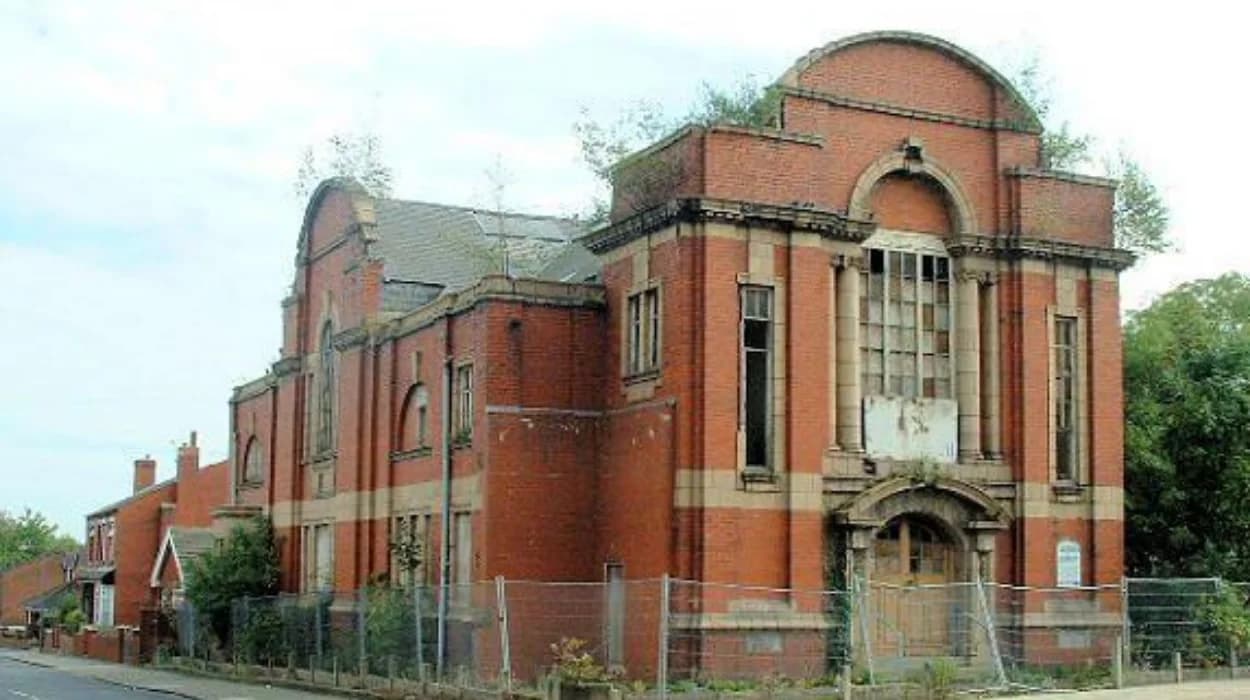
The former Baptist Church at 89 Bolton Road provides another important surviving landmark. Built in 1907 to designs by Bolton architects Bradshaw and Gass, the building is Grade II listed. It uses red brick, terracotta dressings, decorative banding, and a Welsh slate roof.
The architectural history of these buildings demonstrates how religious institutions responded to industrial urbanisation. Larger populations required more churches. New denominations established their own places of worship. Religious buildings became prominent elements within expanding streets.
Their survival also provides evidence of architectural change. Early Victorian churches often used Gothic or Romanesque influences. Later buildings incorporated different approaches to materials, decoration, and internal planning.
Churches therefore function as historical documents. Their construction dates identify periods of population growth. Their architectural forms reveal contemporary design preferences. Their associated schools and halls demonstrate the wider social responsibilities of religious organisations.
What happened to education in historic Farnworth?
Education expanded alongside Farnworth's population and industrial economy. Early weekday schooling appeared at Dixon Green in 1715, while Sunday education developed in the 19th century. Churches, chapels, and local reformers helped create institutions that supported literacy, religious instruction, and community development.
Education was an important part of Farnworth's transition from rural settlement to industrial town.
Bolton's Greenside Conservation Area Appraisal identifies a weekday school at Dixon Green established in 1715. This early institution predates the major industrial expansion of the 19th century and demonstrates that organised education existed in the community before the factory system reached its peak.
The growth of Sunday schools became another important development. Sunday schools provided religious instruction and basic education, particularly for working-class communities.
Roger Holland, described in the conservation documentation as a local cotton merchant, established a Sunday School at Dixon Green in 1808. His initiative reflected concerns about the community's religious and educational conditions.
Education became increasingly connected to religious institutions. Churches and chapels provided buildings and organisational structures. Industrial communities used these institutions to educate children and support families.
The history of education also reflects changing ideas about social responsibility. Industrialisation created new pressures. Children from working families required access to education while communities faced rapid population growth.
Schools therefore became important landmarks in their own right. Their locations often corresponded with churches, chapels, and residential districts.
The educational history of Farnworth has particular relevance for genealogical research. School records, parish documents, census returns, and local registers can help researchers reconstruct family movements and social conditions.
For historians, education records also provide evidence of demographic change. Rising school demand indicates population growth. New buildings reveal expanding neighbourhoods. Changes in curriculum reflect wider national reforms.
Farnworth's educational heritage is therefore closely connected to its industrial and religious history. The town's schools helped create a more organised urban community while preserving links with local institutions.
Why is Farnworth Park historically significant?
Farnworth Park became a major public landmark after its presentation to the town by Thomas Baines and opening by William Ewart Gladstone on 12 October 1864. Its creation reflected Victorian ideas about public recreation, civic improvement, health, and community identity.
Public parks were important products of Victorian urban development. Industrial towns faced overcrowding, pollution, and limited access to open space. Public parks provided managed landscapes for recreation and community use.
Farnworth Park was presented to the town by Thomas Baines, a Member of Parliament, and opened on 12 October 1864 by William Ewart Gladstone, who was also a Member of Parliament and a major Victorian political figure. Bolton's conservation documentation records the event and identifies a monument within the park commemorating its dedication to the people of Farnworth.
The park represented a significant change in the relationship between residents and public space. Industrial workers lived in increasingly dense neighbourhoods. A public park provided access to landscaped open ground within the urban environment.
Its historical importance extends beyond recreation. The park formed part of Farnworth's civic identity. It became associated with public events and local traditions, including the Farnworth Wakes.
The Farnworth Wakes developed after the opening of the parish church and became a local annual tradition. Historical accounts describe earlier festivities in the area, while the conservation appraisal records the Wakes as part of the cultural history surrounding Farnworth Park.
Public parks also reflected Victorian ideas about social improvement. Municipal and philanthropic investment in open spaces was linked to concerns about health, leisure, and community behaviour.
Farnworth Park therefore belongs to a wider national history of Victorian public parks. Its significance comes from the combination of landscape, philanthropy, civic identity, and social history.
The park also provides a useful physical connection between past and present. Unlike many industrial buildings, public parks often survive through changes in economic conditions. Their landscapes retain historical associations even when surrounding buildings have changed.
To experience this historic landmark in person today, consult our comprehensive [Discover Hidden Gems in Farnworth Every Tourist Should Explore During Their Visit] for itineraries and visiting parameters.
How has Farnworth's historical identity survived into the present?
Farnworth's historical identity survives through its listed buildings, conservation areas, parks, churches, street patterns, civic records, industrial remains, and community traditions. These surviving elements connect modern Farnworth with its rural origins, Victorian expansion, industrial economy, and former municipal independence.
Modern Farnworth is the product of centuries of accumulated change.
The rural settlement that existed before industrialisation is no longer the dominant landscape. Yet traces remain in historic routes, older buildings, and the arrangement of surviving neighbourhoods.
The industrial town also changed. Many traditional manufacturing activities declined, while former industrial land acquired new uses. Yet the townscape created by industry remains visible.
The Victorian civic landscape continues to influence the community. Farnworth Park remains an important public space. Historic churches continue to define local landmarks. Older streets preserve the physical framework of earlier development.
The town's former municipal status also remains part of its historical identity. Farnworth was a Local Board area, an Urban District, and a Municipal Borough before becoming part of Bolton Metropolitan Borough in 1974.This administrative history matters because local identity does not disappear when boundaries change. Historical communities retain memories, buildings, institutions, and traditions.
For visitors, the value of Farnworth lies in understanding these layers. The most significant landmarks are not isolated attractions. They form part of a connected historical landscape.
For educators, Farnworth provides a practical example of industrialisation. Students can examine how transport, employment, religion, education, housing, and government changed together.
For genealogists, the town offers a rich field of research through parish records, municipal documents, census material, school histories, and local archives.
For heritage preservationists, Farnworth demonstrates why ordinary buildings and landscapes deserve attention. Nationally important history is often preserved through local places.
The forgotten stories of Farnworth are therefore not separate from its famous landmarks. They explain why those landmarks exist.
The town's history is a continuous process. Rural settlement became industrial community. Industrial community developed civic institutions. Civic institutions created public spaces and services. The former municipal borough became part of modern Bolton.
That sequence defines Farnworth's historical importance.
Its heritage remains valuable because it records the lives of the people who built, worked in, worshipped within, educated their children through, governed, and used these places. The surviving landscape provides evidence of those processes.
Farnworth's historic landmarks are therefore more than old structures. They are primary evidence of social and economic change. Their preservation ensures that the transformation of a Lancashire settlement into a modern Greater Manchester community remains visible, researchable, and understandable for future generations.
FAQS
What is the history of Farnworth?
Farnworth developed from a rural settlement within the historic parish of Deane into an industrial Lancashire township. It later became an urban district and municipal borough before becoming part of Bolton Metropolitan Borough in 1974.