Key Points
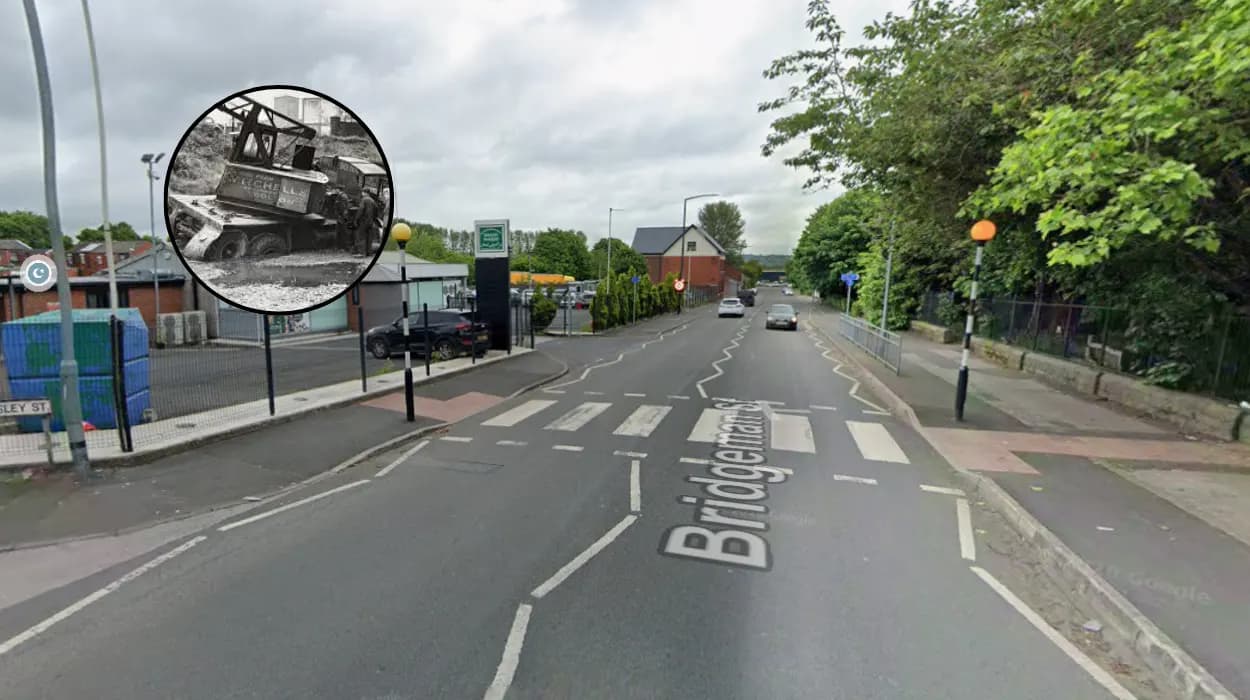
- A mobile crane belonging to Bolton‑based firm Thomas Mitchell and Sons became stuck in the mud while being manoeuvred into position on a site near Bridgeman Street/Bridgeman Place in Bolton.
- The incident relates to a documented historic event from October 1953, identified in archive material and local‑history coverage, rather than a fresh 2026 accident.
- Contemporary references to the case appear in regional and online outlets framing the crane‑bog‑down as a “throwback” or “vintage” incident, often accompanied by a photograph of the stuck crane and onlookers.
- Editors and writers describing the image note that the crane was being moved into place on land adjacent to Bridgeman Street/Bridgeman Place when it sank into soft ground, prompting commentary that “That’s going to take some shifting!” or similar.
- The site is historically associated with light industrial and engineering activity in the Pinner/Bridgeman area, which has long housed engineering and lifting‑equipment firms.
Bolton (Bolton Today) April 17, 2026 – Thomas Mitchell and Sons crane gets bogged down on Bridgeman Street site (1953)
Bolton – A mobile crane operated by local firm Thomas Mitchell and Sons became stuck in the mud during a manoeuvring operation on a site near Bridgeman Street (commonly referenced as Bridgeman Place) in October 1953, according to regional‑archive and local‑history accounts. Photographs and captions from that period show the crane embedded in soft ground, with the caption text used by archivists and media outlets describing the situation and the apparent difficulty of extracting the machine.
The incident has been recirculated in recent online articles and social‑media posts as a historical “throwback” fact, rather than a new 2026‑style breakdown, with editors emphasizing that the crane was “bogged down as it was being manoeuvred into place on land off Bridgeman Street/Bridgeman Place.” One such description, published by a UK news‑syndication outlet on 17 April 2026, notes: “That’s going to require some effort!” alongside the image, underscoring how the heavy plant sank into the ground during repositioning.
The same 1953 event is also referenced in a Newsquest‑group archival note, which catalogues the crane‑bog‑down under the entry title “Crane stuck on Bridgeman Place, Bolton – 1953,” confirming the date, location, and involvement of Thomas Mitchell and Sons. The catalog‑style text does not expand on injuries, casualties, or follow‑up actions, focusing instead on the visual and locational details of the incident.
How was the crane becoming stuck described?
As reported by a staff writer for a UK news‑syndication outlet recounting the archival image, the caption used with the 1953 photograph states that the Thomas Mitchell and Sons mobile crane “became stuck while being positioned on a site near Bridgeman Place in Bolton.” The writer adds that the caption cheekily remarks “That’s going to require some effort!” after the crane sank into the muddy ground, implying that the recovery effort required additional equipment or manpower.
In the Newsquest‑generated archive note on the same scene, the editor or cataloguer records the event simply as “Crane stuck on Bridgeman Place, Bolton – 1953,” without attributing direct quotes to any named individual, but preserving the locality and date for later reference. Both sources treat the episode as a discrete, non‑fatal machinery incident, not as a major industrial accident involving serious injury or structural collapse.
What is known about the location and firm?
As noted by a contributor to a “Memories of Pinner” Facebook group, the area around Bridgeman Street in Bolton has long been associated with light industrial and engineering activity, including firms such as Wadsworth Lifts. That context suggests that heavy‑machinery movements, including crane operations, were not unusual in the vicinity and that the soft‑ground issue may reflect local ground‑conditions rather than a unique failure mode.
Thomas Mitchell and Sons, the Bolton‑based firm named in connection with the crane, appears in these reports solely as the operator or owner of the mobile crane; contemporary coverage does not elaborate on the company’s size, fleet, or later history beyond identifying it as a local engineering or lifting concern.
How have modern outlets framed the 1953 incident?
Digital editors and copy‑writers re‑publishing the 1953 photograph in 2026‑style roundup pieces have typically framed the crane‑bog‑down as a “vintage” or “historical” curiosity, using headlines that emphasise the decade‑old date and the visual oddity of a crane stuck in mud. One editor, writing for a national‑news syndication site, quotes the original caption text and then notes that the image was taken in October 1953, thereby anchoring the event in its proper historical context for contemporary readers.
By contrast, the Newsquest‑style archive entry functions more as a catalog record than a narrative news piece, listing the event under a date‑and‑place heading and leaving interpretation to other writers or historians.
Background of the development
Archival and local‑history materials indicate that the 1953 crane‑bog‑down on Bridgeman Street/Bridgeman Place reflects a type of routine, low‑severity incident sometimes associated with heavy‑plant operations on sites with unexpectedly soft or water‑logged ground. In the mid‑20th century, ground‑condition assessments and site‑preparation protocols were often less systematic than they are today, which can partly explain why a mobile crane might have sunk into the mud during a straightforward manoeuvre.
The Bolton area, with its industrial and engineering‑firm clusters along streets like Bridgeman Street, has historically hosted construction, lifting, and maintenance work, making crane movements a regular feature of local activity. The 1953 incident, therefore, sits within this broader pattern of mid‑century industrial operations rather than marking a one‑off calamity; it is the photograph and subsequent archiving, rather than the event’s scale, that have given it a durable presence in later coverage.
Predicted impact on particular audiences
For local historians and residents of Bolton, the 1953 crane‑bog‑down on Bridgeman Street/Bridgeman Place may serve as a visual illustration of the town’s industrial past and the practical challenges of working with heavy machinery on older‑style sites. Those engaged in heritage or community‑history projects could use the image and associated captions as evidence of how construction and lifting operations were conducted in the 1950s, including the risks posed by unprepared ground.
For students and journalists studying regional‑history reporting or archive‑based storytelling, the incident offers an example of how short, caption‑driven visual records can be repurposed into mini‑features for online “throwback” or “then‑and‑now” formats. The way different editors have handled the same 1953 photograph—sometimes as a cheeky “That’s going to take some shifting!” anecdote and at other times as a dry catalog entry—also demonstrates how tone and framing can shape the perceived significance of a minor machinery mishap for different audiences.