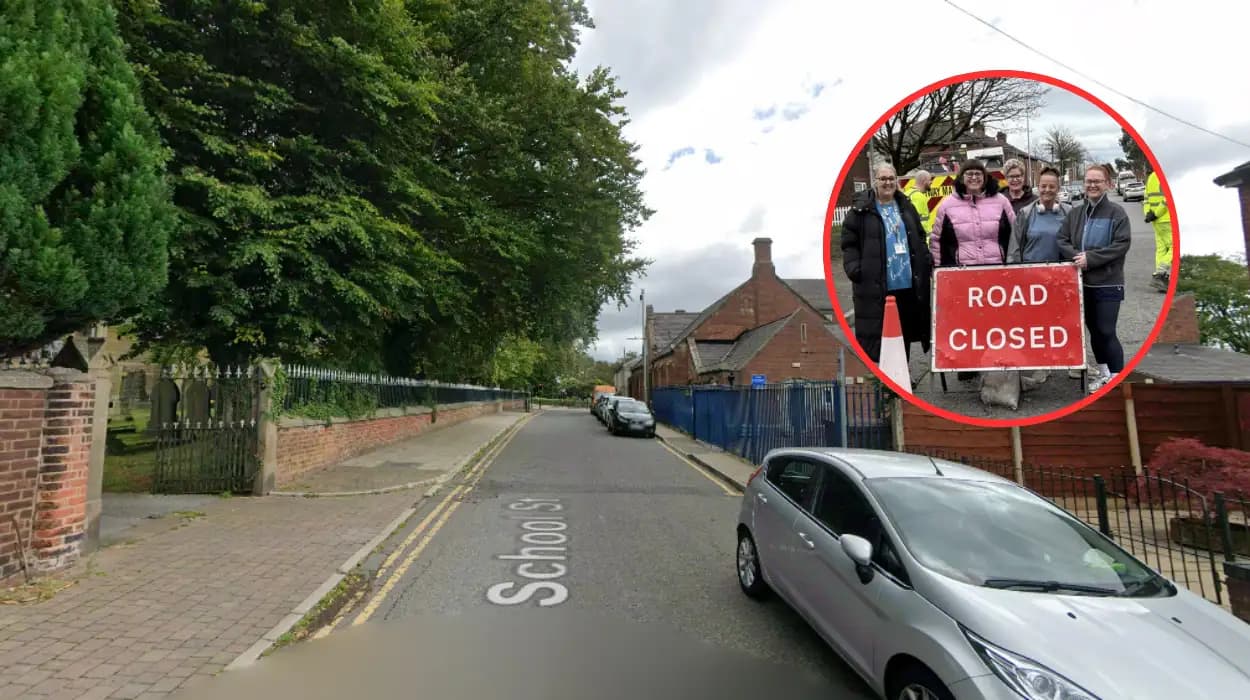
Key Points
- Traffic Restrictions Introduced: Motor vehicles will be temporarily banned from entering specific roads surrounding Sharples Primary School and The Gates Primary School during peak drop-off and pick-up hours.
- Implementation Dates Set: The initiative will go live at Sharples Primary School on June 8, followed closely by an implementation at The Gates Primary School in Westhoughton on June 16.
- Targeted Danger Zones: The traffic bans specifically target cul-de-sacs where congestion routinely builds up, namely Hugh Lupus Street in Sharples and Bristle Hall Way in Westhoughton.
- Staggered Operational Hours: Hugh Lupus Street will close to external traffic between 8:30am and 9am, while Bristle Hall Way will implement dual closures from 8:30am to 9am and again from 3pm to 3:30pm.
- Exemptions for Essential Access: Emergency service vehicles, local residents, and school staff retain full driving access to the restricted zones at all times.
- Borough-Wide Scheme Expansion: The addition of these two institutions expands Bolton’s active "School Streets" network to four operational zones, following earlier rollouts at Kearsley West Primary School and St Bede’s Academy.
- Proven Trial Success: The permanent implementations come on the heels of extensive localized pilot schemes conducted in March, which local highway authorities deemed highly successful.
Sharples (Bolton Today) June 2, 2026 - A series of targeted traffic bans will be legally enforced across further residential roads in Bolton this month as municipal leaders expand the controversial "School Streets" initiative. The local highway infrastructure scheme, which aims to drastically lower carbon emissions, reduce localized traffic gridlock, and shield primary school children from vehicular accidents, will directly impact families and motorists surrounding Sharples Primary School and The Gates Primary School in Westhoughton. By temporarily prohibiting non-essential motor vehicles from entering tactical perimeter roads during peak morning and afternoon periods, municipal planners hope to eliminate the chaotic drop-off and pick-up habits that have historically plagued local neighborhoods.
According to official administrative schedules, the localized driving prohibitions will commence at Sharples Primary School on June 8, followed by a secondary rollout at The Gates Primary School on June 16. The operational mandates will specifically target narrow residential cul-de-sacs where turning vehicles frequently trigger gridlock. In Sharples, unauthorized vehicles will be prohibited from accessing Hugh Lupus Street between 8:30am and 9am. In Westhoughton, the mandate features a dual-window restriction blocking Bristle Hall Way from 8:30am to 9am, alongside an afternoon closure spanning 3pm to 3:30pm.
What is the Purpose of the New Bolton 'School Streets' Traffic Restrictions?
The core objective of the expanding initiative is to establish a pedestrian-focused safety buffer directly outside school gates, effectively forcing motorists to park further away from educational campuses. Local authorities have increasingly identified the concentrated presence of moving vehicles during school arrival and dismissal windows as a primary threat to child safety, citing both structural collision risks and the long-term biological impact of localized exhaust fumes on developing youth.
As reported by reporter Dan Dougherty of The Bolton News, the geographical selection of these specific roads is deeply deliberate. Both Hugh Lupus Street in Sharples and Bristle Hall Way in Westhoughton are structurally classified as cul-de-sacs. Due to their dead-end design, the high volume of parents attempting to execute three-point turns, park on pavements, or reverse in confined spaces during identical thirty-minute windows creates an environment described by local representatives as hazardous.
The implementation means that outside of term-time dates, both Hugh Lupus Street and Bristle Hall Way will immediately revert to standard highway regulations, allowing unrestricted public traffic. Furthermore, to prevent local paralysis and preserve community functionality, explicit exemptions have been written into the traffic orders. Emergency service vehicles, contracted school staff, and verified local residents living within the demarcated boundaries will maintain driving access to the streets, even during the active thirty-minute morning and afternoon enforcement windows.
Explore More Westhoughton News
Westhoughton Councillors Oppose Persimmon Overdevelopments, Westhoughton 2026
Be One Homes Apologises to Evicted Westhoughton Residents, Bolton 2026
Why are Local Leaders Supporting the Motor Vehicle Bans?
Political backing for the vehicular restrictions reflects a growing exasperation among local representatives regarding historical driver behavior and the volatile environments that frequently manifest near school gates during peak hours. Civic leaders argue that the minor inconvenience caused to commuting parents is heavily outweighed by the immediate physical protection afforded to primary school children.
As reported by reporter Dan Dougherty of The Bolton News, Westhoughton Councillor John McHugh stated that
"I think it is a good thing, yes."
Elaborating further on the community necessity of the structural highway changes, Cllr McHugh stated that
"Anything that alleviates the congestion around the school is a good thing, and parents need to be aware that we're doing this for children's safety."
The political endorsement is informed by direct institutional experience. Cllr McHugh, who formerly served the community as a localized school governor, recalled the heightened tensions and systemic gridlock that routinely defined the daily drop-off and pick-up periods. Reflecting on those logistical struggles, Cllr McHugh stated that
"Any primary school is bedlam around pickup time - people are in a rush to get their kids."
The former governor also highlighted the verbal friction that frequently occurs between traffic monitors and non-compliant motorists. Cllr McHugh stated that
"I used to have to tell people to move their cars and they weren't happy about it."
Emphasising the broader cultural shift required from families living within close proximity to the schools, Cllr McHugh stated that
"For some people its just a ten minute walk to keep people safe - it's really important."
Which Other Bolton Educational Institutions Have Implemented Traffic Bans?
The upcoming restrictions at Sharples Primary and The Gates do not represent an isolated policy experiment, but rather the scaling up of a coordinated borough-wide strategy. The expansion builds directly upon prior legislative rollouts executed across alternative segments of the Bolton borough earlier in the current academic term.
As documented by Dan Dougherty of The Bolton News, both Kearsley West Primary School and St Bede’s Academy have already been subjected to active, legally enforceable "School Streets" restrictions. The traffic containment policies were officially implemented at Kearsley West Primary School on May 5, while the corresponding restriction framework at St Bede’s Academy was codified and activated on May 18.
The strategic expansion follows a series of localized road safety experiments conducted across the region earlier in the year. As reported by Dan Dougherty of The Bolton News, all four participating schools—Sharples Primary, The Gates Primary, Kearsley West Primary, and St Bede's Academy—underwent preliminary "School Streets" field trials during the month of March.
Local highway data and community feedback collected during those initial trial phases were considered overwhelmingly successful by municipal planners, satisfying the key performance indicators regarding congestion displacement and safety metrics. Consequently, when the upcoming June 16 rollout at Bristle Hall Way in Westhoughton officially goes live, it will mark the establishment of four permanently active, synchronized "School Streets" safety zones operating throughout the wider Bolton borough.
How Can Other Communities and Schools Register for the Scheme?
The long-term vision of the "School Streets" framework extends beyond these four initial locations. Bolton Council has established a public pathway enabling localized neighborhoods, worried parents, and academic administrators to advocate for similar traffic interventions within their own residential sectors.
As detailed by Dan Dougherty of The Bolton News, the localised expansion of the traffic containment scheme relies on grassroots community engagement and institutional cooperation. Residents, headteachers, and parent-governor associations who wish to formally petition for their local roads to be granted "School Streets" status can initiate the legislative process by directly contacting the specific administrative channels within the local authority.
The application pipeline is managed by Bolton Council’s dedicated highways department, which evaluates incoming requests based on a variety of structural parameters, including road geometry, accident histories, localized air quality metrics, and the feasibility of alternative parking solutions.
What Does This Mean For Local Commuters and Residents Moving Forward?
For motorists who routinely navigate the arterial routes surrounding Sharples and Westhoughton, the formalisation of these orders necessitates a structural adjustment to daily travel itineraries. While the closures are brief—lasting only thirty minutes per session—the knock-on effects on adjacent roads are a subject of ongoing observation by local transport analysts.
The legal enforcement mechanism relies on high-visibility signage placed at the thresholds of Hugh Lupus Street and Bristle Hall Way, warning external drivers of the financial penalties associated with non-compliance. While municipal traffic wardens and local law enforcement are tasked with initial oversight, the overarching goal of Bolton Council remains behavioral modification rather than punitive revenue generation.
By forcing a physical separation between commuting motor vehicles and the immediate entrance pathways of young pupils, transport planners are attempting to foster an environment where walking, cycling, and scooting to school become the natural options for local families. The ultimate success of the expanding network across Sharples, Westhoughton, Kearsley, and beyond will likely be measured by whether these localized traffic interventions successfully translate into long-term reductions in private car dependency across the borough.