Key Points
- Unanimous Decision: Westhoughton Town Council has voted unanimously to refuse a planning application seeking permission to construct up to 310 residential dwellings on green belt land at Marsh Brook, located south of Wigan Road.
- Core Objections: Local elected representatives voiced grave concerns over potential traffic congestion, loss of vital green space, ecological damage to the Marsh Brook Stream Valley, property demolitions, and severe strain on local public infrastructure, including schools, general practitioners, and dental surgeries.
- Developer's 'Grey Belt' Claim: The applicant's planning statement contends that the site should be designated as 'grey belt' rather than traditional green belt, arguing under Paragraph 155 of national planning policy that the development's socio-economic benefits outweigh localised environmental impacts.
- Planning Status & Next Steps: Westhoughton Town Council serves in a purely advisory capacity. The formal decision regarding the application rests with Bolton Council's planning committee, which will review the full submission and issue a binding verdict at a later date.
- Broader Planning Context: Councillors acknowledged that opposing the development will prove challenging given broader strategic housing targets and proposed changes under regional frameworks such as 'Places for Everyone'.
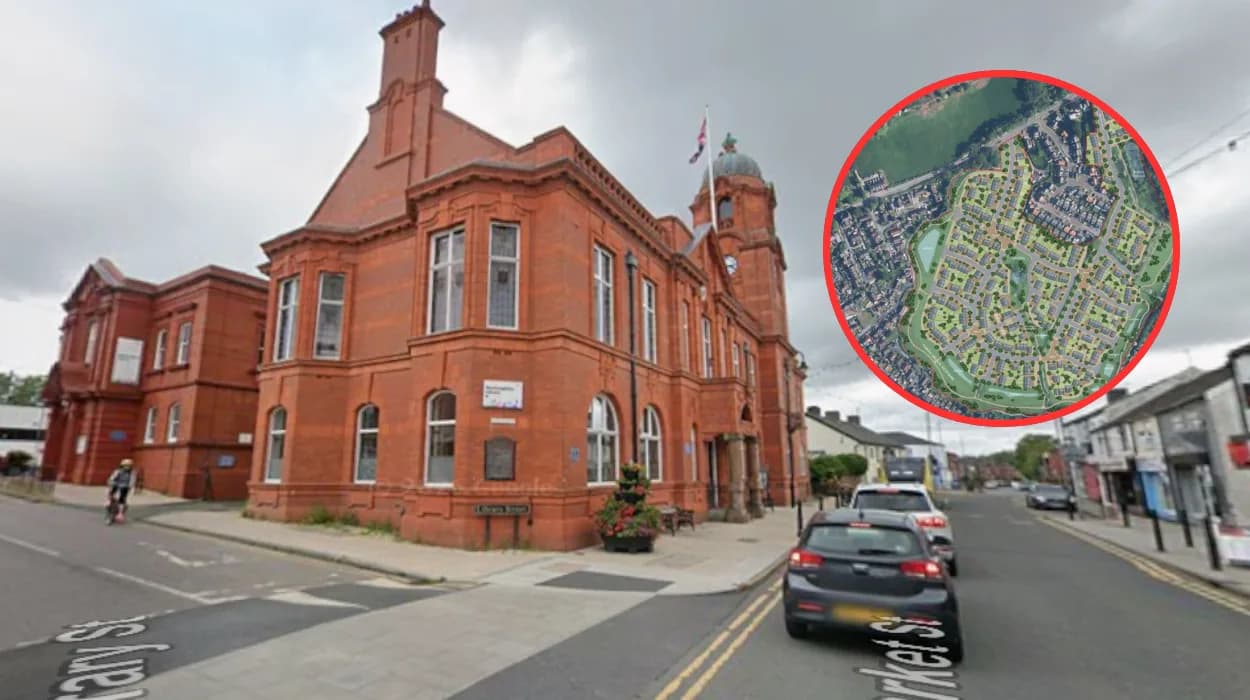
Westhoughton (Bolton Today) August 1, 2026 — Westhoughton Town Council has formally and unanimously rejected a major planning application proposing the construction of up to 310 homes on green belt land situated between Westhoughton and Hindley, marking the start of a high-stakes planning battle over the future of the local landscape.
The full application, which was officially submitted on 16th July 2026, details plans to build a substantial residential settlement on agricultural land at Marsh Brook, lying directly to the south of Wigan Road. However, during a town council meeting this week, local representatives launched a unified defense of the area, arguing that the scale of the proposed development would inflict irreversible damage on the local environment while pushing existing municipal infrastructure past breaking point.
As reported by reporter Dan Dougherty of The Bolton News, the opposition from local members was absolute. Elected representatives expressed strong criticism of the scheme, citing severe traffic implications, the destruction of established flora and fauna, and an absence of developer contributions toward primary healthcare and educational capacity. Despite the town council's decisive vote, the decision remains advisory under local government arrangements, leaving the final legal outcome in the hands of Bolton Council's central planning authority, which is expected to assess the formal application in the coming months.
What Led to Westhoughton Town Council’s Unanimous Rejection of the 310-Home Marsh Brook Plan?
The decision by Westhoughton Town Council to oppose the Marsh Brook development follows intense local scrutiny over how the strategic gap between Westhoughton and neighboring Hindley should be preserved. The application requests permission for up to 310 market and affordable homes on parcel land that has historically served as a buffer separating the two towns.
During the council's session, members evaluated the submission against existing spatial policies and local community needs. The consensus among councillors was that the physical expansion of residential development into the Marsh Brook valley would compromise the rural character of the area. Town councillors expressed frustration that large-scale development proposals continue to target greenfield sites around Westhoughton without offering proportional commitments to upgrade surrounding road networks or social services.
As detailed by Dan Dougherty of The Bolton News, the unanimous vote represents a collective stand by town leaders against what they characterize as speculative over-development. While acknowledging that the borough faces broader housing pressures, members maintained that sacrificing green belt land on Wigan Road is neither sustainable nor justifiable given the surrounding highways topology and community constraints.
Why Are Local Councillors Opposing the Development on Wigan Road?
Elected representatives for Westhoughton have detailed an extensive array of practical, environmental, and logistical grounds for their opposition to the project. Central to their concerns is the immediate impact that hundreds of additional households would have on Wigan Road—already a heavily congested arterial route connecting Bolton and Wigan—and the secondary access corridors running through residential neighbourhoods.
As reported by reporter Dan Dougherty of The Bolton News, Councillor David Wilkinson highlighted the manifold pressures the scheme would create. Councillor Wilkinson stated:
"This planning application is totally unacceptable for a number of reasons. One, the traffic related problems, a loss of green belt, plants and trees, impact on the Marsh Brook Stream Valley, impact on doctors and schools, among other things."
Councillor Wilkinson further noted that the physical layout required to facilitate access for a development of this magnitude would directly disturb existing residents. As recorded by Dan Dougherty of The Bolton News, Councillor Wilkinson explained:
"It will impact the properties around it as well as the roads. It will mean they have to demolish existing properties to achieve what they're wanting to do. Fighting it is going to be a struggle, especially with some of the planned changes in places for everyone."
Similarly, Councillor David Chadwick condemned both the location of the site and the absence of social infrastructure provisions in the submitted documentation. As reported by Dan Dougherty of The Bolton News, Councillor Chadwick stated:
"My fellow Westhoughton Town councillors and I voted to unanimously refuse the planning application for up to 310 houses on land south of Wigan Road. Not only did this proposed development sit within designated Green Belt, but the developers who seem intent on destroying Westhoughton provide no infrastructure or amenities such as doctors, dentists or schools."
How Do Developers Justify Building on Marsh Brook’s Designated Green Belt Land?
Despite the firm local opposition, the applicant behind the Marsh Brook proposal argues that the scheme aligns with modern planning standards and national housing imperatives. The submission contends that the economic, social, and environmental benefits of delivering a mix of market-rate and affordable dwellings outweigh the localized harm caused by developing on green belt land.
According to the planning statement submitted with the application, as highlighted by Dan Dougherty of The Bolton News, the developers explicitly address the site's environmental constraints:
"The development would result in some harm to the openness of the Green Belt, and the proposals result in limited adverse visual impacts on localised receptors and loss of 'best and most versatile' agricultural land, however the development will deliver much needed market and affordable housing and provide significant social, economic and environmental benefits."
The applicants maintain that the delivery of new housing stock is vital for meeting regional housing targets, particularly affordable homes for young families and first-time buyers who are increasingly priced out of the Westhoughton property market. They argue that the scheme incorporates landscape buffering and drainage measures designed to mitigate impacts on the immediate environment while contributing to local economic vitality through construction jobs and ongoing council tax revenue.
What Is 'Grey Belt' Land and How Does Paragraph 155 Apply to This Application?
A pivotal aspect of the legal arguments surrounding the Marsh Brook site centers on the emerging regulatory concept of 'grey belt' land within UK planning law. In an effort to unlock land for housing, planning policies have increasingly drawn a distinction between high-quality, ecologically sensitive green belt land and lower-performing, previously developed, or visually compromised edge-of-settlement sites categorized as 'grey belt'.
Under national planning rules, if a developer wishes to gain planning consent on land formally identified as green belt, they must successfully prove that the site meets specific criteria reclassifying it as 'grey belt', thereby reducing the legal threshold required to permit development.
As reported by Dan Dougherty of The Bolton News, the applicant's planning statement explicitly relies on this legal framing. The statement notes:
"The site falls within the definition of 'grey belt' land, and the circumstances set out in paragraph 155 exist for development of homes in the Green Belt not to be considered as inappropriate."
Paragraph 155 of the National Planning Policy Framework (NPPF) outlines key exceptions where building on green belt land is not deemed inappropriate, provided specific conditions—such as demonstrating housing land supply shortfalls, ensuring sustainable location criteria, and avoiding fundamental harm to green belt openness—are satisfied. However, local councillors strongly dispute this legal characterization, insisting that Marsh Brook comprises valuable agricultural land and a crucial natural stream valley that should remain protected from suburban sprawl.
Explore More Westhoughton News
Action Promised After United Utilities Wearish Lane Pipe Burst: Westhoughton 2026
Westhoughton Dad Kyle Campbell Dies in Thailand Days Before Wedding, 2026
What Infrastructure and Environmental Risks Were Raised by Councillors?
The debate over the Marsh Brook scheme underscores growing tension across Greater Manchester regarding the balance between housing targets and municipal service capacities. Westhoughton councillors warned that adding 310 additional households would place unsustainable pressure on local services that are already operating at or beyond capacity.
Primary healthcare access remains a sensitive topic for local residents. Councillors noted that GP surgeries and dental practices in the Westhoughton and Hindley areas face significant appointment backlogs. Without dedicated funding or site allocations for new healthcare premises within the developer’s masterplan, local leaders argue that existing patients will experience further deterioration in service availability.
Education infrastructure presents a similar challenge. Local primary and secondary schools serving the Wigan Road corridor are currently operating near maximum enrollment. Councillors stressed that introducing hundreds of new families without expanding school capacity would lead to acute classroom overcrowding and force children to travel further afield for schooling.
From an environmental perspective, opposition focused heavily on the ecological health of the Marsh Brook Stream Valley. The watercourse and surrounding fields host natural habitats, mature trees, and biodiversity corridors. Councillors expressed concern that altering the surface drainage, introducing urban runoff, and removing established greenery would degrade the natural valley ecosystem and increase flood risk downstream along the brook.
What Role Does Westhoughton Town Council Play in Bolton Council’s Final Verdict?
While the unanimous rejection by Westhoughton Town Council delivers a powerful political statement of local sentiment, it does not carry statutory legal weight to formally refuse planning permission. In the UK local government structure, town and parish councils act as statutory consultees in the planning process. Their formal comments, objections, and resolutions are submitted to the primary planning authority—in this case, Bolton Metropolitan Borough Council—for evaluation.
Bolton Council's professional planning officers will now undertake a detailed assessment of the Marsh Brook application. This process involves evaluating technical reports covering traffic generation, highway safety, environmental impact assessments, drainage management, and compliance with national and local spatial policies.
Once statutory consultations are complete and public representations have been reviewed, planning officers will compile an official report and recommendation. The application will ultimately be put before Bolton Council's Planning Committee, comprised of borough councillors who hold the legal mandate to grant or refuse planning consent. Should Bolton Council refuse the application, the developer retains the right to submit an appeal to the Planning Inspectorate, an independent government body capable of overturning local decisions if they are found non-compliant with national policy frameworks.
What Broader Planning Challenges Does Westhoughton Face Under 'Places for Everyone'?
The battle over Marsh Brook occurs against the backdrop of Greater Manchester’s wider strategic planning framework, known as 'Places for Everyone'. The joint spatial plan, adopted by nine of the ten Greater Manchester local authorities (including Bolton), sets out long-term targets for housing, employment land, and infrastructure development through to 2039.
Under 'Places for Everyone', local authorities are under statutory pressure to meet ambitious housing delivery targets while protecting high-value green infrastructure where feasible. However, the framework's overarching land release requirements have created complex strategic challenges for outer townships like Westhoughton, where remaining unbuilt land frequently borders neighboring boroughs like Wigan.
As Councillor David Wilkinson cautioned during the council discussion, navigating future planning battles will require significant resilience from the local community. The interaction between national housing mandates, regional spatial frameworks like 'Places for Everyone', and legal mechanisms such as 'grey belt' designations creates a challenging legal environment for towns seeking to preserve greenfield boundaries.
For now, the unanimous stance taken by Westhoughton Town Council sends an unequivocal message to borough decision-makers at Bolton Council: local representatives and residents view the proposed 310 homes on Marsh Brook as an unsustainable intrusion into the green belt that threatens the long-term character and infrastructure stability of their community.