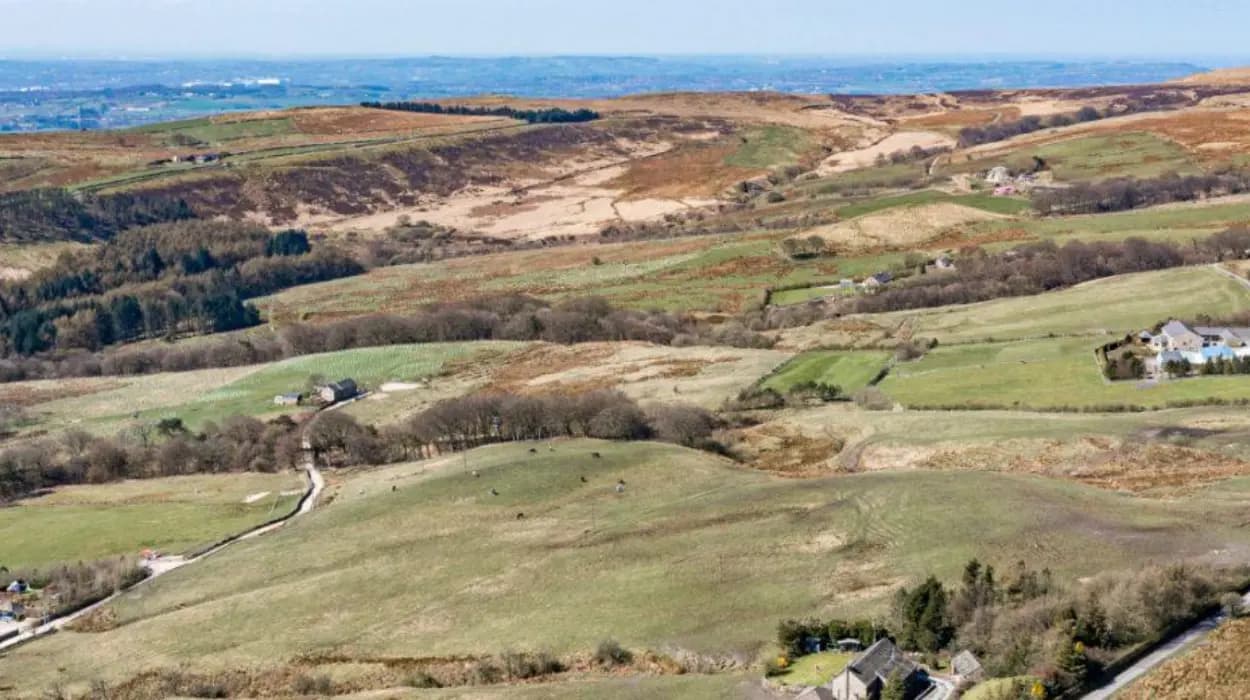
Smithills is one of the most varied wildlife landscapes around Bolton, combining ancient woodland, wet woodland, moorland, heathland, grassland, farmland, bog and wooded cloughs. The landscape covers about 684.66 hectares, or 1,691.79 acres, across Smithills Estate and its surrounding countryside.
The combination of habitats makes Smithills suitable for wildlife watching throughout the year. Seasonal changes alter vegetation, daylight, water levels, breeding activity and animal behaviour. A visitor looking for woodland birds in spring encounters a different ecological setting from someone searching for moorland species during winter.
Smithills also has an unusually strong connection between natural history and human history. Its landscape contains evidence of Mesolithic activity, medieval and later farming, coal mining, stone quarrying, reservoirs, brick and tile production, historic walls and the Grade I listed Smithills Hall. These layers have shaped the habitats visible today.
The Woodland Trust acquired two-thirds of the current Smithills Estate in 2015 and the remaining portion in 2017. Restoration work now focuses on improving habitat connectivity, restoring woodland and peatland, protecting moorland and improving public access.
What makes Smithills one of Bolton’s best wildlife watching landscapes?
Smithills combines ancient woodland, moorland, heathland, grassland, farmland, bog and wooded cloughs within one extensive landscape, creating habitats for birds, mammals, reptiles, bats, insects, wildflowers, fungi and wetland species across every season.
Smithills is valuable for wildlife observation because its habitats occur within a connected upland landscape rather than as isolated pockets. The Woodland Trust describes the estate as a mixture of grassland, farmland, moorland, woodland, wooded cloughs and bog habitats.
The woodland provides shelter, nesting sites, insects, berries and fallen timber. Ancient and wet woodland support plant communities associated with older and wetter soils. Species recorded by the Woodland Trust include wild garlic, bluebell, golden-leaved saxifrage, sphagnum moss and marsh marigold. Fungi include fly agaric and scarlet elf cup.
Open moorland creates a contrasting environment. Red grouse are associated with the moorland habitat, while skylark and other upland birds use open ground. The moorland forms part of the West Pennine Moors Site of Special Scientific Interest, giving the wider ecological landscape recognised scientific importance.
The wooded cloughs are another important feature. These narrow valleys contain streams and wetter vegetation, producing conditions different from exposed moorland. Water movement through the estate has also influenced its historical land use, including industrial activity that depended on reliable water resources.
Wildlife watching therefore works best when visitors treat Smithills as a habitat mosaic. A short walk can move from enclosed woodland into open grassland and then towards wetter ground or upland heath.
How has Smithills developed into a wildlife-rich landscape?
Smithills developed from an agricultural and industrial estate into a protected and restored upland landscape, with farming, coal mining, quarrying, water management, fire damage and conservation each influencing habitats, vegetation patterns and wildlife distribution across the modern estate.
The history of Smithills explains why wildlife habitats are distributed unevenly. In 1620, six farms operated on the estate. By 1769, the number had increased to 14, ranging from 2.6 hectares to 48.9 hectares. Farming therefore played a major role in shaping the landscape before modern conservation management.
Industrial activity later added further changes. Coal mining took place on the estate, and archaeological evidence from the industry remains within the landscape. Stone quarrying also altered the terrain. Reservoirs and a brick and tile works formed part of the historic industrial landscape.
Human activity in the area extends much further back. The earliest evidence identified by the Woodland Trust consists of scatters of Mesolithic flints dating from the eighth to mid-fourth millennia BC. A Bronze Age stone hammer and palstave were reportedly found in 1812. Other reported discoveries include a whetstone, blue ribbed bead, bottle neck and bronze coin.
Smithills Hall provides an architectural landmark within this wider landscape. The Grade I listed building originated as a medieval hall in the 14th century and received later additions, including 15th- or 16th-century work and substantial Victorian alterations. Bolton Council identifies Smithills Hall and its surrounding grounds as a heritage landscape.
The decline of farming and increasing estate-management difficulties altered land management during the modern period. Neglect during the Second World War contributed to deterioration. Conservation subsequently became central to the estate's future.
The Woodland Trust's acquisition programme transformed that direction. The charity purchased two-thirds of the present estate in 2015 and the remainder in 2017. Restoration now includes tree planting, ancient woodland restoration, conservation grazing and peatland re-wetting.
Where should you watch wildlife in Smithills during spring?
Spring wildlife watching in Smithills is strongest around ancient woodland, wet woodland, streams, grassland and moorland edges, where returning birds, emerging insects, flowering plants, nesting activity and increasing daylight make March, April and May productive observation months.
Spring changes the character of Smithills rapidly. Longer daylight increases plant growth, insect activity and bird activity. Woodland floors become important observation areas as bluebells and wild garlic appear alongside other spring vegetation.
Bluebell is one of the characteristic plants identified by the Woodland Trust. Wild garlic also occurs in the estate's ancient and wet woodland. These plants form part of woodland communities that respond strongly to seasonal light conditions before dense summer foliage develops.
Birdwatchers should focus on woodland edges, tree canopies and open clearings. Species recorded at Smithills include willow warbler, bullfinch, song thrush, skylark, cuckoo, buzzard, kestrel, barn owl and raven. The exact species encountered varies with habitat, weather and time of day.
Spring is also an important period for breeding birds. Visitors should keep their distance from nests and avoid disturbing vegetation. Quiet observation from established paths provides better opportunities to watch birds without entering sensitive habitat.
Wet areas deserve attention as temperatures rise. Streams and damp woodland support distinctive vegetation, including golden-leaved saxifrage and marsh marigold. These locations also provide resources for insects and other small animals.
Smithills Hall Country Park adds another accessible wildlife-watching setting. Bolton Council describes its grounds as containing extensive paths and tracks, together with a nature trail.
The historical landscape remains part of the spring experience. Walls, woodland edges, fields and the grounds around Smithills Hall demonstrate how centuries of land management created the boundaries between habitats. For visitors studying cultural landscapes, these features provide direct evidence of the interaction between human land use and ecological change.
To connect today's wildlife landscape with the area's historic attractions, consult our comprehensive [Wildlife Conservation History Around Smithills] for itineraries and visiting parameters.
Which wildlife can you watch in Smithills during summer?
Summer wildlife watching at Smithills focuses on moorland birds, woodland species, butterflies, insects, reptiles, bats, wildflowers and fungi, with longer daylight creating extended observation opportunities across grassland, woodland edges, streams and exposed upland habitats.
Summer produces the longest wildlife-watching period of the year. Early mornings and evenings provide longer periods of usable daylight, while vegetation is at its fullest.
Common lizards are among the species specifically recorded by the Woodland Trust. Sunny, sheltered locations can provide suitable conditions for basking. Visitors should observe reptiles from paths rather than approaching or handling them.
Five bat species have been recorded at Smithills: common pipistrelle, soprano pipistrelle, Daubenton's bat, noctule and brown long-eared bat. Their presence reflects the importance of woodland, water and open feeding areas within the estate.
Bats are most relevant during evening observation. Daubenton's bat is associated with water habitats, while pipistrelles and other species use woodland and open landscapes. A bat detector provides a non-invasive method for identifying ultrasonic activity where permitted and appropriately used.
Moorland provides another important summer environment. Red grouse occur on the moorland, while skylarks use open upland habitat. Ravens also occur across the estate. The open landscape allows observers to distinguish birds against the sky and surrounding hills.
Summer flowers support insects throughout the estate. Woodland clearings, grassland and heathland provide flowering resources, while woodland vegetation creates cooler and more sheltered conditions. Fungi also form part of Smithills' recorded natural heritage, although their visibility varies with rainfall and ground conditions.
The estate's restoration programme has a direct connection with summer biodiversity. The Woodland Trust is creating different habitats to encourage wildlife, including new woodland and improved moorland and peatland conditions. Its current plans include planting 130,000 trees to increase tree cover and establish wildlife corridors.
Summer is also an appropriate season for observing the contrast between restored and historically managed land. Conservation grazing, tree planting and peatland restoration are changing habitat structure while retaining important elements of the historic landscape.
What wildlife can you find in Smithills during autumn?
Autumn wildlife watching in Smithills centres on woodland birds, fungi, changing vegetation, mammals and seasonal movement, with ancient woodland, wet woodland, hedgerows, grassland and moorland providing different observation opportunities as temperatures and daylight decline.
Autumn transforms Smithills through falling leaves, changing vegetation and increased visibility within deciduous woodland. The reduction in dense foliage can make some woodland birds easier to locate, while the woodland floor becomes increasingly important for fungi and invertebrates.
The estate contains towering tree species and areas of ancient woodland. Recorded vegetation includes oak, birch, holly, elder and guelder rose. These trees and shrubs contribute food and shelter for wildlife during the transition into winter.
Fungi are particularly significant during wetter autumn conditions. Smithills contains species including fly agaric and scarlet elf cup. Fungi contribute to woodland ecosystems by breaking down organic material and supporting nutrient cycling. Visitors should avoid picking or damaging fungi because identification from photographs is safer than handling unknown species.
Bird activity changes as summer breeding concludes. Woodland edges and open fields remain useful locations for observing species such as bullfinch, song thrush, buzzard and kestrel. Ravens can be watched over the more open upland landscape.
Autumn also provides an opportunity to examine the relationship between wildlife and historic boundaries. Dry-stone walls divide parts of the estate and remain visible within the modern landscape. The Woodland Trust identifies these walls as part of Smithills' historic character.
The changing water conditions of autumn are important in wet woodland and stream habitats. Water retention is a specific conservation issue at Smithills. The Woodland Trust has described efforts to keep water on the estate for longer, supporting habitat diversity and encouraging wildlife recovery.
For educators, autumn offers a clear opportunity to compare ecological processes with historical land management. The seasonal decline of vegetation reveals walls, tracks, field boundaries and woodland structure that can be less visible during summer.
Which wildlife locations are most useful during winter?
Winter wildlife watching is most effective around woodland edges, sheltered cloughs, open moorland, farmland and watercourses, where reduced vegetation improves visibility and hardy birds, mammals, raptors and woodland species remain active despite shorter daylight.
Winter provides different advantages rather than simply fewer wildlife opportunities. Deciduous trees lose their leaves, opening sightlines through woodland. Birds become easier to detect against bare branches, while exposed moorland provides broad views across the landscape.
Smithills contains five recorded bat species, but winter is not the principal season for active bat watching. Instead, observers should concentrate on birds and mammals that remain active in colder conditions.
Woodland edges are productive because they combine shelter with access to open feeding areas. Species such as buzzard, kestrel, raven, bullfinch and song thrush are among the birds recorded on the estate. Barn owls are also recorded and can be associated with open grassland and farmland habitats.
The moorland remains valuable during winter. Its open structure provides long-distance views, while heathland and rough vegetation provide cover for upland wildlife. Red grouse are associated with the moorland habitat.
Wooded cloughs offer a different winter environment. Their sheltered topography, streams and wetter vegetation create ecological conditions distinct from exposed moorland. These areas also demonstrate the importance of water movement to Smithills' natural and industrial history.
Winter conditions require careful route selection. The Woodland Trust states that Smithills car parks can close when ground conditions are unsafe. Walker Fold car park provides 60 spaces, while Barrow Bridge car park provides 20 spaces. Opening arrangements are seasonal, and gates are locked overnight.
Winter wildlife observation should therefore prioritise safe paths and established access points. Wet, icy or muddy conditions can affect routes, especially in upland areas. The aim is to observe wildlife without damaging vegetation or disturbing animals using limited winter shelter.
How did the 2018 Winter Hill fire change wildlife watching at Smithills?
The 2018 Winter Hill wildfire damaged a substantial section of Smithills, affecting heathland, peatland, woodland, vegetation and wildlife, but subsequent surveys and restoration work have documented ecological recovery and increased sightings of several important species.
The 2018 fire is one of the most important recent events in the ecological history of Smithills. A fire began near the Winter Hill television mast on 28 June 2018, followed by another fire on the eastern side of the estate the next day.
The scale was substantial. The Woodland Trust reported that emergency services worked for 41 days to tackle the fires. Approximately one-third of the 1,700-acre site was destroyed, including plants and trees. Animals were dispersed as the moorland landscape burned.
The effects extended beyond immediate wildlife mortality. Loss of vegetation altered food resources, shelter, soil conditions and water management. Peatland and upland habitats recover slowly because their ecological processes operate over long periods.
Surveys conducted after the fire have documented vegetation recovery and increasing sightings of birds and animals. The Woodland Trust states that restoration is focused on a mosaic of peatlands, uplands, oak woodland and upland wet woodland.
The fire also explains why some parts of Smithills look different from others. Burned areas have followed separate recovery paths depending on soil, vegetation, moisture and subsequent management.
Conservation responses include re-wetting blanket bog, restoring ancient woodland, planting trees and using conservation grazing. These measures improve habitat structure and support wildlife recovery. The Woodland Trust reports increasing numbers of brown hare, raven, crossbill, willow tit and blackcap, among other species.
Several species formerly associated with the estate have declined or disappeared locally. The Woodland Trust identifies twite, little owl and adder as species once found at Smithills but now missing. Their absence demonstrates that wildlife watching is also a way to understand ecological change over time.
How is Smithills being preserved for future wildlife watching?
Smithills is being preserved through habitat restoration, tree planting, peatland re-wetting, conservation grazing, improved paths and wildlife corridors, linking ecological recovery with public access while protecting an estate containing significant natural, archaeological, agricultural and architectural heritage.
Modern conservation at Smithills combines nature recovery with public access. The Woodland Trust has installed 1.6 kilometres of flagged moorland paths and is improving path networks and accessibility. These measures help visitors explore the landscape while directing movement through managed routes.
Tree planting forms a major component of the long-term strategy. The Woodland Trust's current plans include 130,000 new trees, with the objective of doubling tree cover and creating corridors for wildlife.
These corridors matter because wildlife depends on connected habitats. Woodland patches separated by roads, fields or degraded ground provide fewer continuous routes than linked habitats. Tree planting therefore has implications beyond individual trees.
Peatland restoration is equally important. Re-wetting blanket bog helps retain water and supports upland ecological processes. The approach also responds to the historic degradation of water systems caused by land use and industrial activity.
The estate's conservation value is also recognised within Bolton's planning framework. Bolton Council identifies Smithills Hall and its surrounding park as a landscape of historic interest and records broadleaved woodland around the hall as a Site of Biological Importance in its landscape character assessment.
Smithills Hall itself remains an important heritage anchor. The Grade I listed house is owned by Bolton Council and operates as a museum. Its history extends from the medieval period through Tudor and Victorian alterations.
The council also identifies Smithills Hall among Bolton's registered parks and gardens. This designation recognises the cultural value of historic landscapes separately from natural heritage designations such as Sites of Special Scientific Interest.
Preservation at Smithills therefore has several dimensions. Wildlife conservation protects species and habitats. Archaeological conservation protects evidence of earlier human activity. Architectural conservation protects Smithills Hall. Landscape management maintains historic field patterns, walls and open views.
This combined approach gives Smithills long-term historical significance. The estate is not simply a place where wildlife can be observed. It is a living record of changing relationships between people, agriculture, industry, architecture, water, woodland and upland ecology.
Why does seasonal wildlife watching matter for understanding Smithills?
Seasonal wildlife watching reveals how Smithills functions as a changing ecological system, while its archaeological remains, historic buildings, farming landscape and conservation projects show how centuries of human activity continue to influence habitats and wildlife today.
Observing Smithills in one season provides only a partial understanding of the estate. Spring reveals woodland flowers and breeding activity. Summer exposes the diversity of insects, reptiles, birds and bats. Autumn highlights fungi and changing woodland structure. Winter provides clearer views through deciduous woodland and across open upland habitats.
The seasonal approach also supports education. Students can compare habitat changes, record species observations and investigate relationships between weather, vegetation and animal activity. The landscape provides an outdoor setting for studying ecology alongside archaeology and local history.
The estate's historical depth strengthens this educational value. Mesolithic flint scatters demonstrate prehistoric activity. Farming records show the growth from six farms in 1620 to 14 by 1769. Coal mining, quarrying, reservoirs and brick and tile production demonstrate later industrial use.
Smithills Hall adds architectural evidence to the landscape. Its medieval origins, later additions and Victorian alterations demonstrate how buildings changed alongside the surrounding estate. The survival of the hall and its grounds provides a physical connection between architectural history and modern conservation.
Wildlife recovery adds another historical layer. The 2018 fire created a major ecological disruption, while subsequent restoration demonstrates how land management responds to environmental damage. Surveys showing returning vegetation and increased wildlife sightings provide evidence of ongoing ecological change.
For wildlife watchers, this means Smithills should be understood as a year-round landscape rather than a single-season attraction. Woodland, moorland, grassland, farmland, bog and watercourses each produce different observation opportunities.
For heritage researchers, the same landscape provides evidence of centuries of land use. For educators, it provides a field study environment. For conservationists, it provides a working restoration site. For visitors, it provides an accessible example of how natural and cultural heritage coexist.
Smithills' future wildlife value depends on continued habitat management, responsible public access and protection from damaging events. The restoration of woodland, peatland and moorland is already changing the landscape. The long-term objective is a connected and resilient environment supporting wildlife while retaining its archaeological and historical character.
The result is a landscape where wildlife watching can document change rather than simply observe individual species. Every season presents different ecological conditions, while the historic landscape explains why those conditions exist. Smithills therefore offers a particularly strong setting for understanding the relationship between biodiversity, conservation and Bolton's long history.
FAQS
Where is the best place for wildlife watching in Smithills?
Smithills Estate offers several strong wildlife-watching habitats, including ancient woodland, wet woodland, moorland, grassland, farmland, bog and wooded cloughs. Different locations produce different wildlife sightings throughout the year.