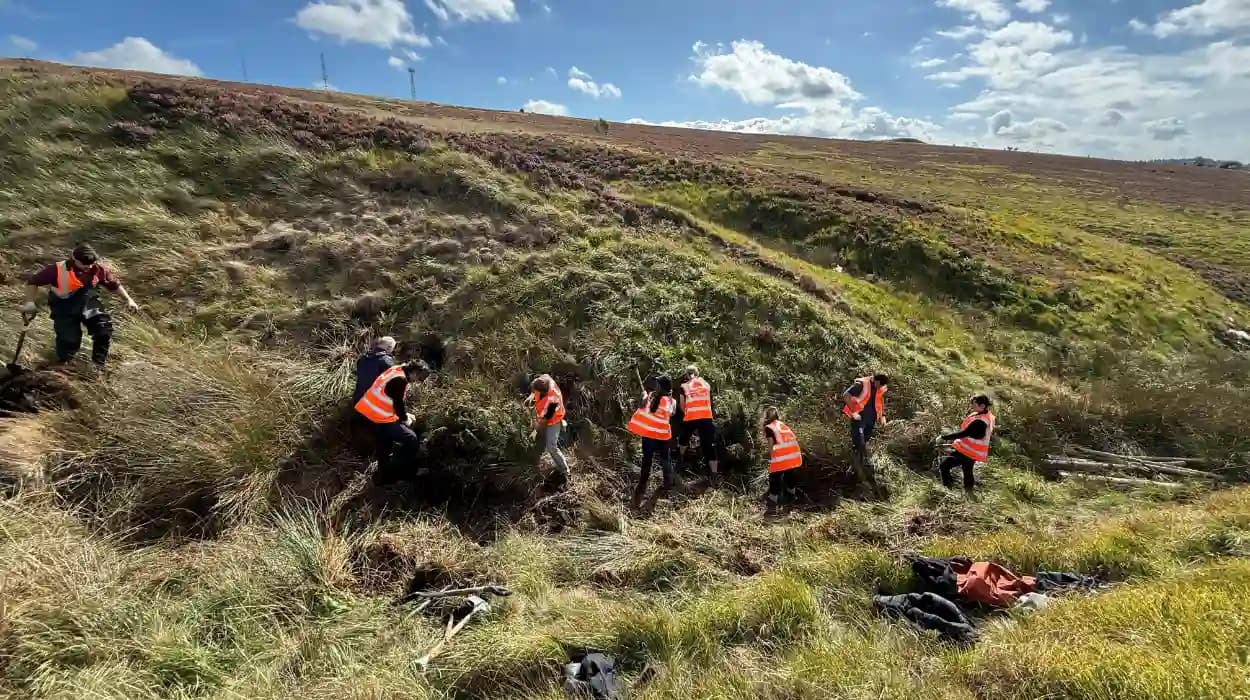
Smithills sits on the northern edge of Bolton where historic farmland, ancient woodland, moorland, peatland and wooded cloughs meet. Its wildlife conservation history is inseparable from the changing management of this upland landscape, the decline of traditional farming, industrial pressures, public access campaigns, legal protection and modern ecological restoration.
Today, Smithills Estate forms one of the most significant conservation landscapes around Bolton. The Woodland Trust manages about 685 hectares of the estate, making it the largest site the organisation has acquired in England. The estate contains ancient woodland, broadleaved woodland, grassland, farmland, heathland, moorland, wooded cloughs and bog habitats.
The conservation story is therefore not simply about protecting individual animals. It concerns the preservation and restoration of an interconnected landscape in which woodland, peat, streams, grassland and open moorland support different species and ecological processes.
Why is Smithills important to wildlife conservation history?
Smithills is important because its landscape contains ancient woodland, upland moorland, peatland, grassland and wooded cloughs that support nationally important wildlife. Its conservation history records changes from estate farming and industry to statutory protection, habitat restoration, tree planting and ecological management.
Smithills occupies a transition between Bolton's urban edge and the West Pennine Moors. This geographical position gives the area an important ecological function. Woodland occupies sheltered valleys and cloughs, while open moorland extends across higher ground.
A clough is a steep-sided wooded valley formed around a watercourse. At Smithills, wooded cloughs provide wetter and more sheltered conditions than the exposed moorland above them. These differences create distinct ecological niches.
The estate also contains peatland. Peat is partially decomposed organic material accumulated under waterlogged conditions over long periods. Healthy peatlands store carbon, retain water and provide specialised habitats for plants and animals.
The West Pennine Moors provides the wider statutory conservation context. Natural England designated the West Pennine Moors as a Site of Special Scientific Interest, or SSSI, in 2016. The designation covers 76 square kilometres across Lancashire and Greater Manchester and recognises its nationally important combination of upland habitats and breeding birds.
The SSSI includes moorland habitats associated with Smithills. The designation recognises species such as merlin, curlew, snipe, lapwing and redshank, alongside large breeding colonies of black-headed gull and Mediterranean gull elsewhere within the protected landscape.
This legal framework transformed conservation from a matter of individual land management into a recognised public environmental responsibility.
How did the historic Smithills estate shape its wildlife landscape?
Historic estate management shaped Smithills through farming, woodland use, water management, grazing and land division. Six farms occupied the estate in 1620, rising to 14 by 1769, creating the field boundaries, pasture, woodland and infrastructure that later conservation projects inherited.
Smithills has a documented agricultural history extending back centuries. Woodland Trust records show six farms on the estate in 1620. By 1769, the number had increased to 14, with holdings ranging from 2.6 hectares to 48.9 hectares.
These farms created a managed landscape rather than an untouched wilderness. Pasture, fields, woodland and moorland were used according to their agricultural value.
Dry-stone walls remain an important physical record of this period. They divided fields and pasture and remain visible across parts of the estate. Their presence also demonstrates how historic land management created boundaries between agricultural land and upland habitats.
Smithills Hall provides the principal architectural record of the historic estate. Historic England identifies Smithills Hall as a Grade I listed building, with origins as a medieval hall house and subsequent additions from later centuries.
The surrounding landscape developed alongside the hall. Historic England records the estate's ownership by the Hospitallers from the late 12th century or earlier, followed by families including the Radcliffes, Bartons, Byroms and Ainsworths. The Ainsworth family purchased the estate in 1801, before Bolton Corporation acquired it in 1938.
The landscape therefore contains both natural and cultural heritage. Its current conservation value cannot be separated from centuries of land use.
How did industry affect wildlife around Smithills?
Industrial activity changed Smithills by increasing pressure on water, woodland and surrounding land. Historic businesses used water flowing from the hills for industrial processes, while later agricultural decline and estate neglect altered habitats, drainage patterns and landscape management.
Smithills developed beside an industrialising Bolton. Water flowing from the uplands was historically valuable to nearby industries.
Woodland Trust records specifically identify brick and tile works and bleach works among businesses that depended on water running from the hillside. This use altered the natural movement and retention of water across parts of the landscape.
Water management is central to understanding Smithills conservation history. Upland streams feed lower valleys, while peat and wet woodland retain water within the landscape.
When land becomes drained or vegetation changes, water moves more rapidly downhill. This affects soil moisture, stream behaviour, flood risk and habitat conditions.
The decline of agriculture created another transition. Woodland Trust records state that farming gradually declined and that neglect during the Second World War, combined with increasing estate management and infrastructure costs, contributed to deterioration.
This period demonstrates why conservation at Smithills focuses on restoring ecological processes rather than simply preserving a fixed historical appearance.
When did modern wildlife conservation begin around Smithills?
Modern conservation at Smithills developed through public ownership, statutory landscape protection and large-scale charitable land acquisition. Key milestones include Bolton Corporation's 1938 acquisition, the 2016 West Pennine Moors SSSI designation, Woodland Trust acquisitions in 2015 and 2017, and restoration from 2017 onward.
Bolton Corporation acquired Smithills Hall and its estate in 1938. The surrounding historic landscape subsequently became part of public management rather than remaining under private estate ownership.
The modern conservation phase accelerated in the 21st century.
The Woodland Trust acquired two-thirds of the present Smithills Estate in 2015 and the remaining portion in 2017. The organisation has since managed the estate as a major landscape-scale restoration project.
In 2017, the project received £1.9 million from the Heritage Lottery Fund to support the transformation of the estate. The programme included land acquisition, public access improvements, tree planting and ecological connectivity.
The timing was significant because the West Pennine Moors had received SSSI protection in 2016. The conservation framework therefore combined statutory environmental protection with direct land management.
This created a stronger basis for restoring woodland, peatland and other habitats rather than managing them separately.
What happened when the West Pennine Moors became an SSSI?
The West Pennine Moors SSSI gave statutory recognition to the area's national wildlife importance in 2016. Its 76-square-kilometre designation covers upland habitats and breeding birds, strengthening conservation management across the wider landscape surrounding Smithills.
Natural England announced the West Pennine Moors SSSI designation on 18 November 2016. It described the site as the largest new SSSI notified by Natural England since 2004.
The designation covers 76 square kilometres between Chorley, Blackburn, Bolton and Haslingden. Its importance comes from the combination of upland habitats, moorland-fringe grasslands and woodland.
An SSSI is a legally protected site recognised for special scientific interest in wildlife, geology or landform. Natural England manages the designation system in England.
The West Pennine Moors designation recognises breeding birds including merlin, curlew, snipe, lapwing and redshank. These species depend on suitable upland and moorland conditions.
The designation also supports conservation management of blanket bog. Natural England identified careful grazing and maintaining suitable water levels as important management approaches for healthy peatland.
The SSSI therefore established an important legal foundation for conservation around Smithills.
Which habitats have been protected and restored around Smithills?
Smithills conservation focuses on connected habitats rather than isolated sites. Important examples include ancient woodland, wet woodland, broadleaved woodland, heathland, grassland, moorland and blanket bog, each supporting different ecological conditions and contributing to wider landscape connectivity.
Woodland Trust identifies several habitat types across Smithills Estate. These include ancient woodland, heathland and moorland, grassland and broadleaved woodland.
Ancient woodland is woodland with a long-established history of tree cover and associated soils, plants and ecological communities. Smithills contains ancient woodland alongside newer planting.
Wet woodland occurs in areas influenced by persistent moisture. Species associated with Smithills include alder and willow in appropriate wet conditions, while oak and birch occur in other woodland settings.
The estate also contains important moorland. Higher ground supports open habitats rather than continuous tree cover.
Grassland provides another ecological layer. Species-rich grassland can support flowering plants and insects, while managed pasture reflects the agricultural history of the estate.
The conservation strategy seeks to maintain connections between these habitats. Woodland Trust plans include creating woodland corridors between existing areas, increasing ecological connectivity and improving biodiversity.
This approach reflects modern landscape ecology. Wildlife populations require suitable habitat, food, shelter and movement routes. Connecting habitats reduces isolation between ecological communities.
Which animals and plants are associated with Smithills?
Smithills supports wildlife associated with woodland, moorland, grassland and wet habitats. Recorded examples include skylark, common lizard, barn owl, raven, willow warbler, grey wagtail and five bat species, alongside bluebells, wild garlic, sphagnum moss and marsh marigold.
Woodland Trust records a wide range of wildlife on the estate. Recorded birds include skylark, willow warbler, barn owl, raven, grey wagtail, buzzard, cuckoo, bullfinch, kestrel and song thrush.
The estate also supports five recorded bat species: common pipistrelle, soprano pipistrelle, Daubenton's bat, noctule and brown long-eared bat.
Common lizards occur in suitable open habitats. Red grouse are associated with the moorland environment. Brown hare has also increased during restoration work.
Plants and fungi provide further evidence of habitat diversity. Woodland Trust identifies wild garlic, bluebell, golden-leaved saxifrage, sphagnum moss and marsh marigold among the site's vegetation. Recorded fungi include fly agaric and scarlet elf cup.
These records show why conservation at Smithills requires several forms of habitat management. A woodland strategy alone cannot protect moorland birds. Peatland restoration alone cannot maintain ancient woodland communities.
The ecological value lies in the combination.
How did the Woodland Trust transform conservation at Smithills?
The Woodland Trust transformed Smithills conservation through landscape-scale management. Its programme combines tree planting, ancient woodland restoration, conservation grazing, peatland rewetting, path improvements and community participation to strengthen habitat connectivity and support recovering wildlife populations.
The Woodland Trust's ownership marked a major change in the management of Smithills Estate. Rather than focusing primarily on individual fields or buildings, conservation planning considers the estate as a connected landscape.
Tree planting has been a major component. Bolton Council's climate strategy records an original target to double woodland cover from 10% to 20% across the 686-hectare estate. More than 90,000 trees had been planted with assistance from more than 1,000 members of the public at the time of that report.
The Woodland Trust now describes plans involving 130,000 new trees. The objective is to increase woodland cover and create wildlife corridors between existing woodland areas.
Peatland restoration forms a second major component. A large-scale programme restored 170 hectares of moorland and introduced measures designed to slow water movement. More than 70 hectares of sphagnum moss was planted to retain moisture.
Sphagnum moss is important to functioning peatlands because it absorbs and retains water while contributing organic material to peat formation.
Conservation grazing provides another management mechanism. Controlled grazing prevents vegetation from becoming excessively dense and helps maintain open moorland conditions.
These interventions demonstrate a shift from passive preservation to active ecological restoration.
Why was the 2018 Smithills wildfire important to conservation history?
The 2018 Winter Hill wildfire became a defining conservation event because it damaged about one-third of the 1,700-acre Smithills landscape, destroyed vegetation and trees, displaced wildlife and exposed the vulnerability of peatland and upland habitats to severe wildfire.
In summer 2018, a major wildfire spread across the Winter Hill and Smithills landscape. Woodland Trust reported that emergency services worked for 41 days to tackle the fire. Approximately one-third of the 1,700-acre site was destroyed.
The fire affected heathland, peatland and woodland. Plants and trees were destroyed, while animals were displaced from affected habitats.
The ecological consequences extended beyond visible vegetation loss. Peat fires can damage organic soils that accumulated over long periods. Recovery therefore requires more than replacing trees.
Post-fire restoration has focused on recovering damaged bog, increasing moisture retention and reducing future wildfire risk. Woodland Trust states that recovery remains an ongoing process.
The event also changed the conservation emphasis around fire prevention. Volunteers have undertaken fire patrols, while restoration work seeks to retain water within peatland.
The 2018 fire therefore became a major dividing point in the recent conservation history of Smithills.
How has peatland restoration changed wildlife conservation at Smithills?
Peatland restoration has shifted Smithills conservation toward water retention, carbon storage, wildfire prevention and habitat recovery. Rewetting damaged bog, restoring sphagnum moss and slowing drainage help create wetter conditions required for healthy peatland ecosystems.
Peatland is one of the most important natural systems within the Smithills landscape. Its ecological function depends on high water levels.
Drainage lowers the water table and exposes peat to drying and decomposition. Dry peat also becomes more vulnerable to wildfire.
Smithills restoration therefore uses measures designed to slow water movement. Leaky dams, wetlands, scrapes, peat dams and natural basins have been tested across the estate. Woodland Trust documented more than 40 flood-prevention measures during an experimental programme.
A leaky dam is a structure that slows water flow without completely blocking a channel. This reduces the speed at which rainfall leaves upland areas.
The estate's elevation also makes water management important for communities below. Smithills rises to about 456 metres above Bolton in the area studied for upland flood-management measures.
Peatland restoration therefore has multiple conservation functions. It supports specialised vegetation, retains water, stores carbon and reduces conditions associated with severe wildfire.
How did public access become part of Smithills conservation history?
Public access became part of Smithills conservation history through a long struggle over recreational rights and modern efforts to combine access with habitat protection. The 1896 access campaign and contemporary path improvements connect social history directly with environmental stewardship.
Public access has a particularly strong historical connection with Smithills.
Woodland Trust records that in 1896 more than 10,000 people gathered on the Smithills moors to demand access rights. This occurred more than 30 years before the Kinder Scout mass trespass of 1932.
The campaign forms an important part of Bolton's social and environmental history. Access to upland landscapes was a major public issue during the development of organised recreation.
Modern conservation continues this connection. The Woodland Trust has installed 1.6 kilometres of flagged moorland paths and is improving path networks and accessibility.
Access management is also a conservation issue. Heavy footfall can damage vegetation and increase erosion, particularly on wet or steep ground.
Well-designed paths concentrate pedestrian movement in durable areas while reducing uncontrolled erosion across sensitive habitats.
The modern Smithills model therefore combines environmental restoration with responsible public access.
To experience this historic landscape in person today, consult our comprehensive [Explore Wildlife Watching Locations in Smithills Throughout Every Season of the Year] for itineraries and visiting parameters.
How is Smithills Hall connected to wildlife conservation?
Smithills Hall connects cultural heritage with landscape conservation because its medieval architecture, historic gardens, parkland and surrounding estate form one cultural landscape. Protecting the building and restoring its setting preserves both architectural evidence and the environmental history around it.
Smithills Hall is a Grade I listed building. Historic England records its origins as a medieval hall house, with later extensions including a west wing remodelled during the Victorian period.
Its surrounding landscape also has formal heritage recognition. Historic England lists Smithills Hall's park and garden as Grade II, describing 19th-century pleasure grounds, gardens and parkland associated with the medieval hall.
Bolton Council identifies Smithills Hall among the borough's five registered parks and gardens.
This designation matters because conservation does not operate only through wildlife legislation. Cultural landscape protection also preserves historic landform, gardens, boundaries and relationships between buildings and countryside.
The hall itself became a museum in 1963, with Victorian rooms opened to the public during the early 1990s.
The surrounding estate therefore provides an educational setting in which architectural history, agricultural history and environmental conservation can be studied together.
What evidence shows that wildlife is recovering around Smithills?
Evidence of ecological recovery includes increased sightings of brown hare, raven, crossbill, willow tit and blackcap after restoration work. Woodland Trust also records returning wildlife alongside recovering vegetation following the 2018 wildfire and continuing habitat-management programmes.
Conservation results at Smithills are measured through ecological observations and habitat surveys.
Woodland Trust reports that species once recorded at the estate, including twite, little owl and adder, are currently absent. At the same time, restoration has been associated with increased numbers of brown hare, raven, crossbill, willow tit and blackcap.
This distinction is important. Conservation success does not mean every historically recorded species has returned.
Instead, monitoring identifies both gains and losses. Species presence provides information about habitat quality, food availability and landscape connectivity.
The 2018 wildfire created another opportunity for ecological monitoring. Woodland Trust surveys have assessed vegetation and animal recovery since the fire. By 2024, the organisation reported signs of recovering vegetation and increased observations of animals and birds.
Long-term monitoring remains necessary because different ecological processes operate at different speeds. Annual wildlife observations, vegetation surveys and habitat assessments provide evidence for changing management decisions.
What conservation challenges remain around Smithills?
Smithills faces continuing conservation pressures from wildfire, habitat fragmentation, climate change, visitor pressure, water loss and declining species. Current management therefore prioritises resilient woodland, restored peatland, connected habitats, responsible access and continued monitoring across the estate.
Wildfire remains one of the most serious threats. The 2018 event demonstrated the scale of damage possible across upland heath, peatland and woodland.
Climate change increases the conservation challenge because hotter and drier conditions increase wildfire risk and place additional pressure on water-dependent habitats. Woodland Trust identifies climate change as a factor intensifying wildfire threats.
Habitat connectivity is another concern. New woodland planting must connect existing habitats without replacing valuable open moorland. The objective is therefore strategic planting rather than blanket tree coverage.
Visitor pressure requires similar balance. Smithills is a heavily used landscape with an established network of paths. Concentrating access through durable routes helps protect sensitive vegetation.
Water management remains fundamental. Rewetting peatland and slowing runoff protect both wildlife habitats and downstream communities.
The future conservation history of Smithills will therefore depend on maintaining ecological processes while preserving public access and historic landscape features.
How has Smithills changed from historic estate to conservation landscape?
Smithills has changed from a medieval and later agricultural estate into a large conservation landscape managed for wildlife, heritage, water, carbon and public access. The transformation retains historic features while restoring habitats damaged by neglect, drainage and wildfire.
The long-term history begins with the medieval estate associated with Smithills Hall. Later centuries brought expanding agriculture, estate mapping, industrial water use, Victorian landscape design and eventual public ownership.
The 20th century brought further change. Bolton Corporation acquired the estate in 1938, and Smithills Hall later became a museum.
The 21st century introduced landscape-scale conservation. Woodland Trust acquisitions in 2015 and 2017 created a major conservation holding. Heritage funding from 2017 supported restoration, public access and habitat connectivity.
The 2016 SSSI designation strengthened the legal conservation context. The 2018 wildfire then demonstrated the vulnerability of the landscape and redirected resources toward peatland recovery and fire prevention.
Today, conservation at Smithills combines ecological science with cultural heritage. Ancient woodland, moorland, farmland, peatland, dry-stone walls, historic gardens and Smithills Hall remain parts of one interconnected landscape.
For educators and heritage researchers, Smithills provides a clear example of how environmental conservation develops through historical change rather than existing separately from it.
What is the long-term historical significance of wildlife conservation around Smithills?
The long-term significance of Smithills lies in its demonstration of landscape-scale conservation around a historic urban fringe. Its history connects medieval landholding, agriculture, industry, public access, statutory protection, ecological restoration and community participation within one continuous landscape.
Smithills provides a documented case study of changing relationships between people and upland environments.
Its medieval estate history explains the cultural landscape. Agricultural records explain field patterns and land use. Industrial history explains water pressures. Public access campaigns explain the social importance of the moors.
The SSSI designation establishes national recognition of ecological value. Woodland Trust ownership introduced large-scale habitat restoration. Tree planting and peatland rewetting address biodiversity, carbon storage, water management and wildfire resilience.
The landscape also demonstrates the importance of conservation continuity. Ancient woodland requires long-term protection. Peatland recovery requires sustained water management. Wildlife populations require connected habitats and suitable conditions over time.
Smithills therefore has significance beyond Bolton. Its 685-hectare landscape provides an established example of integrated conservation involving woodland, peatland, grassland, moorland, historic buildings and public access.
The historical record shows that Smithills was never a static environment. Farming changed it. Industry changed it. Public ownership changed it. Conservation is now changing it again.
The central difference is the purpose of that change. Modern management seeks to restore ecological function while retaining the historic evidence that gives Smithills its cultural identity.
That combination makes wildlife conservation around Smithills an important subject for history enthusiasts, cultural tourists, educators, students and local heritage researchers studying the relationship between Bolton's past and its natural environment.
FAQS
Why is Smithills important for wildlife conservation?
Smithills is important because its landscape contains ancient woodland, moorland, peatland, grassland and wooded cloughs. These connected habitats support birds, bats, mammals, plants and other wildlife while forming part of the wider West Pennine Moors protected landscape.