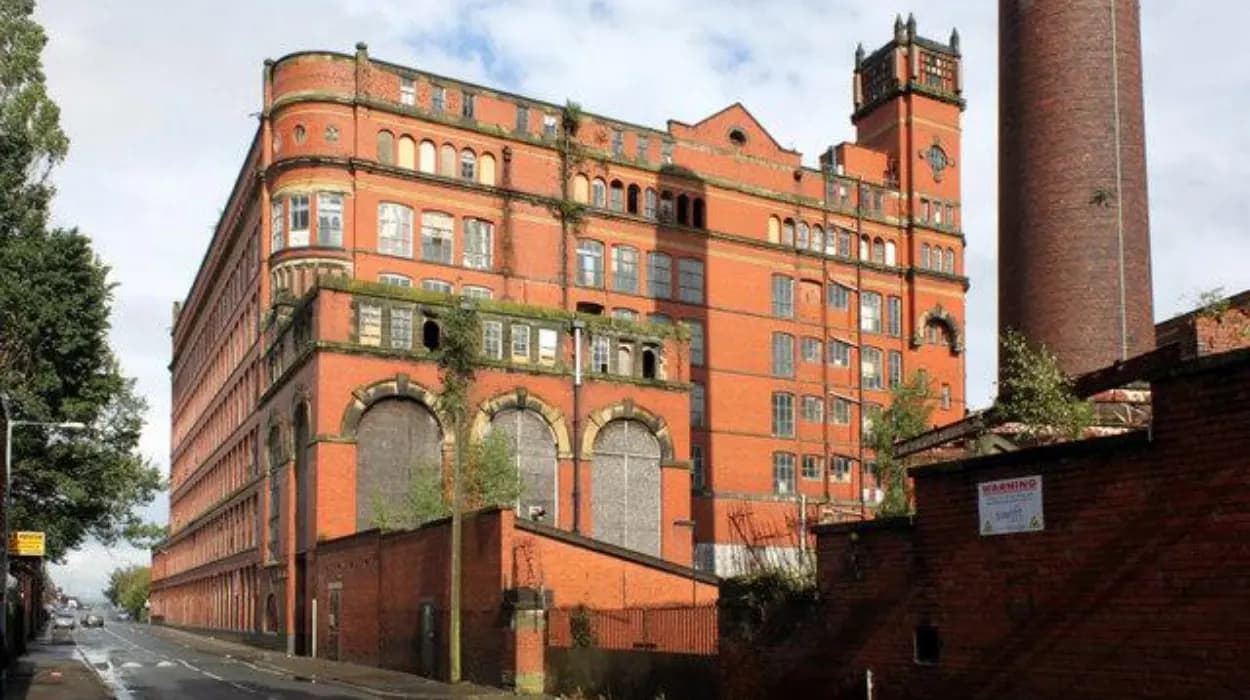
Bolton’s industrial heritage is rooted in textile production, engineering, coal, transport, civic development and technological innovation. The town became one of Lancashire’s major cotton centres during the Industrial Revolution, leaving behind mills, machinery, workers’ housing, civic buildings, canals, railways and museums.
Today, these surviving places provide a direct connection with the people and technologies that transformed Bolton from a predominantly textile-producing market settlement into an industrial town. The heritage is particularly visible through Bolton Museum, Hall i’ th’ Wood, Smithills Hall, Bolton Steam Museum, Kearsley Mill, Bolton Town Hall and the historic town-centre landscape.
Bolton’s industrial story also connects directly with nationally important inventions. Samuel Crompton’s spinning mule, developed in Bolton in 1779, helped transform cotton spinning by producing strong and fine yarn. Historic England identifies the invention as a key development in the mechanisation of the cotton industry.
What makes Bolton’s industrial heritage historically important?
Bolton’s industrial heritage records the transformation of a Lancashire market settlement into a major textile and engineering centre through mechanised cotton production, steam power, transport infrastructure, skilled labour, civic investment and surviving historic buildings that document this industrial transformation.
Bolton’s importance comes from the interaction between technology, geography, labour and capital. The town stood within a region where coal was available, textile skills were established and expanding transport networks connected manufacturers with national and international markets.
Before the factory system, textile production was largely organised through domestic and small-scale workshops. Spinning and weaving were performed by skilled workers using relatively simple equipment. The development of mechanised spinning changed this structure.
The arrival of large mills concentrated machinery and workers within purpose-built industrial buildings. Steam engines supplied increasingly reliable mechanical power, while engineering firms developed the equipment required to operate, maintain and expand textile production.
This industrial expansion changed Bolton’s physical environment. Mills occupied large urban sites. Workers’ housing expanded around employment centres. Roads and railways developed to move people, raw materials and finished products. Civic buildings reflected the wealth and administrative ambitions of the growing borough.
Bolton Council describes the borough as having a rich legacy of historic buildings, with three Grade I listed buildings, 17 Grade II* buildings and 335 Grade II buildings. These designations demonstrate the scale of the surviving built heritage.
Industrial heritage therefore extends beyond individual mills. It includes houses associated with industrial figures, machinery collections, civic architecture, transport infrastructure, archives and streetscapes.
How did Bolton develop before the Industrial Revolution?
Bolton developed from a medieval settlement associated with markets, agriculture and textile production before mechanisation accelerated urban growth. Its position near the West Pennine Moors, local coal resources and established textile skills helped create conditions for later industrial expansion.
The settlement developed around the historic church and market area. Bolton Parish Church records indicate that the town-centre site has a long religious and settlement history, with a Saxon cross dating from the early tenth century providing evidence of an earlier burial ground.
Textile production existed long before the great cotton mills. Woollen production, spinning and weaving formed part of the local economy. The development of textile skills created a foundation that later supported cotton manufacturing.
The transition from wool-based production to cotton manufacturing was gradual. Imported cotton became increasingly important during the eighteenth century as British manufacturers developed new methods for spinning and weaving.
Bolton’s surrounding landscape also mattered. Coal supplied an increasingly important source of energy for industry. The combination of fuel, labour, textile knowledge and access to regional markets created favourable conditions for mechanisation.
The town’s medieval layout remained an important element of its later development. Bolton Council’s historical notes identify the church and market as focal points within the older settlement, while later streets expanded into areas that had previously been open land.
The industrial transformation therefore did not replace an empty landscape. It developed around an established settlement with existing communities, commercial activity and transport connections.
When did Bolton become an important industrial town?
Bolton became a major industrial town during the late eighteenth and nineteenth centuries as mechanised cotton spinning, steam power and mill construction expanded. The first spinning mill appeared in 1780, shortly after Samuel Crompton developed his spinning mule in 1779.
The year 1779 is central to Bolton’s industrial history. Samuel Crompton, born in Bolton in 1753, developed the spinning mule at Hall i’ th’ Wood. The machine combined characteristics of the spinning jenny and water frame and produced fine, strong yarn.
The invention arrived during a period of rapid technological change. Richard Arkwright’s water frame had already demonstrated the potential of mechanised spinning, while developments in steam engineering were making factory production increasingly practical.
The first spinning mill in Bolton was built in 1780. This marked an important transition from dispersed textile production towards concentrated factory production.
Industrial growth accelerated during the nineteenth century. Cotton spinning became a defining part of the local economy, while engineering companies developed machinery for mills and other industries.
The factory system also changed employment. Large numbers of workers became dependent on regular mill employment. Working hours, wages, workplace safety and housing became major social questions in industrial towns.
Bolton’s industrialisation was therefore an economic and social transformation rather than simply an increase in factory numbers.
Who was Samuel Crompton and why is his spinning mule important?
Samuel Crompton was a Bolton-born textile inventor who developed the spinning mule in 1779 at Hall i’ th’ Wood. His machine combined earlier spinning technologies and enabled manufacturers to produce fine, strong cotton yarn at industrial scale.
Samuel Crompton was born in Bolton in 1753. His family leased Hall i’ th’ Wood from 1758, and Crompton lived there while developing the machine that became known as the spinning mule. Historic England specifically identifies the house with Crompton’s invention.
The spinning mule addressed an important technological problem. Earlier machines improved spinning but had limitations concerning yarn quality and production requirements. Crompton’s machine combined features associated with the spinning jenny and water frame.
The result was a machine capable of producing yarn suitable for demanding textile applications. Fine yarn supported the production of higher-quality cotton fabrics and strengthened the wider manufacturing system.
Crompton did not become wealthy from the invention because the machine was not protected by an effective patent. Its design spread among manufacturers, contributing to the expansion of mechanised cotton spinning.
His historical importance is preserved through several Bolton heritage sites. Hall i’ th’ Wood remains the most direct surviving connection with his life and invention, while Bolton Museum holds important textile machinery and local-history collections.
The museum’s collection policy records the only surviving example of a spinning mule made by Crompton himself. It also contains extensive textile machinery, tools, catalogues and industrial material associated with Bolton’s manufacturing history.
What can visitors learn at Hall i’ th’ Wood?
Hall i’ th’ Wood connects Bolton’s medieval domestic architecture with eighteenth-century industrial innovation because Samuel Crompton lived there while developing the spinning mule. The restored house preserves architectural features and interpretation associated with Crompton and Bolton’s textile transformation.
Hall i’ th’ Wood is one of Bolton’s most important industrial heritage buildings. It is a historic manor house with architectural elements from different periods.
Historic England records that the house contains a seventeenth-century extension and retains features including an original staircase. The building also contains later restored interiors created under the direction of Lord Leverhulme.
William Hesketh Lever, later Lord Leverhulme, purchased Hall i’ th’ Wood in 1899. He restored the building and presented it to Bolton Corporation in 1900.
The preservation of the building demonstrates how industrial wealth was later used to protect earlier heritage. Hall i’ th’ Wood became a museum and memorial to Crompton.
Its significance is therefore architectural as well as industrial. Visitors can understand the physical environment in which Crompton lived while studying the technological changes that later transformed cotton production.
The building also demonstrates an important historical connection between domestic life and industrial innovation. Crompton’s invention did not originate inside a modern factory complex. It developed within an older house before becoming part of a much larger mechanised production system.
How does Bolton Museum preserve the town’s industrial story?
Bolton Museum preserves industrial history through textile machinery, photographs, documents, objects, local-history material and interpretation covering work, manufacturing, engineering and everyday life. Its collections connect technological innovation with the people and communities that shaped Bolton’s development.
Bolton Museum traces its institutional history to 1852, when the town adopted the Libraries and Museums Act. The present museum on Le Mans Crescent developed from this earlier municipal collecting tradition.
The museum’s local-history collection contains more than 38,000 objects. These cover subjects including domestic life, work, civic activity, transport, science, medicine, textiles and industrial development.
The textile collection is particularly important. It includes 37 eighteenth- to twentieth-century textile machines deposited by the Bolton textile machinery firm Dobson & Barlow. The collection also includes tools, instruments, technical publications and industrial samples.
The museum holds locally produced textiles, pattern books, cotton samples and machinery connected with spinning, weaving, bleaching, dyeing, finishing and printing.
One particularly significant item is a surviving Crompton spinning mule. The collection also includes a full-size 1903 mill engine manufactured by J&E Woods of Bolton.
These objects help explain industrial processes rather than simply presenting finished products. Machinery demonstrates how raw materials became yarn, while tools and documents reveal the technical knowledge required to operate textile businesses.
For researchers, Bolton History Centre provides additional evidence. Its special collections include textile books, periodicals, pamphlets and published material concerning spinning, weaving and bleaching.
Why is Bolton Steam Museum important to industrial heritage?
Bolton Steam Museum preserves working mill engines that demonstrate how steam power drove textile machinery across northern England. Its collection provides physical evidence of the engineering systems that transformed cotton production and supported Bolton’s industrial economy.
Steam power was fundamental to nineteenth-century industrialisation. A steam engine converted energy from fuel into mechanical motion, allowing factories to operate machinery independently of water-powered sites.
Bolton developed an important engineering sector alongside textile manufacturing. Local engineering firms produced engines, machinery and components required by mills.
Bolton Steam Museum preserves this engineering heritage through working mill engines. Bolton Council describes the museum as the official museum of the Northern Mill Engine Society and notes that it displays the largest collection of working mill engines in Europe.
The museum is volunteer-run and has developed over more than two decades. Its purpose extends beyond displaying machinery. Working engines demonstrate movement, mechanical power transmission and the scale of equipment required by industrial factories.
This is significant for education because static machinery cannot fully communicate how a mill operated. Demonstrations provide direct evidence of mechanical principles, including the transmission of rotary motion from engines to industrial machinery.
The museum also preserves the memory of engineering manufacturers. Their products formed an essential part of the wider cotton economy.
Bolton’s industrial identity therefore rests on engineering as well as textiles. Cotton spinning created demand for machinery, while engineering expertise enabled factories to expand and modernise.
Which historic mills remain important in Bolton today?
Historic mills across Bolton preserve the physical architecture of cotton production, including tall spinning blocks, engine houses, chimneys, warehouses and later power systems. Kearsley Mill is a particularly significant surviving example of early twentieth-century electrically powered textile manufacturing.
Kearsley Mill provides an important later chapter in Bolton’s industrial history. Historic England dates the surviving mill to 1904–1908 and identifies it as a cotton-spinning mill built for the Kearsley Spinning Company.
The building demonstrates how industrial technology continued evolving after the first generation of steam-powered cotton mills.
Kearsley Mill was designed to use electricity generated on site through steam turbine generators. Its construction therefore combines steam technology with electrical power generation.
The building is a five-storey red-brick structure with steel framing and concrete construction. It includes an engine-house and office range, a stair tower and a substantial chimney.
Its survival demonstrates that Bolton’s industrial heritage is not confined to the eighteenth and nineteenth centuries. Industrialisation continued into the twentieth century as manufacturers adopted new energy systems and construction methods.
The architecture also reveals how production requirements shaped buildings. High floors accommodated industrial processes, while structural systems supported heavy machinery and large production spaces.
Kearsley Mill is consequently an important physical record of the transition from traditional steam-driven mill systems towards electrically powered manufacturing.
How did industrialisation change Bolton’s architecture?
Industrialisation transformed Bolton’s architecture by introducing large mills, workers’ housing, engineering buildings, warehouses, transport infrastructure and civic structures. Victorian municipal architecture also expressed the wealth, population growth and administrative importance generated by industrial expansion.
Factories required buildings with large floor areas, strong structural systems, ventilation, power transmission and access for raw materials.
Mills became dominant landmarks within industrial districts. Their chimneys, towers and repetitive windows created a distinctive urban landscape.
Industrial growth also increased demand for housing. Workers needed accommodation close to employment, creating dense residential districts around manufacturing areas.
Commercial architecture developed alongside factories. Banks, offices, warehouses and shops supported industrial trade and financial activity.
Civic architecture expanded as the borough became more economically and politically significant. Bolton Town Hall is a major example.
Historic England records Bolton Town Hall as a Grade II* listed building constructed between 1866 and 1873. William Hill of Leeds designed the original building with assistance from George Woodhouse, while later extensions were designed by Bradshaw, Gass and Hope.
The building’s scale and formal Classical architecture reflected the ambitions of a prosperous Victorian municipality.
Its central hall, council facilities and public rooms represented the administrative infrastructure required by a rapidly expanding industrial town.
What does Bolton Town Hall reveal about the Victorian industrial era?
Bolton Town Hall demonstrates how industrial prosperity supported substantial civic investment during the Victorian period. Built between 1866 and 1873, its Grade II architecture reflects the political, administrative and cultural confidence of an expanding industrial municipality.*
Bolton Town Hall stands in Victoria Square, an area associated with the town’s historic civic centre.
The building was constructed during a period when industrial towns across Britain invested heavily in municipal infrastructure. Town halls provided spaces for councils, public meetings, courts and civic functions.
Its architecture is deliberately monumental. Historic England describes the building as a Classical temple form with a high tower, pedimented entrance and substantial sculptural decoration.
The building also records twentieth-century change. A major fire damaged the central hall in 1981, after which the interior was reconstructed.
This combination of original architecture and later restoration illustrates how historic buildings acquire additional layers of meaning over time.
The town hall is not a textile mill, but it belongs within Bolton’s industrial heritage because industrial growth shaped the municipal society that commissioned it.
Its preservation also demonstrates the relationship between heritage and continued civic use.
Why should Bolton’s historic town centre be included in an industrial heritage visit?
Bolton’s historic town centre provides the urban framework needed to understand industrialisation because markets, churches, civic buildings, commercial premises, transport routes and later industrial districts developed together as the population and economy expanded.
The town centre preserves evidence from periods before, during and after industrialisation.
Bolton Parish Church is particularly important. The current church was designed by E. G. Paley of Paley and Austin and consecrated in 1871. Its 55-metre tower forms a prominent feature of the historic townscape.
Nearby, the Old Town Hall provides another historical layer. Historic England dates the building to 1826 and records its later use as a library. It originally served as Bolton’s town hall before incorporation and continued to accommodate magisterial and police functions until 1874.
These buildings show that industrial Bolton developed around existing civic and religious institutions.
The railway subsequently changed the townscape. Bolton Council’s historical material notes that railway construction helped separate the area around the churchyard and grammar school from the industrial area around Shiffnall Street.
This demonstrates the importance of transport infrastructure in shaping industrial towns.
A heritage visit therefore benefits from examining streets and civic spaces alongside museums and former industrial buildings.
To experience this historic landscape in person today, consult our comprehensive [Bolton's Industrial Revolution and Cotton Industry History] for itineraries and visiting parameters.
How does Smithills Hall connect Bolton’s older history with its industrial period?
Smithills Hall connects medieval, Tudor and Victorian history with Bolton’s later industrial development. Its Grade I listed architecture preserves an exceptionally long sequence of domestic building phases, while its surrounding estate records changing relationships between land, industry and public access.
Smithills Hall stands north of Bolton beside the West Pennine Moors. Bolton Council identifies it as a Grade I listed historic house and one of the oldest and best-preserved manor houses in north-west England.
The building developed over centuries. Its origins include a medieval hall, followed by later additions during the fifteenth or sixteenth century and further Victorian alterations.
The Victorian work included major improvements associated with Richard Ainsworth and architect George Devey.
Smithills therefore demonstrates architectural continuity across different social and economic periods.
Its history also connects with industrial society. The Smithills estate was associated with industrial wealth and changing patterns of land ownership. The 1896 mass trespass provides a significant example of the relationship between landowners and local communities.
Bolton Council records that thousands of people marched in protest after Colonel Richard Ainsworth restricted access to the moors.
This episode demonstrates that industrial-era social history extended beyond factories. Questions concerning land, recreation, access and class also shaped local communities.
Smithills Hall is therefore valuable because it places industrial Bolton within a wider social landscape.
How is Bolton’s industrial heritage preserved for future generations?
Bolton preserves industrial heritage through listed-building protection, museums, archives, restored historic houses, surviving industrial structures, working machinery and public interpretation. These measures preserve both physical buildings and documentary evidence needed for research, education and future conservation.
Preservation operates at several levels.
Listed-building designation provides statutory protection for buildings of special architectural or historic interest. Bolton currently has three Grade I listed buildings, 17 Grade II* buildings and 335 Grade II buildings, according to Bolton Council.
Museums preserve movable heritage. Machinery, tools, textiles, photographs, maps and documents can survive even when industrial buildings disappear.
Archives preserve evidence about people and organisations. Bolton’s textile collection contains published material relating to spinning, weaving and bleaching, providing researchers with evidence beyond surviving architecture.
Local-history collections are particularly important for genealogical research. Employment records, photographs, maps, business documents and community material can reveal connections between families and industrial workplaces.
The preservation of working machinery adds another dimension. Bolton Steam Museum demonstrates the operation of industrial engines rather than simply displaying them as static objects.
Historic houses such as Hall i’ th’ Wood demonstrate another preservation model. The building itself provides evidence about domestic architecture, while its association with Crompton connects it directly to technological history.
These approaches work together. A surviving mill explains industrial architecture. A machine explains production technology. An archive explains ownership and employment. A historic house explains the lives of people associated with industrial change.
What is the long-term significance of Bolton’s industrial heritage?
Bolton’s industrial heritage remains significant because it documents technological innovation, economic change, social transformation, urban development and engineering achievement. Its surviving buildings, collections and archives provide evidence for education, historical research, conservation and understanding Bolton’s identity.
The industrial revolution changed Bolton permanently.
The spinning mule connected the town with major advances in textile technology. Mills transformed production. Steam power expanded manufacturing capacity. Engineering firms supplied machinery. Railways and roads improved movement. Municipal buildings reflected economic growth.
The consequences extended beyond industry.
Industrial employment changed household economies and population distribution. Factory districts created new communities. Housing patterns changed. Civic institutions expanded. Public debate increasingly addressed working conditions, land access, sanitation, education and municipal services.
The physical evidence remains valuable because industrial processes cannot be reconstructed accurately from written descriptions alone.
Kearsley Mill demonstrates early twentieth-century industrial architecture and electrical power generation. Hall i’ th’ Wood preserves the environment associated with Crompton. Bolton Steam Museum preserves working mechanical technology. Bolton Museum holds machinery and documentary collections. Smithills Hall preserves an older landscape that intersects with industrial-era social history.
Bolton’s industrial heritage also has continuing educational value. The collections support object-based learning, local-history research and technical education. Researchers can compare machinery, architecture and documents to understand how industrial systems operated.
For genealogists, industrial history provides another route into family research. Ancestors often appear in connection with occupations, workplaces, streets, textile firms and community organisations.
For conservationists, surviving industrial structures demonstrate how historic buildings can remain useful after their original industrial functions have ended.
Bolton’s industrial heritage is therefore not simply a record of the past. It is an evidence base that continues to support research and public understanding.
How can visitors understand Bolton’s industrial transformation today?
Visitors can understand Bolton’s industrial transformation by combining museums, historic houses, surviving mills, civic architecture, town-centre landmarks and industrial machinery. This approach reveals how technology, buildings, workers, transport, commerce and government interacted across several centuries.
A strong historical approach begins with Bolton Museum because its collections establish the wider context. Textile machinery and local-history objects explain the processes that shaped the town.
Hall i’ th’ Wood then provides a direct connection with Samuel Crompton and the spinning mule. Historic England’s record confirms the building’s association with Crompton’s work.
Bolton Steam Museum provides the mechanical dimension. Working mill engines demonstrate the energy systems that powered industrial production.
Kearsley Mill provides evidence of later industrial development and the transition towards electricity generated through steam turbine systems.
Bolton Town Hall and Bolton Parish Church place industrial growth within the civic and social development of the Victorian town.
Smithills Hall adds a much longer historical perspective. Its medieval, Tudor and Victorian fabric demonstrates that Bolton’s industrial era formed one stage within a much older landscape.
Together, these attractions form a coherent historical sequence.
Bolton’s industrial heritage is strongest when buildings, objects and documents are studied together. The combination reveals not only what was manufactured, but also how technology affected architecture, employment, communities, transport, politics and everyday life.
That interconnected evidence explains why Bolton remains an important industrial heritage destination in Greater Manchester and why its surviving landmarks continue to matter for historians, educators, visitors, conservationists and researchers.
FAQS
What is Bolton famous for historically?
Bolton is historically famous for its cotton industry, textile manufacturing, engineering and role in the Industrial Revolution. The town is particularly associated with Samuel Crompton, who developed the spinning mule in 1779 at Hall i’ th’ Wood.