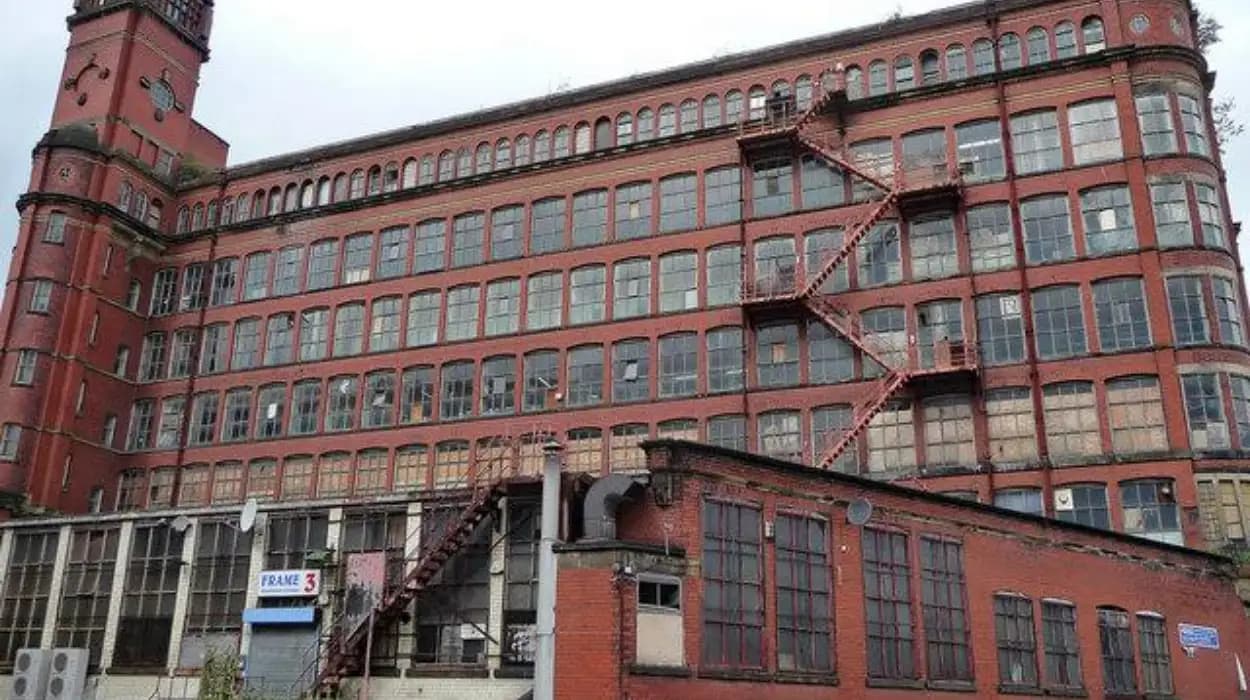
Bolton’s industrial history is closely connected with the rise of cotton manufacturing in Lancashire. During the late 18th and 19th centuries, the town changed from a market settlement into a major industrial centre shaped by spinning, weaving, engineering, coal, canals, railways, factories and a rapidly expanding workforce.
The Industrial Revolution was a period of major technological and economic change that transformed production from predominantly domestic and manual methods into mechanised factory manufacturing. In Lancashire, cotton became one of the most important industries driving that transformation. Bolton occupied a significant position within this textile economy because of its skilled workforce, manufacturing traditions, engineering businesses, transport connections and access to regional markets.
The story of Bolton cotton is also a history of social change. Industrialisation increased employment and population while creating demanding working conditions. Factory legislation, trade union organisation, improvements in transport and changing international markets gradually altered the industry.
Historic England identifies Lancashire as one of the principal regions where the Industrial Revolution transformed both industry and the built environment. Its research records the importance of factory production, steam power and textile mills in creating the distinctive landscapes associated with Lancashire’s industrial towns.
How did Bolton become an industrial town?
Bolton became an industrial town because textile manufacturing expanded alongside mechanised spinning, factory production, engineering, transport infrastructure and population growth, turning the settlement into an important Lancashire manufacturing centre during the late eighteenth and nineteenth centuries.
Before industrialisation, Bolton operated as a market and manufacturing settlement within the historic county of Lancashire. Textile production already existed in the surrounding region, with hand spinning and hand weaving providing income for households.
The crucial change was the increasing mechanisation of textile production. Machines allowed yarn and cloth to be produced on a scale that domestic workers could not match. Production increasingly moved into purpose-built mills where machinery, labour and power were concentrated.
Bolton’s geographical position also mattered. The town stood within the wider industrial belt of east and central Lancashire. Nearby communities such as Horwich, Farnworth, Kearsley, Westhoughton and Little Bolton developed industrial connections with Bolton.
Industrialisation did not occur through cotton alone. Coal supplied fuel for steam engines, ironworking supported machinery manufacture and construction, while transport improvements allowed raw materials and finished textiles to move through the region.
The population figures demonstrate the scale of change. The Bolton Poor Law Union and registration district recorded 40,763 people in 1801. By 1851, the figure had reached 114,712. It stood at 192,405 in 1881 and 275,927 in 1911.
These figures cover the wider registration area rather than only the present-day town boundary, but they demonstrate the dramatic demographic expansion associated with industrialisation.
When did Bolton's cotton industry begin?
Bolton’s cotton industry developed from earlier textile production and expanded rapidly during the late eighteenth century as mechanised spinning and factory organisation transformed Lancashire manufacturing, with the 1770s and 1780s marking an important stage in the region’s transition.
Cotton manufacture existed in Britain before the Industrial Revolution, but production was generally dispersed among households and small workshops. Spinning remained labour-intensive, and yarn production limited the quantity of cloth that could be manufactured.
Technological developments changed this balance.
Richard Arkwright, an industrialist and inventor who settled in Bolton in 1750, became associated with mechanised cotton spinning. His spinning technology helped establish the factory system in which powered machinery operated under centralised management. English Heritage describes Arkwright as a major figure in the development of cotton-spinning machinery that transformed British cotton manufacture.
Another crucial Bolton figure was Samuel Crompton. Born near Bolton in 1753, Crompton developed the spinning mule in the late 1770s. The machine combined principles associated with earlier spinning technologies and enabled the production of finer yarn at industrial scale.
Crompton’s invention became particularly important to Bolton’s textile identity. The spinning mule became one of the defining machines of Lancashire’s cotton industry.
The development of mechanised spinning did not immediately eliminate hand production. Instead, the two systems existed together for a period. Over time, factories gained an increasing advantage because mechanical power allowed production to operate at greater speed and scale.
Bolton consequently became associated with cotton spinning and the engineering expertise required to maintain and improve spinning machinery.
How did Samuel Crompton influence Bolton's cotton industry?
Samuel Crompton influenced Bolton’s cotton industry through the spinning mule, a machine developed around 1779 that combined earlier spinning principles and enabled manufacturers to produce fine cotton yarn efficiently, strengthening Bolton’s reputation as an important centre of mechanised textile production.
Samuel Crompton was born at Firwood Fold near Bolton in 1753. His early experience as a hand spinner gave him practical knowledge of the limitations of existing equipment.
The spinning mule addressed a major manufacturing problem. Earlier machines increased productivity but did not always provide the combination of fineness, strength and flexibility required for high-quality yarn.
Crompton’s machine used a moving carriage carrying spindles. The mechanism drew out the fibres and then twisted the yarn. This allowed spinners to produce finer yarn than many earlier machines could achieve.
The invention had a major industrial effect because fine yarn was essential to high-quality cotton textiles. The mule therefore became an important part of Lancashire’s spinning technology.
Crompton did not secure the financial rewards associated with the later commercial success of his invention. He eventually disclosed the machine’s construction after pressure from manufacturers and received payments from subscribers.
His contribution remains central to Bolton’s industrial heritage because the spinning mule became one of the most important machines associated with Lancashire cotton spinning.
The Crompton connection also illustrates an important feature of the Industrial Revolution: technological development often depended on practical knowledge held by skilled workers as much as on formal scientific institutions.
Why did cotton mills become central to Bolton's economy?
Cotton mills became central to Bolton because they concentrated machinery, labour and power within large production sites, allowing manufacturers to produce yarn and cloth efficiently while generating employment for rapidly growing communities and supporting related engineering, transport and commercial businesses.
The factory system changed the physical structure of Bolton.
A cotton mill required a large workforce, machinery, power generation, storage areas and transport access. Early mills often depended on water power, but steam engines later provided greater flexibility and allowed factories to operate independently of suitable watercourses.
Steam power transformed industrial geography. Mills could be built closer to workers, transport routes and commercial centres rather than being restricted to locations with strong water supplies.
Historic England’s research into Lancashire textile mills identifies steam power and factory-based production as major forces behind the region’s industrial development.
The physical form of a mill reflected its production process. Spinning blocks were often multi-storey buildings designed to accommodate machinery and shafting. Weaving sheds were generally broader, single-storey structures because looms required large, open production spaces.
Gilnow Mill in Bolton provides a surviving example of this integrated industrial form. Historic England records its development from 1857, including a four-storey spinning block, engine house, office and warehouse range, weaving sheds, boiler house and chimney.
Such buildings demonstrate that a cotton mill was not simply a factory floor. It was a complex industrial system combining production, power, storage, administration and transport.
How did steam power transform Bolton's cotton manufacturing?
Steam power transformed Bolton’s cotton manufacturing by providing reliable mechanical energy for spinning and weaving machinery, allowing factories to expand beyond water-powered sites and supporting larger mills, longer production schedules and increasingly concentrated industrial employment during the nineteenth century.
Steam engines changed the relationship between manufacturing and geography.
Water wheels had provided an important source of mechanical power during the earlier stages of industrialisation. Their output depended on water flow and suitable locations.
Steam engines used coal as their primary fuel and therefore connected cotton manufacturing directly with the expanding coal economy. Coal could be transported into industrial districts, while engineering firms manufactured and maintained boilers, engines, shafts and machinery.
The combination of steam power and mechanised spinning encouraged the construction of increasingly substantial mills.
Industrial buildings also became more sophisticated. Fire-resistant construction, iron columns, brick arches and improved ventilation addressed some of the hazards associated with large factories.
The surviving Lancashire textile landscape records this architectural evolution. Historic England notes that textile mills developed distinctive forms as production became increasingly mechanised and industrialised.
By the early twentieth century, Bolton had become associated with exceptionally large spinning mills. Swan Lane Mills provides a particularly important example.
Swan Lane Mills Nos. 1 and 2 were built in phases in 1903 and 1906 to designs by Stott and Sons. Historic England records the complex as a Grade II* listed building and identifies its double-mill arrangement and cast-iron and brick construction.
How did cotton manufacturing change Bolton's landscape?
Cotton manufacturing transformed Bolton’s landscape by replacing smaller-scale production with mills, workers’ housing, warehouses, engineering works, canals, railways and associated infrastructure, creating the dense industrial environment that became characteristic of nineteenth-century Lancashire textile towns.
Industrialisation changed both the town centre and surrounding communities.
Large mills required land and transport connections. Workers required housing within practical travelling distance. Manufacturers needed warehouses, offices, workshops and access to coal and raw cotton.
Rows of workers’ housing appeared near industrial workplaces. Streets became more densely occupied as families moved into Bolton from surrounding rural districts and other parts of Britain.
Industrial expansion also affected nearby settlements. Farnworth, for example, was described in the 19th-century Imperial Gazetteer as a centre of cotton manufacture and iron production. Its population increased from 6,389 in 1851 to 8,720 in 1861, with the growth attributed to cotton mills and foundries.
The wider Lancashire landscape developed a distinctive mixture of industrial buildings and residential streets. Historic England describes this transformation as extending across rural and urban locations and involving industry, housing and transport infrastructure.
The result was a built environment that still influences Bolton’s appearance today.
Some mills disappeared through demolition, redevelopment, fire or decay. Others survived because their structures were adapted, listed or recognised as important industrial heritage.
How did canals and railways support Bolton's cotton industry?
Canals and railways supported Bolton’s cotton industry by improving the movement of coal, raw cotton, machinery and finished textiles, reducing transport constraints and connecting local manufacturers with Lancashire’s wider industrial and commercial network.
Transport was essential to industrial production.
Cotton manufacturers required raw cotton imported into Britain through major ports. Coal was needed to power steam engines. Machinery required heavy transport, while finished yarn and cloth needed distribution to domestic and international markets.
The Manchester Bolton & Bury Canal, opened progressively from the 1790s, strengthened connections between Bolton and the wider regional transport network. Later railway development further accelerated industrial mobility.
Railways provided faster movement of goods and people. Railway stations also supported the growth of industrial settlements by making commuting and commercial travel easier.
Transport infrastructure therefore influenced the location and expansion of factories.
Historic England’s research into Lancashire industrialisation emphasises the role of infrastructure in transforming the built environment. Its case studies include canal-side development and changing road networks alongside textile production.
For Bolton, the relationship between cotton and transport was especially important because the industry depended on supplies arriving from outside the immediate area.
What were working conditions like in Bolton's cotton mills?
Working conditions in early cotton mills were demanding, with long hours, dangerous machinery, noise, heat and widespread child employment. Factory legislation introduced during the nineteenth century gradually restricted working hours, minimum employment ages and workplace conditions.
Factory employment created regular wage labour but also introduced significant hazards.
Workers operated machinery containing rapidly moving spindles, shafts, belts and gears. Cotton fibres filled the working atmosphere, while noise levels could be extremely high. Heat and humidity were used in some spinning processes to improve yarn handling.
Working hours were long during the early nineteenth century.
Parliament records that the earliest factories developed around Lancashire’s expanding cotton industry and that working conditions were frequently severe. In 1800, approximately 20,000 apprentices were employed in cotton mills nationally, while during the following decade children under 13 formed a significant proportion of the cotton workforce.
Parliamentary evidence also specifically referred to Bolton. During debates on the Cotton Mills legislation in 1819, evidence discussed working hours and conditions affecting children in Lancashire factories, including Bolton.
The Factory Acts gradually established minimum standards.
The 1802 Health and Morals of Apprentices Act represented the first factory legislation. The 1819 Cotton Mills Act prohibited the employment of children under nine in cotton mills and restricted working hours for workers under 16. The 1833 Factory Act introduced factory inspectors, while later legislation expanded regulation.
These laws represented a fundamental change in the relationship between industrial employers, workers and the state.
How did cotton workers shape Bolton's social history?
Cotton workers shaped Bolton’s social history through organised labour, trade union activity, community institutions and political campaigns that developed around industrial employment, wages, working hours, workplace safety and representation during the nineteenth and twentieth centuries.
Industrial employment created a large working population with shared economic interests.
Cotton operatives organised around wages, working conditions and employment security. Skilled spinners held particular importance because spinning required specialised knowledge and technical competence.
Trade union activity became an important feature of Lancashire textile communities. Workers used collective organisation to negotiate with employers and respond to changes in wages and working conditions.
Industrial communities also developed institutions outside the workplace. Friendly societies, churches, chapels, schools, libraries, political organisations and social clubs contributed to local identity.
Education became increasingly important as factory regulation changed children’s working lives.
The 1833 Factory Act introduced factory inspectors and established restrictions affecting child labour. Parliamentary debates later recorded increased educational attendance among children affected by factory regulation in towns including Bolton.
Industrialisation therefore changed more than employment. It influenced family structures, education, housing, political participation and community organisation.
For genealogists, this history is particularly important because occupational records, census returns, trade directories and local newspapers can reveal how individual families participated in Bolton’s textile economy.
Which Bolton mills are important for understanding the cotton industry?
Important surviving Bolton textile sites include Gilnow Mill and Swan Lane Mills, while surrounding industrial landscapes such as Barrow Bridge and Horwich provide additional evidence of factory production, workers’ housing, engineering and the wider infrastructure that supported Lancashire’s cotton economy.
Gilnow Mill is one of Bolton’s significant surviving industrial structures. Historic England records the site as an integrated cotton mill originally developed in 1857 and subsequently expanded. Its surviving elements demonstrate how spinning, weaving, power generation and administration operated together.
Swan Lane Mills represents the later phase of industrial development.
The complex of Swan Lane Mills Nos. 1 and 2 was constructed in the early twentieth century. Historic England records the buildings as a Grade II* listed complex. The mills were designed by Stott and Sons and used advanced construction associated with large-scale spinning.
Historic England also records Swan Lane Mills as a complex of three spinning mills. Numbers 1 and 2 were completed as a 210,000-spindle double mill, while No. 3, completed in 1914, added another 120,000 spindles. The combined complex therefore represented 330,000 spindles.
The nearby Barrow Bridge factory village provides a different form of industrial heritage. Historic England identifies it as a case study in factory housing, demonstrating how employers developed residential environments alongside manufacturing sites.
Horwich also preserves evidence of earlier handloom weaving traditions. Historic England’s research includes Club Houses, a former handloom weavers’ colony, as an example of working practices that existed alongside the later factory system.
How did the American Civil War affect Bolton's cotton industry?
The American Civil War caused a major disruption to Lancashire cotton manufacturing because the conflict restricted supplies of raw American cotton, creating the Cotton Famine of the 1860s and exposing Bolton and other textile centres to the risks of dependence on global supply chains.
Lancashire’s cotton industry depended heavily on imported raw cotton.
The United States was the principal supplier of raw cotton to British manufacturers. When the American Civil War began in 1861, the Union blockade restricted exports from Confederate cotton-growing regions.
British mills faced severe shortages.
The resulting crisis became known as the Cotton Famine. Mills reduced production, workers lost employment or experienced shorter working hours, and communities faced increased economic hardship.
Historic England identifies the American Civil War as a major cause of the disruption to Lancashire cotton supplies.
The crisis demonstrated the international nature of Bolton’s industrial economy. A conflict thousands of miles away directly affected employment, wages and production in Lancashire.
Manufacturers subsequently sought alternative cotton supplies from other parts of the world. India became increasingly important to British cotton supply, although the quality and characteristics of different cotton varieties affected manufacturing processes.
The Cotton Famine also demonstrated that industrial strength did not eliminate economic vulnerability. Bolton’s mills depended on international commodities, shipping networks, financial systems and overseas markets.
How did Bolton's cotton industry develop after the Victorian period?
Bolton’s cotton industry expanded into the early twentieth century through larger mills, improved machinery and corporate organisation, but international competition, economic instability, changing consumer markets and technological shifts eventually produced a prolonged decline in British cotton manufacturing.
The late nineteenth and early twentieth centuries represented a major phase of industrial consolidation.
Mills became larger and more specialised. Spinning firms invested in improved machinery and increasingly sophisticated buildings.
Swan Lane Mills illustrates this development. Its early twentieth-century double-mill design reflected the enormous scale achieved by Lancashire spinning companies. Historic England records more than 200,000 spindles in the first two phases alone.
The wider Lancashire industry reached exceptional productive capacity.
Historic England states that Lancashire dominated the British cotton industry by the twentieth century and that the region reached maximum productive capacity in 1926. It also records the subsequent decline caused by economic pressures, coal shortages, industrial disputes, financial restrictions, overseas competition and the growth of man-made fibres.
The decline was gradual rather than immediate.
Some mills remained active for decades after the industry’s peak. Others changed ownership, specialised in different products or were converted to alternative industrial uses.
After the Second World War, British manufacturers faced increasingly strong competition from textile producers in Asia. Lower production costs overseas contributed to the long-term contraction of Lancashire’s traditional textile manufacturing base.
By the later twentieth century, many Bolton mills had closed.
Why did Bolton's cotton industry decline?
Bolton’s cotton industry declined because Lancashire manufacturers faced international competition, changing technology, economic instability, declining export markets, rising costs and competition from countries with lower manufacturing costs, causing widespread mill closures during the twentieth century.
The industry’s decline resulted from several connected economic changes.
British manufacturers increasingly faced competition from overseas producers. Countries in Asia developed expanding textile industries with lower labour and production costs.
Technology also changed. Man-made fibres such as rayon and later synthetic materials competed with traditional cotton products.
British mills faced investment problems as older buildings and machinery became less competitive. Some companies modernised, while others lacked sufficient capital to make large-scale improvements.
Economic crises intensified the problem. The years after the First World War were difficult for many Lancashire textile manufacturers. The General Strike of 1926 and wider economic pressures affected industrial production.
Historic England records that Lancashire’s textile industry began reducing output after its 1926 peak and later experienced a brief post-war revival before facing intensified overseas competition after 1952.
The decline transformed Bolton’s economy.
Industrial employment fell. Mills closed or were demolished. Industrial buildings lost their original functions, while former mill districts underwent redevelopment.
Yet the physical remains of the industry became increasingly important as heritage assets.
What remains of Bolton's cotton industry today?
Bolton’s cotton heritage survives through listed mills, industrial buildings, workers’ housing, historic streets, archives, photographs, museum collections and archaeological evidence that preserve the physical and documentary record of the town’s industrial transformation.
The decline of manufacturing did not erase its historical importance.
Historic buildings provide direct evidence of industrial technology. Mill walls, windows, floors, columns, engine houses, boiler houses and chimney bases can reveal how production operated.
Gilnow Mill remains an important example of an integrated cotton mill in Bolton.
Swan Lane Mills provides evidence of the later large-scale spinning industry and is protected as a Grade II* listed complex.
Industrial archaeology provides another source of evidence. Archaeologists can examine demolished mill sites, foundations, water-management systems, transport routes and industrial waste to reconstruct production landscapes.
Historic England has conducted extensive research into Lancashire textile mills because many historic structures have been lost through demolition, decay and fire. Its research also emphasises that surviving mills can be adapted to new uses while retaining their contribution to local identity.
For visitors exploring Bolton today, the industrial landscape can therefore be understood as a connected heritage network rather than a collection of isolated buildings.
To experience this historic industrial landscape in person today, consult our comprehensive [Discover Bolton's Rich Industrial Heritage Through Fascinating Attractions and Historic Landmarks Today] for itineraries and visiting parameters.
Why is Bolton's cotton history important for genealogy and education?
Bolton’s cotton history is important for genealogy and education because census records, trade directories, newspapers, factory records, maps, photographs and surviving industrial buildings provide evidence about occupations, migration, family life, working conditions and community development.
Cotton manufacturing affected thousands of households across Bolton and surrounding districts.
A person listed as a spinner, weaver, cotton operative, mechanic, piecer, warehouse worker or textile labourer in a census record was connected to a much wider industrial system.
Census data can identify occupations and household structures. Trade directories can identify employers and businesses. Local newspapers can provide information about strikes, accidents, mill closures and community events.
Historic maps help researchers locate former mills and workers’ housing. Comparing maps from different decades can reveal how industrial districts expanded.
Photographic archives provide another important source. Historic England has made more than 10,000 photographs relating to Bolton’s social history available as educational material, including images of mills and local places.
Industrial history therefore provides a framework for understanding individual family histories.
A genealogical researcher tracing a Bolton ancestor who worked in a cotton mill can combine census occupations with mill locations, trade directories and historical maps. This approach can establish a stronger connection between an individual and the industrial environment in which they lived.
For educators, Bolton’s cotton industry provides a local case study of wider national developments. Students can examine industrialisation through technology, economics, labour, urbanisation, transport and international trade.
What is the long-term legacy of Bolton's Industrial Revolution?
The long-term legacy of Bolton’s Industrial Revolution is visible in its urban landscape, surviving mills, transport routes, industrial communities, engineering traditions, archival collections and cultural identity, connecting the town’s present environment with its historic role in Lancashire cotton manufacturing.
Bolton’s Industrial Revolution permanently changed the town.
The population expanded rapidly. Manufacturing became central to employment. New streets and housing were constructed. Transport infrastructure connected the town to regional and international markets.
The industrial period also established a distinctive architectural legacy.
Mill buildings remain among the clearest physical reminders of Lancashire’s textile economy. Their scale, construction and surviving machinery demonstrate the technological development of spinning and weaving.
Historic England’s Lancashire research emphasises the importance of preserving textile mills because they provide an enduring sense of place in communities whose identities were shaped by industrialisation.
Bolton’s industrial history also demonstrates the global nature of nineteenth-century manufacturing.
Raw cotton crossed oceans. Coal powered engines. Machinery was designed and manufactured through regional engineering networks. Finished textiles entered domestic and international markets. International wars and economic changes affected local employment.
The industry therefore connected Bolton to a global economic system long before modern globalisation.
Today, preservation gives these connections a physical form. Listed buildings such as Swan Lane Mills and surviving industrial structures such as Gilnow Mill allow researchers and visitors to examine the architecture of production.
Bolton’s cotton history is consequently not only a story about factories. It is a record of technological innovation, urban growth, working-class communities, transport development, international trade, social legislation and architectural change.
The Industrial Revolution created the foundations of modern Bolton while leaving a substantial heritage record for future research.
Understanding that history requires attention to both achievement and cost. Mechanised production increased output and created employment, but early factory work also involved dangerous conditions and long hours. Legislation gradually changed the relationship between workers and employers.
The surviving evidence provides an opportunity to study these changes with precision.
From Samuel Crompton’s spinning mule to the enormous early twentieth-century Swan Lane Mills, Bolton’s industrial story demonstrates how technological innovation reshaped an entire community. The mills that survive, the structures that disappeared and the records preserved in archives together form a continuous historical record.
Bolton’s cotton industry ultimately declined, but its influence remains embedded in the town’s buildings, streets, communities and heritage. Its Industrial Revolution remains one of the defining chapters in the history of Bolton and Lancashire.
FAQS
When did Bolton’s cotton industry begin?
Bolton’s cotton industry developed from earlier domestic textile production and expanded rapidly during the late 18th century as mechanised spinning and factory production transformed Lancashire manufacturing.