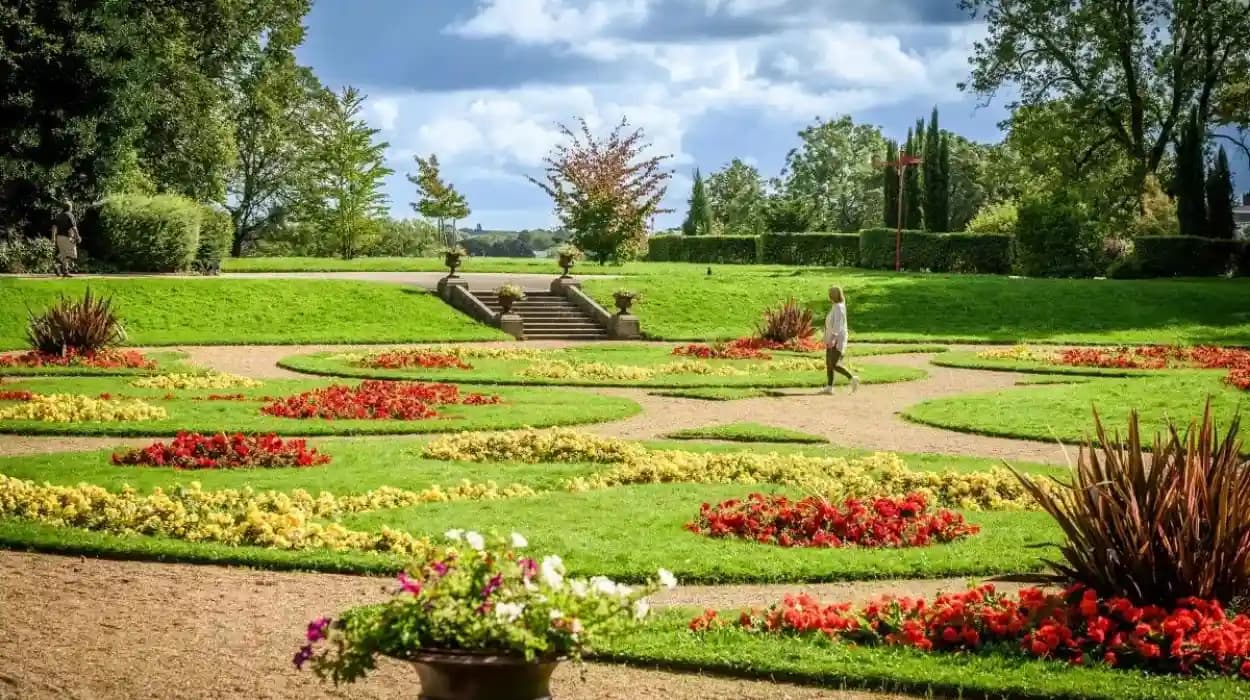
Bolton's public gardens and historic green spaces form an important part of the borough's cultural landscape. They connect Victorian urban planning, industrial history, philanthropy, cemetery design, recreation, wildlife conservation, and modern regeneration. Places such as Queen's Park, Farnworth Park, Leverhulme Park, Moss Bank Park, Moses Gate Country Park, and Tonge Cemetery demonstrate how open spaces developed alongside Bolton's expanding population.
The borough's landscape changed dramatically during the Industrial Revolution. Cotton mills, worker housing, transport infrastructure, canals, and dense streets transformed agricultural settlements into industrial communities. Public parks provided structured open space within this increasingly urban environment. Their purposes included recreation, public health, employment, civic improvement, and social gathering.
Bolton Council currently identifies five registered parks and gardens of historic interest: Queen's Park, Smithills Hall, Farnworth Park, Hulton Park, and Tonge Cemetery. Registered parks and gardens are designated because of their historic and cultural importance rather than solely their ecological value.
For visitors interested in gardens, architecture, photography, and local history, these spaces offer evidence of how Bolton's communities used landscapes across more than 160 years. The strongest historical example is Queen's Park, which opened in 1866 during the Lancashire cotton famine and retains much of its Victorian layout.
Why did Bolton develop public gardens and parks during the Victorian period?
Bolton developed public parks to improve urban conditions, provide recreation, support employment during industrial hardship, and create civic amenities as population growth transformed agricultural land into densely built industrial neighbourhoods. Queen's Park directly reflects these Victorian social, economic, and municipal priorities.
Bolton became a major textile manufacturing centre during the Industrial Revolution. Population growth created demand for housing, roads, sanitation, schools, public institutions, and recreational space. Industrial workers lived close to mills, and many neighbourhoods contained limited private gardens or substantial open land.
The creation of Queen's Park illustrates the relationship between economic crisis and municipal improvement. During the American Civil War, beginning in 1861, disruption to cotton supplies caused severe hardship in Lancashire's cotton-producing towns. Bolton experienced unemployment because textile manufacturers depended heavily on imported raw cotton.
Central government made loans available to local authorities for improvement schemes designed partly to provide employment. Bolton's Local Improvement Act received Royal Assent in 1864 and provided powers for projects including the creation of a public park.
This process transformed social policy into physical infrastructure. Instead of treating open land simply as unused space, Victorian authorities incorporated landscaping, paths, planting, water features, terraces, and public facilities into an organised municipal environment.
The approach also reflected nineteenth-century ideas about public health. Access to fresh air, walking space, trees, gardens, and recreation was increasingly regarded as beneficial in rapidly industrialising towns.
Queen's Park therefore represents more than a landscaped destination. It is a physical record of industrial crisis, municipal intervention, employment policy, landscape design, and changing expectations about public access to green space.
What makes Queen's Park Bolton's most important historic public garden?
Queen's Park is Bolton's most significant historic public park because it opened in 1866, retains major elements of its Victorian design, carries Grade II registration, and preserves gardens, terraces, water features, bridges, statues, and viewpoints within a 22-acre landscape.
Queen's Park stands approximately 0.7 kilometres north-west of Bolton town centre. Historic England lists the park as a Grade II registered park and garden under entry number 1001390. The designation recognises its historic landscape significance.
William Henderson designed the park. The landscape was created from meadow and pasture land acquired under the 1864 improvement programme. Historic England records an estimated enclosure and planting cost of approximately £90,000, a substantial municipal investment for the period.
The park formally opened on 24 May 1866. Bolton Council's conservation-area appraisal records an attendance of approximately 20,000 people for the opening ceremony. Businesses closed and a public procession travelled from the town centre to the new park.
The original name was Bolton Park. It became Queen's Park in 1897 during Queen Victoria's Diamond Jubilee year.
Several historic landscape components remain identifiable. These include the promenade terrace, sunken garden, ornamental water features, viewpoint, bridges, paths, mature planting, and historic statues. The locally known "pie crust" viewpoint provides an elevated position overlooking the town.
The park also contains surviving architectural elements associated with Victorian civic design. George Woodhouse designed original park buildings. Woodhouse was also associated with important Bolton buildings, including Bolton Town Hall.
The relationship between the park and the River Croal is particularly significant. The watercourse passes through the lower part of the landscape and helped shape the park's topography and circulation.
Queen's Park also preserves evidence of Bolton's intellectual and cultural history. The former Chadwick Museum opened in 1884 and contained collections assembled for public education. Although the building was later demolished, its collections became part of the development of Bolton's present museum service.
How did the Victorian design of Queen's Park shape photography and relaxation?
Queen's Park combines formal gardens, curved paths, terraces, water, mature trees, statues, bridges, and elevated viewpoints. These elements create varied photographic compositions while preserving the Victorian principle of combining structured landscape design with public recreation and visual access.
Victorian landscape design depended on movement through space. Visitors encountered different views as they walked between formal and informal areas. Straight paths established visual direction, while curved routes created changing perspectives.
Historic England records a central walk and interconnected straight and serpentine walks. The landscape included a lake, pond, garden terrace, flower beds, pavilion, statues, and other designed features.
The sunken garden remains particularly important for understanding the original landscape composition. Formal planting creates lower-level views framed by surrounding paths and terraces.
The promenade terrace provides another historically important viewpoint. Its elevated position connects the designed landscape with Bolton's wider urban setting.
Photography benefits from these surviving design relationships because historic landscape features provide identifiable foreground, middle-ground, and background elements. Bridges frame the River Croal, terraces create horizontal lines, and mature trees establish vertical structure.
The wider townscape also has historical significance. Victorian visitors originally saw a landscape dominated by industrial chimneys and mill buildings. Modern photographs record a substantially transformed skyline while retaining the same basic geographical relationship between the park and the town.
The park's restoration also demonstrates the importance of heritage conservation. Between 2010 and 2016, a major restoration programme supported by approximately £4.3 million from the Heritage Lottery Fund and additional Bolton Council funding repaired paths, water features, bridges, statues, and landscape elements.
In 2026, Bolton Council reported further improvements including restored benches, new wildflower areas, a sensory garden, and planters at entrances.
These interventions show how historic gardens can remain functional public spaces while retaining their original design character.
How does Farnworth Park reflect Bolton's nineteenth-century civic history?
Farnworth Park reflects nineteenth-century civic philanthropy because Thomas Baines presented the land to Farnworth, and the park opened on 12 October 1864 under William Ewart Gladstone. Its landscaped setting remains closely connected with Farnworth's industrial and civic development.
Farnworth developed rapidly during the nineteenth century as textile manufacturing expanded. The Manchester, Bolton and Bury Canal had already improved regional transport connections, while mills and associated housing changed the settlement's physical structure.
Farnworth Park was opened on 12 October 1864. Bolton Council's conservation-area documentation records that Thomas Baines presented the park to the town and that William Ewart Gladstone opened it. A stone monument records the dedication of the park for the benefit of Farnworth's population.
The park occupies an important position within Farnworth's historic urban environment. Housing around the park demonstrates how open space helped create a more varied townscape within densely developed districts.
Farnworth Park is also one of the five parks and gardens in Bolton recognised on the historic register.
The landscape has civic associations extending beyond recreation. The park hosted Farnworth Wakes, a traditional community event associated with the town's parish history. It also contains a war memorial unveiled in November 1924 by James Stones, a prominent local civic figure.
The Barnes family played an important role in the park's history. Thomas Barnes was associated with Farnworth's industrial development and provided land for the community. His nephew Alfred Barnes served as chairman of Farnworth Local Board and worked to secure civic improvements.
For historical photography, the park is significant because its open landscape provides a direct contrast with the surrounding industrial-era street pattern. Photographs can document the relationship between public green space, terraces, civic monuments, mature vegetation, and historic urban development.
What historical role does Leverhulme Park play in Bolton's landscape?
Leverhulme Park demonstrates the influence of industrial philanthropy on public recreation. William Hesketh Lever purchased 67 acres for a proposed public park during the First World War and presented the land to Bolton after municipal financing became difficult.
William Hesketh Lever, later Lord Leverhulme, was an industrialist associated with the development of Sunlight Soap and Port Sunlight. His connection with Bolton included the restoration of Hall i' th' Wood, the historic house associated with Samuel Crompton and the spinning mule.
In 1914 Bolton Corporation negotiated to purchase 67 acres for a public park. The outbreak of the First World War created government restrictions that prevented the corporation from raising all the required funds. Lever purchased the land himself and presented it to the town.
He later acquired additional land to enlarge the park. Bolton Corporation subsequently named it Leverhulme Park.
The park therefore represents a different phase of Bolton's public landscape history from Queen's Park. Queen's Park emerged from Victorian municipal improvement during the cotton famine, while Leverhulme Park developed through early twentieth-century private philanthropy.
Its present facilities demonstrate the continuing adaptation of historic public land. Bolton Council identifies a football pitch, running track, dog-walking areas, nature trails, an orienteering course, cycle trail, bowling green, cricket pitch, multi-use pitch, and playground.
This combination of recreation and landscape makes Leverhulme Park relevant to visitors studying the evolution of public open space. The site demonstrates how parks shifted from primarily formal Victorian pleasure grounds toward broader recreational landscapes supporting sport, exercise, nature observation, and community activity.
Why is Tonge Cemetery important for garden and heritage photography?
Tonge Cemetery is significant because it opened in 1856 as Bolton's first municipal cemetery and became a Grade II registered park and garden in 2002. Its landscaped grounds, monuments, mature vegetation, and burial records provide important evidence of Victorian social history.
Tonge Cemetery opened on New Year's Eve 1856 as Bolton's first municipal cemetery. It was originally known simply as Bolton Cemetery.
Its landscape was designed by William Henderson, the same landscape designer associated with Queen's Park. This connection places Tonge Cemetery within the wider development of nineteenth-century designed landscapes in the Bolton area.
In 2002, English Heritage, now Historic England, placed Tonge Cemetery on the Register of Parks and Gardens as a Grade II site because of its historic interest.
A historic cemetery differs from a conventional recreation park, but its landscape architecture has similar characteristics. Paths, planting, monuments, trees, boundaries, and views create a deliberately structured environment.
Tonge Cemetery also has considerable genealogical importance. Bolton Council provides information about burial records and cemetery history, while online resources include burial records, grave maps, cremation information, genealogy resources, and ancestry material.
A 2026 council maintenance programme uncovered several previously obscured monuments and graves. These included large Blair and Glaister family monuments and graves associated with former Bolton mayors Thomas Cullen and John Orton.
For researchers, these discoveries demonstrate why historic gardens and cemeteries should be treated as documentary landscapes. A monument can provide names, dates, occupations, family relationships, civic status, and evidence of changing memorial styles.
Photography in such settings should document architecture, landscape structure, inscriptions, and conservation features respectfully. The historical value lies in recording physical evidence rather than treating the cemetery solely as a recreational location.
How does Smithills Hall connect historic gardens with medieval and industrial Bolton?
Smithills Hall connects Bolton's medieval, early modern, Victorian, and industrial histories within one landscape. The Grade I listed house stands beside formal gardens and the West Pennine Moors, creating a preserved setting for architectural and landscape study.
Smithills Hall is a Grade I listed historic house owned by Bolton Council and operated within the Bolton Museum portfolio. Bolton Council describes it as one of the oldest and best-preserved manor houses in north-west England.
The house originated as a medieval hall during the fourteenth century. A fifteenth- or sixteenth-century east wing and a late sixteenth-century west wing expanded the building. Victorian alterations later introduced further architectural changes.
Richard Ainsworth employed the Victorian architect George Devey to make significant improvements to the property. The surviving landscape therefore provides evidence of several architectural and social periods rather than one isolated historical phase.
Smithills Hall is surrounded by formal gardens and lies close to the West Pennine Moors. This geographical relationship makes the site particularly valuable for understanding the transition between designed domestic landscapes and wider rural terrain.
The gardens also provide an important context for interpreting the hall. Historic buildings are not isolated architectural objects. Their surrounding landscapes reveal how residents approached entrances, views, cultivation, recreation, service areas, and movement through the estate.
For educators and heritage researchers, Smithills Hall provides a concentrated study area covering medieval domestic architecture, early modern expansion, Victorian restoration, estate management, and modern public heritage management.
Its importance is reinforced by Bolton Council's designation of Smithills Hall as one of the borough's five registered parks and gardens.
Which Bolton green spaces are best for nature-focused relaxation and scenic photography?
Moses Gate Country Park, Leverhulme Park, Moss Bank Park, and Queen's Park provide different landscape environments for relaxation and photography. Their features include woodland, water, formal planting, sports grounds, paths, mature vegetation, and historic structures.
Moses Gate Country Park occupies a former industrial landscape at Farnworth. Bolton Council describes it as a large country park and local nature reserve with woodland and waterside walks, nature trails, horse routes, and cycle routes.
The park's industrial connections are particularly important. Rock Hall, built in 1807, was associated with the Crompton family, whose paper-making business operated nearby. The property later became associated with bleach works before being divided into residential units during the mid-twentieth century.
Rock Hall opened as a visitor centre in 1982 and became a focal point for Moses Gate Country Park. It closed to the public in 2014. In 2026 Bolton Council reported plans connected with a National Lottery Heritage Fund bid to establish a Community Heritage Hub containing historical displays, a café, activity spaces, and Lancashire Wildlife Trust offices.
Moss Bank Park provides a different landscape. Bolton Council lists a bowling green, cricket pitch, football pitch, playground, and tennis courts among its facilities. It demonstrates the modern recreational role of municipal parks rather than the formal Victorian garden tradition represented by Queen's Park.
Leverhulme Park similarly combines organised sport with nature trails, cycling, walking, and community recreation.
These spaces are valuable for scenic photography because they represent different landscape categories. Queen's Park provides formal Victorian design. Moses Gate provides woodland and waterside scenery. Leverhulme Park provides recreational landscape. Moss Bank Park provides structured sports and community space.
Visitors researching Bolton's green-space history should therefore distinguish between registered historic landscapes, municipal recreation grounds, country parks, and nature reserves. Each category represents a different planning objective.
To experience these historic and scenic places in person today, consult our comprehensive [History of Bolton's Historic Parks and Gardens] for itineraries and visiting parameters.
How has Bolton preserved and renewed its historic public gardens?
Bolton's approach combines statutory heritage designation, landscape restoration, routine maintenance, community involvement, and new investment. Queen's Park provides the clearest example, while Tonge Cemetery and Moses Gate demonstrate continuing efforts to preserve historic landscapes and improve public access.
Historic England's Register of Parks and Gardens identifies landscapes of special historic interest and grades them I, II*, or II. Bolton Council states that registered landscapes can include public parks, private gardens, cemeteries, rural parkland, and other green spaces.
Bolton has five registered parks and gardens: Queen's Park, Smithills Hall, Farnworth Park, Hulton Park, and Tonge Cemetery.
Queen's Park provides the strongest example of conservation-led restoration. Its 2010–2016 restoration programme used Heritage Lottery Fund support and council funding to repair important historic features. The work included dredging lakes, recreating a carved stone fountain, rebuilding Dobson Bridge, restoring footbridges, conserving statues, and resurfacing paths.
The park's recent improvements show that conservation continues after major restoration. Bolton Council reported new wildflower areas, a sensory garden, entrance planters, restored benches, and improvements to the children's area in 2026.
Moses Gate Country Park is another current example of landscape investment. In 2026, Bolton Council proposed using part of a £1.5 million Pride in Place Impact Fund allocation for park and footpath improvements, including woodland access, a bird hide, and improved access to the river.
The borough's emerging Green Space Strategy for 2025–2040 also places quality and access standards within longer-term planning. Bolton's Local Plan documentation records 67 Sites of Biological Importance and 17 protected Local Nature Reserves.
This framework demonstrates the changing role of public gardens. Victorian parks were created primarily around civic improvement and recreation. Modern green-space policy additionally considers biodiversity, accessibility, heritage conservation, climate resilience, public health, and community participation.
What does Bolton's garden history reveal about the borough's wider development?
Bolton's gardens reveal the transition from agricultural settlement to industrial town and then to a modern borough focused on heritage, recreation, biodiversity, and regeneration. Their surviving layouts provide physical evidence of changing social priorities across more than 160 years.
Bolton's public landscapes cannot be separated from the borough's industrial development. The nineteenth-century parks emerged during periods of rapid population growth, textile manufacturing, urban expansion, and public-health concern.
Queen's Park directly records the social consequences of the cotton famine. Farnworth Park records civic philanthropy and local government development. Tonge Cemetery records Victorian burial reform and municipal administration. Leverhulme Park records twentieth-century industrial philanthropy. Moses Gate records the transformation of an industrial landscape into a country park.
These different origins explain why Bolton's green spaces vary considerably in appearance. A formal Victorian park contains terraces, ornamental planting, monuments, water features, and carefully planned paths. A country park contains woodland, open terrain, waterside routes, and ecological habitats. A historic cemetery contains memorial architecture within a deliberately landscaped setting.
The borough's present administrative structure also reflects a long history of local-government change. Bolton Borough was incorporated in 1838, while the modern Metropolitan Borough of Bolton was created on 1 April 1974 and incorporated Bolton with towns and townships including Farnworth, Kearsley, Horwich, Blackrod, Westhoughton, Little Lever, and South Turton.
This administrative history helps explain why Bolton's green-space heritage extends beyond the town centre. The modern borough contains landscapes with different historical origins and civic identities.
For photographers, historians, educators, and cultural tourists, these landscapes function as open-air historical records. Their paths, trees, monuments, bridges, terraces, buildings, waterways, and boundaries preserve evidence that is not always visible in written archives.
The future historical relevance of these gardens depends on maintaining both physical features and documentary records. Conservation plans, photographs, maps, inscriptions, oral histories, planting records, and community memories all contribute to understanding how these landscapes changed.
Bolton Council's continuing investment shows that historic green spaces remain active parts of the borough rather than static museum exhibits. Their future significance will come from the ability to preserve historic character while supporting contemporary recreation, biodiversity, accessibility, education, and community use.
For visitors seeking the strongest combination of historical design and scenic photography, Queen's Park provides the clearest starting point. Its 1866 origins, Grade II designation, surviving Victorian layout, restored gardens, River Croal, statues, terraces, bridges, and views make it an especially important example of Bolton's public landscape heritage.
The wider network adds essential context. Farnworth Park demonstrates civic philanthropy. Tonge Cemetery preserves genealogical and memorial evidence. Leverhulme Park records industrial philanthropy. Smithills Hall preserves a medieval estate landscape. Moses Gate Country Park demonstrates the conversion of industrial land into a modern ecological and recreational destination.
Together, these places demonstrate that Bolton's public gardens are historical infrastructure. They document how successive generations responded to industrialisation, unemployment, urbanisation, recreation, public health, philanthropy, heritage conservation, and environmental change.
FAQS
What is the most historic public garden in Bolton?
Queen’s Park is one of Bolton’s most important historic public gardens. It opened on 24 May 1866 and is a Grade II registered park and garden, preserving important Victorian landscape features.