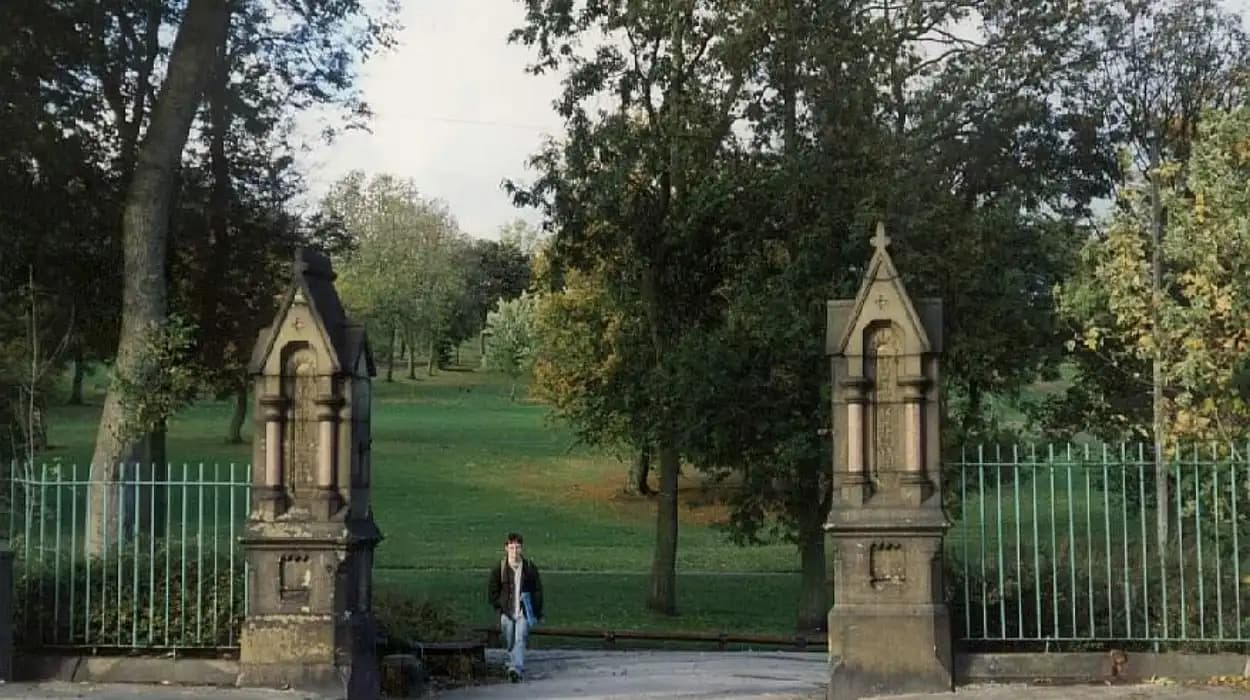
Bolton’s historic parks and gardens record the borough’s transformation from an industrial Lancashire district into a town with planned public landscapes, recreational spaces, ornamental gardens, historic estates and protected green heritage. Their development reflects Victorian municipal reform, industrial wealth, social welfare, landscape design and modern conservation.
Bolton’s parks are important because they connect environmental history with the history of cotton manufacturing, urban expansion, philanthropy and public health. Queen’s Park, Farnworth Park, Smithills Hall and Park, Hulton Park and Tonge Cemetery are among the landscapes recognised on Bolton’s register of historic parks and gardens. Bolton Council identifies five registered parks and gardens within the borough: Queen’s Park, Smithills Hall, Farnworth Park, Hulton Park and Tonge Cemetery.
The borough also contains other significant public green spaces, including Moss Bank Park, Moses Gate Country Park and Leverhulme Park. These landscapes represent different stages in Bolton’s environmental and social history, from nineteenth-century private estates and Victorian public parks to twentieth-century recreation grounds and restored country parks.
Why did Bolton develop historic parks and gardens?
Bolton developed historic parks and gardens because industrial growth created demand for public recreation, healthier urban environments, social improvement and carefully planned landscapes. Victorian investment transformed pasture, private estates and institutional land into parks serving rapidly expanding communities.
Bolton experienced major population and economic growth during the Industrial Revolution. Cotton spinning, weaving, bleaching, engineering and associated industries transformed the town and surrounding settlements. Industrial expansion created employment but also produced dense housing, pollution and pressure on limited open space.
The incorporation of Bolton as a municipal borough in 1838 strengthened local government and created greater institutional capacity for planned urban improvements. The expanding corporation increasingly became responsible for streets, public buildings, sanitation and civic infrastructure. Bolton Council records describe how the town’s population, prosperity and importance increased during industrialisation, strengthening demands for municipal reform and improved public administration.
Public parks became part of this wider Victorian improvement movement. They provided formally designed areas for walking, recreation and access to greenery. They also represented civic investment and municipal ambition.
The history of Bolton’s parks therefore cannot be separated from industrial history. Their creation occurred during a period when cotton production generated substantial wealth while economic crises created severe unemployment. The relationship between industry and parks is particularly clear in the development of Queen’s Park during the Lancashire Cotton Famine.
How did the Victorian era change Bolton’s public parks?
The Victorian era established Bolton’s principal tradition of planned public parks through municipal improvement, private philanthropy and professional landscape design. Queen’s Park and Farnworth Park demonstrate how nineteenth-century landscapes combined recreation, ornamental planting, employment relief and civic identity.
The Victorian public park movement developed across Britain during the nineteenth century. Municipal authorities, industrialists and philanthropists created landscapes with lawns, lakes, promenades, trees, gardens and recreational facilities.
Bolton participated directly in this national movement. Professional landscape gardeners designed parks according to principles that separated circulation routes, ornamental spaces, water features, planting schemes and viewpoints.
William Henderson was an important figure in this process. The landscape gardener from Birkenhead designed Queen’s Park and also worked on Farnworth Park. His career linked Bolton with wider developments in Victorian landscape design across northern England. Historic England identifies Henderson as the designer of Queen’s Park, which opened in 1866.
These parks were not simply areas of undeveloped countryside. They were constructed cultural landscapes. Paths, trees, lawns, lakes, terraces, entrances and architectural features created deliberate visual and social environments.
The parks also served practical purposes. During periods of unemployment, public works created employment while producing permanent civic infrastructure. This function became especially important during the Cotton Famine of the 1860s.
How did the Cotton Famine influence Queen’s Park?
The Cotton Famine directly influenced Queen’s Park because the American Civil War disrupted cotton supplies to Lancashire mills, causing unemployment and hardship. Public improvement schemes provided employment while creating a permanent municipal park from former pasture known as Spa Fields.
The American Civil War began in 1861 and disrupted the supply of raw cotton from the American South to British textile manufacturers. Lancashire depended heavily on imported cotton, and the resulting shortage severely affected industrial communities.
Bolton was one of the towns affected by the crisis. Workers experienced unemployment and reduced incomes as mills struggled with insufficient raw materials.
Central government responded by making loans available to local authorities for improvement works. Bolton used this policy framework to develop public infrastructure, including a new park.
The Bolton Local Improvement Act received Royal Assent in 1864. The scheme enabled the corporation to acquire land and develop what became Bolton Park, later renamed Queen’s Park. Bolton Council’s conservation appraisal records the relationship between the Cotton Famine, unemployment, government loans and the creation of the park.
The park therefore has an unusual dual history. It was both a landscape improvement project and an employment-relief measure.
Its creation demonstrates how Victorian public parks could operate as economic, social and environmental infrastructure simultaneously.
When did Queen’s Park open and what survives from its original design?
Queen’s Park formally opened on 24 May 1866 after being laid out during 1865 and 1866. Its surviving historic features include the original circulation pattern, ornamental water features, terrace promenade, viewpoint, planting framework and historic structures associated with the Victorian design.
Queen’s Park was originally known as Bolton Park. The formal opening ceremony took place on Thursday, 24 May 1866. Bolton Council records that approximately 20,000 people attended the opening, with a procession travelling from the town centre. Local businesses closed and workers received time away from work for the celebration.
Historic England lists Queen’s Park as a Grade II registered park and garden under National Heritage List entry 1001390. The listing states that William Henderson designed the park and that it retains most of its principal design elements shown on an 1882 map.
The original landscape included ornamental lakes, promenades, trees, shrubs, flower beds and viewpoints. The park also incorporated architectural structures, boundary treatments and a park keeper’s lodge.
The former entrance lodge survives as a separately listed Grade II building. Historic England dates the lodge to approximately 1866 and describes its coursed stone construction, slate roof and distinctive L-shaped plan.
Queen’s Park consequently preserves both landscape and architectural heritage. Its significance lies in the survival of the relationship between designed landform, circulation routes, planting and buildings.
How did Farnworth Park become part of Bolton’s historic landscape?
Farnworth Park originated as part of the Birch Hall estate and was developed as a public park through private philanthropy. Thomas Barnes announced the scheme in 1860, while William Henderson and Robert Galloway shaped the landscape before its 1864 opening.
Farnworth developed as an industrial settlement south of Bolton. Cotton manufacturing created substantial local wealth, and members of industrial families increasingly funded civic and recreational projects.
Thomas Barnes, a Justice of the Peace and three-time Member of Parliament for Bolton, owned the Birch Hall estate. In 1860 he announced plans to lay out part of the estate as a park for Farnworth residents. The project commemorated his father and marked his son’s coming of age.
William Henderson was appointed to design and lay out the grounds. Robert Galloway subsequently completed the project. Galloway had trained in Liverpool and had professional experience as a gardener at Birch House and Birch Hall.
Farnworth Park opened in 1864. Historic England records its original design and later extensions during the twentieth century. The landscape is now a Grade II registered park and garden.
Farnworth Park demonstrates the importance of private landowners in the creation of Victorian recreational landscapes. Unlike Queen’s Park, which emerged through a municipal improvement programme, Farnworth Park began as a philanthropic estate project.
What is the historical importance of Smithills Hall and its gardens?
Smithills Hall and its surrounding landscape preserve centuries of Bolton’s rural, architectural and social history. The medieval manor house developed through later additions, while its gardens and parkland retain connections with historic estate management and the surrounding West Pennine landscape.
Smithills Hall is one of the most significant historic properties in Bolton. The building originated as a medieval manor house and contains architectural development dating from several centuries.
Bolton Council describes Smithills Hall as a Grade I listed building and one of the oldest and best-preserved manor houses in north-west England. The surviving structure records architectural changes from the late fourteenth century through later medieval and Victorian phases.
The surrounding park is also historically important. Bolton’s landscape character assessment identifies Smithills Hall and Park as a registered historic park and notes the importance of its broadleaved woodland.
The estate illustrates a different form of historic landscape from Queen’s Park. It was not originally designed as a Victorian municipal recreation ground. Its character developed from a historic landed estate associated with agricultural land, woodland, domestic buildings and the management of a country house.
Victorian alterations added another layer. Richard Ainsworth employed architect George Devey for significant improvements to Smithills Hall. The resulting landscape therefore contains evidence of medieval, early modern and Victorian development.
Smithills Hall and Park are especially important for understanding how Bolton’s urban-industrial history coexists with older rural landscapes.
To experience this historic landscape in person today, consult our comprehensive [Explore Bolton's Most Beautiful Public Gardens for Relaxation and Scenic Photography Adventures] for itineraries and visiting parameters.
How did Moss Bank Park develop from an industrial landscape?
Moss Bank Park developed from nineteenth-century private grounds connected with nearby industrial activity and the planned community at Barrow Bridge. Its landscape preserves evidence of the relationship between industrial estates, worker recreation, designed grounds and later public park development.
Moss Bank Park represents another connection between industrial history and green space. Bolton’s landscape character assessment identifies the park as having developed from nineteenth-century private grounds associated with nearby bleachworks and the planned industrial community at Barrow Bridge.
Barrow Bridge was associated with industrial development and purpose-built worker housing. The surrounding landscape incorporated gardens, lodges and recreational areas connected with industrial employers.
This relationship was significant because industrial communities required more than factories and housing. Employers and estate managers created controlled environments that combined work, residence and leisure.
The surviving park landscape represents the later public interpretation of this industrial environment. Modern recreational facilities occupy a setting with deeper connections to the industrial development of north Bolton.
Moss Bank Park is also an example of how historic green spaces evolve. A landscape can retain elements of its earlier land-use pattern even after its economic purpose changes.
What role did Leverhulme Park play in Bolton’s twentieth-century history?
Leverhulme Park originated from land associated with industrialist William Hesketh Lever and became a public park through philanthropy. The Corporation sought 67 acres in 1914, but Lever purchased the land during the First World War and presented it to Bolton.
William Hesketh Lever, later Lord Leverhulme, was one of the most influential industrialists associated with north-west England. He founded Lever Brothers and developed the model industrial community at Port Sunlight in Cheshire.
Lever also had strong connections with Bolton. In 1899 he purchased Hall i’ th’ Wood and restored it before presenting the property to the town in 1902. The building became a museum associated with Samuel Crompton, the Bolton inventor of the spinning mule.
In 1914 Bolton Corporation negotiated to purchase 67 acres for a public park. The outbreak of the First World War disrupted the financial arrangements.
Lever subsequently purchased the land himself and presented it to Bolton. He acquired additional land, enlarging the site. The corporation later named the park Leverhulme Park in recognition of his contribution.
Leverhulme Park demonstrates the continuing influence of industrial philanthropy after the main Victorian public-park movement. Its creation also shows how private wealth remained important to public open-space provision during the early twentieth century.
How did Moses Gate Country Park preserve Bolton’s industrial and rural heritage?
Moses Gate Country Park combines woodland, water, former industrial land and historic buildings. Rock Hall, built in 1807 for the Crompton family, later became the park’s visitor centre, creating a direct link between industrial enterprise, historic property and modern environmental recreation.
Moses Gate Country Park occupies a substantial landscape around water, woodland and former industrial activity in Farnworth. The park provides an example of environmental regeneration layered over older economic and residential history.
Rock Hall is central to the site’s heritage. Bolton Council records that the hall was built in 1807 and was associated with the Crompton family, whose paper-making business became highly successful. The building later housed managers of a bleach works before being divided into apartments during the 1940s and 1950s.
In 1982 Rock Hall opened as a visitor centre and became a focal point for Moses Gate Country Park. It closed to the public in 2014.
In 2026 Bolton Library and Museum Services sought community memories, photographs and objects connected with Rock Hall and the country park as part of plans for a proposed Community Heritage Hub supported by a National Lottery Heritage Fund bid.
This ongoing heritage work demonstrates that historic parks are not static monuments. Their interpretation changes as researchers, museums, local authorities and communities document previously overlooked aspects of their history.
How many historic parks and gardens are officially registered in Bolton?
Bolton Council currently identifies five registered parks and gardens: Queen’s Park, Smithills Hall, Farnworth Park, Hulton Park and Tonge Cemetery. These landscapes receive heritage recognition because of their design, cultural importance and historical development.
Historic England’s Register of Parks and Gardens recognises designed landscapes using three grades: Grade I, Grade II* and Grade II. The designation applies to different landscape types, including public parks, private gardens, cemeteries and historic parkland.
Bolton Council identifies five registered examples in the borough. They are Queen’s Park, Smithills Hall, Farnworth Park, Hulton Park and Tonge Cemetery.
The register differs from natural-environment designations. A registered park is recognised primarily for historic design and cultural significance. A Site of Special Scientific Interest, by contrast, is designated for nationally important wildlife, geological or ecological features.
This distinction matters when studying Bolton’s green heritage. A historic landscape can be significant because of its designed layout, architecture, planting history and relationship with people even when its principal importance is not ecological.
The five registered landscapes therefore provide a useful framework for understanding the borough’s formal landscape heritage.
Why is Tonge Cemetery historically important as a designed landscape?
Tonge Cemetery is historically important because it combines burial heritage, Victorian landscape design, architecture and municipal history. Opened in 1856, it forms part of Bolton’s registered landscape heritage and illustrates the nineteenth-century development of planned cemetery environments.
Tonge Cemetery opened in 1856 and was laid out by William Henderson. Historic England identifies it as one of Bolton’s important historic landscapes and records surviving buildings associated with the cemetery’s nineteenth-century development.
Victorian cemeteries were carefully planned environments. They incorporated paths, planting, boundary walls, chapels, lodges, monuments and burial areas.
Their design reflected changing attitudes toward urban sanitation and burial. Rapidly growing industrial towns required additional burial capacity, while reformers promoted healthier and more orderly cemetery environments outside crowded churchyards.
Tonge Cemetery therefore belongs to the same broad period of civic landscape development as Queen’s Park and Farnworth Park. Its function differed, but its planning principles shared an emphasis on designed circulation, architecture, planting and controlled land use.
For genealogical researchers, cemetery landscapes also have particular value. Burial records, monuments and inscriptions can provide evidence about families, occupations, religious affiliations and social networks within historic Bolton communities.
How did historic parks change during the twentieth century?
Twentieth-century changes altered Bolton’s historic parks through new recreation facilities, changing maintenance practices, infrastructure development and periods of decline. Later conservation programmes restored important Victorian features while adapting landscapes for modern public use.
The twentieth century brought major changes to Bolton’s parks. Recreational expectations expanded beyond formal promenades and ornamental gardens. Parks increasingly accommodated sports, children’s play, community events and informal recreation.
Some historic features disappeared. Queen’s Park, for example, originally contained a large lake where the modern children’s play area stands. Bolton Council records that the lake later became a popular paddling pool before being filled during the 1970s.
Industrial decline also transformed the visual context. The skyline around Queen’s Park once contained numerous mill chimneys and factory structures. Changes in manufacturing altered the surrounding townscape and the views from the park.
Maintenance difficulties affected some historic parks during the late twentieth century. Queen’s Park experienced periods of deterioration during the 1980s and 1990s. Subsequent investment focused on recovering historic landscape character while improving facilities.
The history demonstrates that conservation is an active process. Historic parks require continuous management because vegetation grows, water systems deteriorate, structures weather and recreational requirements change.
How was Queen’s Park restored for modern visitors?
Queen’s Park underwent major restoration during the twenty-first century, combining heritage conservation with modern recreation. The programme restored lakes, walls, paths, gardens and fountains while introducing updated visitor facilities and strengthening community involvement.
Queen’s Park received substantial restoration investment between 2010 and 2016. Bolton Council reported that the restoration involved a £4.3 million Heritage Lottery Fund grant alongside additional council funding.
The restoration addressed both historic and practical problems. Lakes were dredged, walls and the fountain were reinstated, drainage and footpaths were improved, and new visitor facilities were introduced.
The project demonstrates an important principle in historic landscape conservation: restoration does not require removing modern use. Historic character can coexist with play areas, cafés, sports facilities and accessible paths when interventions respect the underlying landscape.
By 2019 Queen’s Park had received four consecutive Green Flag Awards, part of the national scheme recognising high-quality parks and green spaces.
In 2026 Bolton Council reported that the park had received Green Flag status nine times since 2017. Recent improvements included wildflower areas, a sensory garden, restored benches, improved planters and ecological management of ponds.
The Victorian fountain was also returned to working order in 2026 after repairs costing £17,000.
What do Bolton’s historic parks reveal about industrial society?
Bolton’s historic parks reveal how industrial society responded to population growth, pollution, unemployment, social reform and changing ideas about public health. Their landscapes converted private estates and undeveloped land into structured spaces for recreation, civic improvement and community life.
The parks provide physical evidence of social change. Their creation coincided with Bolton’s transition into a major industrial centre.
Queen’s Park demonstrates the relationship between economic crisis and public works. Farnworth Park demonstrates industrial philanthropy. Leverhulme Park demonstrates early twentieth-century philanthropic land transfer. Smithills Hall preserves an older landed estate. Tonge Cemetery records Victorian municipal responses to burial and urban growth.
These landscapes therefore represent different mechanisms of urban improvement.
They also reveal changing ideas about public access. Private estates historically restricted access according to ownership. Public parks established landscapes where residents could enter for recreation without being members of an estate or institution.
The physical design reinforced this change. Public entrances, promenades, open lawns and formal gardens created spaces intended for collective use.
Bolton’s parks are consequently important historical sources. Their paths, walls, trees, lakes, lodges and buildings provide evidence that written records alone cannot fully explain.
How are Bolton’s historic parks protected today?
Bolton’s historic parks are protected through heritage registration, conservation planning, restoration projects, landscape management and community involvement. Historic England designation provides national recognition, while Bolton Council manages local planning and conservation responsibilities.
Bolton Council’s heritage framework identifies registered parks and gardens as heritage assets. Registered landscapes are graded according to their historical and design significance, with Grade I, Grade II* and Grade II classifications.
Queen’s Park is nationally registered at Grade II. Historic England states that the landscape retains principal design elements from its nineteenth-century plan despite the loss of some original structures.
Conservation does not mean freezing a park in one historical period. Historic landscapes contain layers of change. Effective management therefore balances historic character with accessibility, safety, biodiversity, recreation and community use.
Community groups have also become important. Friends of Queen’s Park work alongside Bolton Council staff, contributing to maintenance and public engagement. Bolton Council credited this partnership as part of the park’s continuing improvement and Green Flag recognition.
Modern conservation consequently involves government, heritage organisations, local authorities, volunteers and residents.
What is the long-term historical significance of Bolton’s parks and gardens?
Bolton’s historic parks and gardens preserve the borough’s environmental, industrial and civic history in physical form. They document Victorian reform, industrial philanthropy, estate development, public recreation and modern conservation while remaining active landscapes used by contemporary communities.
The long-term importance of Bolton’s parks extends beyond leisure. They preserve evidence of how the borough responded to industrialisation and urban growth.
Queen’s Park records the social consequences of the Cotton Famine and the Victorian response through public works. Farnworth Park records private philanthropy and professional landscape design. Smithills Hall and Park preserve medieval and later estate history. Leverhulme Park records industrial philanthropy during the First World War. Tonge Cemetery records Victorian municipal planning. Moses Gate preserves the relationship between industry, historic property and environmental regeneration.
The landscapes also provide research opportunities for historians, archaeologists, genealogists, architectural historians and environmental researchers.
Historic maps can reveal former boundaries, paths and water features. Cemetery monuments provide genealogical evidence. Historic buildings reveal changing architectural practices. Planting patterns and surviving trees provide evidence about landscape design.
Their future historical relevance depends on continued documentation and conservation. Restoration projects demonstrate that historic landscapes can remain functional public spaces while retaining evidence of their past.
Bolton’s parks and gardens are therefore not separate from the town’s history. They are part of the historical infrastructure through which industrial communities created public space, preserved memory and adapted their environment.
FAQS
What is the oldest historic park in Bolton?
Smithills Hall and Park contains the oldest landscape heritage among Bolton’s major historic parks, with Smithills Hall itself originating in the medieval period. The site preserves centuries of estate, architectural, and landscape history.