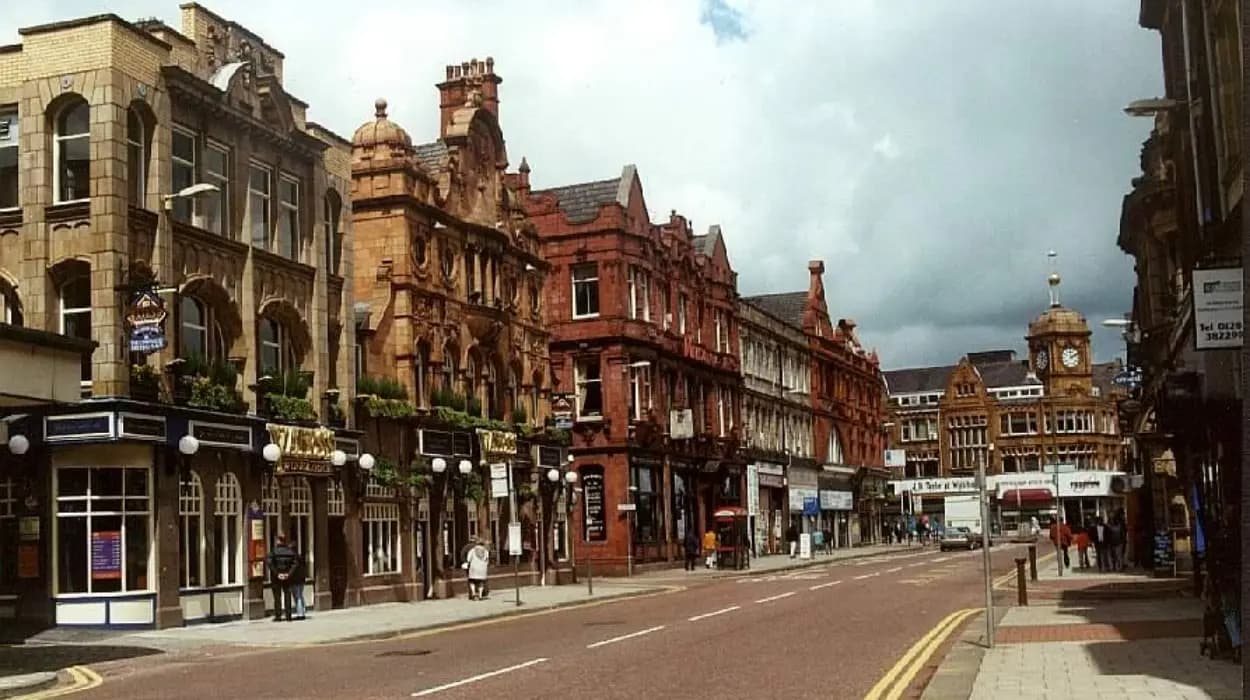
Bolton town centre preserves the physical record of a Lancashire market town transformed by industrialisation, municipal government, commerce, religion, and transport. Its historic streets connect medieval foundations with Victorian architecture, twentieth-century redevelopment, and modern regeneration.
The town centre is not a single architectural period. Its street pattern contains evidence from different phases of urban growth. Churchgate and Bradshawgate retain connections with the older settlement. Deansgate developed into a major commercial street. Mawdsley Street reflects nineteenth-century civic and professional expansion. Market Street and the streets around the former market buildings reveal the changing relationship between trade, shopping, and public space.
Bolton Council identifies the whole town centre as a conservation area. The designation recognises the area's architectural and historic interest and provides a planning framework for managing change. Bolton currently has 26 conservation areas, ranging from the town centre to rural settlements across the borough.
For visitors interested in local history, these streets provide an accessible way to understand how Bolton evolved. For educators and researchers, they form an outdoor historical record. For genealogists, street names and surviving buildings provide geographical clues that help connect historic occupations, businesses, institutions, and family addresses.
What makes Bolton town centre historically important?
Bolton town centre is historically important because its streets preserve evidence of medieval settlement, market activity, religious life, industrial wealth, municipal government, Victorian commerce, and twentieth-century urban change within a compact historic urban landscape.
Bolton's historic importance comes from the relationship between its streets rather than from one isolated building. The town centre developed as a connected urban system. Religious institutions, markets, workshops, shops, offices, courts, civic buildings, and transport routes all influenced its physical form.
The settlement expanded significantly during the Industrial Revolution. Bolton became internationally associated with cotton spinning and textile manufacturing, supported by coal, engineering, canals, railways, and a rapidly growing workforce. Although many mills stood outside the immediate commercial core, industrial wealth influenced the construction of central civic and commercial buildings.
The nineteenth century produced much of the architecture visitors see today. Commercial premises gained larger windows, decorative façades, pilasters, cornices, and upper-floor offices. Civic buildings adopted monumental architectural styles that communicated the growing importance of local government.
The town centre also reflects political change. Before municipal incorporation in 1838, Great Bolton and Little Bolton operated through older systems of local administration. Bolton Council's historical account describes the pre-1838 town as a complex patchwork of independent districts, with Great Bolton and Little Bolton forming the two principal central townships.
The creation of the municipal borough changed the administrative geography of Bolton. Later civic expansion required purpose-built facilities for government, justice, education, policing, and public services.
This history remains visible in the streets. A visitor walking from Churchgate towards Bradshawgate, Deansgate, Mawdsley Street, and the market area crosses different phases of Bolton's urban development.
How did Bolton's historic street network develop?
Bolton's historic street network developed from an older settlement centred on religious and market activity before expanding through industrialisation, commercial growth, municipal government, transport improvements, and twentieth-century redevelopment that reshaped but did not erase earlier routes.
The oldest urban geography is associated with the parish church and the market. Churchgate formed one of the principal historic streets, while Bradshawgate became another important route through the developing town.
The medieval settlement was smaller than the modern town centre. Streets were shaped by movement between homes, workshops, religious buildings, markets, and surrounding rural routes.
Churchgate's importance is closely connected with St Peter's Church, now Bolton Parish Church. Bolton Council's conservation appraisal records that a church has stood on the site for more than 1,000 years. The same appraisal describes Churchgate as historically one of Bolton's two principal streets, with some of the earliest buildings in the town located along the street and the eastern side of Bradshawgate.
Urban expansion accelerated during the eighteenth and nineteenth centuries. Population growth created demand for shops, warehouses, workshops, public buildings, housing, and transport infrastructure.
Industrialisation changed the scale of the town. Cotton manufacturing generated employment and wealth, while associated industries supported engineering, construction, warehousing, and commercial services.
The historic street network therefore became layered. Older routes remained in use while new streets and buildings were inserted around them.
This process explains why Bolton's town centre contains buildings from very different dates. Medieval foundations and church history coexist with Georgian survivals, Victorian commercial architecture, Edwardian civic monuments, post-war redevelopment, and contemporary regeneration.
The street pattern is therefore an historical document. Its alignments, plot widths, building heights, and changes in architectural style reveal how the town expanded.
Why should visitors explore Churchgate and the area around Bolton Parish Church?
Churchgate deserves attention because it connects Bolton's oldest religious landscape with historic commercial buildings, the Market Cross, Bradshawgate, and the town centre's wider medieval and Victorian development. It provides one of the clearest routes for understanding Bolton's long urban history.
Churchgate is one of the most significant historic streets in central Bolton. Its name reflects its historic relationship with the parish church.
Bolton Parish Church occupies an ancient religious site. The present church building contains later architectural phases, but the location itself has more than a millennium of religious continuity.
The churchyard is historically important because burial grounds preserve evidence of earlier communities. Gravestones, memorials, and burial records provide information about names, occupations, family relationships, and social status.
For genealogists, the church and surrounding streets are especially valuable. Parish registers, burial records, and historic maps can help researchers establish where families lived and worked. Street-level research becomes more effective when physical locations are combined with archival sources.
Churchgate also demonstrates how religious and commercial functions existed alongside each other. Businesses operated close to the church, while markets and public movement shaped the surrounding urban environment.
The street's architectural character reflects this layered history. Historic buildings sit alongside later interventions, showing that conservation does not mean freezing a town at one date.
The Market Cross stands near the entrance to Churchgate. Bolton Council states that a market cross has occupied the site since 1482, making it one of the oldest heritage monuments in the town centre. The current cross was commissioned in 1909, while three bronze plaques at its base describe aspects of Bolton's history. The council restored the monument in 2023.
The Market Cross is therefore an important historical marker. It links the physical location of modern visitors with the commercial traditions of the medieval and early modern town.
What can visitors discover along Bradshawgate?
Bradshawgate is historically significant because it formed one of Bolton's principal historic streets and preserves evidence of commercial expansion, nineteenth-century architecture, civic development, and the transition from an older market town to an industrial urban centre.
Bradshawgate runs through the central townscape and remains one of the key streets for understanding Bolton's development.
Its historic importance is connected with its role as one of the principal streets of the older town. The Churchgate Conservation Area appraisal identifies the eastern side of Bradshawgate as containing some of Bolton's earliest buildings.
The street's development accelerated as Bolton's population and economy expanded. Commercial buildings replaced or transformed smaller structures. Ground floors became shops and businesses, while upper floors accommodated offices, workshops, storage, or residences.
This mixed-use pattern was typical of nineteenth-century industrial towns. Buildings were economically efficient because several activities could operate within the same urban block.
Bradshawgate also illustrates the influence of architectural technology. The nineteenth century introduced improved building materials, larger panes of glass, more sophisticated ironwork, and increasingly elaborate decorative façades.
Visitors should examine building proportions rather than focusing only on individual landmarks. Narrow plots, repeated upper-floor windows, shopfronts, and vertical façades reveal how commercial property developed.
The street also demonstrates the effects of later change. Historic buildings were adapted for new businesses, while some structures were replaced. This created an architectural mixture rather than a perfectly uniform historic environment.
For researchers, Bradshawgate is particularly useful when comparing historical maps with modern street layouts. The persistence of the route helps establish continuity even where individual buildings have disappeared.
Why is Deansgate one of Bolton's most important historic streets?
Deansgate became one of Bolton's principal commercial streets and retains a strong nineteenth- and twentieth-century architectural character, with historic shopfronts, narrow plots, decorative façades, and civic-scale buildings reflecting the town's growth as an industrial and commercial centre.
Deansgate represents the commercial expansion of Victorian and Edwardian Bolton.
Bolton Council's conservation appraisal describes Deansgate as the town's long-established principal shopping street. The street is characterised by nineteenth- and twentieth-century commercial buildings, generally no more than three storeys high, creating a relatively consistent scale.
The architecture reflects commercial competition. Businesses used façades to attract customers and communicate prosperity. Pilasters, decorative parapets, tall windows, and corner features created visual distinction while maintaining the rhythm of the street.
The narrowness of historic plots is particularly important. Individual properties often occupy relatively limited frontages, producing a repeated vertical rhythm. This pattern reflects the subdivision of commercial land and the incremental development of urban property.
Deansgate also demonstrates the changing meaning of public space. The central section was pedestrianised, together with streets including Old Hall Street, Market Street, Oxford Street, and Mealhouse Lane. The conservation appraisal notes that this pedestrianised network allows Deansgate to function in a manner similar to a city square.
The modern pedestrian environment therefore does not erase the historic character of Deansgate. Instead, it changes how visitors experience the street.
The contrast between historic façades and contemporary retail activity provides a direct example of adaptive urban continuity. Buildings constructed for earlier commercial economies continue to serve modern businesses.
Visitors interested in architectural history should look upward. Ground-floor shopfronts often receive the most attention, but upper elevations preserve decorative details, window arrangements, parapets, and roofline features that reveal the original architectural ambitions of the buildings.
What is the historical importance of Market Street and the Old Market Hall area?
Market Street and the Old Market Hall area represent Bolton's long commercial tradition, connecting historic shopping routes with nineteenth-century market architecture, pedestrian spaces, and the continuing importance of retail activity to the town centre's identity.
Markets were fundamental to the development of British towns. They concentrated trade, encouraged regular movement, and created demand for services.
Bolton's historic market area developed as a major commercial focus. The Old Market Hall area retains evidence of this history through its architecture and street arrangement.
The conservation appraisal for the Deansgate area identifies the Old Market Hall as an important character zone. It describes the 1850s market hall as having an imposing pedimented entrance on Knowsley Street and a strong presence on Corporation Street. The surrounding historic shopfronts and adjacent commercial buildings reinforce the market area's architectural identity.
The architecture reflects nineteenth-century confidence. Classical and Italianate details were used to give commercial buildings a formal appearance.
The market was more than a shopping facility. It was an urban institution. It brought together producers, traders, customers, transport workers, and businesses.
Modern Bolton Market continues the town's market tradition. The current main market is located on Ashburner Street in the heart of the town centre. Bolton Council describes it as a major food market in the North West.
The movement from historic market halls to modern market facilities demonstrates continuity through adaptation. The precise buildings and trading arrangements changed, but the commercial function of central market activity remained important.
For visitors, the market area provides an opportunity to understand how economic activity shaped street design. Large market buildings required wide entrances, accessible routes, storage facilities, and surrounding commercial premises.
The relationship between Market Street, Corporation Street, Knowsley Street, and surrounding pedestrian areas shows how retail geography evolved over time.
What makes Mawdsley Street important for understanding Victorian Bolton?
Mawdsley Street is important because its surviving nineteenth-century buildings reveal Bolton's expansion as a civic and professional centre, with architecture connected to courts, education, offices, workshops, residences, and municipal institutions.
Mawdsley Street provides a different perspective on Bolton's history. While Deansgate represents commercial retail activity, Mawdsley Street reflects civic and professional development.
Bolton Council describes Mawdsley Street as a conservation area containing several historic buildings of civic significance. The council's 2026 preservation work focused on No. 27 Mawdsley Street, a Grade II listed property requiring structural protection and repairs.
The traditional terraced properties on the street date from approximately 1800 to 1865. Their historical uses included offices, workshops, and residences. The wider civic setting includes the former County Court building, Court Chambers, Technical School, and clubs.
This combination is significant because it demonstrates how nineteenth-century towns organised professional life.
Courts represented legal authority. Technical education supported industrial development. Offices accommodated growing businesses. Workshops supported skilled employment. Residences housed people who worked within the expanding urban economy.
The architecture is therefore inseparable from the social history of the town.
Mawdsley Street also demonstrates the importance of preservation. Historic buildings often survive because they remain adaptable. A building that once functioned as a residence can become an office. A workshop can be converted for another commercial use.
However, adaptation requires careful management. Bolton Council's recent intervention at No. 27 Mawdsley Street shows that heritage preservation involves practical structural work, temporary scaffolding, weather protection, and long-term repair.
For visitors, the street provides a valuable architectural counterpoint to the larger commercial avenues. Its scale allows closer examination of historic façades and the relationship between individual buildings.
How did Bolton's civic buildings change the character of the town centre?
Bolton's civic buildings transformed the town centre by introducing monumental architecture for municipal government, justice, education, and public administration, reflecting the nineteenth-century expansion of local government and the wealth generated by industrialisation.
The nineteenth century changed the relationship between Bolton's residents and municipal authority.
Before 1838, local administration operated through older systems involving separate townships and institutions. Municipal incorporation created a new framework for borough government.
The construction and adaptation of civic buildings followed this change. Public architecture became a physical expression of municipal authority.
Bolton Town Hall is the most prominent example. Bolton Council notes that the building is less than 150 years old despite its appearance of permanence and that it has undergone significant alterations during its history.
The Old Town Hall provides an earlier stage in this civic history. Historic England records that it served as the town hall before borough incorporation and continued to be used for magisterial and police functions until 1874. It was converted for use as a library in 1879.
This sequence demonstrates how buildings can outlive their original functions.
The civic landscape around the town centre also reflects the development of professional administration. Courts, police facilities, educational institutions, libraries, and council offices required dedicated buildings.
These structures changed the scale and appearance of central streets. Their architectural styles often differed from ordinary commercial premises because public buildings were designed to communicate permanence and authority.
The historic streets around Bolton's civic centre therefore provide evidence of political and social change. They show how industrial towns developed increasingly complex systems of government and public services.
For educators, the civic architecture offers a practical way to explain the relationship between industrialisation and local government.
Which historic streets best reveal Bolton's industrial-era transformation?
Deansgate, Bradshawgate, Churchgate, Market Street, Mawdsley Street, and the streets around the historic market area collectively reveal Bolton's transformation from a market settlement into an industrial town with expanding commerce, civic administration, professional services, and modern urban infrastructure.
Industrialisation did not create a completely new town. It transformed an existing settlement.
The older streets remained important because they already connected key destinations. Commercial pressure increased the value of central land, leading to rebuilding, expansion, and architectural replacement.
The textile economy influenced the town centre even when mills stood elsewhere. Industrial businesses required banks, accountants, insurers, lawyers, suppliers, retailers, transport services, and government administration.
This economic network strengthened central streets.
The physical evidence includes commercial terraces, warehouses, offices, engineering-related businesses, public buildings, and improved transport connections.
Bolton's industrial history also extended beyond cotton. Coal mining, paper manufacturing, engineering, and other industries contributed to the wider regional economy.
The town centre became the service hub for these activities.
The result was a layered urban landscape. Medieval routes survived. Victorian commercial buildings appeared beside older structures. Civic institutions expanded. Later twentieth-century redevelopment introduced new forms of architecture.
The historic streets therefore tell the story of economic change through physical geography.
A visitor does not need to enter a museum to observe this process. The relationship between street width, building height, plot size, shopfronts, and public buildings provides evidence of changing economic priorities.
This is one reason Bolton's town-centre conservation area has lasting educational value. Bolton Council states that conservation areas protect the best of the townscape and natural environment, illustrate the evolution of Bolton, and provide an historic framework for future development.
To experience this historic landmark in person today, consult our comprehensive [How Bolton Town Centre Developed Through the Centuries] for itineraries and visiting parameters.
How can visitors read Bolton's historic architecture while walking?
Visitors can read Bolton's historic architecture by examining building materials, plot widths, window patterns, shopfronts, rooflines, decorative details, street alignments, and changes in scale that identify different periods of urban growth and economic development.
Historic streets require careful observation.
The first feature to examine is building height. Many central commercial buildings remain relatively low-rise, particularly around Deansgate. This creates a consistent urban scale despite differences in architectural style.
The second feature is plot width. Narrow frontages often indicate historic property divisions. Wider buildings can represent later redevelopment or the consolidation of several plots.
Windows provide another clue. Large display windows reflect retail functions, while smaller upper-floor windows can indicate offices, workshops, or residences.
Decorative features also reveal architectural ambition. Pilasters, cornices, parapets, turrets, and pediments were common devices in nineteenth-century commercial architecture.
Materials matter as well. Brick, stone, cast iron, and later concrete reflect different construction periods and technologies.
Visitors should also observe how buildings meet the pavement. Historic shopfronts often preserve details associated with earlier commercial activity, while modern alterations can reveal how businesses adapted older structures.
Street corners deserve special attention. Corner buildings often received distinctive architectural treatment because they were visible from multiple directions.
Public buildings can be identified through scale and formal design. Their entrances, symmetry, inscriptions, and monumental façades often distinguish them from ordinary commercial premises.
These observations create a simple method for architectural history. The street becomes a sequence of evidence.
For students, the approach can support fieldwork. For genealogists, it helps interpret historical maps and photographs. For tourists, it provides a deeper understanding of the buildings encountered during an ordinary walk.
How are Bolton's historic streets protected today?
Bolton's historic streets are protected through conservation-area designation, listed-building controls, planning policies, heritage assessments, and practical repair programmes that manage development while retaining significant architectural and historic features for future generations.
Conservation is an active planning process.
Bolton Council currently identifies 26 conservation areas across the borough. The town centre is included within this framework because of its architectural and historic significance.
A conservation area is different from a collection of isolated listed buildings. It protects the character and appearance of an area as a whole.
The National Planning Policy Framework defines a heritage asset as a building, monument, site, place, area, or landscape with heritage significance that warrants consideration in planning decisions. Significance can derive from archaeological, architectural, artistic, or historic interest.
This broader definition matters in historic streets. A building does not need to be individually listed to contribute to the character of a historic area.
Bolton's heritage records demonstrate the scale of the wider historic environment. The council reports 352 listed buildings and a Greater Manchester Historic Environment Record containing more than 18,000 entries across the region. Bolton's recorded heritage dataset includes 196 building or standing structures, 55 find spots, 502 monuments, and 58 places, producing a total of 1,171 entries in the council's summary.
These figures show why heritage protection extends beyond famous landmarks.
Recent preservation work on Mawdsley Street provides a practical example. In 2026, Bolton Council began emergency measures to protect a Grade II listed property, including structural scaffolding and a temporary roof.
Such work demonstrates that preservation requires continued investment.
The future of Bolton's historic streets therefore depends on balancing conservation with adaptation. Buildings must remain useful, safe, and economically viable while retaining the features that establish their significance.
Why do Bolton's historic streets matter for future generations?
Bolton's historic streets matter because they preserve evidence of how communities lived, traded, worshipped, governed, worked, and adapted to industrial change, giving future generations a physical record that complements archives, photographs, maps, archaeological research, and genealogical records.
Historic streets are irreplaceable sources of evidence.
Written records explain events, but buildings and street patterns provide physical context. A historic map identifies a location. A surviving building demonstrates its scale. A street alignment reveals continuity. A shopfront suggests commercial use. A churchyard preserves evidence of past communities.
Together, these sources create a richer historical record.
Bolton's streets also demonstrate that urban history is cumulative. Medieval religious foundations influenced later town development. Market activity shaped commercial geography. Industrialisation expanded the population and economy. Municipal government created new civic buildings. Twentieth-century redevelopment altered the townscape. Contemporary regeneration continues the process.
The result is a living historic environment.
For genealogical researchers, street continuity has particular value. Families often appear in census records, directories, parish registers, electoral records, and property documents under addresses that remain identifiable today.
For educators, the town centre provides a practical case study in industrial urbanisation.
For heritage preservationists, it demonstrates the importance of protecting both individual buildings and wider townscape character.
For visitors, the historic streets provide a direct route through Bolton's development.
The most important lesson is that heritage is not limited to monumental landmarks. The ordinary commercial terrace, civic building, churchyard, market route, and street corner all contribute to the historical identity of the town.
Bolton's historic streets should therefore be understood as a connected heritage landscape. Churchgate establishes the ancient religious context. Bradshawgate demonstrates the older commercial route. Deansgate records the expansion of nineteenth-century retail architecture. Market Street and the market area preserve the town's trading tradition. Mawdsley Street reveals civic and professional growth.
Together, these streets create a compact historical framework for understanding Bolton.
Their future significance depends on continued conservation, informed planning, sensitive adaptation, and public engagement. The preservation of historic buildings is not simply about retaining old structures. It is about maintaining the evidence needed to understand how Bolton became the town it is today.
For anyone exploring Bolton town centre, the historic streets are therefore essential destinations in their own right. They provide a continuous record of settlement, commerce, religion, industry, government, and community life, connecting the medieval past with the modern town and preserving a foundation for future historical research.
FAQS
What are the most historic streets in Bolton town centre?
The most notable historic streets include Churchgate, Bradshawgate, Deansgate, Mawdsley Street, and Market Street. Together, they reveal Bolton's development from an older market settlement into a major industrial and commercial town.