Bolton town centre developed from a medieval market settlement beside the River Croal into a major Lancashire cotton town and later a modern commercial centre. Its streets, market areas, civic buildings, churches, transport links and surviving historic structures record this transformation across centuries.
The history of Bolton town centre is closely connected to geography, trade, religion, industrialisation, municipal government and transport. The River Croal influenced the location of early settlement. The medieval market created a commercial focus. The textile industry transformed the town during the 18th and 19th centuries. Railway development connected Bolton to wider regional and national markets. Victorian civic buildings expressed the wealth and confidence of an expanding industrial borough.
Today, the town centre contains evidence from different stages of this development. Churchgate preserves the historic relationship between the parish church and the medieval market. Victoria Square represents the civic and commercial expansion of the 19th century. Bradshawgate and Deansgate retain important historic street patterns and buildings. Bolton Market continues the town's long tradition of commercial exchange.
Understanding how Bolton developed through the centuries explains why its modern urban landscape contains medieval, Georgian, Victorian, industrial and 20th-century layers within a relatively compact area.
How did Bolton town centre begin?
Bolton town centre began as a medieval settlement centred on a market and parish church beside the River Croal, with Churchgate forming the historic core. A market charter granted in 1251 established Bolton as an important commercial settlement serving surrounding agricultural communities.
The earliest development of central Bolton was shaped by its physical setting. The River Croal formed a natural geographical feature through the settlement. The parish church stood close to the centre of medieval activity, while roads connected Bolton with surrounding settlements and agricultural areas.
Churchgate takes its name from its connection with the parish church. Bolton Council's conservation-area research identifies Churchgate as the heart of the medieval town. Weekly markets operated in the area from the medieval period until the early 19th century.
The granting of a market charter in 1251 was a major milestone. A market charter was a formal royal or lordly permission to hold a regular market. It gave commercial activity a recognised legal framework and strengthened Bolton's role as a trading centre.
The medieval settlement depended heavily on its surrounding hinterland. Farmers brought agricultural products into the market. Traders exchanged goods required by local households and businesses. The market also created demand for inns, workshops, storage facilities and other services.
This early commercial function established the basic urban structure that later development expanded. Streets leading towards the market and parish church became important routes. The central area remained commercially significant even after Bolton's economy changed from agriculture and local trade to textile manufacturing.
The medieval foundations therefore remain essential to understanding Bolton town centre. Modern streets do not represent a completely new urban landscape. They contain the accumulated structure of a settlement that developed over many centuries.
How did medieval Bolton develop around its market?
Medieval Bolton developed around regular commercial activity, religious institutions and transport routes. Churchgate became a central street, while the market connected local farmers, craftsmen and traders. Bolton's medieval economy remained primarily regional, but textile production was already becoming an important part of its economic identity.
The medieval market gave the town a permanent commercial focus. Markets were important economic institutions because they brought together producers and consumers at regular intervals. Bolton's market served communities beyond the immediate settlement.
Churchgate became particularly significant because it connected the commercial centre with the parish church. Its position reflects the close relationship between religion and urban life during the medieval period.
The surrounding street network developed gradually rather than according to a single planned design. Historic routes such as Bradshawgate and Deansgate became increasingly important as Bolton expanded. Their later commercial prominence reflects the continued importance of routes established or strengthened during earlier periods.
Textile manufacturing also contributed to Bolton's medieval economy. The town became associated with wool production before the later dominance of cotton. Bolton Council's town-centre heritage material identifies wool manufacturing as an important part of the medieval economy.
The medieval period established several features that continued into later centuries. These included a central market, commercial streets, religious buildings and connections with surrounding settlements.
The physical appearance of medieval Bolton changed substantially over time. Timber-framed buildings were replaced or re-fronted. Streets were widened and improved. New materials such as brick and stone became more common. However, the underlying street pattern continued to influence the town centre.
This continuity explains why Churchgate remains historically important. The street represents the relationship between Bolton's medieval religious centre and its commercial development.
Why did Bolton become an important textile town?
Bolton became an important textile town because existing wool and textile skills combined with mechanisation, steam power, factory production and expanding markets. During the 18th and 19th centuries, cotton manufacturing transformed employment, population, architecture and the physical scale of Bolton town centre.
The Industrial Revolution fundamentally changed Bolton. Industrialisation refers to the transition from hand production and agricultural economies towards mechanised manufacturing and factory-based production.
Cotton became the defining industry. New machinery increased production capacity. Steam power reduced dependence on traditional water-powered systems. Factory owners invested in mills, machinery and transport infrastructure.
The town's economy expanded beyond the medieval market function. Bolton became part of the wider Lancashire cotton industry. Raw cotton entered the region through national and international trading networks. Finished textiles were distributed across Britain and overseas.
Industrial growth increased employment opportunities. Workers moved into Bolton from surrounding districts and other parts of Britain. Population growth created demand for housing, shops, schools, churches, public services and transport.
The town centre also changed. Commercial streets became busier. Banks, offices, warehouses, shops and public buildings appeared alongside older structures. Industrial wealth created demand for impressive civic architecture.
The relationship between the town centre and surrounding mill districts became increasingly important. Many factories were located outside the immediate central area, but the town centre remained the location for administration, retail, finance and public life.
Industrialisation also produced severe urban pressures. Rapid population growth created overcrowding and sanitation problems. Smoke pollution affected the urban environment. Public authorities gradually introduced improvements in roads, drainage, public health and municipal services.
The result was a new urban landscape. Medieval Bolton had been a market town. Industrial Bolton became a major manufacturing centre with a much larger population and a more complex urban economy.
How did the market shape Bolton town centre?
The market shaped Bolton town centre by creating a long-term commercial focus that moved from the medieval Churchgate area towards the modern Victoria Square area in the early 19th century. This relocation strengthened central retail, civic development and commercial investment around the new market site.
The market remained central to Bolton's identity as the town expanded. Its location changed as the medieval street network became unsuitable for the scale of commercial activity generated by industrial growth.
During the early 19th century, the market was relocated to a new town-centre position now associated with Victoria Square. Bolton Council's town-centre heritage material identifies this relocation as a major stage in the development of the modern central area.
The new market location became an anchor for commercial activity. An urban anchor is a major destination that attracts visitors and supports surrounding businesses.
The development of Victoria Square changed the geography of central Bolton. Commercial activity increasingly concentrated around the market and the civic buildings that followed.
The market's evolution reflected wider changes in consumer culture. Industrial workers and a growing urban population required regular access to food, clothing and household goods. Traders responded to this demand.
The modern Bolton Market continues this historical tradition. The current market is located on Ashburner Street in the heart of the town centre and operates as a major food and retail destination.
The market therefore represents more than a retail facility. It is a direct continuation of Bolton's centuries-old commercial function.
Its history also demonstrates how urban centres adapt. The market moved location, buildings changed, and trading patterns evolved. The underlying role remained consistent: connecting people, products and commerce within the central town.
When did Bolton become a borough?
Bolton became a single incorporated municipal borough on 11 October 1838, replacing fragmented local administration in Great Bolton and Little Bolton. Municipal incorporation created a stronger civic authority capable of managing the rapidly expanding industrial town and its growing public services.
Before 1838, central Bolton was divided between different administrative arrangements. Great Bolton and Little Bolton operated as separate townships. Local governance involved courts leet, magistrates, borough officials and trustees.
The growth of industrial Bolton exposed weaknesses in this system. A rapidly expanding population required more coordinated services. Roads, sanitation, policing and public health required stronger administration.
Bolton's incorporation in 1838 created a unified borough government. This change was important because municipal institutions became increasingly responsible for managing an industrial urban population.
Bolton Council's history of the Town Hall explains that incorporation took place on 11 October 1838. The new council initially had to operate from several unsuitable premises around the town centre.
The creation of a unified borough also influenced the physical development of the centre. Municipal government required administrative buildings. Public investment created demand for better streets, civic spaces and public facilities.
This period marked a transition from an older form of local administration to modern municipal government. Bolton's civic identity became increasingly visible in its architecture.
The town centre consequently became not only a place of trade but also the administrative heart of the borough.
How did Victorian Bolton transform the town centre?
Victorian Bolton transformed the town centre through municipal investment, commercial expansion and monumental architecture. The period produced Bolton Town Hall, improved market facilities, new civic spaces and major public buildings that expressed the wealth and confidence of an industrial Lancashire borough.
The Victorian period was one of the most important phases in Bolton's urban development.
Industrial prosperity generated municipal ambition. The borough required a substantial civic centre that reflected its economic importance.
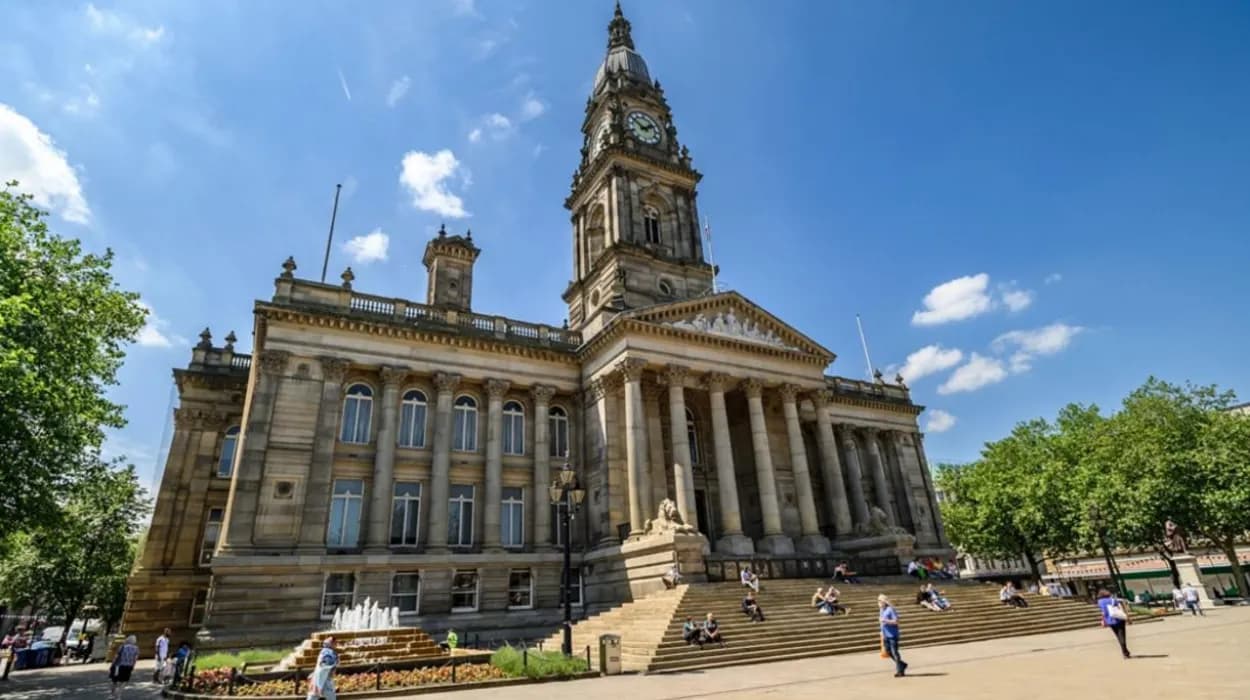
Bolton Town Hall became the defining architectural symbol of this period. The building was constructed between 1866 and 1873 to designs by William Hill of Leeds, assisted by George Woodhouse. It was later extended in 1938. Historic England lists the building at Grade II* for its special architectural and historic interest.
Grade II* listing identifies a building of particular importance with more than special interest. The designation gives the building statutory protection under the heritage system.
Victoria Square developed as the civic heart of the expanding town. The Town Hall's position established a strong relationship between government, commerce and public space.
Victorian architecture also appeared throughout the wider centre. Banks, commercial buildings, churches and public institutions reflected the prosperity created by textile manufacturing.
The market was another major focus of redevelopment. The first Market Hall was built in 1855 and redesigned in 1894, according to Bolton's town-centre heritage timeline.
These projects changed the visual character of central Bolton. Earlier buildings remained, but Victorian structures increasingly dominated major streets and squares.
The Victorian town centre therefore represented a new phase in Bolton's history. The medieval market town had become a self-governing industrial borough with substantial civic ambitions.
How did transport change Bolton town centre?
Transport transformed Bolton from a regional market town into a nationally connected industrial centre. The Bolton and Leigh Railway opened in 1828, while later railway expansion, roads and improved connections strengthened movement of raw materials, workers, manufactured goods and visitors.
Transport was essential to industrial growth. Cotton manufacturing required the movement of raw materials and finished products. Workers also needed reliable access to employment.
The Bolton and Leigh Railway opened in 1828. Bolton Council describes it as the second public railway in the world, reflecting the borough's early position within railway history.
Railway development connected Bolton with wider industrial networks. Goods could move more efficiently between manufacturing districts, ports and markets.
The railway also influenced the movement of people. Workers travelled between residential districts and employment centres. Visitors and commercial travellers gained easier access to Bolton.
Road improvements produced similar changes. Streets that had originally served a medieval market town became routes within a growing industrial urban network.
Transport altered the relationship between the town centre and its surrounding districts. Bolton no longer functioned as an isolated market serving nearby farms. It became part of a regional industrial system.
The railway's wider legacy remains important. Bolton's borough has 11 railway stations, while Bolton railway station recorded 3.2 million passengers in 2019/20, according to Bolton Council's railway heritage material.
The history of transport therefore forms an essential part of the town-centre story. Roads and railways supported the industrial economy and helped establish Bolton as a significant urban centre.
Why are Churchgate and Bradshawgate important to Bolton's history?
Churchgate and Bradshawgate are important because they preserve historic routes through Bolton's commercial core. Churchgate reflects the medieval relationship between market and parish church, while Bradshawgate demonstrates the continued importance of a major commercial street through industrial and modern urban development.
Churchgate is one of the most historically significant streets in central Bolton. Its name comes from its connection with the parish church.
The Churchgate Conservation Area appraisal identifies the street as the heart of medieval Bolton. It also records its role in weekly markets from the medieval period until the early 19th century.
The street contains buildings from different periods. Some structures incorporate earlier timber-framed buildings that were later re-fronted. Victorian commercial architecture appears alongside 20th-century development.
This mixture demonstrates the continuous redevelopment of central Bolton.
Bradshawgate developed as another important commercial route. Its historic character survived significant changes to the town centre during the 20th century.
The survival of these streets is important for heritage research. Historic street patterns provide evidence of how settlements developed before modern planning systems.
For genealogists, streets such as Churchgate and Bradshawgate also provide geographical reference points. Property records, directories, census returns and electoral records often identify addresses through historic street names.
The streets therefore have architectural, commercial and social importance. They connect modern Bolton with the physical layout of earlier centuries.
How did Bolton's civic architecture expand in the 19th century?
Bolton's civic architecture expanded because industrial growth created demand for municipal administration, public services and representative buildings. Town Hall, market buildings, libraries, museums and public parks formed a civic landscape that expressed the borough's economic strength and expanding responsibilities.
The 19th-century town centre became a concentration of civic institutions.
The Town Hall provided administrative space for the incorporated borough. Its monumental architecture reflected the importance of municipal government.
Other institutions developed around the centre. Libraries and museums supported public education and cultural life. The Grade II listed building at 1 Newport Street, dating from the 1820s, was used by Bolton Corporation as an exchange library and museum.
Public parks also formed part of the Victorian civic programme. Queen's Park opened in 1866 on land acquired under the Bolton Improvement Act of 1864. Historic England records that the park was created from meadow and pasture land and designed by William Henderson.
The park was located around 0.7 kilometres north-west of the town centre. Its creation provided public open space for an increasingly industrial population.
These projects reflected changing ideas about urban government. Municipal authorities increasingly accepted responsibility for public health, recreation, education and environmental improvement.
The town centre became the symbolic focus of this civic expansion.
The architectural legacy remains visible today. Listed buildings preserve important examples of historic design, construction and civic ambition. Bolton Council explains that listed status covers the whole building, including important interiors and fixed features, not simply the external façade.
How did Bolton town centre change during the 20th century?
During the 20th century, Bolton town centre shifted from an industrial commercial centre towards modern retail, transport and service functions. New roads, department stores, shopping developments and civic projects changed the historic urban fabric while older streets and listed buildings remained.
The 20th century introduced major changes to shopping and urban planning.
Industrial employment declined gradually across Britain after the peak of the textile era. Bolton's town centre increasingly relied on retail, offices, services and leisure.
The introduction of modern shopping formats changed consumer behaviour. Department stores and purpose-built retail centres competed with traditional independent shops and markets.
The physical town centre also changed. Roads were redesigned to accommodate rising levels of motor traffic. Traffic management schemes affected historic streets.
The ring road was completed by the 1990s, according to Bolton Council's town-centre heritage timeline. Bradshawgate remained relatively untouched by the ring-road development, helping preserve part of its historic character.
Post-war development also introduced new buildings and altered older structures. Some historic properties were demolished. Others were adapted for new uses.
This period created a more complex town centre. Medieval streets existed alongside Victorian civic architecture and modern retail developments.
The result was an urban landscape shaped by competing priorities. Economic modernisation required new commercial space and improved transport. Heritage protection sought to retain buildings and streets with historic significance.
Bolton's 20th-century history therefore demonstrates that urban development is continuous. The town centre did not stop evolving after the Industrial Revolution. It entered a new phase shaped by retail, automobiles, planning and changing economic conditions.
What historic buildings still survive in Bolton town centre?
Historic buildings surviving in Bolton town centre include Bolton Town Hall, the parish church and buildings along Churchgate, Bradshawgate and surrounding civic streets. These structures preserve evidence of medieval religious life, Victorian municipal government, industrial commerce and later urban adaptation.
The surviving historic buildings provide physical evidence of Bolton's development.
Bolton Town Hall remains the most prominent civic landmark. Its construction between 1866 and 1873 represents the height of Victorian municipal ambition. Historic England's Grade II* designation recognises its architectural and historical significance.
Churchgate retains its historic relationship with Bolton Parish Church. The street's buildings demonstrate the gradual layering of architecture over earlier urban foundations.
The former Old Town Hall also illustrates institutional change. Historic England records that it served as the town hall before borough incorporation and continued to accommodate magisterial and police functions until 1874. It was later converted into a library in 1879.
This building demonstrates how historic structures can change function without losing their connection to the town's history.
Listed buildings across Bolton also illustrate the importance of conservation. Historic England maintains statutory records of buildings considered to have special architectural or historic interest.
The surviving heritage assets should therefore be understood as part of an interconnected urban landscape. A single building provides evidence of one period. A street containing buildings from different periods provides evidence of continuous urban change.
The preservation of these structures is essential for understanding Bolton's historical geography.
How has Bolton town centre been preserved while continuing to develop?
Bolton town centre has been preserved through listed-building protection, conservation areas, heritage assessments and adaptive reuse, while regeneration introduces new commercial, residential and public functions. This approach retains significant historic assets while allowing the central area to respond to changing economic needs.
Heritage preservation does not require every building to remain unchanged. It focuses on protecting structures and places with recognised historic or architectural value while managing appropriate change.
Bolton's conservation areas provide an important framework for protecting historic character. The Churchgate Conservation Area, for example, recognises the importance of the medieval street pattern, parish church setting and varied historic architecture.
Listed-building protection provides another layer of control. Historic England's statutory listing system identifies buildings of special architectural or historic interest. Bolton Council also provides guidance on listed buildings and the need for consent for works affecting their character.
Adaptive reuse is another important preservation process. It involves giving an existing historic building a new function while retaining significant architectural features.
The former exchange library and museum at 1 Newport Street demonstrates the potential for this approach. Bolton Council identified the Grade II listed building as an important historic asset requiring repair and consideration for renewed public use.
This process links the past with the present. Historic buildings remain useful when they accommodate contemporary functions.
To experience this historic landscape in person today, consult our comprehensive [Explore Historic Streets in Bolton Town Centre Every Visitor Should Never Miss] for itineraries and visiting parameters.
The future of Bolton town centre therefore depends on managing both continuity and change. Historic buildings provide identity and evidence. New development provides economic and social functions.
How did Bolton town centre evolve from an industrial town into a modern urban centre?
Bolton evolved from a medieval market town into a cotton-manufacturing powerhouse and later a diversified urban centre serving retail, services, culture, education and leisure. Each economic transition reshaped streets, buildings, transport systems and public spaces without completely erasing earlier layers.
The first major phase was medieval commercial development. The market and parish church created the core of the settlement.
The second phase was industrialisation. Cotton manufacturing expanded rapidly during the 18th and 19th centuries. Industrial employment increased population and created demand for larger commercial and civic infrastructure.
The third phase was municipal expansion. Borough incorporation in 1838 strengthened local government. Victorian investment produced major civic buildings and public spaces.
The fourth phase was transport-led expansion. Railways and improved roads connected Bolton to wider markets and industrial networks.
The fifth phase was modernisation. During the 20th century, retail development, road planning and changing economic conditions altered the town centre.
The current phase focuses on regeneration and adaptation. Bolton Council's town-centre planning has identified large-scale investment and redevelopment as part of efforts to create a modern centre while retaining heritage. A 2019 council masterplan hub described a £1.2 billion regeneration programme for the wider town centre.
The long-term pattern is clear. Bolton town centre has repeatedly changed its economic role while retaining important elements of its historic structure.
This historical continuity is particularly important for future development. Medieval streets, Victorian civic buildings, market traditions and industrial heritage provide a framework for understanding the modern town.
Bolton's future historical significance will depend on how effectively new development respects this accumulated urban character.
Why is the history of Bolton town centre important today?
The history of Bolton town centre is important because its streets and buildings record more than 800 years of commercial, industrial, civic and social change. Understanding this history explains the town's present urban form and strengthens heritage preservation, education and responsible regeneration.
Bolton's town centre is a historical record built into the landscape.
The medieval market explains the importance of Churchgate. Industrialisation explains the expansion of commercial streets and the growth of surrounding districts. Municipal incorporation explains the development of civic government. Victorian prosperity explains the monumental architecture around Victoria Square.
Transport history explains Bolton's connection with national industrial networks. Modern regeneration reflects the continuing need to adapt the centre to changing economic conditions.
For historians, the town centre provides evidence of long-term urban development. For cultural tourists, its buildings and streets provide a direct connection with Lancashire's industrial heritage. For educators, the centre offers a compact case study of medieval markets, industrialisation, municipal reform, Victorian architecture and modern urban regeneration.
For genealogical researchers, historic streets and civic institutions provide valuable geographical references. Census records, trade directories, electoral registers and property documents can connect individuals with specific parts of the town centre across generations.
The preservation of historic buildings also has long-term research value. Architectural details, street layouts and surviving structures provide evidence that written records alone cannot supply.
Bolton town centre therefore represents a layered historical environment. Its development began with a medieval market settlement. It expanded through textile manufacturing and industrialisation. It acquired civic prominence during the Victorian period. It adapted to modern retail, transport and service economies.
The central lesson is that Bolton was never shaped by one period alone. Its identity emerged through continuous change.
The River Croal, Churchgate, the medieval market, the Victorian Town Hall, Victoria Square, historic commercial streets and modern regeneration projects all belong to the same long urban history.
That continuity makes Bolton town centre an important example of how a northern English town developed through the centuries while retaining visible evidence of its past. The surviving heritage fabric provides a foundation for future development and ensures that the story of Bolton remains physically present within the modern town.
FAQS
How old is Bolton town centre?
Bolton town centre has medieval origins and developed around a market and parish church. A market charter was granted in 1251, making the town an established centre of trade during the medieval period.