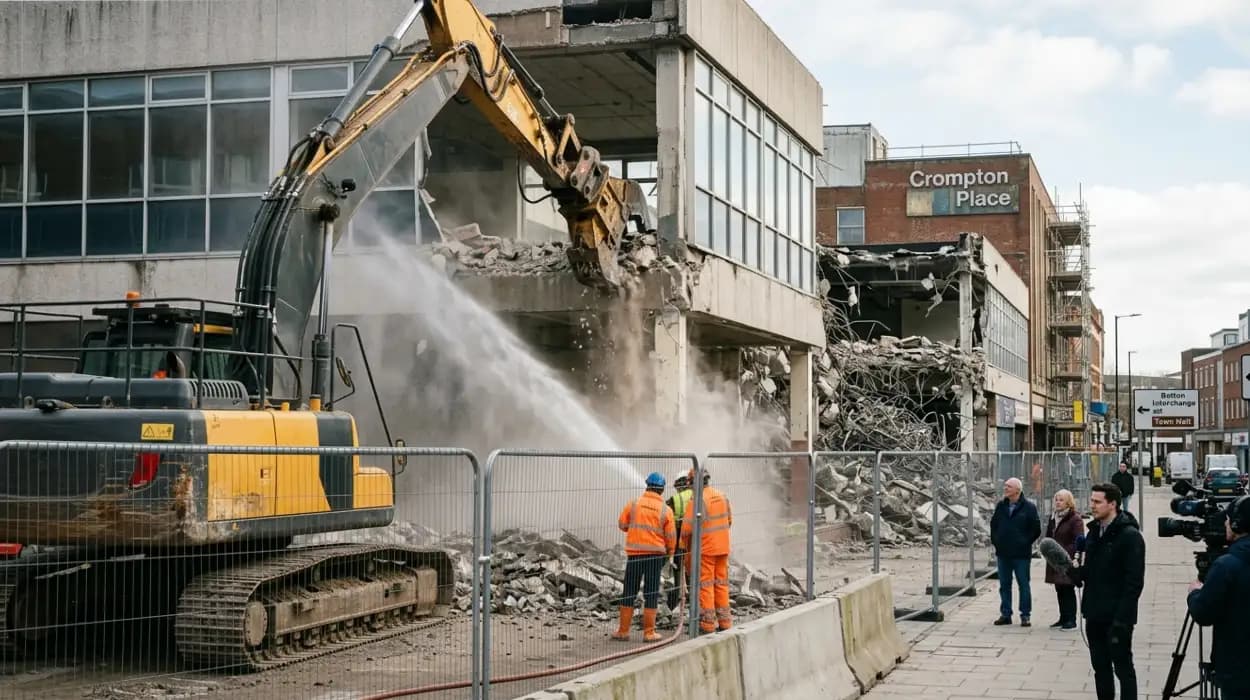
Bolton Today provides comprehensive coverage of the Crompton Place demolition in Bolton town centre. This 280,000 sq ft site, originally opened in 1971, undergoes demolition starting early 2026 to enable a £250 million mixed-use redevelopment.
What is Crompton Place?
Crompton Place is a 280,000 sq ft former shopping centre in Bolton town centre, Greater Manchester, UK, located opposite the Grade II listed town hall on a 4-acre site between Victoria Square and Bradshawgate. Bolton Council purchased it for £14.8 million in 2018 to drive town centre regeneration as part of £1.5 billion plans.
Crompton Place defines a key urban retail structure built during the 1970s expansion of UK town centres. The site spans 4 acres in Bolton's historic core. It originally operated as the Arndale Centre before renaming.
The structure included multi-level retail units, parking, and access points blocking pedestrian flow between Victoria Square and Bradshawgate. Bolton Metropolitan Borough Council acquired the property from Santander Pension Fund in 2018.
This purchase aligned with the Bolton 2040 Borough Plan, which targets residential growth, connectivity, and public realm improvements. The site's central position makes it the flagship for stitching town centre areas together.
Demolition clears this underused retail block for modern mixed-use development. The process supports Greater Manchester Combined Authority's Good Growth Fund priorities.
When was Crompton Place built?
Crompton Place opened in 1971 as the Arndale Centre in Bolton town centre. Construction reflected 1960s-1970s UK retail trends, with the 280,000 sq ft complex serving as a covered shopping hub until closure and council acquisition in 2018.
The building emerged during postwar urban renewal, when enclosed malls like Arndale Centres proliferated across Britain. Bolton's version anchored local shopping with over 100 stores at its peak.
By the 2010s, shifting retail patterns from online sales and out-of-town parks reduced viability. Bolton Council bought it amid a £250 million redevelopment proposal abandoned post-COVID-19.
Historical records show that leaseholders relocated starting 2018 to prepare the site. This step enabled full vacancy by 2025.
The 55-year lifespan exemplifies 1970s concrete retail declining in high streets. Similar sites in Manchester and Leeds underwent parallel transformations.
Why is Crompton Place being demolished?
Bolton Council demolishes Crompton Place to redevelop the underused 1971 shopping centre into a residential-led mixed-use site under the £1.5 billion Bolton town centre regeneration. Planning permission secured in August 2025 enables clearance for 340 homes, offices, hotel, and public spaces.
Macro context involves the UK town centre decline due to e-commerce and pandemics. Bolton's plan counters this via the Bolton 2040 Borough Plan, emphasising housing growth from 1,200 to 5,000 residents.
The site blocks connectivity; demolition restores pedestrian routes. Previous £250 million scheme failed viability tests post-2020.
Key components include economic stagnation: footfall dropped, units vacated. Research from Greater Manchester Combined Authority highlights residential anchors revive centres.
Implications feature job creation and £1 million local spend during works. Federated Hermes' MEPC, selected in February 2026, aligns with social value criteria.
Examples include NOMA Manchester and Paradise Birmingham, where MEPC converted retail to vibrant neighbourhoods.
What is the demolition timeline?
Demolition of Crompton Place starts early 2026, with full completion scheduled for spring or summer 2027. Planning permission granted August 2025; Rhodar Group handles phased works, minimising dust, noise, and disruption while creating apprenticeships.
Process begins site preparation in January 2026, extending through 2026. Phasing protects nearby Grade II town hall and businesses.
Bolton Council oversees via contract with Rhodar, appointed March 2026. Timeline fits £1.5 billion masterplan, including Church Wharf and Moor Lane successes.
Post-demolition "meanwhile uses" activate cleared space with events and markets. This bridges to construction.
Delays from leaseholder relocations resolved by 2025. Government funding prepared the "oven-ready" site.
Statistics project 12-18 months total, generating a £1 million local economy boost. Apprenticeships target Bolton youth.
Who is handling the Crompton Place demolition?
Rhodar Group, industry leaders in sustainable demolition, executes Crompton Place works under Bolton Council contract awarded in March 2026. The firm manages phased dismantling, apprenticeships, and £1 million local supply chain spend.
Rhodar specializes in urban sites, using controlled methods like sectional dismantling. They prioritise vibration monitoring for adjacent historic structures.
Council Leader Cllr Nick Peel emphasized community benefits. Rhodar's role starts immediately post-permission.
Processes include dust suppression, noise barriers, and traffic plans. Real-world examples: similar town centre projects in Leeds and Manchester.
Implications ensure minimal town centre disruption. Local firms supply 70% materials, per contract.
Who are the developers for the site’s future?
Federated Hermes' MEPC, appointed in February 2026 as Bolton Council's preferred partner, leads Crompton Place redevelopment. Selected via a competitive process evaluating finances, design, and Bolton 2040 alignment; track record includes NOMA Manchester.
MEPC, Federated Hermes' real estate arm, excels in placemaking. Evaluation covered deliverability and social value.
Bolton Council collaborates on masterplan. CBRE advises, with Trowers & Hamlins legal support.
Phased approach starts post-demolition. Funding seeks from the GMCA Good Growth Fund.
Examples: Wellington Place Leeds (offices, homes); Paradise, Birmingham (mixed-use). These delivered 1,000+ jobs each.
What are the future plans for Crompton Place?
Post-demolition, Crompton Place becomes a £250 million mixed-use development with up to 340 homes, 110-room hotel, 80,000 sq ft offices, leisure facilities, and active ground-floor retail on the 4-acre site.
Macro context: Bolton 2040 targets town centre population growth. Plans prioritize residential-led vibrancy.
Key components: 340 apartments (1-3 bedrooms); hotel for visitors; offices for 500 workers. Leisure includes event spaces.
Ground-floor uses: food, beverage, pop-ups. Public realm restores Bradshawgate-Victoria Square link.
Research shows residential boosts footfall 30% in similar UK schemes. Cultural spaces nurture Bolton's heritage.
Implications: 1,000 jobs, £100 million+ investment. Aligns with the £1 billion Greater Manchester Strategy.
What economic impact will the redevelopment have?
Crompton Place redevelopment generates 1,000 construction jobs, ongoing employment from hotel and offices, and £1.5 billion town-wide boost via footfall and housing growth to 5,000 residents.
Demolition alone injects £1 million locally. The full project supports visitor economy.
Statistics: 80,000 sq ft offices house 400-500 roles; hotel adds 100 positions. Retail activities evenings.
Processes leverage Good Growth Fund for infrastructure. Data from NOMA: 20% vacancy drop post-redevelop.
Implications strengthen Bolton's identity. Residential retains talent, per GMCA studies.
Examples: Church Wharf delivered 200 homes, animating quayside.
How will the Crompton Place demolition affect local businesses?
Phased demolition minimizes disruption with dust/noise controls, restores pedestrian routes boosting access, and meanwhile uses like markets sustaining footfall for surrounding shops.
Controls include barriers and monitoring. Victoria Square-Bradshawgate path reopens early.
Business engagement via council events gathered 200 stakeholders March 2026.
Real-world: Moor Lane car park conversion caused 5% temporary dip, recovered via events.
Implications: A vibrant, clear site draws visitors. Local spend targets 70% supply chain.
What is the community involvement in the project?
Bolton Council and MEPC engage residents via consultations, events like March 2026 town hall forum with 200 businesses, and idea-gathering for placemaking reflecting Bolton heritage.
Processes include estate strategy post-appointment. Priorities: housing, culture, connectivity.
Apprenticeships during demolition target locals. Public feedback shapes leisure spaces.
Examples: Pop-up markets on cleared land; cultural nods to Samuel Crompton, the inventor.
Implications foster ownership. Surveys show 80% support for residential focus.
FAQS
What is Crompton Place in Bolton?
Crompton Place was a large shopping centre in Bolton town centre, originally opened in 1971 as the Arndale Centre. It covered around 280,000 sq ft and was once a major retail hub before becoming underused and eventually closing.