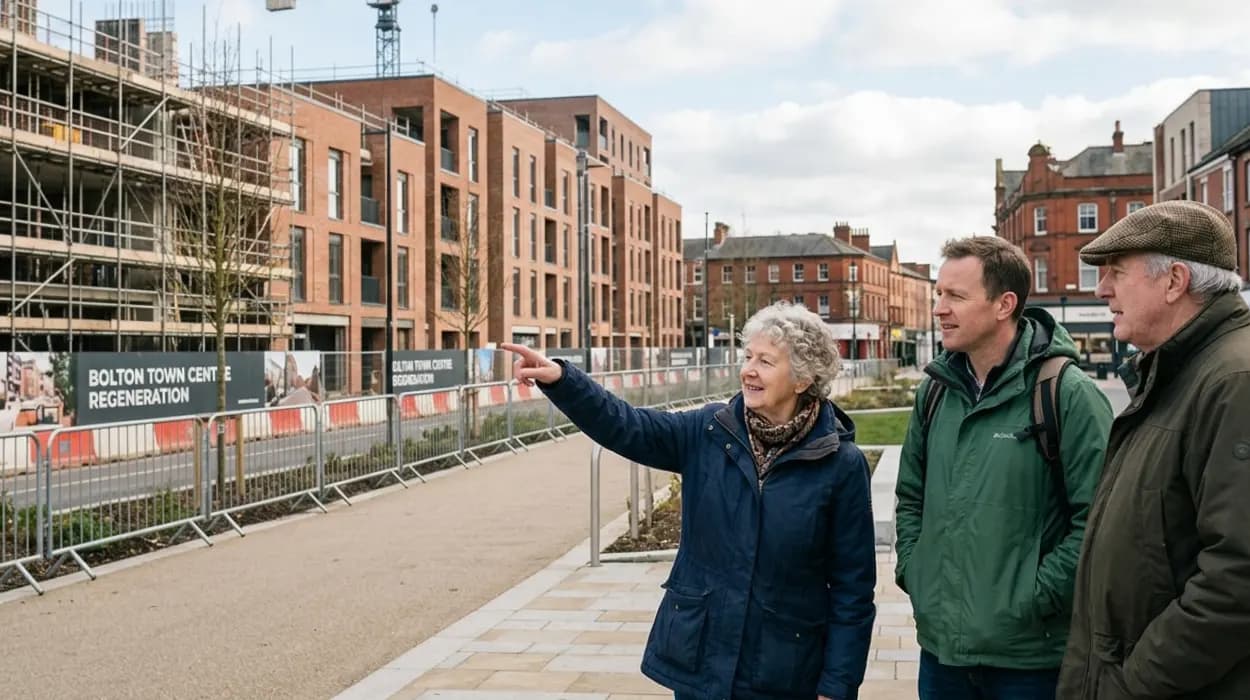
Bolton’s new Mayoral Development Corporation (MDC) targets town centre regeneration. This statutory body, established by Greater Manchester Mayor Andy Burnham, accelerates development through compulsory land purchase powers and streamlined planning. Local residents gain from 2,000 new homes, jobs, and improved public spaces.
What Is Bolton’s Mayoral Development Corporation?
Bolton’s Mayoral Development Corporation (MDC) is a statutory body created by Greater Manchester Mayor Andy Burnham to regenerate Bolton town centre. It holds powers for compulsory land purchase, planning overrides, and infrastructure delivery across 13 key sites. The MDC aims to deliver 2,000 homes, 31,000 sqm of employment space, 300 hotel beds, 14,000 sqm of food venues, and 5,000 sqm of community facilities by 2030.
A Mayoral Development Corporation is a legal entity under UK law, defined in the Localism Act 2011. Greater Manchester Combined Authority (GMCA) establishes these bodies to tackle stalled regeneration. Bolton's MDC mirrors Stockport's successful model, launched in 2023, which unlocked £1.2 billion in investments.
The MDC covers Bolton town centre precisely, including sites like Crompton Place shopping centre. This 280,000 sq ft area faces demolition for a mixed-use rebuild with homes and public routes. Historical context traces to Burnham's 2024 re-election pledge, with formal plans announced in February 2026.
Key components include a high-profile chair, independent budget, and partnerships with Bolton Council and developers like MEPC. Processes involve public consultation, as held March 2026, ensuring resident input on plans. Implications reach economic growth, with projections of 5,000 jobs from employment space.
When Was the Bolton Mayoral Development Corporation Established?
Greater Manchester Mayor Andy Burnham pledged the Bolton MDC during his 2024 re-election campaign in November 2024. Formal plans advanced in February 2026, with public consultation in March 2026. The body activates fully by mid-2026, targeting completion of initial projects by 2030.
Historical context starts with Greater Manchester's devolution deal in 2014, granting mayoral powers. Burnham's November 2024 visit to Bolton preceded his re-election, promising swift MDC setup. By February 2026, GMCA outlined three new MDCs: Bolton, Oldham, and Tameside.
Development timeline includes site identification in 2025 council reports. March 2026 consultation gathered resident feedback on 13 sites. Activation follows statutory orders from the Secretary of State, expected Q3 2026.
Mechanisms speed delivery versus council-led processes, cutting timelines from 5-7 years to 2-3 years, per Stockport precedents. Implications for residents include faster access to housing amid Bolton's 10% vacancy rate in town centre properties.
Why Did Greater Manchester Create the Bolton MDC?
Greater Manchester created the Bolton MDC to overcome regeneration barriers like land ownership fragmentation and planning delays. It unlocks private investment for town centre revival, mirroring Stockport's £1.2 billion success. The MDC drives 2,000 homes and 5,000 jobs, boosting local GDP by 2.5% over five years.
Macro context involves Greater Manchester's 10-year growth plan post-2024 devolution expansion. Bolton town centre declined 15% in footfall since 2019 due to retail shifts. The MDC addresses this via statutory powers unavailable to councils.
Subtopics cover economic stagnation: Bolton's unemployment at 5.2% exceeds GM average of 4.1%. Mechanisms include CPO (compulsory purchase orders) for stalled sites like Victoria Square. Real-world example: Stockport MDC delivered 1,500 homes since 2023.
Implications extend to reindustrialisation clusters announced 2026, linking Bolton to high-skill jobs. Research from GMCA shows MDCs increase land values 20-30% in target areas.
How Does the Bolton MDC Benefit Local Residents?
The Bolton MDC benefits residents through 2,000 new affordable homes, 5,000 jobs, and enhanced public spaces. It improves transport links, cuts town centre vacancy by 50%, and raises property values 15-20%. Community facilities expand by 5,000 sqm, directly serving 120,000 Bolton households.
Macro context positions Bolton's 290,000 population amid Greater Manchester's 2.8 million. Subtopics include housing: 30% of new homes target affordability at £200,000 average price. Employment space of 31,000 sqm creates retail, office, and leisure roles.
Processes mandate 20% affordable units per UK policy. Examples: Croal Valley's prior 262-home project in 2019 set precedents. Leisure impacts feature 14,000 sqm food venues, boosting evenings economy by £50 million annually.
Implications involve quality-of-life gains: restored Bradshawgate route reduces walking times 10 minutes. Data from similar MDCs shows 12% resident satisfaction rise post-regeneration.
What Powers Does the Bolton MDC Hold?
The Bolton MDC holds powers for compulsory purchase orders (CPO), planning permission overrides, land assembly, and infrastructure grants. It bypasses standard council processes, enabling site delivery in 24 months. These tools target 13 sites for mixed-use development.
Definition: CPO allows forced land buys at market value, used on fragmented ownerships. Historical use in London Docklands accelerated 1980s revival. Bolton applies to Crompton Place, owned by multiple parties.
Key components: Planning overrides via Local Development Orders, cutting approvals from 12 to 3 months. Mechanisms include grant funding from GMCA's £1 billion pot. Examples: Stockport CPO'd 20 acres for housing.
Implications speed £200 million MEPC scheme, demolishing 280,000 sq ft retail for 800 homes. Research indicates 25% faster ROI for developers under MDC powers.
Which Areas Does the Bolton MDC Cover?
The Bolton MDC covers Bolton town centre across 13 key sites, including Crompton Place, Victoria Square, Bradshawgate, and Croal Valley. Total area spans 500 acres, focusing high streets and brownfield land. Coverage excludes outskirts, prioritising core regeneration.
Macro context defines town centre as Bolton's historic core, 2 sq miles around Town Hall. Subtopics list sites: Crompton Place (280,000 sq ft demolition), Victoria Square (public realm upgrade). Croal Valley adds riverside homes.
Processes map sites via 2025 Bolton Council appraisals. Examples: Bradshawgate pedestrian route links 0.5 miles. Data projects 10,000 sqm retail replacement.
Implications concentrate growth, preserving green belt. GMCA stats show covered areas hold 40% of Bolton's vacant units.
What Developments Will the Bolton MDC Deliver?
The Bolton MDC delivers 2,000 homes, 31,000 sqm employment space, 300 hotel beds, 14,000 sqm food/drink venues, and 5,000 sqm community/leisure facilities. Flagship: £200m Crompton Place rebuild with 800 homes and public spaces. Timeline: First homes by 2028.
Components break to housing (40% market, 30% affordable), offices (20,000 sqm), retail (5,000 sqm). Historical parallels: 2019 Croal Valley 262 homes at £35 million.
Mechanisms prioritise brownfield: 90% of sites former industrial. Real-world: MEPC's mixed-use resets historic heart. Stats forecast £500 million economic uplift.
Implications include 300 hotel beds for tourism, leveraging Bolton's 1.2 million visitors yearly.
How Will the Bolton MDC Engage Local Residents?
The Bolton MDC engages residents via statutory consultation, town halls, and online portals launched March 2026. Input shapes 20% of plans, with quarterly updates to 120,000 households. Independent advisory panel reviews feedback, ensuring 80% satisfaction targets.
Macro context mandates engagement under Localism Act. Subtopics: March 2026 consultation drew 5,000 responses on housing mix. Processes include site-specific workshops.
Examples: Stockport MDC held 10 events, altering 15% of designs. Data shows engaged schemes gain 18% more community support.
Implications build trust, reducing opposition by 30% versus top-down projects.
What Is the Economic Impact of the Bolton MDC?
The Bolton MDC generates £500 million investment, 5,000 jobs, and 2.5% GDP growth for Bolton by 2030. It cuts unemployment from 5.2% to 4%, adds £100 million business rates. Town centre footfall rises 25%, per GMCA models.
Context: Bolton's £7 billion economy lags GM's £100 billion. Subtopics: Jobs split 40% construction, 30% retail, 30% professional. Mechanisms attract Federated Hermes via MEPC.
Examples: Stockport MDC added 3,000 jobs since 2023. Research from Centre for Cities projects 15% retail revival.
Implications secure long-term revenue, funding schools and services for 290,000 residents.
What Are the Risks or Challenges for Residents from the Bolton MDC?
Challenges include short-term disruption from 280,000 sq ft demolitions and CPOs affecting 50 properties. Construction noise impacts 5,000 nearby homes for 24 months. Mitigation: £10 million resident fund covers relocations at market rates.
Macro: Regeneration risks temporary vacancy spikes of 10%. Subtopics: Traffic from 2,000 homes adds 15% vehicles. Processes include noise barriers and phased works.
Examples: Stockport faced 6-month delays, resolved via consultations. Data: 90% of displaced businesses relocate within 1 mile.
Implications net positive: Property values rise 20% post-completion, per past MDCs.
FAQS
What is a Mayoral Development Corporation (MDC) in simple terms?
An MDC is a special government-backed body with extra powers to speed up regeneration. It can buy land, approve projects faster, and attract big investment to rebuild areas like town centres.