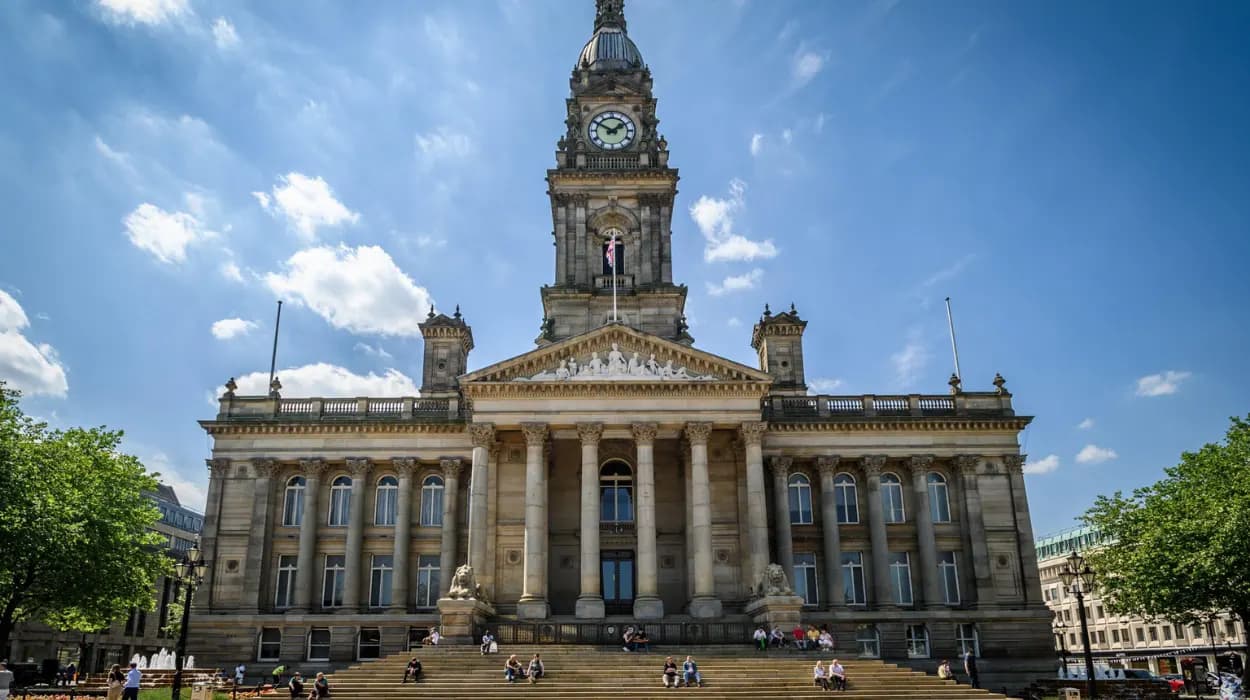
Bolton town centre contains a concentrated record of the town’s transformation from a medieval market settlement into a major Victorian textile centre and then into a modern Greater Manchester borough. Its historic buildings preserve evidence of municipal government, religion, commerce, education, public culture and industrial wealth.
The strongest architectural landmarks stand around Victoria Square, Churchgate, Knowsley Street, Le Mans Crescent and the older streets leading toward Little Bolton. Together, they show how Bolton’s urban landscape changed as population increased, markets expanded and civic institutions developed.
For visitors interested in local history, Bolton town centre offers a particularly accessible heritage trail. Bolton Town Hall represents nineteenth-century municipal ambition. Bolton Parish Church preserves a much older religious tradition. Bolton Market Hall records the growth of organised Victorian commerce. The Old Man & Scythe preserves an important timber-framed building and association with the English Civil War. Le Mans Crescent demonstrates twentieth-century civic architecture.
Historic England records several of these buildings on the National Heritage List for England. Listed-building designation identifies structures of special architectural or historic interest and provides statutory protection under the Planning (Listed Buildings and Conservation Areas) Act 1990.
Why is Bolton town centre important for understanding local history?
Bolton town centre is important because its surviving buildings document the town’s development from medieval market settlement to Victorian industrial municipality and modern civic centre, with landmarks representing religion, commerce, government, education, architecture and community life across several centuries.
Bolton developed around a market and parish church before industrialisation transformed its economy. The town became particularly important during the Industrial Revolution because textile manufacturing, cotton spinning, engineering and associated commercial activity expanded rapidly across Lancashire.
The physical centre changed alongside this economic growth. Streets became more densely developed, markets required permanent premises, municipal government required larger buildings and churches were rebuilt to accommodate expanding populations.
The nineteenth century produced some of Bolton’s most recognisable architecture. The present Town Hall was constructed between 1866 and 1873. Bolton Market Hall opened in 1855. The present Bolton Parish Church was constructed between 1867 and 1871. These buildings belong to the period when Bolton was consolidating its status as an important industrial municipality.
The twentieth century added another architectural layer. Le Mans Crescent formed part of a large civic-centre project developed during the 1930s and completed in 1939. Its architecture reflects a different approach from the Victorian buildings around Victoria Square.
This concentration of buildings makes Bolton town centre valuable for historical study. Visitors can examine architectural changes without travelling between distant settlements.
What makes Bolton Town Hall one of the most important historic buildings?
Bolton Town Hall is a Grade II listed civic landmark built between 1866 and 1873 to designs by William Hill of Leeds, assisted by George Woodhouse, and later extended by Bradshaw, Gass and Hope during the twentieth century.*
Bolton Town Hall stands on the west side of Victoria Square. Historic England designates it Grade II*, placing it among buildings of particularly important architectural or historic interest. Its original construction took place from 1866 to 1873.
William Hill of Leeds designed the principal building, while Bolton architect George Woodhouse assisted with the project. The council had invited 200 architects to compete for the design. Six finalists were assessed, with Hill’s £54,000 proposal receiving first place.
The architecture uses a classical temple form rather than the Gothic Revival style associated with several other major Victorian town halls. The main elevation has a high podium, broad steps, a five-bay portico and composite columns.
The pediment contains allegorical sculpture by William Calder Marshall. The central entrance forms the visual focus of the building, while the clock tower rises above the principal composition.
The building represented municipal confidence during a period of rapid industrial expansion. Bolton had been incorporated as a municipal borough in 1838. The new town hall provided a purpose-built centre for civic administration at a time when the borough was increasing in population, economic importance and institutional complexity.
The Town Hall also demonstrates adaptation. Bradshaw, Gass and Hope extended the building during the 1930s. The practice had been founded in Bolton in 1862 by Jonas James Bradshaw and became one of the town’s most influential architectural firms.
The central hall suffered a major fire in 1981. Historic England records that the interior was subsequently reconstructed, including important decorative elements and the organ case. Other historic rooms retain features such as plasterwork, cornices, panelled doors and Minton Hollins tiles.
This combination of original Victorian architecture, twentieth-century extension and post-fire reconstruction makes Bolton Town Hall particularly valuable for architectural and municipal history.
What can visitors learn from Bolton Parish Church?
Bolton Parish Church records more than eight centuries of religious history, with evidence of an eleventh-century church, a fifteenth-century replacement and the present Victorian Gothic building designed by E. G. Paley and consecrated in 1871.
Bolton Parish Church stands near Churchgate and is dedicated to St Peter. Evidence of an earlier church survives in fragments of stonework, indicating a building existed by the eleventh century. The earliest recorded incumbent identified by the church is John de Sanwyog in 1254.
The medieval building was replaced around 1420 as the settlement expanded. That structure remained in service for approximately four centuries. Some elements associated with earlier worship survive, including fifteenth-century wooden seats, a Jacobean lectern and wooden altar, and other reused historic material.
The present church was designed by E. G. Paley of Paley and Austin. Its foundation stone was laid on 27 April 1867. The building was consecrated on St Peter’s Day, 29 June 1871, by Bishop James Fraser.
The church is built from Longridge stone and represents Victorian Gothic architecture. Its tower reaches approximately 55 metres, or 180 feet, and forms one of the most prominent vertical landmarks in central Bolton. The building measures approximately 47.5 metres in length and 20.5 metres in width.
The church is important because its architecture represents the nineteenth-century rebuilding of a much older religious institution. The present structure therefore does not replace Bolton’s medieval history; it physically incorporates elements and traditions associated with earlier buildings.
For genealogical researchers, parish churches are particularly significant because religious institutions historically recorded baptisms, marriages and burials. Bolton’s parish history therefore connects architectural heritage with family-history research.
Why is Bolton Market Hall significant to Victorian commercial history?
Bolton Market Hall is a Grade II listed Victorian market building designed by G. T. Robinson and opened on 19 December 1855, providing permanent covered trading space during a period of rapid population growth, commercial expansion and industrialisation.
Bolton Market Hall stands on Knowsley Street and forms one of the town centre’s most important surviving commercial buildings. Historic England lists the Market Hall and associated ground-floor shops as Grade II. The official listing dates the building to 1854 and identifies G. T. Robinson as its architect.
The opening ceremony took place on 19 December 1855. Contemporary accounts recorded a major civic occasion, with thousands of people attending. The building occupied approximately 7,000 square yards and was described at the time as an exceptionally large covered market.
Its construction reflected a practical urban problem. Growing commercial activity had placed pressure on older market arrangements. A permanent covered hall offered greater control over trading space and created a more organised environment for vendors and customers.
Architecturally, the building combines ashlar facing with a cast-iron internal structure and glazed roof. The main Knowsley Street entrance has a central entrance block, giant composite columns and a large arch. The town’s heraldic identity appears within the entrance design.
The market underwent alterations during its history. A fish market opened nearby in 1865. Later changes affected the internal arrangement and circulation of stalls.
The survival of the building demonstrates the durability of Victorian commercial architecture. It also provides evidence of the relationship between urban planning and industrial-era consumer culture.
Visitors examining the Market Hall should therefore consider more than its function as a shopping destination. Its design reflects the nineteenth-century development of regulated, permanent and covered commercial space.
What is special about the Old Man & Scythe on Churchgate?
The Old Man & Scythe is a Grade II listed public house on Churchgate with a documented historical tradition reaching back centuries, while its present form includes a timber frame, early twentieth-century remodelling and associations with the English Civil War.
The Old Man & Scythe occupies numbers 6, 8 and 10 Churchgate. Historic England lists the building at Grade II. The official listing states that it is reputed to have been rebuilt in 1636, although its present appearance owes much to early twentieth-century remodelling.
The building retains a genuine timber frame partly visible at the rear. Its exterior includes mock-timber detailing, slate roofing, gabled wings and distinctive bay windows.
The pub has an important connection with the English Civil War. James Stanley, 7th Earl of Derby, was executed outside the building in 1651 following his involvement in the conflict. The event forms part of Bolton’s seventeenth-century political and military history.
The building’s significance therefore extends beyond its age. It provides evidence of changing architectural materials, commercial use and political history within one location.
Historic England also records surviving interior features, including elements of an early plan and fitted bar furniture.
The building illustrates how historic town-centre structures can survive through repeated adaptation. A structure can retain important historic fabric while its appearance and internal arrangement change over time.
For visitors exploring Churchgate, the Old Man & Scythe provides an architectural contrast with the much larger Victorian civic buildings around Victoria Square.
How does Le Mans Crescent represent twentieth-century Bolton?
Le Mans Crescent represents Bolton’s interwar civic ambitions through a large 1930s complex designed by Bradshaw, Hope and Gass, combining library, museum, art gallery and former civic functions within a formally planned architectural ensemble.
Le Mans Crescent forms one of Bolton’s most distinctive twentieth-century architectural spaces. Historic England lists the Civic Centre at Grade II. The complex was constructed between 1931 and 1939 for Bolton Borough Council and designed by Bradshaw, Hope and Gass.
The civic ensemble originally incorporated a library, museum and art gallery, magistrates’ court and central police station. Its design uses ashlar gritstone and red brick walling over a steel frame, with a curved crescent frontage and a prominent central arch.
The architects designed the crescent to create a formal setting for the existing Town Hall. This arrangement demonstrates deliberate civic planning rather than isolated building construction.
The project also reflects Bolton’s continued investment in public institutions after the height of the Victorian industrial period. Libraries, museums and courts were important elements of twentieth-century municipal life.
Construction began before the Second World War, but wartime conditions affected the museum’s opening. Bolton Libraries and Museums records that the museum did not open to the public until 1947.
The complex also has a strong archival significance. Bolton Council acquired the Bradshaw Gass & Hope architectural archive in 2022. The archive covers the practice’s work from 1862 into the 1960s and contains architectural drawings, correspondence and other records relating to thousands of commissions.
Le Mans Crescent therefore has two layers of historical importance: the surviving building and the documentary archive that helps researchers understand how buildings across Bolton and beyond were designed.
What is the history behind Bolton’s old Exchange and library building?
The former Exchange and Reference Library in Victoria Square dates from 1825–1826 and was designed by Richard Lane, later becoming a public library and museum before its changing civic functions reflected Bolton’s expanding educational and cultural institutions.
The building now associated with the former Exchange and Reference Library stands on the south side of Victoria Square. Historic England lists it at Grade II.
Richard Lane designed the building between 1825 and 1829. It was originally intended for the Bolton Exchange and newsroom, with an upper room used as a library.
The building predates the present Town Hall by several decades. Its presence demonstrates that Bolton’s civic and commercial ambitions were already developing before the great Victorian municipal expansion.
The architecture uses ashlar stone, a slate roof, and classical detailing. The front elevation has giant Ionic columns and a prominent central entrance. Decorative carving includes wreaths and other classical motifs.
In 1852, the Exchange Company allowed the upper floor to be used by the council for a public library. The Bolton Free Library was inaugurated on 12 October 1853. The building later became a reference library after a new library opened elsewhere in Victoria Square.
The building also became associated with museum collections. Its changing use demonstrates the close relationship between commerce, education and public culture in nineteenth-century Bolton.
For researchers, this building is particularly useful because it shows how civic institutions often developed through adaptation rather than entirely new construction.
Where can visitors find earlier municipal history near the town centre?
Earlier municipal history survives at Little Bolton Town Hall, a Grade II listed classical building from 1828 that served local government before borough incorporation and later became associated with magisterial, police, library and community uses.
Little Bolton Town Hall stands on All Saints Street in the historic Little Bolton area. Historic England identifies the building as Grade II listed and records that it functioned as the town hall before borough incorporation.
The building dates from 1828 and was designed by John Thompson. It served the trustees of the former township of Little Bolton.
Its history provides useful context for understanding the political geography of Bolton before the creation of the incorporated borough in 1838. Local government operated through separate townships and institutions before municipal consolidation.
Historic England records that the building continued to serve magisterial and police functions until 1874. It was converted for use as a library in 1879.
The building therefore represents an earlier phase of local administration than the 1870s Town Hall.
Its survival is also an example of heritage adaptation. The building experienced deterioration and later underwent restoration before returning to active use.
This makes Little Bolton Town Hall valuable for visitors studying the relationship between local government and urban development. It also demonstrates that Bolton’s civic heritage extends beyond the grand central Town Hall.
How did Bolton’s historic buildings reflect industrial growth?
Bolton’s historic buildings reflect industrial growth because rising textile production and population created demand for larger markets, civic institutions, churches, libraries and public buildings, producing an urban landscape that visibly connected economic development with municipal investment.
Bolton’s industrial expansion was closely connected with cotton and textile manufacturing. The town became part of Lancashire’s wider industrial network, with mills, workshops, warehouses and associated commercial institutions shaping employment and urban growth.
Economic expansion created pressure on existing civic infrastructure. Older meeting places and market arrangements became inadequate for a growing municipality.
The response was architectural as well as administrative. The Market Hall provided a permanent covered trading environment. The Town Hall created a major municipal centre. The parish church was rebuilt on a larger Victorian scale. Libraries and museums expanded public education and culture.
Bradshaw Gass & Hope provides a direct connection between industrial wealth and architecture. The Bolton-founded practice initially gained prominence through the design of cotton mills before becoming known for major civic and commercial buildings.
This transition is important. Industrial architecture was not limited to mills. Industrial prosperity also helped produce town halls, markets, churches, libraries and cultural buildings.
The town centre consequently became a physical record of economic change. Architectural historians can identify different periods through materials, structural systems, decorative styles and building functions.
How should visitors explore Bolton’s historic buildings today?
Visitors can explore Bolton’s historic buildings most effectively by following a compact town-centre route linking Victoria Square, the Market Hall, Churchgate, Bolton Parish Church and Le Mans Crescent, while checking current access arrangements before entering individual buildings.
A practical heritage walk begins at Victoria Square. Bolton Town Hall provides the principal starting point because its scale and architectural prominence make it easy to identify.
From Victoria Square, visitors can examine the former Exchange and Reference Library before continuing toward the Market Hall on Knowsley Street. The route then leads toward Churchgate and Bolton Parish Church.
The Old Man & Scythe provides a further historic stop on Churchgate. Le Mans Crescent then offers a contrasting twentieth-century civic environment.
To experience this historic town-centre heritage in person today, consult our comprehensive [Stories Behind Bolton's Most Historic Buildings] for itineraries and visiting parameters.
Visitors should distinguish between buildings that operate as public attractions and buildings that are primarily active businesses, offices, religious premises or civic facilities. Listing status does not automatically mean unrestricted public access.
Photographers and researchers should also check permissions. Historic buildings often have different rules for commercial photography, interior photography and organised research.
The most useful approach is to examine façades, dates, architectural materials, inscriptions and spatial relationships. The position of the buildings within the town centre often provides as much historical information as the individual structures.
Why does historic preservation matter for Bolton’s future?
Historic preservation matters because Bolton’s surviving buildings provide physical evidence of municipal government, industrial prosperity, religious practice, commerce and public education, allowing future generations to study urban change through authentic structures and documented architectural fabric.
Preservation protects more than attractive façades. Historic buildings contain evidence about construction methods, materials, institutional organisation and changing patterns of use.
Bolton Town Hall demonstrates nineteenth-century civic ambition. The Market Hall preserves Victorian commercial architecture. Bolton Parish Church records the rebuilding of a much older religious institution. Le Mans Crescent demonstrates interwar municipal planning. The Old Man & Scythe preserves a timber-framed historic commercial building.
The former Exchange building adds another layer by demonstrating the development of public libraries and museums in the nineteenth century.
These buildings also support academic research. The National Heritage List provides formal documentation for listed structures, while Bolton Libraries and Museums holds local collections and architectural records. The acquisition of the Bradshaw Gass & Hope archive has further strengthened the documentary basis for studying Bolton’s built environment.
Historic preservation also supports genealogical research. Parish buildings, civic institutions and former libraries form part of the institutional environment in which records about local residents were created and maintained.
The long-term value of Bolton’s town-centre architecture therefore lies in continuity. A historic building allows modern observers to examine physical evidence that survives from the period being studied.
Which historic buildings should every first-time visitor prioritise?
First-time visitors should prioritise Bolton Town Hall, Bolton Parish Church, Bolton Market Hall, the Old Man & Scythe, Le Mans Crescent and the former Exchange and Reference Library because together they cover the town’s civic, religious, commercial, social and architectural development.
Bolton Town Hall is the strongest landmark for understanding nineteenth-century municipal government. Its Grade II* designation and substantial Victorian architecture make it central to the town’s heritage identity.
Bolton Parish Church provides the longest institutional history within the central heritage landscape. Its present Victorian building stands on a site with evidence of medieval religious activity.
Bolton Market Hall explains the commercial transformation of the nineteenth century. Its 1855 opening reflects the development of permanent covered market infrastructure.
The Old Man & Scythe adds an earlier architectural layer and connects the town centre with seventeenth-century political history. Its Grade II listing recognises the building’s special architectural and historic interest.
Le Mans Crescent represents twentieth-century civic architecture. Its 1930s design demonstrates how Bolton continued to invest in public institutions after the Victorian period.
The former Exchange and Reference Library completes the sequence by showing how commercial buildings were adapted for education, libraries and museum functions during the nineteenth century.
Together, these buildings form a coherent historical sequence. They demonstrate that Bolton town centre is not defined by one architectural period. Its heritage results from centuries of rebuilding, adaptation, investment and institutional change.
What does Bolton’s historic town centre reveal about the town today?
Bolton’s historic town centre reveals a continuous process of urban change in which medieval foundations, Victorian industrial prosperity, municipal expansion and twentieth-century civic planning remain visible within a compact modern commercial environment.
The town centre is best understood as an accumulated historical landscape. Medieval religious foundations remain relevant beside Victorian civic architecture. Nineteenth-century commercial buildings stand alongside twentieth-century public institutions. Historic buildings continue to define streets, squares and movement through the centre.
This continuity gives Bolton particular value for cultural tourism and education. A visitor does not need to study isolated monuments to understand the town’s development. The relationships between buildings provide evidence of changing priorities.
Victoria Square demonstrates the formal civic ambitions of the nineteenth century. Churchgate retains connections with older settlement patterns and religious history. Knowsley Street preserves evidence of commercial development. Le Mans Crescent demonstrates interwar civic planning.
The architectural record also shows how buildings survive through change. Bolton Town Hall was extended. Its central hall was reconstructed after the 1981 fire. The former Exchange building changed from commercial use to library and museum functions. Le Mans Crescent developed through changing public-service requirements.
For educators, these buildings provide case studies in urban history. For architectural students, they demonstrate changing styles, materials and planning principles. For genealogists, they provide context for the institutions that recorded community life.
For visitors, the principal lesson is straightforward: Bolton’s historic buildings are evidence of successive stages in the town’s development. Their value comes from their dates, functions, architectural details, documented histories and continuing presence within the modern town centre.
Bolton’s heritage therefore remains a living historical resource. The buildings around Victoria Square, Churchgate, Knowsley Street and Le Mans Crescent preserve the physical framework through which the town’s civic, commercial, religious and cultural history can still be understood.
FAQS
What is the most famous historic building in Bolton town centre?
Bolton Town Hall is one of the town centre’s most significant historic buildings. Built between 1866 and 1873, the Grade II* listed building was designed by William Hill with assistance from George Woodhouse.