Bolton offers a substantial range of free attractions for visitors interested in history, architecture, museums, parks, industrial heritage and local culture. The town developed from a medieval settlement into one of Lancashire’s major textile centres, leaving a built environment and public heritage network that remains accessible without an admission charge.
For budget travellers, Bolton is particularly useful because several important attractions are publicly owned or maintained as civic amenities. Bolton Museum provides free access to major collections. Queen’s Park preserves a Victorian landscape. Smithills Hall provides access to one of north-west England’s significant historic houses. Bolton Parish Church preserves evidence of worship on its site for around 1,200 years. Public parks and historic streets add further opportunities for free exploration.
The history of these attractions also explains why Bolton became an important industrial town. Cotton manufacturing, municipal reform, Victorian philanthropy, public health policy and heritage conservation all influenced the places visitors can explore today.
Why does Bolton have so many free attractions?
Bolton has many free attractions because public museums, parks, libraries and heritage sites developed as civic institutions serving the whole community. Victorian municipal investment and later public ownership preserved major cultural assets for education and recreation.
Bolton’s modern free-attraction network has roots in the nineteenth century. Industrial growth created wealth but also produced overcrowding, pollution and difficult working conditions. Civic leaders increasingly invested in public institutions that provided education, recreation and access to culture.
The borough itself changed significantly during this period. Bolton was incorporated as a municipal borough in 1838, bringing Great Bolton and Little Bolton into one municipal structure. Charles James Darbishire became the first mayor that year.
Municipal development accelerated alongside industrial expansion. Cotton spinning and weaving transformed the town, while factories, warehouses, workers’ housing, churches, libraries and public parks reshaped its physical landscape.
Public access became an important principle. Museums collected objects for educational purposes. Libraries provided books and information. Parks provided open space. Historic buildings increasingly became publicly managed heritage assets.
This legacy explains why a traveller can spend little money while still examining collections, architecture and landscapes associated with several centuries of Bolton’s history.
The free experience is therefore not simply a modern tourism strategy. It reflects a long tradition of public access to education, recreation and heritage.
What can visitors see for free at Bolton Museum?
Bolton Museum provides free access to collections covering ancient Egypt, local history, art and natural history. Its Egyptology collection contains about 15,000 objects, making the museum one of Britain’s major local-authority centres for ancient Egyptian material.
Bolton Museum is one of the strongest free cultural attractions in the town centre.
The museum operates within the Bolton Library and Museum complex on Le Mans Crescent. Its collections cover several historical subjects, including archaeology, fine art, natural history and local history.
The Egyptology collection is particularly important. Bolton Council states that the collection contains approximately 15,000 ancient Egyptian artefacts. The museum describes it as one of the most significant ancient Egyptian collections in the United Kingdom.
The museum’s modern Egypt galleries opened in September 2018 after a £3.8 million refurbishment project. The galleries include a full-size recreation of the burial chamber of Thutmose III, an eighteenth-dynasty pharaoh who ruled during the fifteenth century BC.
The collection also demonstrates the relationship between Bolton and British Egyptology. Bolton received its first Egyptian material from the Egypt Exploration Society in 1884, the same year the town’s first museum opened in Queen’s Park.
The original museum was the Chadwick Museum. It opened on 12 June 1884 and was established through the legacy of local doctor Samuel Chadwick. Objects from that institution eventually contributed to the collections now displayed at Bolton Museum.
This makes the museum particularly valuable for students. Visitors can examine the development of collecting, archaeology, industrial history and municipal culture within one institution.
Free admission also makes the museum suitable for budget travellers who want substantial indoor cultural activity without paying an entrance fee.
Opening hours and individual exhibitions change, so visitors should check the current council information before travelling. Permanent museum access remains a central part of Bolton’s publicly funded cultural provision.
How does Queen’s Park preserve Victorian Bolton?
Queen’s Park preserves a Victorian public park created in 1866 during Bolton’s industrial expansion. Its original landscape included formal gardens, a promenade, water features and viewpoints, while surviving structures demonstrate nineteenth-century ideas about recreation, health and civic improvement.
Queen's Park opened on 24 May 1866.
The park was created during a period of severe economic disruption in Lancashire. The American Civil War, fought from 1861 to 1865, disrupted supplies of raw cotton to British textile manufacturers. Lancashire experienced widespread unemployment and hardship during the resulting cotton famine.
Public works offered employment while creating long-term civic infrastructure. Queen’s Park became one of the parks associated with this period.
Bolton Council records that the park occupies 22 acres of land and that its original design included features such as the sunken garden, promenade terrace and the viewpoint known as the Pie Crust.
The park’s original architecture was associated with Bolton architect George Woodhouse. Woodhouse also worked on Bolton Town Hall and other important local buildings.
The landscape has changed, but several historic elements remain. A large lake once occupied part of the park. The area later became a paddling pool before being filled during the 1970s.
The Victorian fountain provides another example of preservation. It was one of the park’s original attractions but deteriorated during the twentieth century. Restoration work uncovered buried remains of the original structure. A £17,000 refurbishment completed in 2026 restored the fountain, with regular operation scheduled from April 2026.
Queen’s Park also received Grade II listing and underwent a major restoration between 2010 and 2016. The restoration received £4.3 million from the Heritage Lottery Fund alongside Bolton Council funding. The project included work on lakes, bridges, statues and paths.
The park therefore provides a free way to study Victorian landscape design while also observing how a nineteenth-century industrial town invested in public recreation.
Why is Smithills Hall one of Bolton’s most important free historic attractions?
Smithills Hall is a Grade I listed historic house containing medieval, Tudor and Victorian architectural elements. Its surviving fabric records domestic life across several centuries, while its publicly accessible grounds provide free opportunities to study Bolton’s rural and aristocratic heritage.
Smithills Hall is one of the most historically significant buildings in the Bolton area.
The building originated as a medieval hall in the fourteenth century. Later owners extended it during the fifteenth or sixteenth century and again during the late sixteenth century. Victorian alterations added another architectural layer.
Smithills therefore provides an unusually clear architectural sequence. The medieval Great Hall represents an earlier form of domestic and social organisation. Tudor additions reflect changing requirements for household accommodation. Victorian alterations demonstrate nineteenth-century interest in historic buildings and country-house architecture.
Architect George Devey was involved in significant Victorian improvements commissioned by Richard Ainsworth. Devey redesigned elements of the west wing as the building expanded.
The building became a museum following conservation work. Part of the hall opened as a museum in 1963, while further museum expansion reached the Victorian sections during the 1990s.
Bolton Council owns the building. Current council information states that Smithills Hall and its grounds are free to enter and explore, with regular public opening days.
The surrounding Smithills Hall Country Park extends the free experience beyond the building. The grounds contain paths, tracks, cycling routes, horse-riding routes and a nature trail.
The site is particularly useful for educational visits because architecture, landscape history, social history and conservation can be examined in one location.
Its Grade I status is also significant. Grade I is the highest category of listed-building protection in England and is reserved for buildings of exceptional interest.
For travellers interested in medieval Bolton, Smithills provides a stronger historical connection than many modern visitor attractions.
What can visitors discover at Bolton Parish Church without paying?
Bolton Parish Church preserves evidence of a religious site dating back about 1,200 years. Its surviving Saxon cross, medieval remains, Victorian Gothic architecture and listed status make it one of the town centre’s most important free historical resources.
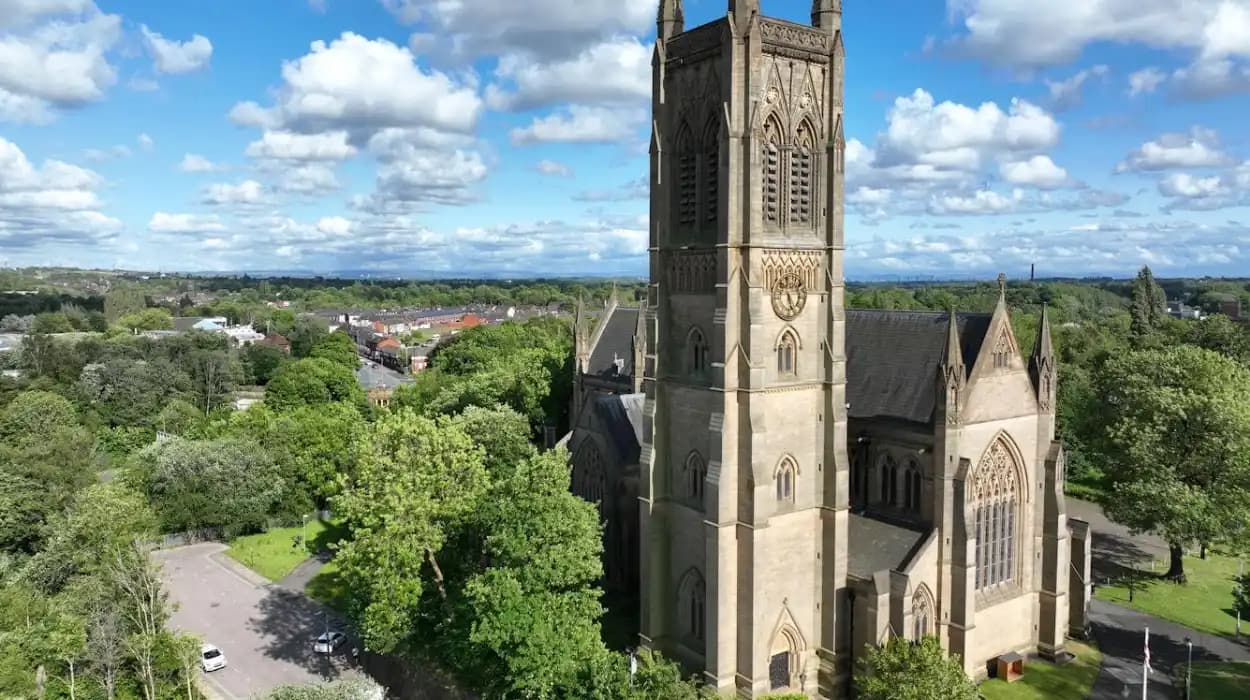
Bolton Parish Church stands at the centre of Bolton’s historic urban landscape.
The exact foundation date of the first church on the site is unknown. Evidence from the present building’s foundations indicates a long history, while a Saxon cross dating from the early tenth century indicates that the location was used as a burial ground.
Stone fragments provide evidence of a church building by the eleventh century. The church was probably connected with monks from Maresay Abbey.
The first recorded incumbent, John de Sanwyog, appears in documentary evidence in 1254. The original Saxo-Norman building was replaced around 1420 by a larger church.
That medieval structure served the community for approximately four centuries. Surviving objects include a Jacobean lectern, wooden altar, pulpit material and fifteenth-century wooden seats.
The current church belongs to the Victorian period. Architect E. G. Paley of Paley and Austin designed the building. Its foundation stone was laid on 27 April 1867, and the church was consecrated on 29 June 1871 by Bishop James Fraser.
The building is Grade II listed and represents Victorian Gothic architecture. It was constructed using Longridge stone.
Its tower reaches approximately 55 metres, or 180 feet. Bolton Parish Church identifies it as the tallest parish church tower in Lancashire.
The church is therefore valuable to visitors studying several periods. The site contains evidence associated with the Anglo-Saxon period, medieval Bolton, early modern religious life and nineteenth-century civic expansion.
Guided heritage tours are also arranged during the year, although arrangements and availability should be checked directly with the church.
Which free historic buildings can budget travellers see around Bolton town centre?
Bolton town centre contains free-to-view historic architecture representing medieval religion, Victorian municipal government, industrial wealth and nineteenth-century civic planning. Bolton Town Hall, the Parish Church and surrounding streets form a compact heritage landscape that can be explored on foot.
The town centre provides an important advantage for budget travellers because several significant buildings stand within walking distance of one another.
Bolton Town Hall is one of the clearest examples of Victorian civic architecture. Construction began in the late 1860s, and the building was officially opened in 1873. It was designed by William Hill and George Woodhouse.
The building reflects the expansion of municipal government after incorporation in 1838. Before incorporation, Great Bolton and Little Bolton had separate administrative arrangements. The creation of a borough required a stronger civic centre.
The Town Hall project therefore represented more than architectural ambition. It reflected the development of nineteenth-century municipal government.
Visitors can examine its exterior without paying an admission charge. The surrounding streets provide additional examples of nineteenth-century commercial and civic architecture.
Le Mans Crescent is particularly important because the library and museum complex forms part of Bolton’s civic cultural infrastructure.
Bolton’s library system also provides historical research opportunities. The Bolton History Centre contains special collections covering local, social, political, environmental, industrial and economic development. The Lancashire Collection includes material ranging from early history to modern times.
The special collections include approximately 500 rare books and about 3,000 journals and periodicals. Access is supervised because conservation and security requirements apply.
This creates a valuable resource for genealogists and academic researchers. A traveller investigating Bolton family history can use local records and historical publications without needing to purchase a commercial tour.
The architecture surrounding these institutions also demonstrates the relationship between municipal reform and industrial prosperity.
To experience this historic landmark in person today, consult our comprehensive [History Behind Bolton's Free Public Attractions] for itineraries and visiting parameters.
Which free parks offer the best connection between Bolton’s industrial history and nature?
Bolton’s public parks preserve landscapes shaped by industrialisation, philanthropy, mining and municipal planning. Queen’s Park, Leverhulme Park and Smithills Hall Country Park provide free outdoor spaces where visitors can examine environmental change alongside the history of work, wealth and public recreation.
Leverhulme Park provides one of the strongest examples of industrial philanthropy.
William Hesketh Lever, later Lord Leverhulme, became one of the most influential industrialists associated with Bolton’s wider history. His business success in soap manufacturing generated substantial wealth, which he used for philanthropic projects.
Lever purchased land for what became Leverhulme Park after Bolton Corporation’s attempt to acquire 67 acres was disrupted by the First World War. He subsequently presented the land to the town, and further purchases expanded the park.
Bolton Council describes Leverhulme Park as the largest area of public parkland in the Bolton area. Its facilities include nature trails, picnic areas, sports pitches, a running track and an orienteering course.
The landscape also contains evidence of earlier industrial activity. Council planning material records nineteenth-century mining across much of the park and the presence of numerous mine shafts.
This creates a direct historical connection between extraction, industrial development, land ownership and modern recreation.
Smithills Hall Country Park provides a different landscape history. Its paths connect a medieval historic house with the wider countryside around Smithills and the West Pennine landscape.
Queen’s Park represents municipal public investment during the Victorian industrial crisis. Leverhulme Park demonstrates private philanthropy. Smithills demonstrates the preservation of an older rural estate within an expanding urban borough.
Together, these landscapes show how Bolton’s open spaces developed through different economic and political processes.
For a traveller, walking through these areas costs nothing while providing direct access to historical geography.
Which historic attractions should budget travellers check before visiting?
Free attractions can have changing opening hours, conservation closures and booking requirements. Travellers should verify current council or heritage-organisation information before visiting Smithills Hall, Bolton Museum, libraries and temporary heritage sites to avoid unnecessary travel.
Free admission does not always mean unrestricted access.
Smithills Hall currently has scheduled opening days. Bolton Council lists Wednesday, Thursday and Friday from 10am to 4pm and Sunday from noon to 4pm for the hall and grounds. These schedules can change because of events, conservation work or operational requirements.
Bolton Museum also publishes its opening information through the council’s museum service. Its free admission policy makes it one of the most reliable indoor choices for visitors seeking cultural activity without an entrance fee.
Hall i’th’ Wood requires particular caution when planning. Bolton Council’s 2025–26 accounts state that the Grade I listed building is closed to the public because it requires extensive renovation work. Its former collections were temporarily moved to the Chadwick Resource Centre.
The building nevertheless remains historically important.
William Hesketh Lever purchased Hall i’th’ Wood in 1899 and restored it after a period of neglect. He presented the house to Bolton in 1902, turning it into a museum containing furniture and household objects from the sixteenth and seventeenth centuries. The house was also associated with Samuel Crompton, inventor of the spinning mule.
Its current closure demonstrates an important principle of heritage tourism: preservation takes priority over unrestricted visitor access.
Rock Hall in Farnworth also illustrates how public heritage develops over time. Stabilisation work and community activity preceded a major restoration project. In July 2026, Bolton Council announced a £4.465 million National Lottery Heritage Fund grant for the Rock Hall Revival project.
The project aims to restore Rock Hall as a community heritage hub while improving connections with the surrounding natural environment.
These examples show that Bolton’s free attractions are part of an active conservation system rather than static historical displays.
How can visitors explore Bolton’s history for almost no money?
A low-cost Bolton heritage visit can combine the free museum, historic civic centre, Parish Church, Queen’s Park and Smithills Hall with walking routes between locations. Public parks and heritage buildings provide substantial historical content without entrance fees or organised tours.
A budget itinerary can begin in central Bolton at the library and museum complex.
Bolton Museum provides the strongest indoor starting point because its collections connect local industrial history with international archaeology. The Egyptology galleries provide a major archaeological resource while local collections explain the development of Bolton itself.
Visitors can then walk through the town centre towards Bolton Parish Church. The church site provides evidence stretching from the early medieval period to the Victorian era.
The next stage can focus on Bolton Town Hall and the surrounding civic landscape. The Town Hall represents the political and administrative transformation that followed borough incorporation in 1838.
A separate visit to Queen’s Park provides a contrasting environment. The park connects directly with the social consequences of nineteenth-century industrialisation and the creation of public recreational space.
Smithills Hall provides a longer historical sequence. Its medieval origins predate Bolton’s industrial expansion by several centuries, while its Victorian alterations demonstrate how historic estates were adapted during the industrial era.
Leverhulme Park adds another perspective. Its landscape records nineteenth-century mining and twentieth-century public recreation while demonstrating the role of Lord Leverhulme’s philanthropy.
The financial advantage is significant. Visitors can focus their spending on transport, food and accommodation rather than entrance tickets.
For students, the same itinerary provides a practical framework for examining industrialisation, municipal government, architecture, conservation, philanthropy and environmental change.
For genealogical researchers, Bolton Library’s special collections provide a more specialised research environment. The Lancashire Collection covers local social, political, environmental, industrial and economic development, creating a strong documentary resource for historical investigation.
Why do Bolton’s free attractions matter for the future of local heritage?
Bolton’s free attractions preserve evidence of industrial, religious, architectural and social history while keeping heritage accessible to residents and visitors. Continued conservation, public funding and community involvement ensure that historically important places remain educational resources for future generations.
Bolton’s free heritage network has long-term importance because access determines how local history is experienced.
A museum collection is valuable not only because of the objects it contains but because the public can study them. A historic building retains educational value when its architecture remains understandable. A park becomes heritage infrastructure when its historic design survives alongside modern recreational use.
Queen’s Park demonstrates this process clearly. The park opened in 1866, underwent major restoration during the twenty-first century and continues to function as a public green space. Its Victorian fountain was restored again in 2026.
Smithills Hall demonstrates the importance of maintaining historic buildings across multiple architectural periods. Its medieval, Tudor and Victorian fabric provides evidence that cannot be recreated once lost.
Bolton Museum demonstrates the importance of collections. Its Egyptology holdings connect local collecting history with international archaeology. The collection developed partly through the Egypt Exploration Society and became a major component of Bolton’s cultural identity.
Public conservation also requires financial investment. Bolton Council has committed resources to major historic buildings, including repairs to Bolton Town Hall and the Central Library and Museum building. A council programme announced an £11.59 million investment covering repairs to several iconic public buildings.
Rock Hall provides a current example of heritage-led regeneration. Its £4.465 million National Lottery Heritage Fund award announced in 2026 is intended to transform the Grade II listed building into a community heritage hub.
These projects demonstrate that free attractions are not simply inexpensive leisure facilities. They are public heritage assets.
For Bolton, this approach protects historical evidence while supporting education, community identity and cultural tourism.
For budget travellers, the result is unusually strong value. A visitor can investigate ancient Egypt, medieval religion, Victorian architecture, industrialisation, municipal reform, philanthropy and landscape history without paying admission to the principal attractions.
Bolton’s free attractions therefore form a connected historical resource. They reveal how a medieval settlement became an industrial town and how that industrial town developed public institutions, parks and conservation programmes.
The most effective low-cost visit is not based on one attraction. It combines the museum, civic centre, Parish Church, Queen’s Park, Smithills Hall and public parks into a chronological exploration of the borough.
That combination gives Bolton a distinctive advantage for history-focused tourism: its most important stories remain visible in publicly accessible places.
FAQS
What are the best free attractions in Bolton?
The best free attractions in Bolton include Bolton Museum, Smithills Hall, Queen’s Park, Bolton Parish Church, Leverhulme Park and Bolton’s historic town-centre architecture. These attractions cover archaeology, local history, Victorian architecture, religion, industrial heritage and public parks.