Bolton’s free public attractions developed from the town’s transformation during the Industrial Revolution, when civic leaders, industrialists, philanthropists and local communities invested in education, recreation and heritage. Public parks, libraries, museums and historic buildings became important parts of Bolton’s civic infrastructure.
The history of free attractions in Bolton is therefore closely connected with the history of municipal government, industrial wealth, working-class education, public health and heritage preservation. Places that visitors enter without an admission charge today often began as Victorian responses to social and economic pressures.
Bolton was incorporated as a municipal borough in 1838, bringing Great Bolton and Little Bolton together under one civic authority. The first mayor was Charles James Darbishire. The borough later expanded through further local-government changes, while the modern Metropolitan Borough of Bolton was established on 1 April 1974.
This civic development created the administrative framework for public amenities. During the nineteenth century, Bolton was also a major cotton-manufacturing centre. Its growing population required access to education, recreation, open space and cultural collections.
Many of Bolton’s free attractions reflect that history directly. Queen’s Park records Victorian municipal improvement and employment policy. Bolton Museum records the development of public education and scientific collecting. Hall i’ th’ Wood preserves the setting associated with Samuel Crompton and the spinning mule. Smithills Hall preserves medieval and later architectural history. Public parks such as Moss Bank Park preserve landscapes connected with Bolton’s industrial families and landowners.
Why did Bolton begin creating free public attractions?
Bolton created free public attractions as industrial growth increased demand for education, recreation, public health and civic improvement. Victorian legislation and municipal government provided mechanisms for establishing libraries, parks and museums, while philanthropy helped preserve historic buildings and expand public cultural resources.
The expansion of Bolton during the nineteenth century changed the relationship between residents and public space. Industrial employment increased the urban population, while cotton manufacturing created substantial concentrations of workers around mills, workshops and densely developed neighbourhoods.
Public amenities addressed several connected problems. Libraries provided access to books and information. Museums provided educational collections. Parks supplied landscaped open space for recreation. Historic buildings later became museums that preserved evidence of earlier forms of domestic, agricultural and industrial life.
The development of these facilities also reflected Victorian ideas about self-improvement. Public institutions were increasingly expected to provide educational opportunities beyond formal schooling. Natural-history collections, archaeological objects, works of art and historical artefacts gave working people access to material that had previously been concentrated in private collections.
Bolton’s first free public library dates to 1852. According to Bolton Libraries and Museums, it was established in Victoria Square following adoption of the Libraries Act. Its collection quickly expanded beyond books. The first item entered in its register was a small collection of fossils, demonstrating the early connection between public libraries and scientific education.
This development established an important principle that continued throughout Bolton’s cultural history: public institutions were not simply recreational facilities. They were places for learning, collecting, research and civic participation.
How did Bolton’s first free public library shape public education?
Bolton’s first free public library was established in 1852 in Victoria Square after the Libraries Act was adopted. It combined access to books with scientific collecting, creating an early municipal foundation for the town’s later museum, library and educational services.
The 1852 library represented an important change in access to knowledge. Books became available through a public institution rather than depending entirely on private ownership or subscription arrangements.
The location in Victoria Square also placed the institution at the centre of civic Bolton. The original library building remains in the square, close to the later Bolton Library and Museum complex on Le Mans Crescent.
The early collection demonstrates the breadth of Victorian public education. Fossils, natural-history material and ethnographic objects were collected alongside books. This reflected contemporary interest in classification, geology, zoology, anthropology and the systematic study of the natural world.
The library also became part of the institutional history of Bolton Museum. Bolton Libraries and Museums dates the history of the present museum service to 1852 and identifies Mere Hall, Hall i’ th’ Wood, Le Mans Crescent and Smithills Hall as buildings connected with the town’s museum history.
For modern genealogical researchers, the significance of this development extends beyond physical attractions. Public libraries became repositories of local information, newspapers, reference works and community knowledge. Their institutional continuity provides an important foundation for researching Bolton families, businesses, streets and civic organisations.
The free-library movement therefore belongs within the wider history of nineteenth-century social reform. Access to information became an increasingly recognised component of civic life.
When did Bolton’s public museum tradition begin?
Bolton’s museum tradition began alongside the free library movement, with collections developing from natural-history and ethnographic material before the Chadwick Museum opened in Queen’s Park on 12 June 1884. The museum established systematic public displays covering science, zoology, anthropology, Egyptology and antiquities.
The first major dedicated museum building in Bolton was the Chadwick Museum. It opened in Queen’s Park on 12 June 1884. Samuel Chadwick, a local doctor and benefactor, provided the foundation for the institution, while A. Dobson of the engineering firm Dobson and Barlow supported the developing museum.
The Chadwick Museum reflected the Victorian preference for systematic classification. Its basement displayed minerals, rocks and fossils. The ground floor presented zoological material, including taxidermied birds and animals, nests, eggs, shells and insects. The first floor included anthropology, Egyptology, antiquities and a room of curiosities.
This organisation reveals how museums functioned as educational institutions. Visitors encountered the natural world, animal life and human history through arranged collections. The building transformed scientific and cultural knowledge into a public experience.
Bolton’s Egyptology collection later became especially important. In 1884 the town received ancient Egyptian material connected with the Egypt Exploration Society. Bolton Libraries and Museums states that the collection is now the largest collection of ancient Egyptian material held by a local-authority museum in the United Kingdom.
The Chadwick Museum building eventually disappeared, but its collections continued through Bolton’s museum service. The survival of collections demonstrates an important principle in heritage history: a museum’s significance is not limited to its original building.
Today Bolton Museum, Art Gallery and Library continues that institutional tradition. Its collections cover art, archaeology, botany, zoology and Egyptology, and the complex contains Greater Manchester’s only public aquarium.
Why was Queen’s Park created during the Victorian period?
Queen’s Park was created during the 1860s as a municipal improvement project and employment measure during the Cotton Famine. Bolton acquired land for the park after the 1864 improvement legislation, and the landscaped public space opened formally on 24 May 1866.
Queen’s Park provides one of the clearest examples of the connection between economic crisis and free public recreation.
During the American Civil War, cotton supplies reaching Lancashire were severely disrupted. Bolton’s cotton industry depended heavily on imported raw cotton, so the shortage produced unemployment and severe hardship. The period became known locally and nationally as the Cotton Famine.
Central government responded by making loans available to local authorities for improvement works. These projects provided employment while creating permanent civic infrastructure. Bolton’s local legislation provided powers for creating the public park.
Land known as Spa Fields was selected for the scheme. Bolton Council’s conservation appraisal records that 43 acres were purchased and that landscape gardener William Henderson of Birkenhead was appointed in September 1864 to prepare plans and supervise the work.
Historic England identifies Queen’s Park as a public park designed by William Henderson and opened in 1866. The park was created from meadow and pasture purchased from the Earl of Bradford under a scheme connected with the Bolton Improvement Act of 1864.
The formal opening took place on 24 May 1866. Bolton Council records that about 20,000 people attended, businesses suspended normal activity and a public procession travelled from the Market Square to the new park.
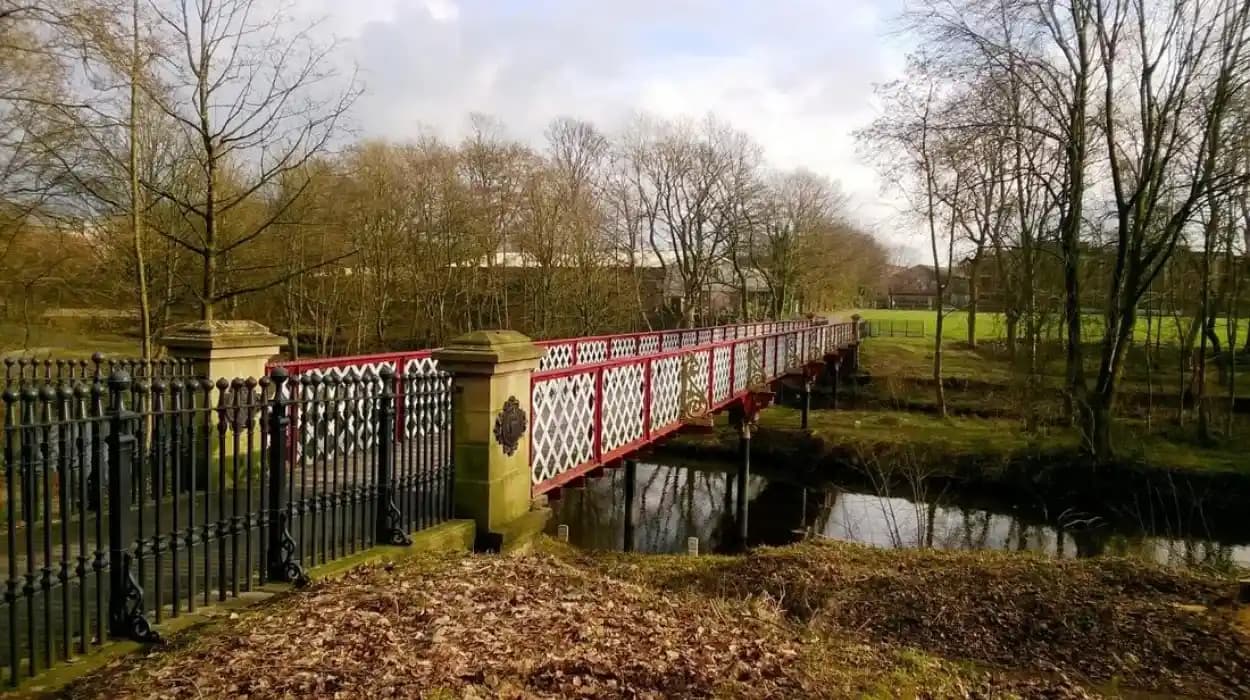
The original landscape contained ornamental lakes, walkways, a terrace promenade, viewpoints, planting, statues, a gardener’s cottage and an iron bridge over the River Croal. Much of the underlying layout remains recognisable.
The park was initially called Bolton Park. It was renamed Queen’s Park in 1897 to commemorate Queen Victoria’s Diamond Jubilee.
The history of Queen’s Park therefore demonstrates that a free attraction was not simply created for leisure. Its original purpose combined employment, civic improvement, landscape design and public recreation.
What historic features survive in Queen’s Park?
Queen’s Park retains important elements of its Victorian design, including its original landscape structure, promenade terrace, viewpoints, water features and historic planting areas. Restoration has preserved these features while adapting the park for contemporary recreation, environmental management and community use.
The park’s surviving landscape is significant because it preserves the structure of an 1860s municipal park. Historic England states that although several built structures have disappeared, most principal design elements shown on an 1882 map remain.
The Victorian fountain is another important surviving feature. It was one of the park’s principal attractions when the park opened. By the 1960s, it had deteriorated and its basin was being used as a flower bed. Restoration work later uncovered substantial remains of the original structure.
In 2026, Bolton Council completed a £17,000 repair project involving new electrical equipment and pumps. The fountain returned to operation after being inactive since 2019.
The park also experienced substantial twentieth-century decline. Bolton Council records that it fell into disrepair during the 1980s and 1990s. A major restoration programme subsequently reversed much of this deterioration.
Between 2010 and 2016, restoration work supported by a £4.3 million Heritage Lottery Fund grant and additional Bolton Council funding repaired historic landscape features. Work included dredging lakes, restoring statues, rebuilding Dobson Bridge, refurbishing footbridges and resurfacing paths.
Queen’s Park was designated a Grade II registered historic park and garden. It also forms part of a conservation area. These designations recognise the importance of the landscape rather than treating individual buildings as isolated monuments.
Its history shows how public attractions require continuous stewardship. The free entrance enjoyed by visitors today depends on historic preservation, municipal maintenance and community involvement.
How did philanthropy preserve Hall i’ th’ Wood for the public?
Hall i’ th’ Wood survived as a public museum because William Hesketh Lever purchased the deteriorating historic house in 1899, funded restoration and presented it to Bolton Corporation in 1902 as a memorial to Samuel Crompton and his contribution to textile manufacturing.
Hall i’ th’ Wood is one of Bolton’s most important historic buildings. The present structure originated as a half-timbered hall in the early sixteenth century. It later received major stone additions, including a Jacobean extension during the seventeenth century.
The building became particularly important because of its association with Samuel Crompton. Crompton was born in Firwood Fold on 3 December 1753 and later lived with his family at Hall i’ th’ Wood.
In 1779 Crompton developed the spinning mule. The machine combined features associated with Richard Arkwright’s water frame and James Hargreaves’s spinning jenny. It addressed the problem of producing strong, fine cotton yarn in larger quantities.
The invention became significant to the development of mechanised cotton production. Its association with Hall i’ th’ Wood therefore connects domestic architecture with the industrial history that transformed Bolton.
By the late nineteenth century, the building had deteriorated. William Hesketh Lever, later Lord Leverhulme, purchased Hall i’ th’ Wood in 1899. He funded its restoration and presented it to Bolton Corporation in 1902. The museum was established as a memorial to Crompton and the textile industry.
Historic England lists Hall i’ th’ Wood as Grade I, the highest category of listed-building protection in England. The official record identifies the building as an early sixteenth-century small manor house with later extensions dating to 1591 and 1648.
The museum preserves furniture, domestic objects and architectural details that help document life during earlier periods. It also interprets Crompton’s work and the technological transformation of cotton spinning.
Hall i’ th’ Wood demonstrates how private philanthropy could transfer historic property into public ownership. It also shows why industrial heritage is inseparable from architectural preservation in Bolton.
Bolton Libraries and Museums currently lists admission as free, although the museum is closed for essential maintenance until further notice at the time of writing.
What makes Smithills Hall an important free historic attraction?
Smithills Hall is an exceptionally important historic attraction because its earliest surviving fabric dates from the late fourteenth century. The Grade I listed manor house preserves medieval, Tudor and Victorian architectural phases and entered public ownership when Bolton Corporation acquired the estate in 1938.
Smithills Hall stands near the West Pennine Moors and is one of the best-preserved medieval buildings in the North West of England. Its earliest section is a late fourteenth-century open hall.
The building developed through successive additions. Cross wings formed a courtyard arrangement, while later extensions altered the structure during the sixteenth and nineteenth centuries. Victorian architect George Devey carried out major alterations during the 1870s and 1880s.
This layered construction gives Smithills Hall particular historical value. The building is not a single-period reconstruction. It records architectural changes across several centuries.
Historic England lists Smithills Hall as Grade I. The building was first listed on 23 April 1952.
The surrounding historic landscape is separately recognised. Historic England lists the Smithills Hall park and garden as Grade II on the Register of Parks and Gardens. The registered landscape includes the relationship between the hall, its historic drives and the surrounding valley.
Public ownership began in 1938, when Bolton Corporation acquired Smithills Hall and Estate. Bolton Council records the acquisition as one of the achievements of Mayor Thomas Halstead’s term.
The transition from private estate to public heritage property changed the function of the building. Instead of serving primarily as a private residence, Smithills Hall became part of Bolton’s public cultural resources.
The hall illustrates the importance of municipal ownership in preserving large historic properties. Without public intervention, the building’s long-term future would have depended on private ownership and changing economic circumstances.
For visitors, the attraction is therefore both architectural and historical. The building itself provides primary evidence of medieval and later construction practices, while its museum interpretation places those physical remains within Bolton’s wider social history.
How did Bolton’s historic parks connect industrial estates with public recreation?
Bolton’s historic parks often developed from former private estates, industrial landscapes or municipal improvement schemes. Moss Bank Park, for example, occupies land associated with the Ainsworth family, cotton bleaching and an eighteenth-century house, linking industrial landownership with later public recreation.
Moss Bank Park demonstrates a different route into public ownership.
The site was formerly part of the Ainsworth family estate. The family had used the area for cotton bleaching from the mid-eighteenth century. The landscape therefore combined industrial activity, domestic occupation and designed open space.
The principal house was built between 1786 and 1790 and was demolished in 1951. The surviving park landscape continued as a public recreational space. Parks and Gardens records the site as approximately 29 hectares and identifies Bolton Council as its owner.
The history is important because it demonstrates how industrial landscapes changed function. Land once associated with private wealth and textile production became municipal open space.
This process occurred across industrial Britain. Urban expansion placed pressure on available land, while public-health reform increased demand for accessible green areas. Parks provided walking space, sports facilities, landscape planting and areas for informal recreation.
Bolton’s park history therefore extends beyond Queen’s Park. Each surviving landscape records a different combination of landownership, industrial development, municipal planning and public access.
The continuing use of these spaces also demonstrates the long historical life of municipal investment. A park established or acquired generations ago remains part of the borough’s public infrastructure.
How did Bolton’s free attractions change during the twentieth century?
During the twentieth century, Bolton’s free attractions shifted from Victorian institutions focused on self-improvement toward broader heritage, recreation and community services. Historic buildings became museums, public parks underwent restoration, and museum collections expanded while municipal ownership strengthened long-term preservation.
The twentieth century brought significant changes to the purpose and management of public attractions.
The decline of heavy industry altered Bolton’s economic landscape. Mills closed, industrial employment contracted and former industrial buildings acquired new heritage significance. Public institutions increasingly became places for interpreting the industrial past rather than supporting an expanding manufacturing economy.
Historic buildings required new conservation approaches. Hall i’ th’ Wood became a museum dedicated partly to Samuel Crompton. Smithills Hall became a public historic house. Museum collections increasingly documented local industry, archaeology, natural history, art and international cultures.
Public parks also faced maintenance challenges. Queen’s Park experienced deterioration during the late twentieth century before major restoration programmes returned historic features to public use.
The modern museum service retains the institutional legacy of the nineteenth century. Bolton Libraries and Museums identifies more than 120 years of museum development and links the collections with buildings and people from Bolton’s local history.
This continuity is particularly valuable for researchers. A collection assembled during the Victorian period can provide evidence for environmental history, industrial history, archaeology, social history and genealogy.
The free-access principle also widened the social role of cultural institutions. Public attractions became resources for families, schools, tourists, researchers and community organisations.
Why are Bolton’s free attractions important for understanding the Industrial Revolution?
Bolton’s free attractions preserve direct evidence of the Industrial Revolution through industrial technology, workers’ environments, public institutions, philanthropic activity and transformed landscapes. Hall i’ th’ Wood, museums and historic parks collectively document how textile manufacturing reshaped technology, wealth, urban society and civic culture.
Bolton’s industrial history cannot be understood through surviving mills alone.
The spinning mule associated with Samuel Crompton represents technological change. Hall i’ th’ Wood provides the domestic setting in which that technology was developed. The museum tradition records how later generations interpreted industrial science. Queen’s Park demonstrates how industrial economic crisis influenced municipal employment and landscape planning.
Philanthropy provides another important connection. William Hesketh Lever used private wealth to preserve Hall i’ th’ Wood and transfer it into public use. His intervention linked industrial wealth with heritage conservation.
Public libraries and museums also demonstrate the educational consequences of industrialisation. As manufacturing created new forms of wealth and employment, civic institutions expanded access to information and cultural resources.
For educators, these attractions provide primary evidence that can be connected to wider themes such as mechanisation, urbanisation, Victorian reform, working-class education and industrial philanthropy.
For genealogists, public institutions provide another research dimension. Streets, occupations, employers, civic organisations and public events frequently appear in local collections and records. Understanding the history of the institutions themselves helps researchers interpret the sources they hold.
How has heritage restoration protected Bolton’s free attractions?
Heritage restoration has protected Bolton’s free attractions through listed-building protection, conservation-area management, public investment, lottery funding and specialist repair. Queen’s Park restoration, Smithills Hall conservation and Hall i’ th’ Wood’s Grade I status demonstrate different approaches to preserving historic public assets.
Heritage protection operates at several levels.
Listing identifies buildings and structures of special architectural or historic interest. Grade I represents exceptional interest, while Grade II represents nationally important buildings and landscapes within the relevant designation system. Hall i’ th’ Wood and Smithills Hall are Grade I listed buildings.
Queen’s Park has a different form of protection because its significance is primarily landscape-based. Historic England lists it as a Grade II registered park and garden.
Restoration projects then address physical deterioration. Queen’s Park provides a clear example. Its £4.3 million Heritage Lottery Fund support helped restore lakes, statues, bridges, paths and water features while retaining the historic Victorian design.
The 2026 fountain repairs demonstrate that conservation does not end when a major restoration project is completed. Historic public attractions require regular maintenance, specialist repairs and reinvestment.
Community groups also contribute to preservation. Friends of Queen’s Park have worked alongside council staff on the park’s maintenance and improvement. The park has received Green Flag recognition nine times since 2017.
These examples demonstrate that free access does not mean that attractions are cost-free to maintain. Public funding, grants, specialist conservation and voluntary participation support the buildings and landscapes that visitors experience without an entrance charge.
How can visitors connect Bolton’s historic attractions with the modern town?
Visitors can connect Bolton’s historic attractions with the modern town by treating parks, museums and historic buildings as parts of one civic landscape. The surviving attractions show how Victorian industry, municipal government, philanthropy and heritage policy continue influencing Bolton today.
Bolton’s free attractions form a connected historical network rather than isolated visitor destinations.
Queen’s Park explains Victorian municipal improvement. Bolton Museum explains the development of public collecting and education. Hall i’ th’ Wood connects domestic architecture with textile technology. Smithills Hall records medieval landownership and later estate development. Moss Bank Park preserves part of an industrial landscape converted to public recreation.
The modern cultural landscape also continues to develop. Elizabeth Park, opened in 2024, became Bolton town centre’s first new park in more than 120 years. The park occupies the former Odeon cinema site and contains a central lawn, flower beds, rain garden, seating and a public performance space.
This recent development demonstrates that the history of free public attractions is still evolving. Earlier generations created parks, libraries and museums in response to industrial and civic conditions. Modern authorities continue creating public spaces in response to regeneration, environmental priorities and community needs.
To experience this historic heritage in person today, consult our comprehensive [Free Attractions in Bolton Every Budget Traveller Should Explore Without Spending Much] for itineraries and visiting parameters.
The relationship between past and present is particularly important for cultural tourism. Visitors can examine physical evidence of centuries of architecture, industrial technology, landscape design and civic planning while also observing how those spaces function in contemporary Bolton.
What is the long-term historical significance of Bolton’s free public attractions?
Bolton’s free public attractions are significant because they preserve the physical and institutional history of industrialisation, municipal reform, public education, philanthropy and heritage conservation. Their continued public use demonstrates how historic assets can retain educational and cultural value across successive generations.
The historical significance of Bolton’s free attractions rests on continuity.
The 1852 free library established public access to knowledge. The 1884 Chadwick Museum expanded that principle into systematic scientific and cultural collecting. Queen’s Park transformed land into a permanent public landscape during the Cotton Famine. Hall i’ th’ Wood preserved a building associated with Samuel Crompton and the spinning mule. Smithills Hall transferred a medieval estate into public heritage use.
Each institution addresses a different historical question.
The library explains how knowledge became publicly accessible. The museum explains how Victorian society classified and displayed knowledge. Queen’s Park explains the relationship between economic crisis, employment policy and public space. Hall i’ th’ Wood explains technological innovation within a domestic setting. Smithills Hall explains the long development of architecture, landownership and social hierarchy.
Their survival also creates valuable research resources.
Archaeologists can study surviving fabric and landscapes. Historians can examine institutional development and municipal policy. Students can investigate industrialisation and Victorian reform. Genealogists can use public collections to reconstruct local communities. Heritage professionals can examine restoration decisions and conservation methods.
The attractions therefore function as historical evidence as well as visitor destinations.
Bolton’s experience also demonstrates the importance of public ownership. Historic buildings and landscapes require long-term management because their significance extends beyond individual ownership periods. The transfer of Hall i’ th’ Wood and Smithills Hall into public care created institutional continuity, while Queen’s Park demonstrates the importance of ongoing landscape investment.
The history behind Bolton’s free public attractions is ultimately a history of public access. The town’s libraries, museums, parks and historic halls developed through legislation, municipal government, philanthropy, industrial change and preservation.
Their continued existence gives modern Bolton a direct connection with its medieval, early-modern, Victorian and industrial past. The fact that many remain free to enter makes that historical record accessible to residents, students, researchers and visitors.
Bolton’s free attractions are therefore not simply places to spend time without an admission charge. They are surviving components of the town’s civic history. Their buildings, landscapes, collections and archives document how Bolton developed from a historic Lancashire settlement into an industrial borough and, later, a modern metropolitan community.
Preserving these places protects more than individual structures. It protects the evidence needed to understand how people lived, worked, learned, manufactured, governed and used public space across centuries. That historical function gives Bolton’s free public attractions enduring value for future generations.
FAQS
What are Bolton’s main free public attractions?
Bolton’s main free public attractions include Bolton Museum, Queen’s Park, Smithills Hall, Hall i’ th’ Wood and Moss Bank Park. These places preserve different aspects of Bolton’s history, including industrialisation, architecture, public education, philanthropy and Victorian civic development.