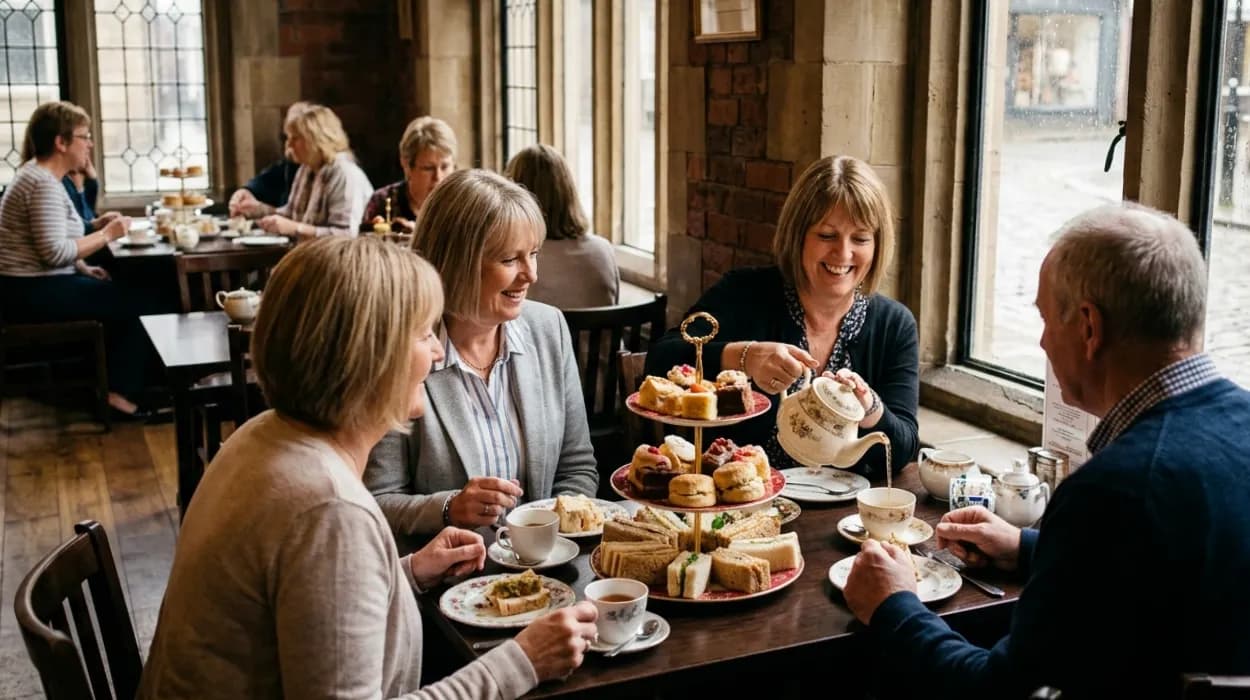
The traditional afternoon tea remains a cornerstone of British culinary culture, functioning as both a social ritual and a specific dining format. Within the Metropolitan Borough of Bolton, located in Greater Manchester, this dining custom is preserved across various historical estates, modern bistros, and specialized tea rooms. Identifying the premier locations for afternoon tea in Bolton requires evaluating structural menu components, historical preservation, and localized service standards.
What is the history of afternoon tea?
The tradition of afternoon tea originated in 1840 when Anna Maria Russell, the 7th Duchess of Bedford, requested a late-afternoon meal of tea, bread, butter, and cakes to bridge the standard twelve-hour gap between luncheon and dinner.
The Origins of the Mid-Afternoon Meal
During the early 19th century, the ruling classes in Great Britain shifted the primary evening meal from approximately 17:00 to 20:00. This social adjustment left an extended operational gap between the midday meal and supper, causing what historical documentation describes as a midday sinking feeling for the elite.
To combat this, the Duchess of Bedford began inviting members of the aristocracy to her private quarters at Woburn Abbey. By the late 1840s, this practice moved from private aristocratic residences to London drawing-rooms, transforming into an elite social gathering where the upper classes dressed in specific afternoon attire.
Evolution Into a Public Commercial Experience
By the late Victorian era, the afternoon tea ritual migrated from private estates to commercial tea rooms, high-end department stores, and luxury hotels. The introduction of public tea rooms allowed unescorted women to socialize safely outside the domestic sphere, advancing industrial and social mobility.
Simultaneously, industrial working-class populations developed "high tea," a distinct iteration served at a high dining table immediately after the completion of factory shifts. High tea featured heavy, hot savory items such as meat pies, cold meats, and jacket potatoes, differentiating it from the delicate, sweet-focused afternoon tea served on low drawing-room tables.
What components make up an authentic afternoon tea?
An authentic afternoon tea must consist of three distinct culinary tiers including finger sandwiches without crusts, freshly baked scones with clotted cream and jam, and an assortment of miniature pastries, all accompanied by loose-leaf tea varieties.
The Savory Component: Finger Sandwiches
The foundational layer of the traditional three-tiered stand contains savory items, specifically finger sandwiches. Authentic construction requires white or wholemeal bread sliced thin, with the crusts entirely removed.
Sandwiches are cut into uniform rectangular fingers or small triangles. Classic fillings follow strict historical protocols, utilizing precise ingredient combinations:
- Cucumber with salted butter on white bread.
- Smoked salmon with cream cheese and chives.
- Egg mayonnaise with mustard cress.
- Wiltshire ham with English mustard.
The Mid-Tier: Scones and Accompaniments
The middle tier contains baked scones, which must be served warm to maintain structural integrity. Traditional recipes dictate the inclusion of plain scones, fruit scones containing sultanas, or savory cheese variations.
Authentic service requires two specific condiments:
- Clotted Cream: A thick cream made by heating full-cream cow's milk using steam or a water bath and then leaving it in shallow pans to cool slowly, bringing the cream content to the surface. It must contain a minimum of 55% milk fat.
- Fruit Preserves: Typically strawberry or raspberry jam produced via traditional boiling methods.
The Top Tier: Patisserie and Sweet Delicacies
The uppermost tier showcases the technical skills of the pastry chef, featuring an assortment of bite-sized cakes and pastries. These items must balance textures and flavors, incorporating fruit tarts, choux pastry, sponge cakes, and chocolate elements. Examples include French macarons, miniature Victoria sponges, lemon posset tarts, and chocolate éclairs.
Where are the best places for afternoon tea in Bolton?
The best venues for afternoon tea in Bolton are Bake & Roast at Smithills Hall, The Last Drop Village Hotel & Spa, and The Cherry Tree at Blackrod, which provide verified regional excellence through historical ambiance and high-quality ingredients.
Bake & Roast at Smithills Hall
Located on Smithills Dean Road, Bake & Roast operates within the structure of Smithills Hall, a Grade I listed manor house with foundations dating back to the 14th century. This venue integrates local heritage with traditional baking methods.
Their handmade afternoon tea menu features traditional finger sandwiches, pork pies, mini quiches, and warm fruit scones served with authentic clotted cream. The venue accommodates up to 40 seated guests inside the historical tea room, making it a primary destination for heritage tourism and localized dining.
The Last Drop Village Hotel & Spa
Situated in Bromley Cross, Bolton, The Last Drop Village Hotel & Spa is a converted 18th-century farm village that delivers a traditional, multi-tiered afternoon tea service. Guests dine inside the Clocktower Bar Lounge or on the external decked terrace overlooking manicured gardens.
The hotel offers specialized menus including a Traditional Afternoon Tea and a distinct Cheese Afternoon Tea, which requires a mandatory 48-hour pre-booking notice. This structure emphasizes local Lancashire cheeses alongside classic British pastries.
The Cherry Tree at Blackrod
The Cherry Tree at Blackrod is an independent, family-owned bistro and bar located on Chorley Road in Blackrod, Bolton. This establishment focuses on contemporary British cuisine, sourcing ingredients from regional Lancashire farms and nearby coastlines.
Their afternoon tea presentation applies modern culinary techniques to classic components, offering artisan breads, fine patisserie, and a selection of premium loose-leaf infusions inside a modern dining space.
How do you properly prepare the perfect scone?
Preparing the perfect scone requires mixing cold cubed butter into self-raising flour, adding whole milk and sugar, handling the dough minimally to prevent gluten development, and baking at 220°C for exactly ten to twelve minutes.
The Scientific Sifting and Fat-Rubbing Process
The structural quality of a scone depends entirely on chemical reactions and temperature control. The primary formula requires sifting self-raising flour with a pinch of salt to aerate the dry ingredients. Cold, unsalted butter is cubed and rubbed into the flour using fingertips or a pastry blender until the mixture resembles fine breadcrumbs.
Keeping the fat cold is vital; if the butter melts before baking, the scone loses its flakiness. The cold fat expands during baking, creating air pockets that form a light texture.
Hydration and Shaping Mechanics
Once the fat is incorporated, caster sugar and cold whole milk are added to bind the mixture into a soft, sticky dough. Minimizing structural agitation during this stage prevents the activation of gluten proteins, which would cause a tough, bread-like texture.
The dough is turned onto a floured surface and pressed down by hand to a uniform thickness of 2.5 centimeters. Mechanical rolling pins are avoided to preserve internal air pockets. A sharp, straight-sided metal cutter is pressed directly down into the dough without twisting, ensuring the scone rises uniformly upward without tilting.
Thermal Expansion and Baking Protocols
The shaped dough rounds are placed on a heated baking tray lined with parchment paper and brushed lightly with an egg wash or milk glaze to produce a golden exterior finish. The tray is placed in an oven preheated to 220°C (425°F or Gas Mark 7).
The high heat causes immediate thermal expansion, forcing the chemical leavening agents—specifically sodium bicarbonate—to release carbon dioxide gas. This gas expands within the fat pockets, splitting the scone horizontally down the center after 10 to 12 minutes of baking.
Explore More Things To Do In Bolton
Best Dog-Friendly Pubs Cafes in Bolton Horwich
Best Independent Coffee Shops in Bolton Town Centre
What is the correct etiquette for eating afternoon tea?
The correct etiquette for eating afternoon tea requires pouring tea first before adding milk, breaking scones apart by hand instead of cutting them with a knife, and consuming items in a strict order from savory to sweet.
Tea Service Protocols and Pouring Mechanics
The performance of afternoon tea follows historical behavioral rules established in the 19th century. When using loose-leaf tea, a silver strainer is placed across the top of the porcelain teacup before pouring from the teapot.
The historic debate regarding the order of milk placement depends on the quality of the porcelain used:
- Historical Lower-Grade Ceramic: Milk was placed in the cup first to prevent the thermal shock of hot tea from cracking the glaze.
- Fine Bone China: Tea is poured first, allowing the guest to measure the exact amount of milk required to balance the flavor profile.
Stirring must be performed in a quiet, linear motion from the 6 o'clock position to the 12 o'clock position, preventing the spoon from clinking against the sides of the porcelain cup. The spoon is then placed on the back of the saucer.
Scone Consumption Protocols
Scones must never be sliced horizontally using a silver knife. Etiquette requires breaking the scone apart horizontally into two natural halves using fingers.
Each half is dressed individually using a small butter knife to apply the clotted cream and jam. The combination must be eaten in bite-sized portions rather than assembled back together into a sandwich. The precise order of cream and jam application depends on two distinct regional traditions:
- The Devon Method: Clotted cream is spread directly onto the warm scone first, acting as a base layer, with a dollop of fruit jam placed on top.
- The Cornish Method: Fruit jam is spread directly onto the scone first, followed by a spoonful of thick clotted cream on top.
The Order of Course Consumption
Dining must proceed strictly upward from the bottom tier of the stand to the top tier. Guests begin by consuming the savory finger sandwiches and savory bakes.
Once the savory items are finished, guests proceed to the warm mid-tier scones. The meal concludes with the consumption of the delicate sweets, tarts, and patisserie from the top tier.
How do afternoon tea venues accommodate modern dietary needs?
Modern afternoon tea venues accommodate dietary needs by engineering dedicated alternative menus that replace standard allergens with gluten-free flour blends, plant-based milk alternatives, and vegan proteins without altering traditional textures.
Gluten-Free Engineering and Cross-Contamination Barriers
The increasing diagnosis of celiac disease and wheat intolerances requires venues to alter the traditional afternoon tea structure. To produce gluten-free finger sandwiches and pastry items, pastry chefs substitute wheat flour with alternative starches, including rice flour, potato starch, and tapioca flour.
Xanthan gum is added to mimic the elastic binding properties of gluten, ensuring that gluten-free scones maintain their structural rise without crumbling. Venues like Bake & Roast at Smithills Hall require minimum group sizes for gluten-free bookings to implement absolute cross-contamination barriers within their preparation areas.
Vegan and Plant-Based Formulations
The shift toward plant-based diets has led to the creation of completely vegan afternoon teas. Traditional dairy and animal products are replaced with plant-derived alternatives across all three tiers:
- Savory Tier: Egg mayonnaise is replaced with seasoned pressed tofu, and meat proteins are substituted with jackfruit or marinated tempeh.
- Scone Tier: Whole milk is replaced with oat or soy milks, and butter is replaced with plant-oil spreads.
- Sweet Tier: Clotted cream is recreated using emulsified coconut cream and soy proteins, while egg whites in pastries are replaced with aquafaba—the starchy water left over from cooking chickpeas—to create vegan macarons and meringues.
What is the economic and cultural impact of afternoon tea today?
The afternoon tea industry drives significant revenue for hospitality venues by converting quiet mid-afternoon operational hours into high-margin dining periods supported by domestic tourism and experiential dining trends.
Hospitality Revenue and Capitalizing on Off-Peak Hours
In the modern commercial market, afternoon tea functions as a high-margin product for hotels, bistros, and historic estates. Restaurant kitchens experience low consumer demand between 14:00 and 17:00, creating operational inefficiencies.
Introducing a premium afternoon tea service allows venues to utilize kitchen staff and dining spaces during off-peak hours. Because the core ingredients—flour, sugar, eggs, and tea leaves—carry low wholesale costs, venues generate strong profit margins while charging premium retail rates for the experience.
Experiential Tourism and the Preservation of Heritage Sites
The contemporary consumer market prioritizes experiential dining over standard meals. Afternoon tea fulfills this demand by offering a structured, multi-sensory social ritual that appeals to both multi-generational family groups and international tourists.
For heritage venues like Smithills Hall, operating a dedicated tea room provides a sustainable income stream that helps fund the structural preservation of Grade I listed architecture. This symbiotic link between historical conservation and the hospitality industry ensures that the afternoon tea ritual remains an active component of Bolton's cultural economy.
FAQS
What is afternoon tea?
Afternoon tea is a traditional British dining ritual consisting of finger sandwiches, warm scones with clotted cream and jam, miniature pastries, and loose-leaf tea served during the mid-afternoon period.