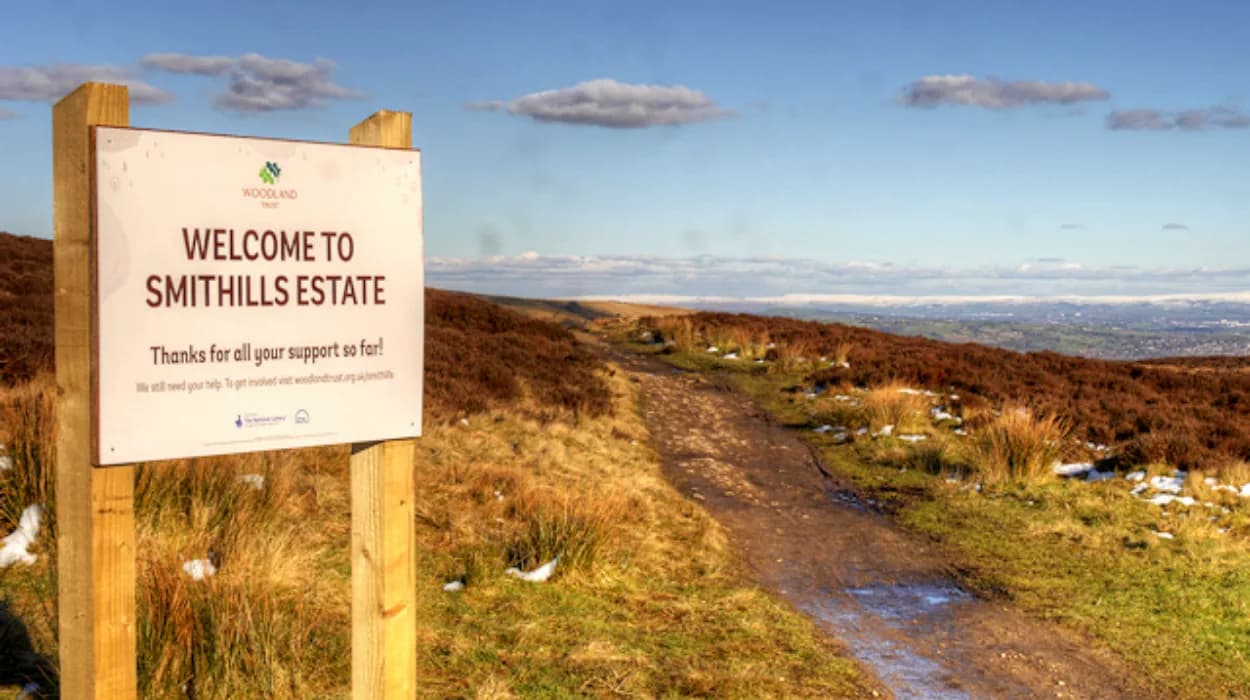
Smithills Estate is one of Bolton’s most important historic landscapes, combining a medieval manor, Grade I listed Smithills Hall, historic farmland, ancient woodland, moorland, cloughs, gardens and surviving estate infrastructure. Its history records more than 800 years of land ownership, agriculture, architecture and conservation.
Located on the northern edge of Bolton beside the West Pennine Moors, the estate connects the town’s urban history with its rural landscape. Smithills Hall provides the architectural centre of this historic environment, while the surrounding land preserves evidence of farming, woodland management, transport, estate planning and changing patterns of land use.
The estate is also significant because its history extends beyond the survival of one historic house. Historic maps, listed structures, surviving landscape features and documented ownership changes show how the land developed over centuries. The estate passed through several prominent families, experienced periods of investment and neglect, and eventually became public property before substantial areas entered modern conservation management.
Today, Smithills represents an important example of historic landscape continuity in Greater Manchester. Its medieval buildings, Victorian additions, agricultural land and woodland demonstrate how successive generations reshaped the same geographical setting while retaining important elements of earlier landscapes.
What is the history of Smithills Estate?
Smithills Estate has an 800-year documented history shaped by medieval landholding, family ownership, farming, Victorian development, public acquisition and modern conservation, with Smithills Hall remaining its principal historic building and the surrounding landscape preserving evidence of earlier agricultural and estate management.
The earliest documented history of Smithills is connected with the medieval manor system of Lancashire. Historic England records that the estate was held by the Hospitallers from the late 12th century or earlier. The Hospitallers were a religious military order that controlled land and property across medieval England.
The land was subsequently leased or occupied by different families. The Radcliffe family became resident at Smithills from 1335, establishing the beginning of the estate’s documented connection with a long succession of private landowners. Bolton Libraries and Museums also identifies 1335 as the starting point of the hall’s recorded 800-year story.
The estate later passed through the Barton family and then the Belasyse family. In the 18th century, ownership changed again before the Ainsworth family acquired Smithills in 1801. The Ainsworths were successful Bolton bleachers whose wealth reflected the industrial development of Lancashire.
The Ainsworth period produced major architectural and landscape changes. The family invested in the medieval house, modernised parts of the property and commissioned Victorian architectural work. George Devey, a prominent Victorian architect, designed significant additions to the hall during the later 19th century.
The estate remained privately owned until 1938, when Bolton Corporation purchased Smithills Hall and its surrounding estate for £70,600. This transaction transformed Smithills from a private landed estate into a public heritage asset.
The subsequent history has involved museum use, public access, restoration and conservation. The Woodland Trust acquired substantial parts of the wider Smithills Estate in the 21st century, creating a modern conservation framework for woodland, moorland and agricultural habitats.
When did Smithills Hall and Estate first become historically significant?
Smithills became historically significant during the medieval period because its land formed part of a manorial estate connected with the Hospitallers, while the Radcliffe family’s documented residence from 1335 established a continuous association between the site, local landholding and the development of Smithills Hall.
The medieval significance of Smithills rests on both its ownership history and its surviving architecture. The estate was part of a wider system in which religious institutions, landed families and agricultural tenants controlled land and resources.
The Hospitallers’ involvement places Smithills within the medieval religious and economic landscape of northern England. Their ownership also demonstrates that the estate had significance beyond the immediate household occupying the hall.
By 1335, William Radcliffe had obtained the manor from the Hulton family, according to Bolton Libraries and Museums. The Radcliffe connection marks a major point in the estate’s documented history because the family became resident landowners associated directly with Smithills Hall.
The surviving building contains fabric from several historical periods. Historic England identifies the earliest part as a medieval open hall, with later wings and extensions added over successive centuries. The building therefore acts as a physical record of changing domestic, social and architectural requirements.
The surrounding landscape also developed alongside the hall. Agricultural land supported the estate economy, while woodland and moorland provided resources and formed the geographical setting of the house.
Smithills’ historical importance therefore comes from the relationship between the building and its landscape. The hall cannot be fully understood without considering the farms, woods, fields, cloughs, roads and estate boundaries that supported it.
How did medieval ownership shape Smithills Estate?
Medieval ownership established Smithills as a managed manorial landscape where land, agriculture and residence were closely connected, creating the foundation for later estate development. The Radcliffe family’s residence from 1335 strengthened Smithills as a long-term centre of local landholding.
Medieval manors operated as economic and administrative units. Landowners controlled estates that included agricultural fields, woodland, pasture and residential buildings. Smithills developed within this system.
The Radcliffe family became associated with Smithills in 1335. Their ownership created a lasting connection between the family and the estate. In 1485, the last Radcliffe owner died without a male heir, and Smithills passed to the Barton family through inheritance arrangements.
The Barton family were wealthy sheep owners. Their ownership reflects the importance of livestock and wool production within the regional economy. Sheep farming was a major element of the medieval and early modern economy of northern England, connecting rural estates with wider textile markets.
The estate continued to evolve as landholding patterns changed. In 1620, a map was prepared by William Senior for Sir Thomas Barton. This map provides important evidence for understanding the historic geography of the estate.
Historic maps are particularly valuable because they record field patterns, farms, roads and estate boundaries that later development altered. The 1620 map therefore forms part of the documentary evidence for Smithills’ historic landscape.
The survival of mapped evidence alongside the physical landscape allows researchers to compare past and present land use. This process helps identify long-term continuity and changes in farming, woodland management and estate organisation.
How did the Barton and Belasyse families change Smithills?
The Barton family inherited Smithills in the late 15th century and retained the estate for almost 200 years before it passed by marriage to the Belasyse family in 1659, beginning a period when Smithills received less direct investment and experienced increasing neglect.
The Barton period represented a long phase of family ownership. The family’s wealth was connected to sheep farming, linking Smithills directly with the economic importance of livestock and wool.
The estate remained with the Bartons for almost two centuries. This long period of ownership allowed the family to establish a substantial connection with the property and its agricultural resources.
In 1659, Smithills passed through marriage to the Belasyse family. The Belasyses owned properties elsewhere in England and had less direct need to maintain Smithills as their principal residence.
This change affected the condition of the estate. Bolton Libraries and Museums records that Smithills entered a period of neglect under the Belasyse ownership.
The history demonstrates an important principle in historic estate development. The physical condition of a country house depended heavily on the financial resources and residential priorities of its owners. When an estate ceased to function as a primary family residence, investment in buildings and landscapes often declined.
Smithills’ later restoration therefore involved repairing and adapting a property that had experienced centuries of incremental change, periods of neglect and changing patterns of occupation.
What happened to Smithills Estate during the 18th century?
During the 18th century, Smithills changed ownership again and became associated with the Byrom family of Manchester, while historic mapping recorded the estate’s expanding agricultural structure and provided evidence of its continuing importance as a managed rural landscape.
Historic England records that the estate was purchased by the Byroms of Manchester in 1722. The Byrom ownership connected Smithills with the growing influence of Manchester’s prosperous commercial families.
A further important record dates from 1769. Hugh Oldham produced a map for Edward Byrom, documenting the estate at a time when agricultural organisation remained central to its identity.
The Woodland Trust records that Smithills contained six farms in 1620. By 1769, the number had increased to 14 farms, ranging from 2.6 hectares, equivalent to 6.5 acres, to 48.9 hectares, equivalent to 121 acres.
This increase demonstrates the complexity of the historic agricultural landscape. Smithills was not simply a single country house surrounded by ornamental grounds. It was an estate containing multiple agricultural holdings and a productive rural economy.
The 18th-century landscape also provides important evidence of how land was divided and managed. Farm sizes varied significantly, showing that agricultural production operated at different scales within the same estate.
Historic maps are therefore essential to understanding Smithills. They reveal patterns that are less obvious from the modern landscape, including former field divisions and historic routes.
The surviving estate landscape retains elements of this agricultural history even though modern land management differs from the 18th-century system.
Why is the Ainsworth family important to Smithills Hall?
The Ainsworth family transformed Smithills during the 19th century by acquiring the estate in 1801, investing in the historic house and commissioning major Victorian alterations that connected the medieval building with contemporary domestic architecture and landscaped estate design.
The Ainsworth family acquired Smithills in 1801. They were successful Bolton bleachers, and their ownership reflected the economic power created by the Lancashire textile industry.
Bleaching was an important stage in textile production. Bleachers processed cloth to improve its appearance before further manufacturing or sale. The industry contributed to the wealth of families who became significant landowners during the Industrial Revolution.
The Ainsworths used their wealth to modernise Smithills. Their period of ownership produced some of the most visible changes to the building and its surroundings.
The estate demonstrates how industrial wealth reshaped historic rural properties. Wealth generated by textile production supported investment in country houses, gardens and estate infrastructure.
In 1870, Richard Henry Ainsworth inherited the house. He subsequently employed George Devey, an influential Victorian architect known for designing country houses and estate buildings.
Devey worked on Smithills during the 1870s and 1880s. Historic England records alterations and extensions during 1874–1878 and again from 1882–1886.
These works created a building that combines medieval, Tudor-period and Victorian architectural elements. The result is not a single-period house but a layered historic structure.
This architectural layering is central to Smithills’ significance. Each generation adapted the building to new social expectations while retaining substantial earlier fabric.
How did George Devey influence the historic landscape?
George Devey influenced Smithills through Victorian extensions to the hall and associated estate architecture, creating a unified relationship between historic buildings, domestic interiors, gardens, approaches and parkland while retaining the medieval character of the original house.
George Devey was a prominent Victorian architect whose work at Smithills extended beyond a simple enlargement of the building.
Historic England identifies a Devey-designed westward extension and a Tudor-style coach house and stable block. The stable complex was probably constructed during the early 1880s after Devey was asked to remove existing stables.
The Devey work demonstrates the Victorian approach to historic architecture. Architects frequently combined new construction with carefully designed references to earlier architectural traditions.
At Smithills, this approach created visual continuity between different phases of the estate. Medieval fabric remained central, while Victorian additions introduced new accommodation and improved domestic facilities.
The wider landscape also changed during this period. Historic England identifies mid-to-late 19th-century pleasure grounds, late 19th-century gardens and associated parkland.
These features demonstrate the changing role of the country estate. The landscape became not only an agricultural resource but also a designed environment associated with leisure, status and domestic life.
The historic setting therefore has architectural significance as well as landscape value. The relationship between the hall, gardens, parkland, approaches and surrounding land forms an integrated historic composition.
What architectural features survive at Smithills Hall?
Smithills Hall survives as a multi-period historic building containing medieval, Tudor-period and Victorian fabric, including an early open hall, later wings, timber framing, stone construction and George Devey’s 19th-century extensions.
Smithills Hall is Grade I listed, the highest category of statutory protection for buildings of exceptional historic and architectural interest in England.
Historic England identifies the earliest surviving part as a late 14th-century open hall, while another listing describes the origins as an early 14th-century medieval hall house. The differing descriptions reflect the complexity of dating the building and its successive phases.
The building was expanded through later additions. An east wing was added during the 15th or early 16th century, while the west wing originated later and was remodelled during the Victorian period.
The original building used roughly coursed and squared rubble, with timber-framed internal partitions. The east wing combines timber framing and stone construction.
The architectural development records changes in domestic life. Medieval halls were organised differently from Victorian country houses. As expectations of privacy, heating, servants’ accommodation and leisure changed, the building required new rooms and circulation arrangements.
The result is a long frontage containing buildings of different heights, materials and architectural styles. This visual complexity is one of the defining characteristics of Smithills Hall.
The hall’s significance therefore lies not only in its age but in its survival as an architectural document showing how one historic house developed over centuries.
How did the Smithills landscape develop around the hall?
The historic landscape developed through a combination of agricultural land, woodland, moorland, gardens, pleasure grounds, parkland, estate roads and watercourses, creating a layered environment where medieval land use and Victorian landscape design remain connected.
Smithills Hall occupies a platform beside a steep valley formed by a tributary of the Raveden Brook. The topography influenced the position of the building and shaped the surrounding landscape.
Historic England records a site of approximately 48 hectares for the registered historic landscape associated with the hall. The boundaries include Smithills Dean Road, an early 19th-century tram road, Raveden Clough and land adjoining schools and playing fields.
The principal approach begins from Smithills Dean Road. A lodge and drive lead towards the hall, with historic gate piers and an avenue contributing to the formal approach.
The landscape contains evidence of 19th-century design. Pleasure grounds, gardens and parkland formed part of the Victorian setting of the medieval house.
This arrangement illustrates the principle of landscape integration. Historic buildings were not isolated structures. Their architectural importance depended partly on approaches, gardens, views and surrounding land.
Smithills preserves this relationship unusually well. The medieval hall remains visually connected with the wider landscape, while the transition from formal gardens to agricultural land, woodland and moorland demonstrates the different functions of the estate.
The landscape is therefore an essential part of the historical interpretation of Smithills Hall.
How did agriculture shape the Smithills Estate?
Agriculture shaped Smithills for centuries by supporting multiple farms, livestock production and estate income, while field boundaries, farm sites and historic maps preserve evidence of a rural economy that continued alongside the development of the hall and its designed landscape.
The agricultural history of Smithills extends across several centuries. The estate contained six farms in 1620 and 14 farms by 1769, demonstrating significant organisation of land for agricultural production.
Farm sizes varied considerably. The smallest holdings recorded for 1769 covered 2.6 hectares, while the largest covered 48.9 hectares.
This variation indicates a diversified agricultural structure. Different farms performed different roles within the wider estate economy, supporting livestock, crops and estate management.
Agricultural land also influenced the appearance of the landscape. Fields required boundaries, access routes and drainage. Dry-stone walls and other historic boundary features form part of the wider cultural landscape.
The decline of traditional farming occurred gradually. The Woodland Trust records that farming declined over time, with neglect during the Second World War and increasing costs of estate management contributing to the deterioration of agricultural infrastructure.
The modern estate therefore contains evidence of both agricultural continuity and agricultural decline.
Understanding this history is important because it prevents the landscape from being viewed solely as woodland or recreational countryside. Its present appearance developed from centuries of farming and land management.
What happened to Smithills Estate after the Ainsworth family?
After the First World War, rising maintenance costs and changing economic conditions placed increasing financial pressure on the Ainsworth estate, leading to its sale to Bolton Corporation in 1938 and its transition from private ownership to public heritage management.
The economic conditions of the early 20th century changed the viability of large country estates.
After the First World War, estate owners faced rising costs and reduced income. Maintaining a large historic house and extensive grounds required substantial resources.
At Smithills, the financial burden eventually became unsustainable for the Ainsworth family. In 1938, Smithills was sold to Bolton Corporation for £70,600.
The acquisition represented a major turning point. Bolton Corporation, the predecessor of the modern local authority, became responsible for the historic house and estate.
The Victorian parts of the hall subsequently served as a residential home and later as a day centre. These uses demonstrate how historic buildings often gained new functions after their private ownership ended.
The older sections received conservation attention. Part of the Grade I listed structure opened as a museum in 1963.
The museum function established Smithills as a public heritage site. The building could then serve educational and cultural purposes while preserving its historic fabric.
During the 1990s, the museum expanded into parts of the Victorian sections. This process brought more of the building’s architectural history into public interpretation.
How did Smithills Hall become a public heritage site?
Smithills Hall became a public heritage site after Bolton Corporation acquired the estate in 1938, with museum access beginning in 1963 and later restoration opening more Victorian interiors to visitors and educational use.
Public ownership changed the purpose of Smithills Hall.
A private country house had primarily served the needs of an individual family and estate administration. Under public ownership, the historic building became a cultural and educational resource.
The opening of part of the hall as a museum in 1963 marked an important stage in this transition. The medieval sections provided an exceptional setting for interpreting local history.
The museum expanded during the 1990s. Victorian areas were brought into the visitor experience, allowing the history of the building to be presented across several architectural periods.
The west wing underwent further restoration in the 21st century. In 2017, Bolton Council announced a £500,000 project to restore the west wing, including the Devey Room, Ainsworth Room, entrance hall and associated facilities. Funding for the project was enabled through the sale of land forming part of the nearby Smithills Estate to the Woodland Trust in 2015.
This restoration demonstrates the continuing relationship between the hall and the wider estate. Conservation of the building and management of the surrounding landscape remain interconnected heritage priorities.
To experience this historic landmark in person today, consult our comprehensive [Best Walking Trails in Smithills for Nature Lovers and Outdoor Adventure Seekers] for itineraries and visiting parameters.
What is the long-term historical importance of Smithills Estate?
The long-term importance of Smithills Estate lies in the survival of an integrated historic landscape where medieval architecture, Victorian country-house design, agricultural land, ancient woodland and modern conservation remain connected within the same geographical setting.
Smithills is historically valuable because its story has not ended with the preservation of a single building.
The estate continues to demonstrate historical change through its physical environment. The hall preserves architectural layers. The surrounding land records agricultural organisation. Woodland reflects ecological continuity and historical management. Roads, boundaries and landscape features preserve evidence of earlier estate planning.
The documented timeline extends from medieval religious ownership to modern conservation. The Hospitallers, Radcliffe family, Barton family, Belasyse family, Byrom family and Ainsworth family each formed part of the estate’s ownership history before public and conservation management transformed its role.
The estate’s future historical relevance depends on continued preservation and research.
Historic maps from 1620 and 1769 provide documentary evidence that can be compared with surviving landscape features. Architectural investigation can identify building phases within the hall. Archaeological research can examine the relationship between settlement, farming and land use.
Environmental conservation also contributes to historical understanding. Ancient woodland and other habitats provide evidence of long-term ecological conditions and human intervention.
Smithills therefore remains an active historical record rather than a static monument. Its value lies in the combination of built heritage, landscape evidence and documented ownership.
For Bolton, the estate provides an important link between the town’s medieval origins and its industrial and post-industrial development. For visitors and researchers, it offers an unusually complete example of how a historic estate changed while retaining significant elements of its original character.
The history of Smithills Estate ultimately demonstrates the importance of studying buildings and landscapes together. Smithills Hall, its gardens, parkland, farms, woodland, moorland and historic approaches form a connected heritage resource. Protecting these elements together ensures that future generations can continue to understand how Bolton’s rural and urban histories developed across more than eight centuries.
FAQS
What is Smithills Estate famous for?
Smithills Estate is famous for its historic Smithills Hall, medieval origins, Victorian architecture, ancient woodland, agricultural heritage and scenic landscape on the northern edge of Bolton.