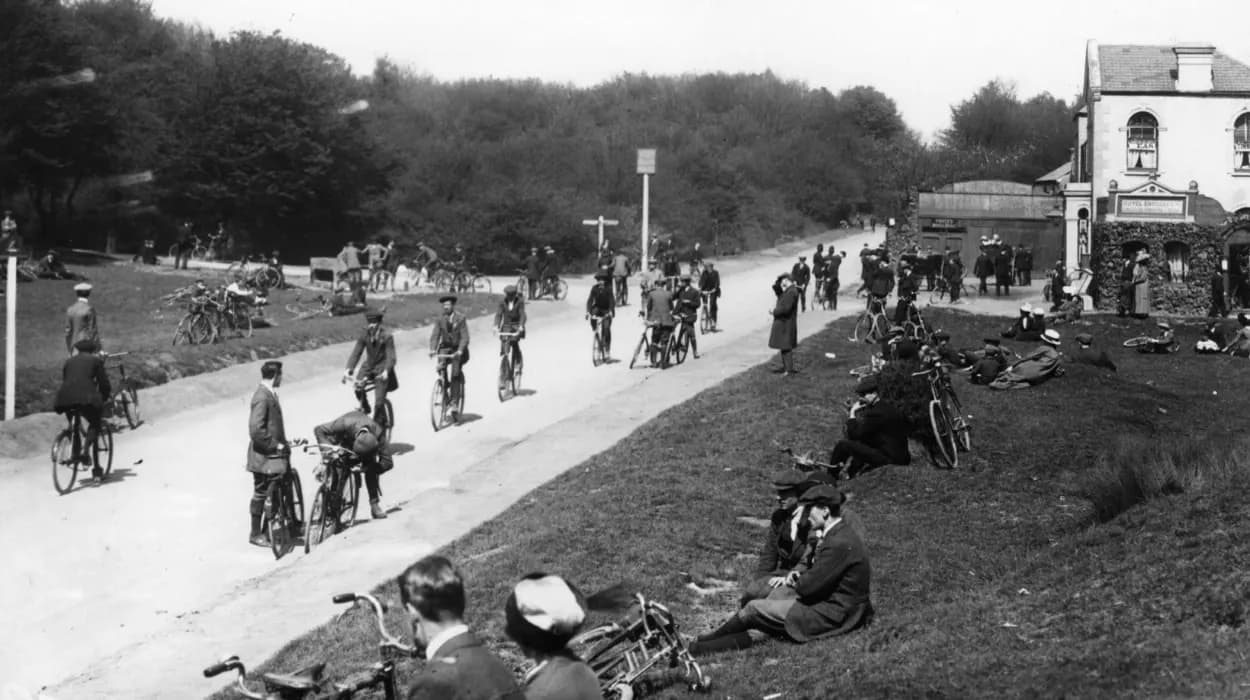
Horwich’s transport history reflects the transformation of a rural Lancashire settlement into a major industrial and railway town. Roads, horse-drawn trams, railways, bicycles, buses and motor vehicles each changed how residents travelled, worked and used the surrounding landscape. The arrival of the Lancashire and Yorkshire Railway’s locomotive works in the 1880s was the decisive turning point.
Cycling developed alongside this transport revolution. By the twentieth century, bicycles provided workers with affordable personal mobility while cycling clubs created organised sporting and social networks. Horwich Cycling Club, founded in 1934, later established a strong tradition of road racing, touring, time trials and community events.
The history therefore extends beyond individual bicycles. It includes the roads that connected Horwich with Bolton and neighbouring communities, the railway infrastructure that supported industrial employment, the tram system that carried passengers, and the cycling culture that emerged around the town’s changing landscape.
How did Horwich develop before modern transport?
Horwich began as a rural settlement surrounded by open countryside, moorland and agricultural land, with walking, horses, carts and carriages forming the main transport system before industrialisation transformed employment and settlement patterns in the nineteenth century.
Horwich has ancient origins. Horwich Town Council records Bronze Age burial sites in the hills surrounding the town, while the settlement developed within a landscape associated with the ancient forest of Horwich. The town remained predominantly rural until industrial expansion accelerated from the late eighteenth century.
The Ridgway family played an important role in early industrial development. In the late eighteenth century, the family moved its bleaching operations to Wallsuches, off Chorley Old Road. The site demonstrates how textile-related industry began altering the local economy before the arrival of the major railway works.
Transport during this period depended heavily on roads and animal power. Workers walked between settlements and workplaces. Horses pulled carts carrying materials and goods. Carriages provided longer-distance passenger transport for people who could afford them.
The geography of Horwich influenced these journeys. The town sits close to the West Pennine Moors, while routes towards Bolton, Chorley and surrounding villages connected industrial communities with rural districts.
This road network later became important for cyclists. The development of reliable bicycles gave residents a form of transport that required neither a horse nor access to a railway timetable.
The relationship between industry and transport became increasingly important during the nineteenth century. Mills, quarries, workshops and other industrial employers required dependable movement of workers, raw materials and finished goods. Horwich therefore entered the transport revolution through a combination of improved roads, railways and public transport.
When did the railway first reach Horwich?
Railway transport reached Horwich through the Blackrod branch in 1868, when goods services began, followed by passenger services in 1870; this infrastructure preceded the locomotive works by sixteen years and established the railway as a permanent feature of Horwich transport.
The railway transformed the scale and speed of movement around Horwich. The branch from Blackrod to Horwich opened for goods traffic on 15 July 1868. Passenger services began on 14 February 1870. The line and station cost £30,400, according to Horwich Heritage’s historical account.
The station originally consisted of one platform, a station building containing a booking office and two waiting rooms, toilets and a goods shed. This infrastructure served both passengers and commercial traffic.
The chronology is important because the railway did not arrive in Horwich only because of the locomotive works. The branch existed before the Lancashire and Yorkshire Railway decided to establish its major engineering complex.
Horwich’s first railway connection also depended on Blackrod. The station now known as Blackrod was originally associated with Horwich, including names such as Horwich Road and Horwich and Blackrod. It later became Horwich Junction after the Horwich branch opened.
The railway created new possibilities for commuting and freight movement. Workers no longer depended entirely on walking or horse transport for longer journeys. Businesses gained a more efficient method of moving industrial goods.
The railway also connected Horwich to the wider Lancashire transport system. The Lancashire and Yorkshire Railway became a major railway company serving towns and cities across northern England. Its network linked industrial communities and provided the infrastructure that supported the expansion of manufacturing.
The railway’s importance increased dramatically after 1884, when the company purchased land for the locomotive works.
Why did Horwich Locomotive Works transform transport in the town?
Horwich Locomotive Works transformed local transport because the Lancashire and Yorkshire Railway established a large engineering complex from 1884, creating industrial employment, expanding the town and increasing demand for railway connections, passenger services, roads, housing and affordable everyday travel.
In 1884, the Lancashire and Yorkshire Railway acquired land at Horwich for a new locomotive works. The project replaced the company’s cramped works at Miles Platting in Manchester. Construction continued through the following years, and the works became fully operational in 1892.
The site was designed as a large railway engineering complex. It included locomotive-building facilities, repair shops, foundries, a forge, a smithy and other specialist workshops. Internal railway tracks connected different parts of the works.
The works changed the physical geography of Horwich. Rows of brick workers’ cottages appeared along Chorley New Road, creating a direct relationship between housing, employment and transport infrastructure. Heritage records describe the works as a centre of a new community.
Employment growth also increased passenger transport demand. The existing railway station struggled to keep pace with the needs of the expanding workforce. A further railway connection from Bolton was constructed, although engineering constraints included the narrow bridge beneath Chorley New Road.
The locomotive works also influenced cycling indirectly. A large industrial workforce needed affordable ways to travel between home and employment. Walking remained important, but bicycles increasingly provided a practical alternative for workers who lived beyond easy walking distance.
The Science Museum Group records that Horwich Works produced 677 new locomotives during its first ten years of operation. Its engineering role expanded into mechanical, electrical and hydraulic work, making the site an important industrial institution rather than simply a locomotive shed.
Horwich therefore became a railway town in both economic and physical terms. Transport was no longer simply a service connecting the town to elsewhere. Transport infrastructure became part of the town’s industrial identity.
How did horse-drawn and electric trams change travel in Horwich?
Horse-drawn trams expanded affordable public transport between Horwich and Bolton before electric tramcars replaced them from 1900; the Horwich route eventually operated as route N and continued until 1946, when buses and changing road transport had made trams obsolete.
Horse-drawn trams were introduced as Horwich and Bolton grew. Horwich Heritage records that horse trams reached Horwich after the construction of the locomotive works, linking the expanding industrial town with Bolton.
The system reflected the social consequences of industrialisation. Large numbers of workers needed dependable transport between residential areas and workplaces. Public transport provided a shared alternative to walking.
The Chorley New Road route developed significantly around the beginning of the twentieth century. Twin tracks reached the Crown Hotel in late 1900. A single-line extension continued around the Crown into Lee Lane, Church Street and Victoria Road before rejoining Chorley New Road.
Bolton Corporation introduced electric tramcars in 1900. Electric traction allowed the horse-drawn system to be phased out and represented a major technological change in local public transport.
A tram depot for eight cars was built on Chorley New Road at the junction with Mottram Street. A passenger waiting room stood alongside the depot. The former tram building survives as a reminder of this period and is now occupied by a tyre depot.
The Horwich route carried the letter N. Some services terminated earlier, including at the Beehive, while other services continued towards Horwich.
Trams also affected cycling conditions. Horwich Heritage records that cyclists had to contend with tramlines, particularly in wet conditions. After the tram route closed, the rails and overhead wires were removed, leaving clearer road space for other road users.
This detail illustrates an important point in transport history: different modes competed for the same road space. Pedestrians, cyclists, trams, horse traffic and later motor vehicles all required infrastructure designed for increasingly complex urban movement.
When did cycling become established in Horwich?
Cycling became an established part of Horwich social and sporting life during the early twentieth century, developing from practical bicycle travel into organised club activity; Horwich Cycling Club was founded in 1934 after earlier cycling traditions had already developed locally.
Cycling spread across Lancashire during the late nineteenth and early twentieth centuries. Academic research into British outdoor recreation records a strong Lancashire cycling culture, with dozens of cycling clubs established in the county by the 1880s and further growth after cheaper bicycles became available.
Cycling was particularly significant in industrial districts because it combined transport and recreation. A bicycle allowed a worker to travel independently while also providing access to countryside beyond the built-up town.
Horwich’s location was well suited to this development. The town stands near the West Pennine Moors and has road connections into surrounding countryside. Cycling therefore connected industrial Horwich with rural landscapes around Rivington, Anglezarke and neighbouring Lancashire districts.
Horwich Heritage records the career of Frank Hart, who became an important figure in local cycling. Hart worked as an apprentice fitter at Horwich Locomotive Works before later working at Leyland Motors. He cycled between Horwich and Leyland, a journey of about 25 miles, demonstrating the bicycle’s practical value as personal transport.
Hart was also a successful cyclist during the late 1920s and early 1930s, competing in time trials and hill climbs. He became a founder member of Horwich Cycling Club in 1934 and served as its first president until 1965.
The development of cycle shops further strengthened the local cycling economy. Hart established a cycle shop on Wright Street before moving to the Arcade and later operating additional shops at 246 Chorley New Road in Horwich and 58 Market Street in Westhoughton.
Cycling therefore developed through several connected elements: affordable bicycles, local roads, industrial employment, cycle retailing, organised clubs and access to open countryside.
What was the history of Horwich Cycling Club?
Horwich Cycling Club was founded in 1934 and developed a long tradition of road racing, time trials, touring and family riding; by 1960 it had more than 100 members, while later decades produced nationally recognised riders and organised competitive events.
Horwich Cycling Club began as a group of cycling enthusiasts and was formerly known as Horwich Wheelers. The club celebrated its 90th anniversary in 2024, confirming its foundation date as 1934.
Its activities extended beyond competitive racing. Horwich Heritage records four sections operating during the 1960 period: road racing, time trials, touring and family rides. Membership exceeded 100 at that time.
This structure demonstrates how cycling served different purposes. Racing developed performance and competition. Time trials emphasised individual speed over measured distances. Touring connected cyclists with destinations beyond Horwich. Family rides provided recreational participation.
The club also became associated with notable cyclists. Its history records riders including Dave Smith, John Kavanagh, John Fiddies and Vinny Smith, alongside former professional rider Dave Leyland. Club riders competed in major British events and international competitions.
The club’s competitive activities expanded beyond road racing. Cyclo-cross, mountain biking and local criterium racing became part of its programme. The club also organised races and supported cycling events in the surrounding area.
Horwich’s cycling culture also connected with wider regional organisations. The Lancashire Road Club was established in 1923 in Bolton and developed strong traditions in road racing, touring and social cycling. Its history records regular cycling holidays to the Lake District and Yorkshire Dales, demonstrating the wider regional culture in which Horwich cyclists participated.
Cycling in Horwich was therefore not isolated from the wider Lancashire cycling movement. It formed part of a regional network of clubs, competitions, touring routes and social organisations.
How did buses and motor vehicles replace trams?
Motor buses began operating in Bolton in 1923 and gradually replaced the tram system; Horwich route N finally closed in 1946, while motor vehicles increasingly reshaped roads, commuting patterns and the balance between public transport, cycling and private car travel.
The arrival of buses introduced greater flexibility into local passenger transport. Unlike fixed tram tracks, buses operated directly on roads and did not require rails or overhead electrical infrastructure.
Bolton’s motor bus services began in 1923. For a period, buses and trams operated alongside each other. The Horwich tram route eventually closed in 1946.
The closure marked a significant change in the appearance of Horwich roads. Tram rails and overhead wires were removed, eliminating infrastructure that had occupied part of the road surface.
Motor vehicles also became increasingly visible during the early twentieth century. Horwich Heritage’s account of Horwich in 1903 records the growing influence of the motor car, telephone, electricity and other technologies. Most local journeys still involved walking, horses or carts at that time, but modern transport systems were already developing.
The transition was gradual rather than instantaneous. Buses expanded passenger mobility, while cars increasingly provided private transport. Lorries became important for industrial freight.
Cyclists continued using the same road network. This produced a changing relationship between transport modes. Roads that had once accommodated pedestrians, horses and bicycles increasingly had to serve motor traffic.
The history of Horwich therefore reflects the national transition from animal-powered transport to mechanical transport. The process affected road design, travel speeds, commuting distances and the organisation of urban space.
The decline of trams did not end public transport. It changed its technology and operating structure.
What happened to Horwich Station and railway transport after the Second World War?
Horwich Station remained part of the town’s railway system until passenger services ended in September 1965, following the national railway restructuring associated with the Beeching era; goods services continued briefly before the station site was eventually converted into recreational space.
Railway transport remained central to Horwich throughout the industrial era. Horwich Works continued building and repairing railway vehicles long after its original Lancashire and Yorkshire Railway ownership ended.
The Lancashire and Yorkshire Railway amalgamated with the London and North Western Railway in 1922. The railway companies were then reorganised under the 1923 Grouping, creating the London, Midland and Scottish Railway. Nationalisation followed in 1948, when Britain’s railway system became part of British Railways.
Horwich Works continued adapting to these changes. The Science Museum Group records that locomotive production was suspended during the economic depression in 1931, resumed during the Second World War period and eventually shifted from steam to diesel and other railway engineering.
The last steam locomotive built at Horwich Works was completed in 1957. The works subsequently concentrated increasingly on repairs and other railway engineering before closing in 1983.
Horwich Station faced a different fate. Passenger services ended in September 1965, with the last passenger train leaving on Saturday 25 September. The station fell within the major programme of railway closures associated with the Beeching era.
Goods services continued for a further year before the station closed completely. The former station site later became Old Station Park, creating a modern recreational use from former railway land.
This change is significant for understanding modern Horwich. Former transport infrastructure has not disappeared entirely. Some railway routes, buildings, industrial structures and converted sites remain as physical evidence of earlier transport systems.
How can Horwich’s cycling and transport heritage still be seen today?
Horwich retains transport heritage through surviving industrial buildings, former railway sites, the former tram depot, historic roads, community archives and cycling traditions; these physical and documentary remains connect present-day travel with the town’s industrial transformation from the nineteenth century onward.
The strongest surviving reminder of railway-era Horwich is the former locomotive works. Heritage records identify the works as a major nineteenth-century engineering complex, with buildings constructed during the first phase of development and later additions for specialist industrial processes.
The former works also represents the scale of industrial employment that shaped Horwich. The site produced locomotives, supported railway maintenance and contributed to wartime manufacturing. During the First and Second World Wars, the works produced armaments and other military equipment.
The transport story is also preserved through Horwich Heritage. Horwich Heritage was established in 1984 after the closure of the locomotive works in 1983. The organisation developed to preserve local history and strengthen public interest in the town’s heritage.
Its Heritage Centre opened at its present Beaumont Road location in 2006. The centre contains exhibitions, archive material and research facilities and provides public access to local historical resources.
The former railway station site provides another example of adaptive reuse. Old Station Park occupies land associated with the former Horwich railway station, preserving the location within the town’s modern recreational landscape.
The former tram depot on Chorley New Road is another physical reminder of public transport history. Its continued existence allows the twentieth-century tram network to be understood through surviving built fabric.
Cycling heritage remains active rather than purely archaeological. Horwich Cycling Club continues to operate and British Cycling lists it as an affiliated club in Lancashire. Its modern membership includes riders across different cycling disciplines.
The club’s historical activities also remain relevant to local heritage. Its road-racing tradition, Rivington events, cyclo-cross activities and community involvement demonstrate how cycling developed from practical transport into organised sport and recreation.
For visitors exploring the relationship between Horwich’s historic places, transport infrastructure and modern leisure landscape, consult our comprehensive [Scenic Cycling Routes Across Horwich Perfect for Weekend Outdoor Adventures and Exploration] for itineraries and visiting parameters.
Why is the history of cycling and transport important to Horwich today?
Horwich’s transport history explains how the town developed from a rural settlement into an industrial community and then a modern residential and recreational centre, while cycling demonstrates the continuing importance of independent mobility, community sport, heritage routes and access to surrounding countryside.
Transport history provides a framework for understanding Horwich’s urban development. The sequence is clear: rural roads supported early settlement; industrialisation increased movement; the railway created new regional connections; the locomotive works generated major employment; trams expanded public transport; buses replaced trams; motor vehicles reshaped roads; and cycling remained a durable form of personal mobility.
The railway was the central industrial catalyst. The Lancashire and Yorkshire Railway’s decision in 1884 to establish its locomotive works altered employment, housing and population patterns. Horwich Town Council records that the town’s population grew to 12,850 during the period of industrial expansion associated with the works.
Cycling formed part of this wider transformation because it gave workers and residents independent control over local journeys. The example of Frank Hart cycling around 25 miles between Horwich and Leyland demonstrates the practical distance a bicycle could cover for employment.
Organised cycling also created a social record of twentieth-century Horwich. The foundation of Horwich Cycling Club in 1934 connected local riders through racing, touring, family riding and time trials. Its later participation in regional and national competitions expanded Horwich’s sporting identity.
The town’s transport heritage also has educational value. Railway workshops reveal industrial engineering. The station demonstrates passenger and goods transport. Tram infrastructure illustrates the development of electric urban transport. Historic roads reveal changing patterns of movement. Cycling clubs document leisure, sport and community organisation.
These subjects also provide useful material for genealogical research. Railway employment records, engineering occupations, cycling clubs, local businesses and residential development can help researchers understand the working and social lives of Horwich residents.
The preservation of transport history therefore extends beyond protecting individual buildings. It involves maintaining the documentary evidence, photographs, oral histories, club records and surviving structures that explain how people moved through the town.
Horwich’s transport story remains particularly valuable because its historic layers are still visible. The former locomotive works, station site, tram infrastructure, historic roads and cycling organisations collectively demonstrate how technology changed everyday life.
From horse-drawn carts to electric trams, from steam locomotives to diesel engineering, and from bicycles used for work and recreation to organised modern cycling, Horwich’s transport history records more than technological progress. It records the physical transformation of a Lancashire community and the changing ways its residents connected homes, workplaces, neighbouring towns and the countryside.
FAQS
When did the railway arrive in Horwich?
The railway reached Horwich in 1868, when the Blackrod branch opened for goods traffic. Passenger services began in 1870, establishing an important connection between Horwich and the wider Lancashire railway network.