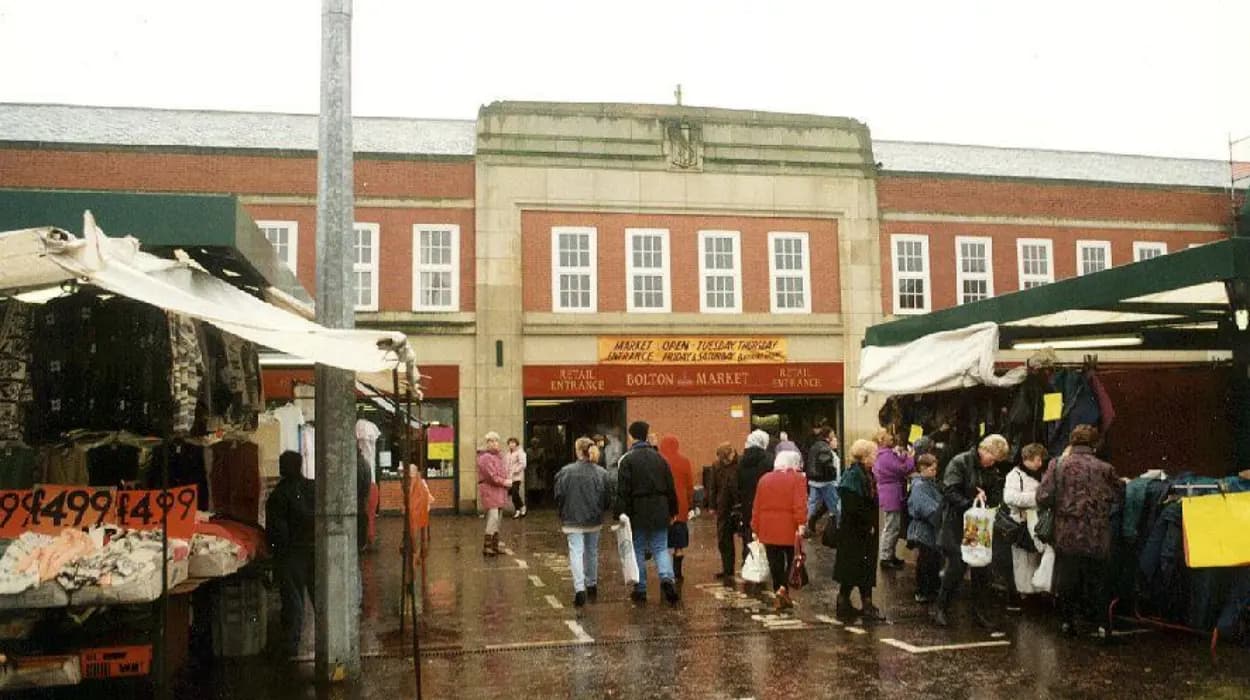
Bolton Market is one of the oldest continuous market institutions in Lancashire. Its history begins with a royal market charter issued in 1251 during the reign of King Henry III. The market has since changed location, architecture, trading practices, products and commercial purpose while retaining its central role in Bolton’s town-centre economy.
The modern Bolton Market stands on Ashburner Street. It is a council-operated traditional market with indoor and outdoor trading areas, fresh-food businesses, non-food traders and a contemporary food hall. The present site developed through major twentieth- and twenty-first-century changes, including the opening of Ashburner Street Market in 1932, refurbishment in 2014, and a £5.59 million transformation supported by the government’s Towns Fund.
The story of Bolton Market therefore involves more than the history of one building. It records the development of Bolton from a medieval market settlement into an industrial town and then into a modern urban centre where traditional retail operates alongside hospitality, leisure and regeneration.
When did Bolton Market first begin?
Bolton Market began in 1251 when King Henry III granted a royal charter allowing a weekly market at the manor of Bolton, together with an annual three-day fair. The market originally operated in the Churchgate area before later relocating as Bolton expanded.
The foundation of Bolton Market dates to the medieval period. On 14 December 1251, King Henry III granted William de Ferrers, Earl of Derby, permission to hold a market at his manor of Bolton in Lancashire. The charter authorised a market every seventh day and an annual three-day fair associated with the feast of St Margaret the Virgin.
A medieval market was an organised commercial institution rather than simply a collection of temporary stalls. The royal charter established the legal basis for regular trading and created a recognised economic function for Bolton.
The original market was held around Churchgate. Churchgate remained an important commercial and civic area for centuries. Historical records identify Monday as the traditional market day before increasing commercial activity required a larger location.
The charter also connected Bolton with the wider medieval economy of Lancashire. Traders brought agricultural produce, livestock, household goods and other commodities to an established market where local residents could buy and sell goods under recognised trading arrangements.
The annual fair added another commercial function. Medieval fairs attracted traders and customers over several days and expanded the range of goods exchanged beyond ordinary weekly transactions.
Bolton’s market charter is significant because it created institutional continuity. The buildings, streets and trading arrangements changed repeatedly, but the legal and commercial tradition of a market remained part of the town’s identity.
How did Bolton Market develop during the medieval and early modern periods?
Bolton Market expanded as the settlement grew, with Churchgate serving as its principal medieval trading area. Increasing population, commercial activity and pressure on available space eventually required relocation, leading the market toward larger town-centre sites during the nineteenth century.
Medieval Bolton was considerably smaller than the modern metropolitan borough. Its market operated within a settlement shaped by the parish church, manor, roads and local agricultural economy.
Churchgate provided a practical trading location because it formed part of the historic centre. Market activity also reinforced the importance of surrounding streets by bringing customers, traders and transport into the same urban area.
The market economy changed as Bolton became more densely settled. Agricultural production remained important, but manufacturing increasingly influenced the town’s economy. Bolton became particularly associated with textile production, especially cotton, during the Industrial Revolution.
Industrialisation transformed the relationship between markets and consumers. A growing urban workforce required regular supplies of food, clothing, household products and other necessities. Markets provided direct access to goods for working households and helped distribute food through the expanding town.
The expansion of Bolton also placed greater pressure on traditional market locations. Streets designed for medieval levels of pedestrian and commercial activity were not designed for the scale of nineteenth-century urban trade.
The relocation of the market to Victoria Square in 1824 represented an important stage in this process. The market was moved from Churchgate because it had become too large for the earlier location.
Victoria Square subsequently became one of the principal civic spaces in Bolton. The market operated there before the construction of the present Town Hall altered the character of the square.
This sequence demonstrates an important pattern in Bolton’s market history: trading institutions remained in the town centre while their physical locations changed to accommodate urban growth.
Why was Bolton Market Hall built in 1855?
Bolton Market Hall opened on 19 December 1855 as a major Victorian covered market designed by architect G. T. Robinson. The building measured about 294 feet long, covered approximately 7,000 square yards and cost £50,000 to construct.
The construction of Bolton Market Hall reflected the commercial expansion of the Victorian town. Covered markets offered protection from weather, organised trading space and a permanent architectural setting for retail activity.
G. T. Robinson designed the building using Victorian engineering and architectural techniques. The structure incorporated ashlar stone façades, an internal cast-iron structure and a glazed roof. Historic England records the building as Grade II listed.
The building was large by nineteenth-century standards. Contemporary descriptions identified it as the largest covered market in the kingdom. Its scale reflected the commercial importance of Bolton during the industrial period.
The market hall was constructed on the site of a former bowling green. Its location placed commercial activity within the rapidly developing centre of Victorian Bolton.
The building also incorporated shops around its edges. Alterations in 1894 introduced additional commercial accommodation on Knowsley Street and Corporation Street. This created a relationship between the market interior and surrounding street-level retail.
The market was not restricted to one type of product. Fresh food formed a major part of its purpose, while surrounding shops supported a wider retail economy.
The Victorian market therefore combined architecture and commerce. Its large roof, cast-iron framework and glazed surfaces created a permanent indoor environment while its location supported the concentration of shoppers and traders.
How did the fish market change Bolton’s trading system?
A dedicated fish market opened beside Bolton Market Hall on 22 December 1865, costing £30,000. Its construction expanded specialist food trading, while later twentieth-century changes transferred important market activity toward Ashburner Street.
The construction of a dedicated fish market demonstrates the increasing specialisation of Victorian food retail.
The fish market opened ten years after the main covered market. Its cost of £30,000 represented a substantial municipal and commercial investment in food infrastructure.
Specialist facilities were important because perishable foods required appropriate handling and trading environments. A dedicated fish market provided space specifically associated with this category of trade.
Bolton’s market system consequently developed into a network of related trading functions rather than a single undifferentiated hall.
The Victorian market complex continued to evolve. Alterations in 1894 changed the relationship between the hall and surrounding shops, while further internal changes followed during the twentieth century.
In 1932, the fish market was demolished as market activity shifted toward the Ashburner Street area. Historical accounts identify the opening of Ashburner Street Market in 1932 as a decisive stage in the transition from the Victorian market complex to the modern market site.
This change did not represent the disappearance of Bolton’s market tradition. It represented a relocation and restructuring of market functions.
The nineteenth-century Market Hall and the twentieth-century Ashburner Street Market therefore form different chapters in the same institutional history.
Why did Bolton Market move to Ashburner Street?
Ashburner Street became the principal site for Bolton’s modern market during the twentieth century. The Ashburner Street Market was built in 1932 and subsequently expanded and adapted into the present complex, including separate food halls and outdoor trading areas.
The move toward Ashburner Street reflected changes in Bolton’s urban structure and retail requirements.
The 1932 market provided a purpose-built environment for trading at a time when the town was already heavily industrialised. Its development separated the modern general market from the Victorian Market Hall that later became part of the Market Place shopping complex.
Academic research into Bolton’s urban public spaces identifies the Ashburner Street market as active at its current site from the 1970s in its modern form, with the market hall developing into distinct fish, fruit and vegetable, and lifestyle areas.
The site has continued to evolve rather than remaining architecturally fixed. Bolton Council planning documentation describes the market as a traditional general market built at Ashburner Street in 1932 and subsequently extended and adapted over time.
The present site covers approximately 12,750 square metres. The council’s planning documentation records about 6,300 square metres of ground-floor internal market space, together with storage, plant areas and offices.
The site also includes covered external trading space and other supporting facilities. This arrangement allows different types of businesses to operate within one market environment.
The modern Ashburner Street market consequently represents a twentieth-century response to the same commercial need established by the 1251 charter: providing a recognised place where traders and consumers meet.
How did Bolton Market change during the late twentieth century?
During the late twentieth century, Bolton Market developed into a multi-hall retail environment serving food and non-food traders. Pedestrianisation, market canopies, refurbishment and improved stall layouts helped adapt the Ashburner Street site to changing shopping patterns.
By the 1990s, Ashburner Street Market had developed a recognisable combination of indoor and outdoor retail.
Historical photographs from 1996 show a pedestrianised Ashburner Street area with new market canopies and refurbished facilities for outdoor trading. The market included fruit, vegetables, fish, plants and other products.
Pedestrianisation altered the relationship between vehicles, shoppers and stalls. Market streets became spaces designed more directly around pedestrian movement.
The market’s product range also remained diverse. Fresh food continued to form a major part of the offer, while non-food businesses occupied dedicated areas.
The late twentieth century also witnessed a major transformation of the old Victorian Market Hall. The historic building was refurbished and converted into the Market Place Shopping Centre. Queen Elizabeth II officially opened the refurbished centre on 1 December 1988.
This created two distinct commercial identities. The Grade II listed Victorian Market Hall became a modern shopping destination, while Ashburner Street remained the location of Bolton’s traditional market.
The separation is important when describing Bolton Market today. References to “Bolton Market” can refer to the active traditional market on Ashburner Street, while “Bolton Market Hall” often refers historically to the nineteenth-century building now incorporated into Market Place.
Bolton Museums’ Worktown collection also preserves photographic evidence of market trading. Images by Humphrey Spender document shoppers and traders in Bolton Market Hall during the early 1980s before its conversion into an indoor shopping centre.
These records provide primary visual evidence of the changing relationship between market traders, customers and town-centre retail.
What happened to Bolton Market during its 2014 refurbishment?
Bolton Market underwent a major refurbishment programme that culminated in the reopening of its indoor market in January 2014. The project modernised trading areas, introduced a Lifestyle Hall and improved the outdoor market while maintaining continuity for traders.
The early twenty-first century brought another phase of adaptation.
Bolton Council approved planning permission in November 2012 for alterations and refurbishment of Bolton Market. The programme included the conversion of New Street Car Park to create a new outdoor market venue.
During February 2013, traders in the miscellaneous section moved temporarily into containers on Ashburner Street. The council’s monitoring report recorded that this arrangement allowed trading to continue without a break in continuity.
The refurbished indoor market reopened in January 2014. The outdoor market followed in spring 2014.
The Lifestyle Hall became an important part of the refurbished market. Council documentation from the period describes the Lifestyle Hall as newly opened in 2014 and invites businesses to apply for occupancy within the redeveloped market.
The refurbishment demonstrated a practical preservation principle. A traditional market did not need to remain physically unchanged to retain its historic function.
Instead, infrastructure could be modernised while the underlying market structure continued.
This approach also positioned Bolton Market for later diversification. Food retail, lifestyle businesses, events and community activities increasingly became part of the market’s wider role.
The market’s evolution therefore moved beyond simple stall replacement. It involved changes to the building, circulation, outdoor space, trader accommodation and customer experience.
How did Bolton Market become a recognised food destination?
Bolton Market developed a strong food identity through specialist fresh-produce traders, food events and national market awards. Recognition included the BBC Radio 4 Food and Farming Awards in 2011 and the National Association of British Markets Authorities Market Innovation award in 2015.
Food has remained central to Bolton Market throughout its history.
The Victorian market provided a permanent environment for food trading, while the dedicated fish market added specialist provision in 1865.
The Ashburner Street market continued that tradition through fish, meat, fruit and vegetable trading. Modern council documents identify meat and fish, fruit and vegetables, and non-food goods and services among the market’s principal categories.
The market’s food reputation strengthened during the twenty-first century. Bolton Markets records several awards, including Best Food Market at the BBC Radio 4 Food and Farming Awards in 2011, Best Indoor Retail Market in 2010 and Market Innovation of the Year from the National Association of British Market Authorities in 2015.
Food also became an important mechanism for attracting visitors beyond ordinary weekly shopping.
The Bolton Food and Drink Festival developed into a major regional event. In 2017, Bolton Council reported approximately 200 traders from across the country and a record 267,000 visitors during the festival’s bank holiday programme.
Market events also introduced demonstrations, entertainment and specialist activities. In 2017, the market hosted cookery demonstrations, floral masterclasses, live music and family activities as part of Love Your Local Market fortnight.
This diversification changed the economic role of the market. Customers could visit for fresh produce, specialist shopping, events or food experiences rather than relying on the market solely for routine household purchases.
What changed at Bolton Market between 2022 and 2024?
Bolton Market entered another major redevelopment phase through a £5.59 million transformation funded by the government’s Towns Fund. The programme expanded the market, improved outdoor areas and introduced a dedicated food hall designed for nine traders and 192 diners.
The latest redevelopment connected Bolton Market with wider town-centre regeneration.
The £5.59 million transformation was funded through the government’s Towns Fund. The programme formed part of a wider group of projects involving Elizabeth Park, Bolton Central Library, Ashburner Street improvements and the Wellsprings innovation hub.
The food hall was designed as a modern hospitality venue. Plans provided nine catering units and communal seating for 192 customers.
The council opened the new food hall to the public on 7 June 2024. The completed venue included Japanese, Caribbean, Indian and Italian food alongside burgers, chicken, sandwiches, kebab dishes, desserts and drinks.
The venue also introduced a bar operated by Bolton Gin Company and facilities for televised sport and entertainment.
The design created approximately 200-person capacity across indoor and outdoor seating, including 160 outdoor seats.
The food hall also extended the market’s operating hours on Fridays and Saturdays. This shifted part of the market’s function from daytime retail toward evening hospitality.
The redevelopment therefore represents a structural change in the meaning of a market. The modern market combines traditional retail, fresh food, independent businesses, hospitality and social activity within the same destination.
The project also reinforced the market’s relationship with the surrounding town centre. The nearby Central Library, Elizabeth Park and other regeneration projects create a cluster of civic, cultural and commercial uses.
How many businesses and jobs are connected with Bolton Market?
Bolton Market supports a substantial local trading network. Bolton Council planning documentation recorded approximately 200 local businesses operating from the market and around 500 employees, demonstrating its continuing role as an economic institution within Bolton town centre.
The market’s economic significance extends beyond individual stalls.
A 2024 Bolton Council planning report recorded approximately 200 local businesses operating from the market and around 500 people employed there.
These figures demonstrate the market’s function as a business environment rather than simply a retail attraction.
Market stalls provide relatively small trading units compared with conventional high-street premises. This structure supports independent businesses selling specialist products and services.
The market also supports businesses indirectly through supply chains. Fresh-produce traders require suppliers, transport, storage and distribution. Food-hall operators require ingredients, staff, equipment and services.
The market therefore operates within a wider commercial network.
The council’s market strategy has also recognised the role of markets in town-centre activity. Earlier planning policy identified the improvement of Bolton Market as a destination as part of the wider Cultural Quarter strategy.
This approach reflects a change in town-centre planning. Markets are no longer treated solely as places for purchasing low-cost goods. They are also used as anchors for pedestrian activity, independent enterprise, food culture and regeneration.
Bolton Market’s employment role also gives the site continuing social and economic relevance.
How has Bolton Market preserved its traditional identity?
Bolton Market preserves its traditional identity through permanent stall trading, fresh-food retail, independent businesses and direct customer interaction. Modern facilities have been added without removing the market’s fundamental structure as a place where individual traders sell goods directly to customers.
The market’s historical continuity is strongest in its trading model.
Unlike a conventional department store, Bolton Market remains organised around individual traders and businesses. Each business operates within a defined trading space and contributes to the overall market environment.
Fresh food remains particularly important. Current market information highlights fruit and vegetables, meat, fish and other goods, while many produce traders also provide home delivery.
The market has also retained its community function.
Market events have included teenage markets, cookery demonstrations, floral masterclasses, live entertainment and family activities. These programmes expand the market’s use without eliminating its retail purpose.
The presence of community organisations also reinforces this role. Bolton FM operates its studios from the market on Ashburner Street, providing a local broadcasting service from the market environment.
The market’s physical facilities have also been adapted to contemporary expectations. Current market information identifies free Wi-Fi, cash-machine facilities and public, disabled and baby-changing facilities.
These additions demonstrate how a historic market institution can retain its traditional commercial model while incorporating modern services.
For visitors studying Bolton’s history, the market provides evidence of several stages of urban development in one location. Its products, businesses, architecture and surrounding streets show how retail responded to demographic and economic change.
To experience this historic landmark in person today, consult our comprehensive [Best Markets in Bolton Town Centre Every Tourist Should Visit Throughout the Year] for itineraries and visiting parameters.
What is the significance of Bolton Market today?
Bolton Market remains a direct link between Bolton’s medieval trading charter and its modern town-centre economy. Its present form combines traditional retail, fresh food, independent businesses, outdoor trading and contemporary hospitality within a market institution with more than seven centuries of history.
Bolton Market’s historical importance rests on continuity through change.
The market charter dates to 1251. Churchgate served as the medieval trading location. Victoria Square became a larger market location in 1824. The Victorian Market Hall opened in 1855. Ashburner Street Market opened in 1932. Major refurbishment followed in 2014, and the latest food-hall transformation opened in 2024.
Each stage responded to a different urban condition.
The medieval market served a small settlement and agricultural economy. The Victorian market responded to industrial expansion and population growth. The twentieth-century Ashburner Street market reflected modern urban retail requirements. The twenty-first-century market responds to competition, changing consumer behaviour, hospitality demand and town-centre regeneration.
The historical Market Hall also remains an important architectural remnant. Historic England lists the Market Hall and associated ground-floor shops as Grade II, recognising the significance of its nineteenth-century fabric, cast-iron structure and glazed roof.
The distinction between the listed Victorian Market Hall and the present Ashburner Street Market is essential for understanding Bolton’s commercial history.
Together, they demonstrate how the town repeatedly adapted its market infrastructure rather than abandoning the market institution.
The present market also has a clear role in regeneration. The £5.59 million transformation links retail with hospitality and public-realm investment. The new food hall, improved outdoor areas and surrounding town-centre projects establish the market as part of a wider regeneration strategy.
For historians and educators, Bolton Market provides a compact case study of urban economic change.
For cultural tourists, it provides a living commercial environment connected to Bolton’s medieval charter, Victorian expansion, industrial development and modern regeneration.
For heritage researchers, the market offers evidence through buildings, planning records, photographs, municipal documents and surviving trading practices.
For genealogical researchers, market history provides useful context for understanding the occupations and commercial environments experienced by Bolton families across different generations.
The evolution of Bolton Market is therefore not simply a sequence of building projects. It is the documented development of a commercial institution across more than 775 years.
From the 1251 royal charter to the 2024 food hall, Bolton Market has repeatedly adapted its location, architecture, products and services while retaining its essential purpose: bringing traders and customers together in the centre of Bolton.
FAQS
When did Bolton Market first open?
Bolton Market dates back to 1251, when King Henry III granted William de Ferrers, Earl of Derby, a royal charter to hold a weekly market and an annual three-day fair at Bolton.
Where was Bolton Market originally located?
The medieval market was originally held around Churchgate, close to Bolton Parish Church. As Bolton expanded, increasing commercial activity required larger market spaces.