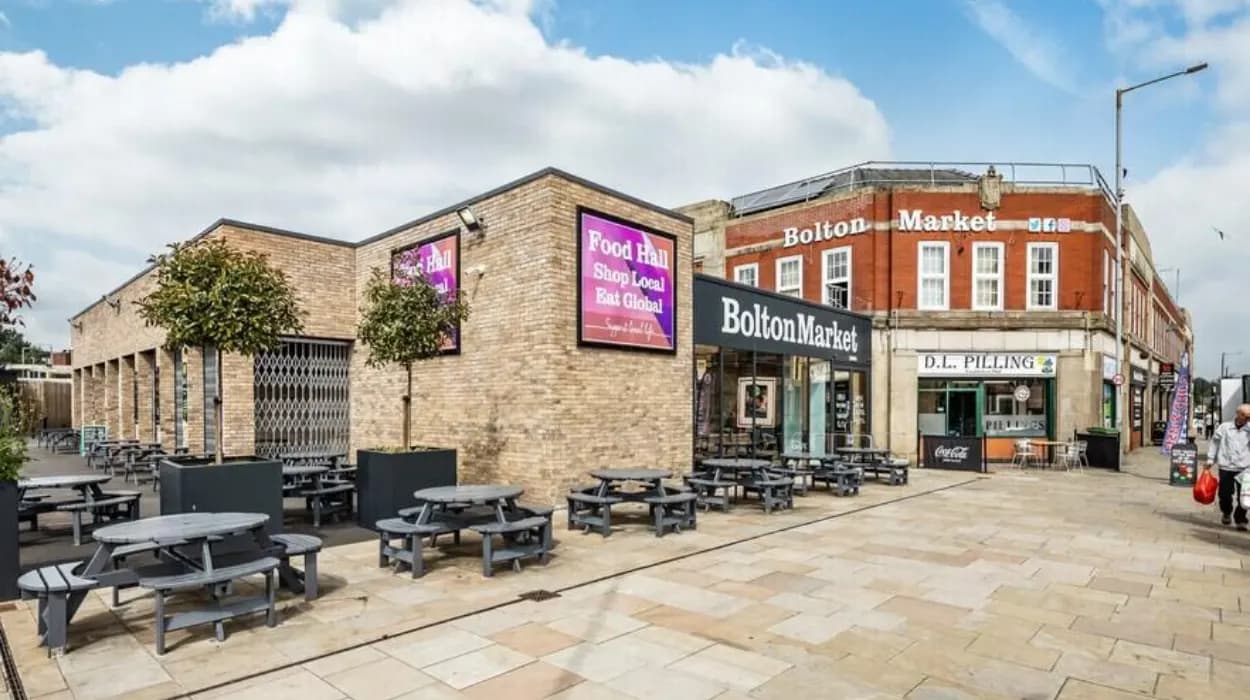
Bolton’s market tradition is one of the oldest continuous elements of the town’s commercial history. A market charter was granted in 1251, establishing a weekly market and annual fair at the medieval manor of Bolton. The present market system developed through later market halls, outdoor trading areas, specialist food events, artisan markets, and seasonal festivals.
Today, the principal destination is Bolton Market on Ashburner Street, supported by specialist events such as the Bolton Makers Market, the Bolton Food and Drink Festival, and seasonal Christmas markets in the town centre. Together, these markets connect medieval commerce with contemporary independent retail, food culture, local enterprise, and tourism.
For visitors interested in Bolton’s history, markets also provide an important way to understand how the town developed from a medieval settlement into an industrial Lancashire centre and, later, a modern Greater Manchester borough.
What is the history of markets in Bolton town centre?
Bolton’s market history begins with a royal charter from 1251, when Henry III granted William de Ferrers permission to hold a weekly market and annual three-day fair at Bolton. This charter established the legal foundation for centuries of commercial activity.
The medieval market belonged to a wider system of regulated commerce. A market charter was a royal or authorised legal grant permitting regular trading at a specified place and time. In Bolton’s case, the 1251 charter was granted to William de Ferrers, Earl of Derby, giving him and his heirs permission to hold a market every seventh day and an annual fair.
The original market was associated with Churchgate, close to the medieval parish church. Churchgate became an important part of Bolton’s early commercial geography because religious, administrative, residential, and trading functions were concentrated within a relatively compact settlement.
The annual fair had a different commercial function from the weekly market. A weekly market supplied ordinary necessities, while an annual fair attracted wider trading activity. Livestock, agricultural goods, textiles, household products, and other merchandise formed part of the wider economic culture of medieval fairs across England.
Bolton later became one of Lancashire’s major textile centres. The expansion of cotton spinning and weaving transformed the scale of the town’s population and commerce. Markets consequently became part of a much larger urban economy.
The town was incorporated as a borough in 1838, an important political milestone that created a unified municipal authority for Great Bolton and Little Bolton. Bolton Council describes the earlier town as two principal townships divided broadly by the River Croal.
The nineteenth century therefore brought both commercial expansion and municipal restructuring. Market buildings became larger, more permanent, and more closely integrated with roads, public buildings, shops, and transport routes.
Where is Bolton Market and what does it offer tourists today?
Bolton Market is located on Ashburner Street in the town centre and currently operates four days weekly, offering fresh meat, fish, fruit, vegetables, clothing, jewellery, fabrics, household goods, and other products alongside its dedicated Food Hall.
The modern Bolton Market is the principal market destination for visitors who want to experience traditional market trading in a contemporary setting.
The official market describes its location as being at the heart of Bolton town centre. Bolton Interchange is approximately 0.4 miles away, making the market accessible by bus and rail connections.
The market currently opens:
- Tuesday: 9am–5pm
- Thursday: 9am–5pm
- Friday: 9am–5pm
- Saturday: 9am–5pm
It is closed on Monday, Wednesday, and Sunday under the published standard schedule. Bank-holiday arrangements can differ.
The market contains several distinct retail areas. The Fish and Meat Hall contains 20 units selling meat, fresh fish, shellfish, poultry, eggs, and seasonal game. The Fruit and Veg Hall sells fresh produce sourced from different parts of the world. The Lifestyle Hall and Outdoor Market include fashion, jewellery, handbags, electrical goods, cosmetics, fabrics, gifts, and related merchandise.
This range demonstrates how the market has adapted from a predominantly provisioning function into a broader retail destination.
For tourists, the significance is not simply the number of stalls. The market provides a direct view of independent retail practices that differ from department stores and enclosed shopping centres.
Why is Bolton Market historically important to the town?
Bolton Market is historically important because its modern trading function continues a market tradition established by royal charter in 1251, while its nineteenth-century market halls demonstrate how industrial growth required larger commercial buildings and more organised municipal trading infrastructure.
The history of Bolton Market reflects the wider development of British market towns.
Medieval markets depended on regular trading days and established locations. Industrial-era markets required larger covered spaces, improved sanitation, regulated stalls, and stronger municipal management.
Bolton’s industrial growth intensified these requirements. The town became internationally associated with cotton manufacturing, and its growing population increased demand for food, clothing, household products, and other necessities.
A major nineteenth-century milestone came with the construction of Bolton Market Hall.
The original Market Hall opened on 19 December 1855. Historical records describe it as a large Victorian covered market, while the building later underwent substantial alterations. A fish market opened beside it in 1865.
The original market hall occupied a site associated with the town’s expanding commercial centre. Its construction illustrates a wider Victorian movement towards purpose-built covered markets.
These buildings were practical infrastructure. They sheltered traders and customers from weather, concentrated commercial activity, and provided municipal authorities with greater control over trading conditions.
The market therefore belongs within Bolton’s industrial architectural history as well as its retail history.
What happened to Bolton Market Hall after it opened in 1855?
Bolton Market Hall underwent major changes after its 1855 opening, including alterations in 1894, further twentieth-century modifications, and redevelopment associated with the modern Market Place complex, while elements of its Victorian structure remained incorporated into the later development.
The 1855 building represented an ambitious Victorian response to the needs of a rapidly expanding industrial town.
Historical records place the Market Hall at approximately 294 feet in length, with an area of around 7,000 square yards. The reported construction cost was £50,000, a substantial municipal investment for the period.
The fish market followed in 1865. It cost approximately £30,000 and operated alongside the main market hall.
In 1894, the original Market Hall was altered to provide shops along Knowsley Street and Corporation Street. Further changes followed during the early twentieth century. By 1938, the internal layout had been reorganised, with roofed stalls arranged in more compact islands rather than the earlier long rows.
The fish market eventually disappeared. It was demolished in 1932, when the Ashburner Street market development opened.
The later redevelopment of the market site demonstrates an important principle in urban history: market buildings change when population, retail practices, transport systems, hygiene standards, and consumer expectations change.
The survival of historic architectural elements alongside modern commercial functions gives Bolton’s market area continuing heritage significance.
What can visitors find in the Bolton Market Food Hall?
Bolton Market Food Hall provides a modern dining component within the historic market tradition, with Japanese, Caribbean, Indian, Italian, Hainanese chicken, kebabs, desserts, drinks, and other food businesses serving customers throughout designated weekly opening periods.
The Food Hall opened to the public on 7 June 2024 as part of a £5.9 million transformation of Bolton Market supported by the government’s Towns Fund.
The project added a new food-focused destination while retaining the market’s established retail role.
The Food Hall contains seating for approximately 200 people, with indoor and outdoor seating. Bolton Council stated that the development included 160 outdoor seats using space around Bolton Market.
The food offer includes several international cuisines. Examples include Japanese food, Caribbean dishes, Indian food, Italian food, Hainanese chicken, kebab dishes, gourmet-style burgers, desserts, and sweet drinks.
The Food Hall also forms part of Bolton’s evening economy. Friday and Saturday opening extends into the evening, while the venue has hosted musicians and acoustic performers.
This development illustrates the changing function of markets. Medieval markets concentrated on trade. Victorian covered markets expanded organised food retail. Contemporary market halls combine retail, dining, social activity, and visitor experiences.
The Food Hall therefore represents a modern layer within a commercial institution whose roots extend back more than seven centuries.
When should tourists visit Bolton Market during the year?
Tourists can visit Bolton Market throughout the year during its regular Tuesday, Thursday, Friday, and Saturday schedule, while Friday and Saturday Food Hall evenings and seasonal town-centre events provide additional opportunities for food, shopping, cultural activities, and festive markets.
Spring provides a strong period for exploring independent retail and specialist events. The reopening of outdoor trading activity after winter also supports seasonal produce and changing trader selections.
Summer brings larger public events. The Bolton Food and Drink Festival is one of the most significant annual events connected with the town-centre market economy.
In 2025, the festival celebrated its twentieth year and brought more than 180 traders into Bolton town centre from 22 to 25 August. The programme included global food, desserts, vegan products, chef demonstrations, and an open-air Kitchen Theatre.
For 2026, Bolton Council scheduled the Food and Drink Festival for 28–31 August, covering the August Bank Holiday weekend.
Autumn provides another opportunity to experience the regular market alongside independent events.
The Bolton Makers Market first arrived in Bolton in October 2025 and returned to Newport Street in 2026. A council announcement dated 16 April 2026 described a 60-stall event running from 11am to 4pm, with independent traders, artisan producers, handmade products, street food, baked goods, and crafts.
Winter brings Christmas markets and seasonal events. Bolton has repeatedly used Victoria Square and other central streets for festive market activity. In 2025, the Makers Market returned to Newport Street on 14 December, featuring handmade gifts, food, decorations, and local creative businesses.
Visitors should therefore distinguish between the permanent market and temporary markets. The permanent market follows its published weekly schedule. Specialist markets operate according to individual event programmes.
What is the Bolton Makers Market and why should tourists visit it?
Bolton Makers Market is a specialist independent market featuring artisan food, handmade products, gifts, crafts, homewares, and creative businesses, with recent Bolton events held on Newport Street and attracting approximately 60 stalls for seasonal shopping and cultural activity.
The Makers Market represents a different stage in Bolton’s market history.
The traditional market concentrates heavily on everyday retail and food provisioning. The Makers Market focuses on small businesses, creative production, handmade merchandise, specialist food, and direct interaction between producers and customers.
The April 2026 event included food traders such as The Kashmiri Guys, Chefsy Africana, The Curry Man, and Nigirun, alongside bakeries and specialist food producers. Handmade products included jewellery, wax products, crafts, fragrance, textiles, and homewares.
The market also included community organisations, demonstrating how contemporary markets operate as civic spaces as well as commercial venues.
Its location on Newport Street gives visitors an opportunity to explore the wider town centre alongside the market.
The Makers Market also has a seasonal function. Its December 2025 edition focused on Christmas gifts, decorations, food, and winter products.
For heritage visitors, the market provides evidence of a continuing shift from mass retail towards independent production and experiential shopping.
How did industrialisation change Bolton’s market culture?
Industrialisation transformed Bolton from a market-based local settlement into a major textile-manufacturing town, increasing population, consumer demand, municipal infrastructure, and commercial activity and creating the conditions for large Victorian market halls and more regulated urban retail environments.
The Industrial Revolution altered Bolton’s physical and economic structure.
Cotton spinning and weaving created employment and attracted workers. Population growth increased demand for staple goods, including meat, fish, vegetables, bread, clothing, and household products.
Markets were essential to this system because they connected producers, wholesalers, independent retailers, and consumers.
The nineteenth-century covered market also reflected changing ideas about urban management. Municipal authorities increasingly focused on public health, regulation, street organisation, and commercial order.
The construction of the 1855 Market Hall therefore belongs to a broader Victorian programme of civic improvement.
Bolton’s municipal transformation also mattered. The incorporation of the borough in 1838 created a unified local authority after a period when Great Bolton and Little Bolton had separate administrative structures.
The growth of civic institutions accompanied the expansion of commercial infrastructure.
Town Hall construction, market development, improved streets, transport connections, and expanding retail districts formed interconnected elements of nineteenth-century urbanisation.
Bolton’s market history therefore provides a useful case study for students examining how industrialisation reshaped British towns.
How have shopping centres and modern retail changed Bolton’s traditional market landscape?
Modern retail altered Bolton’s commercial geography by introducing department stores, enclosed shopping centres, retail parks, and online shopping, while the traditional market adapted through redevelopment, specialist food retail, independent traders, public events, and new market-based visitor experiences.
The twentieth century introduced new forms of retail competition.
Department stores created larger enclosed shopping environments. Later, shopping centres consolidated multiple retailers within purpose-built complexes. Out-of-town retail parks changed travel patterns again.
The former Crompton Place Shopping Centre, opened in 1971, became an important part of this later retail history. Its subsequent decline reflected wider changes affecting traditional shopping centres across Britain.
Bolton Council acquired Crompton Place in 2018 and has since pursued redevelopment of the site. Current plans include the creation of new public connections and temporary uses such as public performances, events, and pop-up markets while redevelopment progresses.
This context is important because markets are no longer competing only with traditional shops. They now function within a mixed urban environment that includes hospitality, entertainment, housing, cultural venues, public spaces, and digital commerce.
The survival of Bolton Market demonstrates the resilience of a market institution when its role changes without losing its core function.
How do Bolton’s seasonal markets support the town centre?
Seasonal markets support Bolton’s town centre by bringing independent traders, food businesses, makers, visitors, and community organisations into central streets, while festivals and Christmas events extend market activity beyond the normal weekly trading schedule.
Seasonal markets create temporary concentrations of commercial activity.
The Bolton Food and Drink Festival demonstrates this mechanism at the largest scale. Its 2025 programme brought more than 180 traders into the town centre, combining food sales with demonstrations and family activities.
The Makers Market operates on a smaller scale but serves a distinct purpose. Its 2026 event brought around 60 stalls to Newport Street, including food producers, makers, craftspeople, and community organisations.
Christmas markets provide another seasonal model. Bolton Council’s 2025 programme included the Makers Market, artisan markets, festive attractions, and town-centre Christmas activities.
These events create links between commerce and civic identity.
They also demonstrate why market history remains relevant to contemporary urban regeneration. Market activity can occupy streets, squares, halls, and temporary spaces without requiring a permanent retail building.
This flexibility gives markets an important role in the changing physical geography of Bolton town centre.
What historic buildings can tourists see around Bolton’s markets?
Visitors exploring Bolton’s markets can connect commercial history with major civic and heritage buildings, including Bolton Town Hall, the parish church area, Victorian market structures, historic streets, and later commercial developments that collectively document the town’s medieval, industrial, and modern transformation.
Bolton’s market district should be understood as part of a wider heritage landscape.
Bolton Town Hall stands in Victoria Square and represents the nineteenth-century civic ambitions of the expanding industrial borough. The building was developed after the borough’s incorporation in 1838, with a dedicated Town Hall Committee established in 1863.
The historic parish church area connects the modern town to the medieval settlement from which the market developed.
The market itself provides another architectural layer. The 1855 Market Hall represented Victorian covered-market design and municipal investment in commercial infrastructure. Later changes incorporated shops, altered internal arrangements, and connected the historic building with modern retail development.
The surrounding streets also document changes in urban planning.
Commercial roads became increasingly important as Bolton expanded. Buildings associated with retail, banking, municipal administration, entertainment, and transport formed a dense central district.
For visitors interested in architectural history, the market is therefore a useful starting point rather than an isolated attraction.
To experience this historic commercial landscape in person today, consult our comprehensive [Evolution of Bolton Market from Past to Present] for itineraries and visiting parameters.
How can tourists plan a year-round Bolton market itinerary?
A year-round Bolton market itinerary should combine the permanent Ashburner Street market with specialist Makers Market dates, the August Food and Drink Festival, and Christmas trading events, allowing visitors to compare everyday commerce with seasonal food, craft, cultural, and community activity.
A practical itinerary begins with Bolton Market on Ashburner Street.
The permanent market provides the strongest connection with Bolton’s long-term trading tradition. Visitors can examine the Fish and Meat Hall, Fruit and Veg Hall, Lifestyle Hall, and Outdoor Market.
A second visit should focus on the Food Hall. Its international food offer demonstrates the contemporary transformation of the market from a basic provisioning centre into a food and hospitality destination.
A third visit can coincide with the Bolton Makers Market. This provides a contrast between established market retail and newer artisan enterprise.
The August Food and Drink Festival provides the largest seasonal market experience. The 2025 edition involved more than 180 traders, and the 2026 festival is scheduled for 28–31 August.
A winter visit should focus on Christmas markets and festive events. The December 2025 Makers Market demonstrates how Newport Street has been used for seasonal independent retail.
Opening times should always be checked before travelling because regular market hours and event schedules differ.
Why do Bolton’s markets remain important to local heritage?
Bolton’s markets remain important because they preserve a commercial tradition documented from 1251 while continuing to support independent traders, food businesses, artisans, seasonal events, and public activity within a town centre undergoing major economic and physical change.
Markets are valuable historical sources because they reveal how communities obtain goods and organise commercial relationships.
Bolton’s market history spans medieval chartered trade, Victorian industrial expansion, twentieth-century retail modernisation, and twenty-first-century regeneration.
The 1251 charter provides the institutional starting point. The 1855 Market Hall represents the industrial-era transformation. The 1932 Ashburner Street development demonstrates twentieth-century adaptation. The 2024 Food Hall represents contemporary regeneration.
This sequence provides a clear historical timeline:
1251: Henry III grants Bolton permission for a weekly market and annual fair.
1838: Bolton becomes an incorporated borough, strengthening unified municipal administration.
1855: Bolton Market Hall opens as a major Victorian covered market.
1865: A dedicated fish market opens beside the Market Hall.
1894: Alterations add shops along Knowsley Street and Corporation Street.
1932: The fish market is demolished, and the Ashburner Street market opens.
2024: The modern Food Hall opens following the £5.9 million market transformation.
2025: Bolton Food and Drink Festival reaches its twentieth year, while the Makers Market establishes a new town-centre presence.
2026: Makers Market events continue on Newport Street, while the Food and Drink Festival is scheduled for 28–31 August.
The significance of these milestones extends beyond retail.
They show how Bolton repeatedly redesigned its commercial infrastructure in response to demographic growth, industrialisation, changing consumer behaviour, new retail formats, regeneration policy, and evolving visitor expectations.
For historians, the key fact is continuity. Bolton’s market story began with a royal charter in 1251 and continues through a permanent market, modern Food Hall, artisan events, and major annual food festivals.
For tourists, the result is a year-round opportunity to experience Bolton through its food, independent traders, architecture, public spaces, and commercial heritage.
For educators and heritage researchers, the market provides a compact case study of medieval commerce, industrialisation, municipal government, Victorian architecture, twentieth-century retail change, and twenty-first-century urban regeneration.
Bolton’s markets are therefore not simply places to shop. They are surviving components of the town’s historical infrastructure, adapted repeatedly to the economic and social conditions of each era.
What is the future historical significance of Bolton’s markets?
The future historical significance of Bolton’s markets lies in their ability to preserve long-established independent trading while adapting to food tourism, artisan production, seasonal events, public-space regeneration, and changing town-centre economics within one of Greater Manchester’s historic industrial settlements.
Bolton’s market tradition has survived because the function of the market has changed with the town.
The medieval market supplied a local population. The Victorian market hall supported a rapidly expanding industrial economy. The twentieth-century market adapted to changing retail structures. The contemporary market combines food, independent retail, leisure, cultural activity, and tourism.
The £5.9 million market transformation demonstrates direct public investment in this continuing role. The Food Hall added another reason for visitors to spend time within the market complex and helped connect traditional retail with the town centre’s evening economy.
The Makers Market demonstrates another direction. Independent makers, artisan producers, and small food businesses use temporary market spaces to reach customers without requiring permanent high-street premises.
Meanwhile, the redevelopment of nearby town-centre sites creates new opportunities for temporary markets and public events. Bolton Council has specifically identified pop-up markets among the potential meanwhile uses associated with the cleared Crompton Place site.
This creates a direct connection between Bolton’s oldest commercial tradition and its future town-centre strategy.
For historians, the key fact is continuity. Bolton’s market story began with a royal charter in 1251 and continues through a permanent market, modern Food Hall, artisan events, and major annual food festivals.
For tourists, the result is a year-round opportunity to experience Bolton through its food, independent traders, architecture, public spaces, and commercial heritage.
For educators and heritage researchers, the market provides a compact case study of medieval commerce, industrialisation, municipal government, Victorian architecture, twentieth-century retail change, and twenty-first-century urban regeneration.
Bolton’s markets are therefore not simply places to shop. They are surviving components of the town’s historical infrastructure, adapted repeatedly to the economic and social conditions of each era.
FAQS
What is the main market in Bolton town centre?
Bolton Market on Ashburner Street is the town’s principal traditional market. It offers fresh meat, fish, fruit, vegetables, clothing, household goods, gifts and other products.