Bolton’s history of indoor entertainment reflects the town’s transformation from a Lancashire market settlement into a major industrial centre and then into a modern cultural borough. Theatre, music halls, cinemas, dance halls, amateur drama, libraries, museums and indoor community venues all formed part of this development.
Indoor entertainment means organised leisure activities provided inside purpose-built or adapted buildings. In Bolton, these activities included theatrical performances, variety shows, music, dancing, film screenings, public lectures, exhibitions and community events. Their development followed changes in population, industrial employment, technology, transport, household incomes and municipal culture.
The history is particularly important because indoor entertainment was never separate from Bolton’s social history. The venues reflected the industrial town’s population, working patterns and aspirations. They also created spaces where residents from different occupations encountered the same performances and cultural programmes.
Bolton’s entertainment history therefore extends beyond surviving theatres. It includes buildings that disappeared, venues that changed function, organisations that survived through amateur activity, and institutions that continue to provide indoor cultural experiences.
When did indoor entertainment begin to develop in Bolton?
Bolton’s organised indoor entertainment expanded rapidly during the nineteenth century as industrial growth increased population, disposable income and demand for music, theatre and social recreation. Music halls, theatres, public halls and other enclosed venues became important parts of urban leisure culture.
The foundations developed alongside Bolton’s industrial expansion. Cotton manufacturing transformed the town during the nineteenth century. Large numbers of workers and their families created demand for affordable recreation close to densely populated neighbourhoods and commercial streets.
The growth of entertainment buildings also reflected wider Victorian changes. Improvements in lighting, building construction, transport and commercial organisation made larger indoor venues practical. Gas lighting improved evening performances. Purpose-built auditoria provided controlled seating and stage arrangements. Commercial theatre operators developed regular programmes rather than relying solely on occasional performances.
Music halls were particularly important. They combined popular entertainment with social interaction and commercial refreshments. Bolton had purpose-built music-hall provision by the late nineteenth century. Academic research into Lancashire music halls identifies Bolton’s rebuilt Victoria Theatre of Varieties as operating as a music hall from 1882 and the Grand Cirque as opening in 1894. The Empire Theatre of Varieties opened in 1908 and later became the Hippodrome.
This development placed Bolton within the wider entertainment culture of industrial Lancashire. Comparable towns such as Preston, Blackburn, Oldham and Manchester developed substantial music-hall networks during the same period.
Indoor entertainment also provided employment. Performers, musicians, stage workers, cleaners, ticket sellers, managers, ushers and catering staff all formed part of the entertainment economy.
The venues consequently had an economic function as well as a cultural one. They occupied valuable urban sites, attracted evening footfall and contributed to the commercial life of central Bolton.
How did Victorian theatres and music halls shape entertainment in Bolton?
Victorian theatres and music halls established Bolton’s commercial entertainment culture by combining drama, variety performances, music and social gathering. Venues such as the Victoria Theatre of Varieties and Grand Cirque demonstrated how industrial prosperity supported permanent indoor leisure institutions.
The Victorian period created a strong demand for variety entertainment. Audiences expected programmes that could combine songs, comedy, drama, instrumental music and specialised acts.
Bolton’s Victoria Theatre of Varieties formed part of this culture. Academic research records its operation as a music hall from 1882. The Grand Cirque followed in 1894, adding another large-scale entertainment venue to the town.
These buildings were designed around audience visibility and stage presentation. Their interiors separated performance areas from audience seating while providing circulation routes and entrances capable of handling substantial crowds.
The commercial model depended on repeated performances. A venue could host different acts across a week, encouraging audiences to return regularly. This system created a recognisable entertainment calendar for working households.
The social importance of these venues extended beyond the performances themselves. They provided enclosed spaces for evening recreation during a period when many industrial workers lived in densely developed neighbourhoods with limited private leisure space.
The emergence of professional entertainment also changed cultural consumption. Residents no longer depended entirely on travelling performers visiting occasionally. Permanent venues allowed regular programmes and established entertainment businesses.
Bolton’s music-hall history therefore forms an important bridge between nineteenth-century public entertainment and the twentieth-century cinema industry.
What was the Bolton Empire Theatre and how did it become the Hippodrome?
The Bolton Empire Theatre opened in August 1908 as a variety theatre on Deansgate. In 1916, it became a cinema and was renamed the Hippodrome. It later returned to theatrical use as Bolton Repertory Theatre before closing in 1961.
The building stood on Deansgate opposite Bolton Post Office. Its original identity was the Bolton Empire Theatre. It opened in August 1908 as the New Empire Theatre and operated within the established variety tradition.
The venue demonstrates how entertainment buildings adapted when audience preferences and technology changed.
Cinema became commercially important during the early twentieth century. The Empire changed hands in 1916 and became a full-time cinema under the Bolton Entertainment Company, operating as the Hippodrome. Sound equipment was installed by the late 1920s.
The change from variety theatre to cinema was significant because film required different technical arrangements. Projection equipment, screen placement and auditorium sightlines became central to the building’s operation.
The Hippodrome later returned to live theatre during the 1940s. It became associated with Bolton Repertory Theatre, which presented productions until 1961. Contemporary theatre records also preserve programmes from the Bolton Hippodrome, demonstrating its role in regional repertory theatre.
The building eventually closed despite public opposition and proposals for civic use. It was demolished, removing a major physical reminder of Bolton’s early twentieth-century entertainment history.
Its changing functions illustrate a recurring pattern in Bolton. Buildings were repeatedly adapted as new entertainment technologies and audience preferences emerged.
Why did cinemas become so important to indoor entertainment in Bolton?
Cinemas became central to Bolton’s indoor entertainment culture during the twentieth century because film offered affordable, repeatable mass entertainment. By the 1930s, Bolton supported numerous cinemas, including large auditoria that accommodated more than 2,000 people.
The cinema expanded rapidly after the First World War. Film provided a standardised entertainment product that could be screened repeatedly throughout the day.
Bolton became an important cinema centre. A historical study of British cinema records numerous Bolton cinemas operating during 1932–1938, including the Belle, Capitol, Carlton, Crompton, Embassy, Empire, Gem, Grand, Hippodrome, Imperial, Majestic, Odeon, Palace, Palladium, Plaza, Queens, Regal, Rialto, Ritz, Royal, Theatre Royal and Tivoli.
This concentration demonstrates the scale of cinema culture in the town. The venues varied considerably in size, ownership and programming.
Admission prices also indicate the commercial accessibility of cinema. The surviving 1930s data records prices ranging from a few pence to around one shilling and sixpence at several larger venues.
The cinema was therefore not restricted to affluent audiences. Its business model depended on high attendance and repeated screenings.
The architecture also changed. Large auditoria incorporated balconies, decorative interiors, foyers and improved projection systems. Cinema buildings became prominent commercial landmarks in town centres.
The industry also generated employment in projection, management, ticketing, maintenance and customer services.
Cinema became one of Bolton’s most important indoor leisure activities because it combined technological novelty with predictable admission prices and regular programming.
What made the Odeon Bolton historically significant?
The Odeon Bolton opened on 21 August 1937 with 2,534 seats, making it the largest Odeon in the country at opening. Its Art Deco architecture, prominent corner location and later conversion to bingo illustrate changing twentieth-century leisure culture.
The Odeon stood at the corner of Ashburner Street and Black Horse Street in central Bolton. It opened on 21 August 1937 with Dark Journey, starring Conrad Veidt and Vivien Leigh. More than 2,600 people attended its opening night.
The original auditorium contained 2,534 seats, including 936 seats in the balcony. Historic England records that it was the largest Odeon in the country when it opened.
Architects Harry Weedon and W. Calder Robson designed the building. Its Art Deco character reflected the architectural language of interwar cinema. The building occupied an entire island site and presented a highly visible urban frontage.
The cinema represented the scale reached by mass entertainment in the 1930s. It was not simply a room for film projection. It was a major architectural destination designed to accommodate thousands of customers.
The building later experienced technological and commercial changes. It operated with three cinema screens by the time it closed in 1983. It then became a bingo hall and continued in that role until 2004. Historic England records that the building was demolished in 2007.
The Odeon’s history demonstrates the lifecycle of twentieth-century entertainment architecture. A building created for cinema survived beyond its original use by adapting to another form of indoor recreation.
How did dance halls change indoor entertainment in Bolton?
Dance halls expanded Bolton’s indoor leisure culture by providing dedicated spaces for social dancing, live music and organised recreation. The Astoria Palais de Danse, constructed in 1928, represents the purpose-built dance-hall movement that shaped British popular entertainment.
Dance halls became particularly important during the early and mid-twentieth century. They differed from theatres and cinemas because participation was central to the experience.
The Astoria Palais de Danse in Bolton was constructed in 1928 at the expense of local businessman Thomas Bolton. Architectural research identifies it as a notable example of a purpose-built British dance hall.
Purpose-built dance halls were designed around the dance floor. Their architecture also accommodated musicians, refreshment areas, circulation spaces and spectator facilities.
The development reflected broader changes in leisure culture. Dancing provided an organised social activity that suited young adults and working families. It also supported musicians, bands, instructors, catering workers and venue staff.
Bolton’s dance-hall culture remained significant into the post-war period. Memories collected by Bolton Museum demonstrate the importance of venues such as the Palais and Navada to local youth culture during the early 1960s.
The same source records the emergence of clubs and coffee bars, including the Beachcomber and Casa Blanca. These establishments show how indoor entertainment expanded beyond traditional theatres and cinemas.
Dance halls therefore represented a different model of leisure. The audience became participants rather than passive spectators.
How did youth culture transform Bolton’s indoor entertainment?
Youth culture transformed Bolton’s indoor entertainment after the Second World War by increasing demand for dance halls, clubs, coffee bars, music venues and cinemas. These spaces supported new forms of social identity, popular music consumption and independent leisure.
The post-war period produced major changes in entertainment habits. Young people gained greater cultural visibility and sought venues suited to music, dancing and social interaction.
Bolton Museum’s research into local youth culture records memories from residents who experienced these changes during the 1950s and 1960s. One account describes social life expanding from limited activities to dance halls, clubs and coffee bars after obtaining employment in Bolton town centre.
The venues mentioned include the Palais, Navada, Beachcomber and Casa Blanca. They demonstrate the diversity of indoor entertainment available to young people.
Music became increasingly central. Imported recordings, live bands and emerging popular styles changed the relationship between audiences and performers.
This period also demonstrates the importance of affordable employment-linked leisure. Young workers could use wages for entertainment, clothing, refreshments and social activities.
Bolton’s indoor entertainment therefore became more specialised. Traditional theatres and cinemas remained important, but clubs, dance halls and music venues provided alternative experiences.
The change also affected architecture. Entertainment interiors increasingly prioritised dance floors, bars, stages, sound systems and flexible social spaces rather than conventional theatre seating.
These changes formed part of a national transformation in British popular culture. Bolton participated in that transformation while retaining strong local entertainment institutions.
How did amateur theatre preserve indoor entertainment traditions in Bolton?
Amateur theatre preserved live performance in Bolton by giving local residents opportunities to act, direct, build sets, manage lighting and organise productions. Bolton Little Theatre, founded in 1931, and Farnworth Little Theatre, established in 1948, remain important examples.
Amateur theatre provided an alternative to commercial entertainment. Local organisations allowed residents to participate directly in production rather than attending solely as audiences.
Bolton Little Theatre was founded in 1931. Its Hanover Street theatre was acquired, converted and opened in 1934. The organisation has maintained a regular programme of plays, apart from interruptions associated with war and rebuilding.
The organisation joined the Little Theatre Guild of Great Britain in 1949. Its history demonstrates the institutional strength of amateur drama in Bolton.
Farnworth Little Theatre provides another important example. Established in 1948, it presented its first full-length play, Night Must Fall, in 1949. It subsequently maintained a continuous programme of up to five full-length productions a year.
Amateur theatres also preserve practical skills. Acting is only one part of production. Volunteers undertake wardrobe, lighting, sound, publicity and set construction.
This model gives indoor entertainment a community function. The audience and production workforce often come from the same local population.
For heritage researchers, amateur theatre organisations are also valuable historical records. Programmes, photographs, posters, membership records and production archives can reveal patterns of local participation that commercial entertainment records do not always capture.
Why is the Albert Halls important to Bolton’s entertainment history?
The Albert Halls became a major Bolton cultural venue for concerts, exhibitions, social events and other indoor entertainment. Its history demonstrates the importance of municipal architecture and public gathering spaces in shaping Victorian and modern cultural life.
The Albert Halls form part of Bolton Town Hall’s civic complex. The original Albert Hall served as a major Victorian gathering space, hosting concerts, bazaars and other public events.
The building’s scale reflected the ambitions of Victorian municipal culture. Town halls were not limited to administrative functions. They also provided spaces for public meetings, ceremonies, concerts and cultural activity.
The Albert Halls continued to host entertainment into the twentieth and twenty-first centuries. Bolton Council describes the venue as having hosted concerts, shows and exhibitions for more than 100 years.
A major fire in 1981 altered the building’s physical form. The original Albert Hall was not restored to its previous structural arrangement. A smaller Festival Hall and smaller Albert Hall were created within the complex.
The venue’s history therefore illustrates both preservation and adaptation. Historic entertainment buildings do not always survive in their original configuration.
The continuing use of the Albert Halls also demonstrates the long-term value of civic cultural infrastructure. Its role extends from Victorian public culture to contemporary concerts, comedy, exhibitions and community events.
How did the Octagon Theatre change modern indoor entertainment in Bolton?
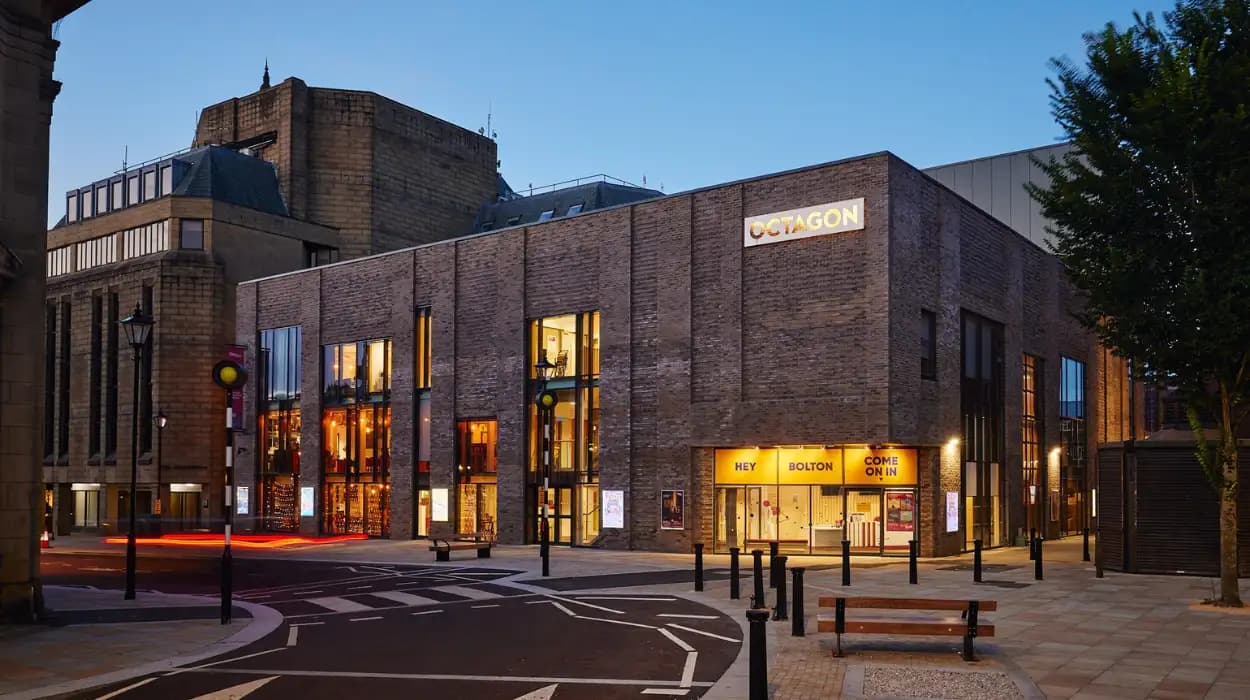
The Octagon Theatre introduced a flexible professional theatre model to Bolton when it opened on 27 November 1967. Its design, community programme and producing role created a modern cultural institution that has reached millions of people over subsequent decades.
The Octagon Theatre opened on 27 November 1967 and was officially opened by Princess Margaret. It originated from an initiative involving five students and their college lecturer, Robin Pemberton-Billing, who became its founding artistic director.
The theatre was designed as a flexible professional venue. Its founders wanted theatre to become an integral part of cultural life in Bolton and surrounding communities.
The original programme extended beyond conventional repertory theatre. It included music, dance and film, alongside education work and community activity.
The Octagon’s institutional history demonstrates how post-war cultural policy influenced local entertainment. Public fundraising, Bolton Council support and an Arts Council grant contributed to its construction.
The theatre estimates that approximately 3.5 million people attended the Octagon during its first five decades. It also became associated with artists and professionals including Danny Boyle, Vanessa Kirby, Fiona Shaw, Kwame Kwei-Armah, Es Devlin and Maxine Peake.
A major redevelopment between 2018 and 2021 improved accessibility, sustainability and the building’s facilities. The Octagon reopened in May 2021 following the transformation.
The Octagon therefore represents the continuation of Bolton’s indoor entertainment tradition through a modern producing theatre.
How did libraries and museums become part of Bolton’s indoor entertainment history?
Libraries and museums expanded Bolton’s definition of indoor entertainment by combining education, exhibitions, storytelling, film, workshops and cultural events. Bolton Museum and Bolton Central Library demonstrate how public institutions became accessible spaces for both learning and leisure.
The development of public cultural institutions broadened indoor recreation beyond commercial entertainment.
Bolton Museum, Library and Archive forms part of the town’s cultural infrastructure. Bolton Council describes the museum and library complex as a major cultural asset within the town centre.
The museum has also used exhibitions and events to connect historical collections with popular culture. A 2022 exhibition about 100 years of childhood in Bolton included toys, games, photographs and local memories. Its youth-culture section examined music, nightclubs, venues, bands and singers that influenced young people.
The institution also uses film and special-effects exhibitions to connect cultural education with contemporary entertainment. In 2024, Bolton Museum hosted an exhibition on special-effects model making for film and television at the University of Bolton.
Libraries have also provided indoor entertainment. Bolton Central Library’s lecture theatre hosts family cinema sessions, including free films scheduled by Bolton Council.
This approach reflects a modern understanding of public cultural services. Entertainment, education and heritage increasingly overlap within the same institutions.
The historical importance lies in accessibility. Public cultural venues allow people to experience performances, exhibitions, films and educational programmes without depending entirely on commercial ticketed entertainment.
How did war and social change affect Bolton’s indoor entertainment?
War, economic change and social transformation altered Bolton’s entertainment patterns by changing venue operations, household spending and audience behaviour. The survival of theatres, cinemas, libraries and amateur organisations demonstrates the resilience of indoor recreation during periods of disruption.
Bolton’s entertainment industry experienced major changes during the twentieth century. The two World Wars affected employment, mobility, household finances and public life.
Entertainment venues also adapted to changing technologies. The Hippodrome’s conversion from variety theatre to cinema demonstrates how technological developments changed commercial use. Later, its return to live theatre reflected another shift in audience demand.
Amateur theatre experienced interruptions during wartime periods but retained long-term continuity. Bolton Little Theatre’s charitable history records interruptions caused by war and rebuilding before regular seasons resumed.
Cinema also developed as a major mass medium during the interwar period. The scale of Bolton’s 1930s cinema provision demonstrates the strength of demand despite wider economic pressures.
After 1945, television became an increasingly important source of home entertainment. Commercial venues responded by differentiating their experiences through larger screens, live performances, dancing, music and social activities.
The later decline of individual cinemas did not end indoor entertainment. Instead, activities shifted between building types and commercial models.
This pattern is essential to understanding Bolton’s history. Entertainment survived through adaptation rather than through the preservation of every individual venue.
Which historic entertainment buildings and institutions survive today?
Bolton retains important surviving cultural institutions, including the Albert Halls, Octagon Theatre, Bolton Little Theatre and Farnworth Little Theatre. These venues preserve different traditions of civic entertainment, professional theatre and community drama.
Survival is uneven. Some important buildings were demolished, while others remain active after substantial alterations.
The Octagon remains a functioning professional theatre. Its 2021 redevelopment strengthened its long-term cultural role and improved accessibility and sustainability.
The Albert Halls continue to operate as a major entertainment venue after more than a century of cultural use. Bolton Council describes concerts, shows and exhibitions as part of its continuing programme.
Bolton Little Theatre continues the amateur tradition established in 1931. Its theatre building on Hanover Street remains associated with local drama production.
Farnworth Little Theatre also remains active. Its volunteer-led structure preserves a model of community theatre that began in 1948.
Other venues survive only through archival evidence. The Odeon Bolton, for example, was demolished in 2007. Historic England’s archive retains photographic documentation of the building and records its cinema and later bingo-hall uses.
The former Hippodrome has likewise disappeared physically. Its history survives through photographs, programmes, local research and theatre archives.
These surviving records are essential because demolished entertainment buildings remain historically significant even when their structures no longer exist.
How can visitors understand Bolton’s indoor entertainment heritage today?
Visitors can understand Bolton’s entertainment heritage by combining surviving theatres and civic venues with museum collections, archival evidence, historic photographs and local cultural programmes. This approach connects vanished cinemas and theatres with institutions that continue Bolton’s indoor entertainment tradition.
Bolton’s surviving cultural infrastructure provides direct access to this history. The Octagon represents post-war professional theatre. The Albert Halls represent long-running civic entertainment. Bolton Little Theatre and Farnworth Little Theatre preserve community-based performance traditions.
Bolton Museum provides another route into the subject. Its exhibitions and collections document local social history, youth culture, popular entertainment and material culture.
Historic photographs are especially important for demolished venues. The Historic England Archive contains an image of the Odeon Bolton dating from 1969–1970 and records its 1937 opening, 2,534-seat original layout, later three-screen operation, bingo use and 2007 demolition.
Local historical sources also document the former Hippodrome and its transformation from the Empire Theatre to cinema and then repertory theatre.
To experience this historic cultural landscape in person today, consult our comprehensive [Best Rainy Day Activities in Bolton for Families, Couples, and Solo Visitors] for itineraries and visiting parameters.
This approach is useful for history enthusiasts, cultural tourists, educators, and genealogical researchers. Entertainment venues often provide evidence about where people gathered, how they spent leisure time, and which cultural activities were available within particular neighbourhoods.
What does Bolton’s indoor entertainment history reveal about the town’s wider development?
Bolton’s indoor entertainment history reveals the relationship between industrialisation, urban growth, technology, public culture and changing leisure habits. The transition from music halls to cinemas, dance halls, clubs and modern theatres mirrors wider changes in British society.
The history begins with the growth of nineteenth-century industrial Bolton. Increasing population and commercial prosperity created a market for organised recreation.
Music halls and variety theatres established the first major commercial entertainment infrastructure. Their programmes reflected popular tastes and provided regular evening leisure.
Cinema then introduced a technologically based form of entertainment. The large number of cinemas recorded in Bolton during the 1930s demonstrates the strength of mass film culture. The Odeon’s 2,534-seat auditorium illustrates the architectural scale achieved by this industry.
Dance halls introduced participation as a central element of leisure. The Astoria Palais de Danse represented this development in Bolton during the 1920s.
Post-war youth culture diversified entertainment further. Dance halls, clubs, coffee bars and music venues became important spaces for young residents.
Professional theatre later gained a major modern institution through the Octagon. Its flexible design and community objectives reflected changing approaches to cultural participation.
Public institutions also expanded their role. Museums and libraries incorporated exhibitions, film, storytelling and educational activities into their programmes.
The long-term pattern is therefore one of adaptation. Bolton did not move from one entertainment form to another in a simple sequence. Different forms overlapped, declined, revived and changed function.
Why is Bolton’s indoor entertainment heritage important for future research?
Bolton’s indoor entertainment heritage is important because surviving buildings, photographs, programmes, archives and memories document everyday social history. These sources reveal patterns of leisure, employment, architecture, technology and community identity that extend beyond conventional political history.
Entertainment records provide valuable evidence for historical research. Theatre programmes identify performers, companies, dates and productions. Cinema records identify films, admission prices and audience capacity. Photographs reveal architectural design and urban change.
The surviving evidence also supports genealogical research. A family member’s appearance in a theatre programme, employment at a cinema, membership of an amateur company or participation in a local entertainment organisation can provide useful evidence about everyday life.
Architectural research benefits from surviving buildings and photographic collections. The Odeon archive, for example, records its architectural character and changing uses.
Social historians can use oral histories to investigate youth culture. Bolton Museum’s work collecting memories demonstrates how personal recollections can complement formal institutional records.
Preservation also depends on documentation. Once a cinema or theatre is demolished, photographs, plans, programmes and written records become the primary evidence for understanding the building.
Bolton’s cultural strategy identifies theatres, libraries, music venues, museums, galleries, arenas, heritage assets and creative organisations as components of the borough’s cultural infrastructure. It also identifies the Octagon as a major producing theatre and notes the importance of film and television activity in the borough.
The future historical value of Bolton’s indoor entertainment therefore depends on continued documentation and preservation.
The town’s entertainment heritage is not limited to famous buildings. It includes ordinary audiences, volunteers, performers, cinema workers, musicians, dancers, librarians, museum staff and community organisers.
Together, these people and institutions created a continuous culture of indoor leisure that has evolved for more than a century.
Bolton’s indoor entertainment history ultimately demonstrates how leisure follows urban change. The venues changed because Bolton changed. Industrial growth created demand for music halls. New technology created cinemas. Social transformation expanded dance halls and clubs. Public cultural policy supported modern theatre. Museums and libraries broadened access to film, exhibitions and educational entertainment.
The buildings that remain and the records of those that disappeared provide a detailed historical record of this transformation. They show how Bolton residents used indoor spaces to watch, listen, learn, dance, perform and participate in community life.
For Bolton Today, this heritage forms an important part of the borough’s wider cultural history. It connects historic architecture with modern entertainment and places local leisure within the broader history of British urban society.
FAQS
When did indoor entertainment become popular in Bolton?
Indoor entertainment expanded significantly during the 19th century, when Bolton’s industrial growth increased its population and created demand for theatres, music halls, public halls and other organised leisure venues.