Bolton has a strong indoor cultural offer shaped by its medieval market-town origins, Victorian industrial expansion, textile economy, civic architecture, museums, libraries, historic halls and performing arts institutions. Rainy weather provides a practical reason to explore the town’s museums, archives, galleries, theatres, churches, markets and historic interiors.
The borough developed from a medieval settlement around the River Croal into a major Lancashire cotton-manufacturing centre during the Industrial Revolution. That transformation created the public buildings, libraries, museums, churches, theatres and commercial spaces that continue to support indoor activities today. Bolton Council describes the town as a settlement that grew around a medieval market before industrialisation transformed its economy and population.
For visitors, rainy-day activities in Bolton therefore extend beyond entertainment. They provide direct access to local history, archaeology, Egyptology, natural history, fine art, architecture, genealogy and performing arts. The strongest options include Bolton Museum and Art Gallery, Bolton Aquarium, Bolton Central Library and History Centre, Smithills Hall, Bolton Parish Church, the Octagon Theatre and Bolton Market.
What makes Bolton a good rainy-day destination?
Bolton combines museums, galleries, archives, historic buildings, theatres, markets and libraries within a compact urban area, creating indoor activities for families, couples, students, heritage visitors and independent travellers throughout the year. Its industrial history gives many attractions strong historical and educational value.
Bolton's indoor attractions reflect several centuries of economic and social change. The medieval town developed around a market and agricultural hinterland. Wool manufacturing became important before cotton transformed the settlement during the eighteenth and nineteenth centuries. The resulting population growth created demand for civic institutions, education, entertainment and public culture.
This historical development explains why many of Bolton's best rainy-day destinations are concentrated around the town centre. The Bolton Library and Museum building on Le Mans Crescent combines museum galleries, art collections, the central library, archives, a History Centre and an aquarium. Bolton Council's exhibition policy identifies the building as a major cultural centre containing permanent collections, temporary exhibition space, learning facilities and archive resources.
Indoor attractions also support different visitor purposes. Families can use educational galleries and organised activities. Couples can visit exhibitions, theatres and heritage buildings. Solo visitors can spend several hours studying museum collections, historical documents, architectural records or books without requiring a group itinerary.
The historical character of Bolton makes these activities especially useful during wet weather because the buildings themselves form part of the visitor experience. Victorian civic architecture, medieval heritage, industrial collections and twentieth-century cultural institutions demonstrate how the town changed from a market settlement into a major industrial and cultural centre.
What can families do at Bolton Museum and Art Gallery on a rainy day?
Families can explore Ancient Egypt, fine art, natural history, local heritage and zoological displays at Bolton Museum and Art Gallery, while the adjoining aquarium provides another indoor educational experience. The venue combines formal collections with family activities and learning opportunities.
Bolton Museum and Art Gallery is one of the strongest all-weather cultural destinations in the borough. The institution presents collections covering Egyptology, archaeology, art, botany, zoology, local history and world cultures. Its official visitor information specifically highlights Ancient Egypt, art, natural history, local heritage and the aquarium.
The Egyptology collection has particular historical importance. Bolton's collection contains around 12,000 ancient Egyptian objects from more than 65 sites in Egypt. The collection represents periods from the Neolithic era, beginning around 5,000 BC, through the Arab Period from the seventh century AD onwards. Its objects include textiles and other forms of material culture.
The connection between Bolton and Egyptology also reflects the town's industrial history. Cotton manufacturing created commercial connections with international markets, including Egypt. Bolton's museum subsequently developed one of Britain's significant local-authority Egyptology collections. The museum states that the collection has international significance and that many objects retain provenance information because they were excavated rather than acquired without archaeological context.
The art collection provides another indoor activity. Bolton Museum houses more than 3,500 fine-art objects, with most works produced by British artists between the eighteenth century and the present. This creates an opportunity to examine changes in British artistic practice alongside the town's own industrial and social development.
The Nature Gallery adds natural-history content. The wider botanical collection contains approximately 60,000 specimens, including herbarium specimens preserved on sheets or stored in packets. Such collections provide useful evidence for studying plant distribution, classification and historical collecting practices.
Families can therefore treat a museum visit as an educational indoor programme rather than a single exhibition stop. Children can move between ancient artefacts, animals, plants, art and local history while adults examine the historical context of the collections.
Visitors should check the latest museum information before travelling because individual galleries can close temporarily for maintenance. The museum service currently reports partial closure of its Nature Gallery for essential maintenance.
Why is Bolton Aquarium one of the best wet-weather activities for children?
Bolton Aquarium provides an indoor introduction to freshwater fish and aquatic biodiversity inside the Central Library and Museum building. Opened in January 1941, it retains its original location while its collections, animal-care methods and educational role have developed substantially.
Bolton Aquarium has a distinctive place in the town's cultural history. It opened in January 1941, during the Second World War, and the present aquarium retains the same location and overall layout established at that time. The museum service states that its approach to fish care, education and behind-the-scenes work has changed considerably since opening.
The aquarium's original collection focused heavily on British freshwater fish. Supplies came through fish farmers, local dealers and anglers who provided captured specimens. Historical displays also included reptiles and mammals at different periods. The modern collection has shifted towards fish from around the world.
Bolton Council describes the aquarium as Greater Manchester's only public aquarium. It forms part of the Central Library and Museum complex on Le Mans Crescent, making it particularly convenient during poor weather because visitors can combine aquatic displays with museum galleries and library facilities under one indoor cultural destination.
The aquarium also has an educational function. Dedicated staff answer questions from visitors and researchers, while the service provides opportunities for school groups. Its current operating licence under the Zoo Licensing Act 1981 runs from 12 July 2025 to 11 July 2031.
For families, the aquarium provides a straightforward educational route into biology. Children can observe freshwater species while learning about habitats, adaptation, classification and conservation. Adults can also connect the aquarium's history to the wider development of public museums and educational institutions in twentieth-century Britain.
What can couples do indoors in Bolton when it rains?
Couples can combine museum galleries, historic architecture, theatre performances, church heritage and market food during wet weather. Bolton's compact town-centre cultural district allows visitors to move between several indoor destinations while examining buildings and institutions created during different periods of local development.
A couple's rainy-day itinerary can begin at Bolton Museum and continue through the town's civic centre. Le Mans Crescent provides an architectural connection between cultural institutions and Bolton's municipal development. The crescent was designed by the Bolton architectural practice Bradshaw Gass & Hope and completed in 1939.
Bradshaw Gass & Hope was founded in Bolton in 1862 by Jonas James Bradshaw. The firm initially became known for designing cotton mills before expanding into civic and commercial architecture. Its archive, acquired by Bolton Library and Museum Service in 2022, contains material covering thousands of architectural commissions and work extending from 1862 into the 1960s.
This makes an architectural visit valuable even when outdoor sightseeing is impractical. Visitors can study the civic buildings from sheltered viewpoints, then enter museums, libraries, churches or theatres to continue the historical exploration indoors.
The Octagon Theatre provides another strong option. Founded in the 1960s, the theatre opened in 1967 and was formally associated with a period when British regional theatre was expanding. Princess Margaret opened the Octagon in November 1967. The building underwent a major redevelopment and reopened in May 2021.
The Octagon's current programme includes theatre productions, community work and activities involving young people. Its modern building therefore represents both the continuation of Bolton's cultural infrastructure and the adaptation of older institutions to contemporary audiences.
For couples interested in religious architecture, Bolton Parish Church provides another indoor historical destination. The current Grade II listed church was designed by E. G. Paley of Paley and Austin. Its foundation stone was laid on 27 April 1867, and it was consecrated on 29 June 1871.
A combination of museum, architecture, theatre and church heritage creates a historically focused indoor itinerary without requiring extensive exposure to rain.
What historical attractions can solo visitors explore in Bolton?
Solo visitors can spend extended periods studying museum collections, archives, genealogy records, architectural material and historic interiors. Bolton's Central Library and History Centre are particularly valuable for independent researchers because they provide access to books, local-history resources, archives, indexes and burial information.
Bolton Central Library is particularly suitable for visitors who prefer self-directed research. Its catalogue contains books and other materials held across Bolton's libraries and allows users to search by author, title and keyword. The library also provides access to borrowing, reservations and other research-related services.
The History Centre provides a deeper level of research. Bolton Library and Museum Service describes it as a place where visitors can browse archives and indexes and plan research using local-history collections. The centre forms part of the Central Library and Museum complex on Le Mans Crescent.
Genealogical researchers can also investigate burial records. Bolton Council states that burial information is available through several channels, including digitised scans, computerised burial and cremation registers, cemetery maps and photographs of memorials and headstones through Deceased Online. Bolton History Centre also provides access to records on microfilm.
This resource has particular relevance for family historians tracing Bolton ancestors. Industrialisation caused major population growth during the nineteenth century, while employment in cotton manufacturing and associated industries drew workers into the town. Local records can therefore provide evidence about occupations, addresses, family relationships, deaths and burial locations.
Solo visitors interested in architecture can also investigate the Bradshaw Gass & Hope archive. The collection includes perspective drawings, business correspondence and other architectural documentation. Its acquisition created an important research resource for local people, students and architectural historians.
To experience this historic heritage landscape in person today, consult our comprehensive [Indoor Entertainment Throughout Bolton's History] for itineraries and visiting parameters.
Why should visitors explore Smithills Hall on a rainy day?
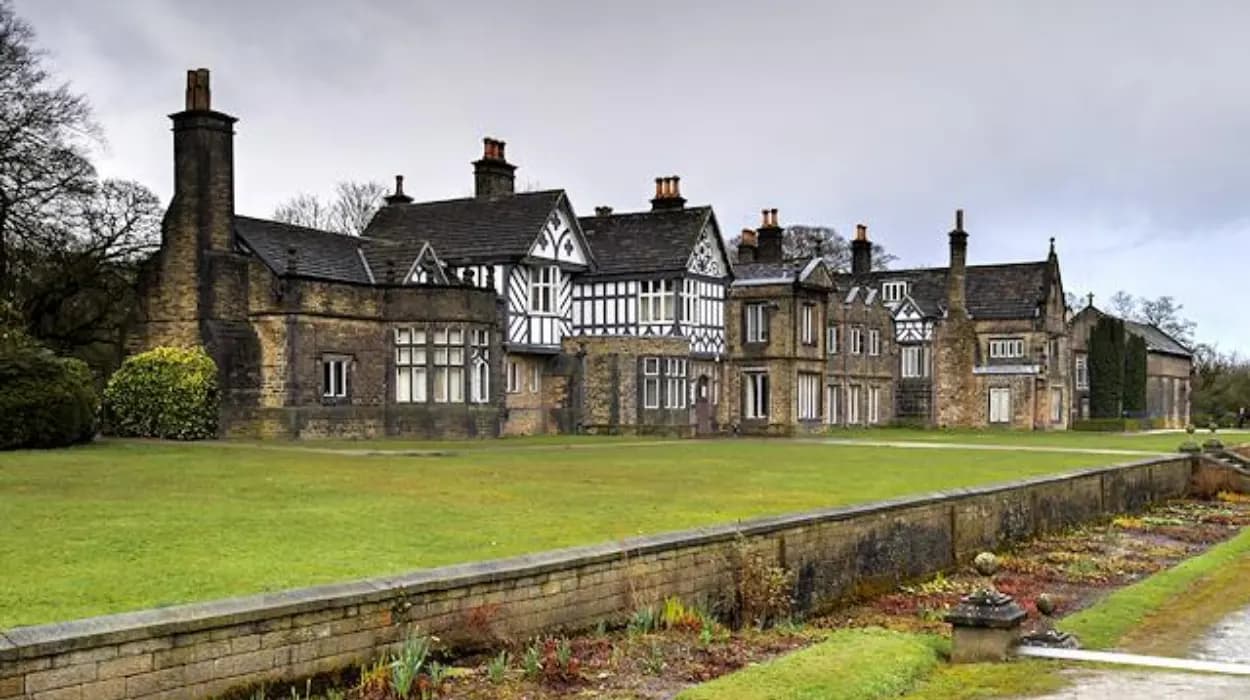
Smithills Hall provides access to one of north-west England's best-preserved historic manor houses, with architectural fabric dating from the medieval period through later extensions. Its interior spaces, collections and historical interpretation provide a substantial heritage activity when weather limits outdoor exploration.
Smithills Hall stands near the West Pennine Moors and is a Grade I listed historic house. Bolton Council describes it as one of the oldest and best-preserved manor houses in north-west England. The building demonstrates architectural and social development from the late fourteenth century to the late nineteenth century.
The earliest phase dates from the fourteenth century. A fifteenth- or sixteenth-century east wing and a late sixteenth-century west wing were later added. During the Victorian period, Richard Ainsworth commissioned architect George Devey to undertake significant improvements. The resulting building therefore contains evidence from several architectural periods.
Smithills Hall also demonstrates how domestic architecture changed over centuries. Medieval halls had different spatial arrangements and social functions from later Victorian country houses. Visitors can examine surviving architectural features as evidence of changes in household organisation, status, technology and taste.
Bolton Council acquired Smithills Hall and Estate in 1938. The acquisition represents an important stage in the preservation of a major historic property as a public cultural resource.
Current visitor information lists Smithills Hall as free to enter and gives scheduled opening periods during the week and on Sunday. Visitors should verify current times before travelling because heritage venues can change opening arrangements for maintenance, events or operational reasons.
Rain does not eliminate the historical value of the site. The building's interior is itself the principal historical resource, making Smithills Hall particularly relevant for visitors interested in medieval and Victorian domestic architecture.
Is Hall i' th' Wood suitable for a historical rainy-day visit?
Hall i' th' Wood is a Grade I listed sixteenth-century half-timbered building associated with inventor Samuel Crompton. Its historic interiors and displays connect domestic architecture, textile technology and Bolton's industrial development, although the museum is currently closed for essential maintenance.
Hall i' th' Wood is one of Bolton's most important historic buildings. Bolton Library and Museum Service describes it as a Grade I listed sixteenth-century half-timbered hall and identifies it as one of the north-west's important buildings. The museum displays furniture, objects and artefacts associated with earlier domestic life.
The building is particularly significant because of its connection with Samuel Crompton. Crompton was a Bolton inventor associated with the spinning mule, a machine that combined principles from earlier spinning technologies and contributed to the development of cotton spinning.
The building therefore links architectural heritage to industrial history. Bolton's cotton industry expanded rapidly during the Industrial Revolution, creating demand for increasingly efficient spinning and weaving technologies. The development of machinery such as Crompton's spinning mule formed part of the technological transformation that helped make Lancashire a global centre of cotton manufacturing.
Hall i' th' Wood was presented as a gift to Bolton in 1902. Bolton Council records identify the building as one of two historic properties owned by the authority and open to the public historically, alongside Smithills Hall.
Current museum information states that Hall i' th' Wood is closed for essential maintenance until further notice. This status is important for rainy-day planning because visitors should not assume that all historic halls operate continuously throughout the year.
Even while closed, the site remains relevant to understanding Bolton's industrial heritage. Its association with Crompton connects domestic architecture directly with the technological history of cotton production.
What can visitors learn from Bolton Parish Church indoors?
Bolton Parish Church provides an indoor historical experience spanning roughly 1,200 years of worship on the site, with archaeological evidence, medieval survivals and a Victorian Gothic building. Its architecture, bells, memorials and guided heritage tours provide several research themes.
Bolton Parish Church stands on a site with a long religious history. The church states that Christian worship has existed there for approximately 1,200 years. A Saxon cross in the west porch dates from the early tenth century and indicates that the location was a burial ground. Stone fragments provide evidence for a church building by the eleventh century.
The first recorded incumbent was John de Sanwyog in 1254. As Bolton's population expanded, the earlier Saxo-Norman church was replaced around 1420 by a larger building. That structure served the town for approximately four centuries before the present church was constructed.
The current building represents nineteenth-century Victorian Gothic architecture. E. G. Paley of Paley and Austin designed the church, with construction using Longridge stone. The foundation stone was laid in 1867, and the building was consecrated in 1871. It is Grade II listed.
The tower reaches 55 metres, or approximately 180 feet. The church is 47.5 metres long and 20.5 metres wide, with an internal height of 25 metres. These measurements demonstrate the scale of the Victorian rebuilding programme.
The church also supports heritage tours. Its official information states that guided tours can be arranged around historical, educational and architectural subjects. Bellringing has taken place at the church for about 300 years, while the current ring of twelve bells was installed in 1974.
For visitors interested in religious history, genealogy, architecture or civic development, the church provides evidence from multiple periods within one building complex.
How can Bolton Market provide an indoor cultural experience?
Bolton Market offers an indoor commercial environment rooted in the town's long market tradition. Its modern food and retail activity continues an economic function that helped shape Bolton's medieval settlement and later town-centre development during industrial expansion.
Markets are fundamental to Bolton's urban history. Bolton Council's town-centre heritage material identifies the medieval market as an important element in the settlement's development around the River Croal. During the medieval period, Bolton functioned primarily as a market town supported by surrounding farmland and an emerging wool-manufacturing sector.
The market's role expanded as Bolton industrialised. During the early nineteenth century, the market moved to a new location in the town centre, identified with the area around present-day Victoria Square. Commercial development around the market subsequently contributed to the construction of major civic buildings.
The historic market tradition therefore connects present-day food shopping with the economic mechanisms that shaped the town. Markets provided spaces for exchanging agricultural produce, manufactured goods and everyday necessities, while later industrial growth increased the size and complexity of urban commerce.
Bolton Market is now located on Ashburner Street. Bolton Council describes it as the town's main market and highlights its growing reputation as a food market in the North West. Current council information lists opening days as Tuesday, Thursday, Friday and Saturday, from 9am to 5pm.
For rainy-day visitors, the market provides an indoor environment that differs from museum-based activities. It offers an opportunity to examine the continuing commercial function of the town centre while connecting present-day retail practices with centuries of market history.
What makes the Octagon Theatre an important indoor activity?
The Octagon Theatre represents Bolton's modern cultural history and provides an indoor programme of theatre and community activity. Opened in 1967 and substantially redeveloped before reopening in 2021, it demonstrates the continuing role of performance in regional cultural life.
The Octagon Theatre opened in 1967 during a period of major expansion in regional theatre across Britain. Princess Margaret opened the building in November 1967. Its creation reflected a wider cultural policy of establishing professional theatre outside London's traditional theatrical centre.
The theatre became part of Bolton's cultural infrastructure alongside museums, libraries, churches and civic buildings. Its location in the town centre makes it especially useful during wet weather because visitors can attend performances without depending on outdoor conditions.
A major redevelopment transformed the building before its reopening in May 2021. Bolton Council and Arts Council England supported the redevelopment, which the Octagon describes as the largest transformation in its history.
The modern Octagon also operates beyond scheduled performances. Its programme includes drama groups, community engagement and work with young people. The theatre states that it works with thousands of young people and community groups each year.
This combination of historic origins and modern adaptation makes the Octagon relevant to visitors studying the development of cultural institutions. It demonstrates how a 1960s regional theatre can remain part of a town's cultural infrastructure through architectural redevelopment and community programming.
Can families find organised rainy-day activities in Bolton libraries?
Bolton libraries provide indoor educational activities including storytelling, baby sessions, reading programmes, digital resources and family events. These services extend the town's historic commitment to public education and make libraries useful destinations for families during wet weather.
Bolton's library network is part of the town's wider public cultural infrastructure. Modern library services combine books and research resources with activities for children and families. The council's current family programme includes Baby Time, Toddler Tales and other scheduled activities.
Baby Time provides interactive songs and activities for families with babies. Current council information lists a Tuesday session at Bolton Central Library, while other Baby Time sessions operate at Family Hubs across the borough.
Toddler Tales is designed for children aged two to five and uses storytelling as an early-learning activity. Such programmes demonstrate the library's modern role as both an information institution and a community learning space.
The library also supports independent learning. Its catalogue provides access to books and other items across Bolton's library network, with search functions based on author, title and keyword. This makes the library useful for students and researchers as well as families.
School-aged children can also benefit from museum and library programming. Bolton's Family Hubs information directs families towards current library and museum activities, including school-holiday programmes.
Because schedules change, visitors should consult Bolton Council and Bolton Libraries and Museums before travelling. The council specifically advises checking whether published sessions remain available during school holidays.
How does Bolton's industrial history improve a rainy-day itinerary?
Bolton's industrial history connects museums, architecture, libraries, historic houses and markets into one coherent indoor heritage experience. Cotton manufacturing, engineering, civic construction and population growth created institutions whose surviving buildings and collections now provide practical cultural activities.
Bolton's industrial transformation began accelerating during the eighteenth and nineteenth centuries. Cotton became the dominant industry, and the town expanded to accommodate a rapidly increasing population. The industrial economy affected employment, housing, transport, civic administration, education and public culture.
The relationship between industry and architecture remains visible. Bradshaw Gass & Hope began in Bolton in 1862 and initially specialised in cotton mills before designing civic and commercial buildings. Its archive demonstrates how industrial wealth and urban expansion generated demand for professional architectural services.
Museum collections preserve another part of this transformation. Bolton's local-history collection records the town's industrial heritage and its influence on the composition of the local population. The Egyptology collection also reflects the international connections created through the cotton economy.
Historic houses demonstrate the domestic dimension of this history. Smithills Hall preserves evidence of elite and domestic life across several centuries, while Hall i' th' Wood connects historic architecture with Samuel Crompton and textile technology.
The result is a connected rainy-day itinerary. A visitor can study industrial technology at a museum, examine architectural records at the library, explore a historic house, attend a theatre performance and visit the market without abandoning the central theme of Bolton's urban development.
Which rainy-day activities are best for history students and researchers?
History students and researchers have particularly strong indoor resources in Bolton because museum collections, archives, architectural records, genealogy resources and historic buildings provide primary and secondary evidence. These resources support research into industry, religion, architecture, migration, family history and material culture.
Bolton Museum's collections provide evidence across several disciplines. The Egyptology collection contains approximately 12,000 objects from more than 65 Egyptian sites. Its provenance information gives researchers valuable contextual evidence about archaeological material.
The fine-art collection contains more than 3,500 items, while the botanical collection contains approximately 60,000 specimens. These holdings support research into art history, natural history, collecting practices, and changing museum interpretation.
The Bradshaw Gass & Hope archive adds architectural primary sources. The collection covers the firm's work from 1862 through the 1960s and includes drawings and business correspondence. This provides evidence for studying professional architecture, industrial buildings, and civic development.
The History Centre supports local and family research. Burial records provide evidence about individuals and communities, while library catalogues allow researchers to locate books and local-history material.
These resources have long-term importance because local history depends on preserving both physical objects and documentary evidence. Museum artefacts, architectural drawings, photographs, registers and books each record different aspects of Bolton's development.
Rainy weather therefore creates a practical opportunity for concentrated research. Indoor institutions allow visitors to spend longer periods with primary material without depending on favourable outdoor conditions.
How have Bolton's indoor heritage institutions preserved local history?
Bolton has preserved local history through municipal museums, libraries, archives, historic buildings and cultural organisations. Their collections retain physical objects, documents, architectural evidence and community memories, allowing modern visitors to examine changes that occurred across centuries of local development.
Preservation in Bolton operates through several connected institutions. Bolton Library and Museum Service manages museum collections, exhibitions, archives and historic halls. Bolton Council owns historic properties including Smithills Hall, while the parish church maintains a separate religious and architectural heritage.
The preservation process also includes acquisition. In 2022, Bolton Library and Museum Service acquired the Bradshaw Gass & Hope architectural archive through support from Arts Council England's V&A Purchase Grant Fund and the Art Fund. The archive preserves evidence from a major Bolton architectural practice.
Community participation forms another part of preservation. In 2026, Bolton Council appealed for memories, objects and photographs connected with Rock Hall and Moses Gate Country Park. Rock Hall was built in 1807 and later became a visitor centre for the country park in 1982.
The council's heritage project illustrates how preservation extends beyond famous buildings. Personal photographs, objects and memories can provide evidence about everyday life, local businesses, workplaces and community activities that formal records do not fully capture.
Preservation also requires ongoing maintenance. Hall i' th' Wood is currently closed for essential maintenance, while the museum's Nature Gallery has partial closure for maintenance. Such interruptions demonstrate that heritage preservation requires continuing investment rather than a single act of conservation.
How should visitors plan a rainy-day itinerary in Bolton?
Visitors should group attractions by location, check opening times before departure and allow sufficient indoor time for museums, libraries, historic buildings, markets and performances. A practical itinerary should prioritise confirmed opening arrangements because schedules and maintenance closures change.
A family itinerary can centre on Bolton Museum, Art Gallery and Aquarium. These facilities share the Central Library and Museum complex, allowing visitors to combine ancient history, art, natural history and aquatic displays in one indoor destination.
A history-focused itinerary can add the History Centre and Central Library. Researchers can move from public museum displays to books, archives and local-history resources within the same cultural complex.
A heritage itinerary can include Bolton Parish Church and Smithills Hall when their scheduled opening arrangements align. Smithills Hall currently lists public opening periods from Wednesday to Friday and on Sunday, while the parish church provides heritage tours by arrangement.
A couple's itinerary can combine a museum visit with a theatre performance. The Octagon's current programme changes throughout the year, so performance times should be checked before travel. The theatre provides accessible booking arrangements and dedicated access information.
Visitors should also distinguish between permanent facilities and temporary programmes. Museum exhibitions, family workshops, library sessions and theatre productions operate according to individual schedules. Bolton Council's family information specifically advises checking whether sessions remain available during school holidays.
The most reliable planning method is to verify each venue's official opening information immediately before departure. This is particularly important for Hall i' th' Wood, which is currently closed for essential maintenance, and for museum galleries affected by maintenance work.
Why do rainy-day activities matter to Bolton's long-term heritage?
Rainy-day activities strengthen the practical role of Bolton's heritage institutions by bringing visitors into museums, libraries, historic buildings, theatres and markets throughout the year. Continued public use supports cultural education, local research, conservation awareness and transmission of historical knowledge.
Bolton's indoor attractions are not isolated leisure facilities. They form part of a broader heritage system that preserves evidence of the town's development. Museums preserve objects, libraries preserve publications, archives preserve documents, historic buildings preserve architectural fabric and theatres preserve cultural traditions.
This system has educational value. Bolton's museum collections support formal and informal learning across archaeology, history, art, natural science and material culture. The aquarium provides school-related educational opportunities, while libraries support reading, research and family learning.
The system also supports local identity without requiring a single interpretation of the past. Industrial history, religious history, domestic architecture, migration, commerce, art and natural history all form part of Bolton's historical record.
Long-term preservation depends on continued care. The Bradshaw Gass & Hope archive demonstrates the importance of preserving documentary evidence, while the continuing maintenance of historic buildings and museum galleries demonstrates the financial and technical requirements involved in protecting physical heritage.
Bolton's heritage also remains relevant to future research. Genealogists can use burial records and local archives. Architectural historians can examine drawings and surviving buildings. Students can study industrialisation through museum collections. Families can introduce children to local history through museums, libraries and historic sites.
For these reasons, rainy-day activities in Bolton provide more than shelter from poor weather. They create structured access to the town's historical record and demonstrate how institutions established during different periods continue to serve the public.
Bolton's strongest wet-weather destinations are therefore the places where present-day activity and historical evidence overlap: Bolton Museum and Art Gallery, Bolton Aquarium, Bolton Central Library and History Centre, Smithills Hall, Bolton Parish Church, the Octagon Theatre and Bolton Market.
Together, these venues provide a year-round indoor framework for understanding Bolton's transformation from a medieval market settlement into an industrial town and then into a modern cultural centre. Their collections, buildings, archives and programmes ensure that the history of Bolton remains accessible to families, couples, solo visitors, students, educators and researchers.
FAQS
What are the best rainy day activities in Bolton?
The best rainy-day activities in Bolton include visiting Bolton Museum and Art Gallery, Bolton Aquarium, Smithills Hall, Bolton Central Library and History Centre, Bolton Parish Church and the Octagon Theatre. These attractions provide indoor options for families, couples, history enthusiasts, and solo visitors.